Where Busan’s New Density Meets the Old City
Busan’s Beomil and Munhyeon districts are gaining homes and financial offices while North Port plans evolve. The public return depends on what reaches existing streets: accessible crossings, working infrastructure, viable local businesses and spaces people can actually use.

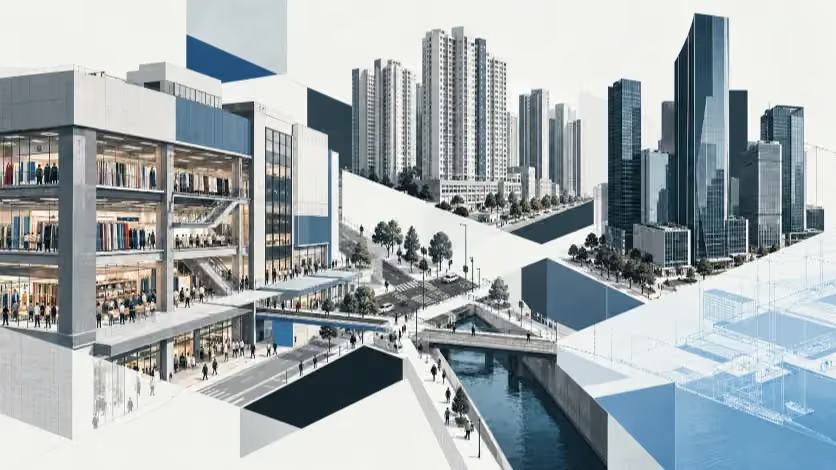
New apartments in Beomil and offices at BIFC are changing central Busan. Along Dongcheon and toward North Port, the harder test is whether older markets, homes and workplaces gain the public connections and infrastructure they need.
Busan completed a new 45-story addition to its International Finance Center in January 2026. Approved for use the previous month, the building was expected to accommodate roughly 170 companies and 4,000 employees as the third phase filled. At the January 29 ceremony, the city also pointed to planned childcare, a children’s financial library and community facilities. For the existing markets, workshops and neighborhoods across Dongcheon, the effects of that expansion would depend on more than how many offices the new tower could hold.
On March 18, Busan approved the development plan for Gwangmu Cultural Park on 6,677.9 square meters of idle national land in Jeonpo-dong. It set out cultural, recreational and convenience facilities near Dongcheon, on a site earlier associated with the financial district’s waterfront ambitions. The legal decision established what could be built there; it did not establish a park already open to the public or a route connecting it to the surrounding streets.
The older center is being remade on multiple timetables. Apartment complexes have opened in one Beomil neighborhood while other redevelopment sites remain subject to amended approvals; financial firms are gathering at BIFC alongside an older economy of textile trading and garment production. North Port, railway property and active military logistics present a longer horizon for connecting the city to its waterfront. The crucial question is what this investment makes possible between development sites: accessible routes, usable public places and streets in which existing communities can still work and live.
The Work the Old City Was Built Around
Busanjinseong Park carries more than one account of the city's origins. The fortress first built in 1490 stood below Jeungsan; the site generally associated with the park today took on a different military role during the Japanese invasions that began in 1592. Japanese forces built an auxiliary fortification at Jaseongdae. In 1607, after the war, Joseon naval authorities moved their command there. Later alterations and twentieth-century reconstruction left a place whose visible heritage is itself a record of changing decisions about what the city should remember.
Residents have intervened in that record. In January 2023, Jaseongdae Park officially became Busanjinseong Park after a local campaign challenged a name associated with the colonial period. Members of a neighborhood cooperative had argued for a different understanding of the site's history and helped secure the change. Changing the name of a public park did not create a new industry, but it gave residents a tangible part in deciding how the place would represent its history. Its value does not depend on an apartment price or a visitor-spending estimate.
Other parts of Beomil's past were organized around the movement and transformation of goods. The market that became Busanjin Market developed into a permanent trading place in the early twentieth century, later specializing in textiles, clothing and goods associated with weddings. Its continuing function extends well beyond the market building: buyers who come for particular fabrics, shipments that must arrive on time, merchants who draw on specialized knowledge and smaller businesses that work with goods after they leave a stall.
Large-scale textile production had its own history nearby. Chosun Spinning Company, established with Japanese capital in 1917, began operating in 1922 and resumed production in 1925 after a major fire. The factory belonged to the colonial industrial economy, with its own organization of labor and power; it should not be remembered simply as a lost golden age of local manufacturing. The name Jobang-ap, the area in front of the mill, endured in the vocabulary of the district. Yet the factory, the textile market and the later small garment workshops were not necessarily successive links in one unbroken industrial chain. Each required different premises, labor arrangements and customers. Their proximity shows how many kinds of work a relatively small central district has accommodated, without establishing a direct lineage among individual firms.
The attempt to preserve part of that working history is visible in the neighborhood regeneration initiative selected in 2017. The original Raechugo! Jaseongdae project covered 113,275 square meters and brought together heritage, hanbok culture, sewing-related activities, resident organization and physical improvements. A community cooperative subsequently organized guided walks and cultural experiences. Those are tangible uses of public investment and local initiative. Their contribution to manufacturing, however, has to be traced through orders, training, paid work and the survival of productive businesses. A successful heritage program need not be discredited because it cannot carry an industrial economy on its own; nor can cultural participation be used as evidence that the economy has been restored.
The functions concentrated here still place distinct demands on urban space. A fabric merchant needs deliveries and access for buyers. A workshop needs affordable working premises, machinery and skilled people. A resident needs housing and ordinary services, while a visitor to a cultural site needs a public route that is open and intelligible. Construction that increases a neighborhood's floor area can help some of these activities and alter the conditions for others. The effects emerge at the edges between properties, not just within the boundaries of the project receiving approval.
Two Neighborhoods on Different Housing Clocks
The population figures make the uneven pace of rebuilding unusually clear. Beomil 2-dong ended 2018 with 9,144 registered residents and 2025 with 6,145. Beomil 5-dong moved in the opposite direction, from 4,877 to 8,953. Most of that second district's increase arrived abruptly: its year-end count rose from 4,224 in 2022 to 8,496 in 2023. That May, the 2,040-apartment Doosan We've the Zenith Harbor City received approval for use and began taking residents. The timing makes the new housing a strong explanation for the change in available residential capacity; the public population series cannot show where the occupants previously lived.
Combined, the two administrative neighborhoods gained 1,077 registered residents between 2018 and 2025. That net figure could be made to sound like urban recovery. Read separately, it describes a sharp rise beside a long decline. It says nothing by itself about forced departures, households that moved within Dong-gu, or older residents returning after reconstruction. It also has a geographical limit: neither administrative dong corresponds exactly to the 113,275-square-meter regeneration district, the individual apartment sites or the boundaries of the Beomil 2 redevelopment project. Those are different units, even when their names appear to overlap.
The redevelopment named Beomil 2 illustrates how slowly legal housing supply can become lived housing. The city designated the area around 662-59 Beomil-dong in August 2009. Subsequent changes to the improvement plan were announced in 2018, 2021, a notice taking effect in January 2025, and January 2026; Dong-gu's project implementation approvals have their own sequence beginning in 2022, with another amendment in April 2026. A management-disposition plan was approved in August 2024. The lengthy record is not seventeen years of continuous construction. It is a succession of decisions governing the land, the project and the rights of its participants.
Reporting at the 2024 management-disposition stage described a plan for 1,456 apartments, with buildings as high as 49 stories, and anticipated demolition in the latter half of 2025. The later amendments cannot be taken as proof that demolition proceeded as forecast. Nor can the reported unit total be treated as the completed 2026 housing inventory without comparing the current approved drawings. Residents may leave during a prolonged transition, but a causal account of Beomil 2-dong's population losses would need actual clearance, household and movement records rather than the start date of a redevelopment designation.
Another project shows why the names require care. Beomil 3 redevelopment, marketed as e-Pyeonhansesang Beomil International Finance City, is located in administrative Beomil 2-dong. Its published plan described 856 apartments, including 384 units for general sale, with a June 2028 move-in target. Those 384 are part of the 856, not additional supply. The date is prospective, unlike Harbor City's 2023 occupancy. Advertisements for still other developments, including the 998-apartment Blanc Summit 74 and a separately listed 276 officetel units, reflect different products and markets. None of these totals reveals how many net homes will be gained after old stock is removed, what renters can afford, or how many former occupants will return.
Redevelopment has a substantial practical case. New homes can replace poor-quality structures, bring families close to the subway and support businesses that need customers. Beomil 5-dong's registered population rose sharply in the year new apartments entered use, and concentrating homes around existing transit can have advantages over outward expansion. But a final apartment count describes the end of a development's housing program. It does not describe the intervening years of vacancy, the terms on which people return or the public services available when they do.
Busan's revised 2030 urban and residential renewal framework acknowledges problems in fragmented, project-centered redevelopment and places greater emphasis on everyday streets, green routes and neighborhood facilities. Those policy aspirations create a useful question for Beomil: what has a development been required to contribute beyond its own buildings, and how do those obligations connect with facilities funded separately by the city or district? Korea already has instruments for securing public benefits from redevelopment. Judging their adequacy requires the actual approved schedules of roads, land dedication, rental housing, open space and access rights. The official Beomil 2 notices establish the legal approval sequence; the attached contribution tables are still required to assess the project's specific obligations. Neither a high tower nor a premium sales brochure establishes how much public value its developer has supplied.
A Financial District, an Older Economy
On the other side of Dongcheon, the 63-story BIFC tower opened in 2014 and became the center of an expanding financial complex. The January 2026 completion of its third phase was another substantial addition. For shipping finance, insurance and related services, proximity to specialist firms and public institutions has a practical value: transactions often require people with different expertise to work together. Busan has continued recruiting such companies. On October 19, it announced three more firms for D-Space on the 63rd floor of the original tower, bringing the number associated with that location to ten. That was a development in the original building, separate from occupancy of the new 45-story tower.
The city's January estimate of about 4,000 eventual workers in the third phase describes expected occupation, not an October headcount. Its economic-inducement figures are modeled forecasts. A building can be complete before its offices, shops and public amenities settle into everyday use, and that process matters to the surrounding economy. The city gains an asset capable of accommodating work; it does not thereby establish how much spending reaches an older commercial street or how the area behaves after offices close.
Reporting by Kookje Ilbo offers a narrower, more useful observation. During a January visit, the newspaper found busy lunchtime restaurants and cafes in the first phase, quieter conditions later in the day, and multiple tenant-seeking premises in the second-phase retail area. Workers interviewed for the article discussed shortcomings in places suitable for meetings and visitors. The third-phase operator was considering a bookstore and event space to draw people beyond the lunch trade. It would be a mistake to turn that January snapshot inside BIFC into an October vacancy rate for all of Munhyeon or an account of sales at Busanjin Market. It does, however, expose a distinction between the concentration of offices and the commercial life that develops around them.
A lunch customer, a fabric buyer and a manufacturer commissioning production participate in different economies. The financial district could bring more meals, errands and service demand to nearby streets. Textile trading may depend on buyers who travel from elsewhere, and small garment production on contracts, equipment and skilled work rather than casual foot traffic. The new district's prosperity could reinforce some of these activities while leaving others largely untouched. Treating the old market as an automatic beneficiary—or inevitable casualty—would hide the mechanisms that need investigating.
A 2024 study of Beomil's garment-manufacturing cluster described the aging of experienced technical workers, production moving abroad and limited entry by younger workers. Researchers developed and examined proposals for training sample makers and new technical entrepreneurs. The research did not measure a wholesale collapse of every firm or prove that nearby tower development caused the difficulties. It located a more specific problem: how production knowledge is renewed and how people acquire the skills to make goods that someone will purchase.
There is a public institution trying to address that problem. Busan Techno Park's January 2026 council work plan recorded, for 2025, 352 instances of cutting-automation support, 1,725 uses of equipment or working space, and 30 manufacturer–designer matching supports at the Beomil Garment Manufacturing Support Center. It also reported training completions and limited startup support. Those figures measure service activity, not 352 distinct profitable firms, 1,725 jobs or a proven recovery of local production. The center is separate from the Jaseongdae heritage and neighborhood-regeneration program. Keeping the two accounts apart makes it possible to ask what each investment achieved on its own terms.
The cultural cooperative offers another form of public benefit. Its guided walks and hanbok experiences give residents and visitors a way to engage with the area's layered history; the support center seeks to preserve or build productive capacity. If the former purchases work from local sewing businesses, or the latter helps workshops establish lasting orders, the connection would matter. The published program descriptions do not yet quantify that exchange. Both initiatives deserve to be recognized without turning their outputs into one undifferentiated success statistic.
The economic consequences extend beyond a complex’s retail podium. Office employees may patronize older streets; fabric buyers need reliable deliveries and routes into the market; publicly supported manufacturers need contracts that sustain paid work. Business and travel records, and accounts from those who use these places, would establish where those relationships have developed. In each case the transactions also depend on the streets and public passages joining one destination to another.
What a Crossing Actually Connects
One such route already exists. The Golden Bridge opened across Dongcheon in May 2016, a 41.7-meter pedestrian crossing built at a reported cost of about 3.9 billion won. It was intended to ease journeys between the financial-center area and streets toward Beomnaegol. In January 2023, Nam-gu completed work to widen a cramped stretch of riverside sidewalk between Mujigae Bridge and Beom 5 Bridge in Munhyeon-dong. That improvement addressed a daily problem for residents and students. Both projects delivered something more precise than a general aspiration for an attractive waterfront: an actual crossing and a usable width of pavement on identified segments.
Their existence complicates any claim that Dongcheon has simply been left as a barrier. It is possible to cross at the Golden Bridge; some of the riverside path has been improved. The meaningful question begins at either end. A pedestrian traveling from a station to a market, a workplace or a park needs continuous pavement, legitimate crossings, manageable gradients and entrances that are open. A space described as public within a private project may have conditions attached to its use. A landscaped setback can improve a street without offering a route through a block. The answer cannot be calculated from bridge length or park area; it requires actual access rights and a walk along the connected streets.
That distinction reaches the Gwangmu site. In 2023, Busan promoted the idle Defense Ministry property in Jeonpo-dong as part of a waterfront and financial-district initiative. The proposal contained business-support facilities, decks, bridges and far-reaching river ambitions tied to other projects. The March 2026 decision instead gives legal form to a cultural park. Its 6,677.9-square-meter plan includes cultural, convenience, infrastructure and recreational space. A cultural use could offer genuine civic value to people with no connection to the financial sector, and a park need not double as a through-promenade to be worthwhile. But public entrance, operating arrangements and routes to surrounding streets have to be established when the facility is delivered, not inferred from the ordinance-like precision of a planning table.
The wider Dongcheon vision has a similar problem of scale. Busan described a proposed water-and-culture corridor of roughly 7.5 kilometers toward North Port in April 2026. A separate procurement concerned detailed design for about 6.29 kilometers of measures dealing with valley water and the separation of rainwater and sewage flows. One is a broad civic conception; the other is an engineering scope. The shorter length does not measure an opened walking route, and an engineering design does not yet measure cleaner water or reduced flood risk. Both may be necessary. Their benefits arise through different construction and maintenance systems.
The improvements along Dongcheon have been real but specific: a pedestrian bridge, a widened sidewalk, a newly approved park plan and design work for the water system. Each has a different purpose, and none supplies a measured journey across the entire district. The next question is where those facilities meet the existing street network, which routes remain legally available and who maintains the connections between them.
The Old Ground Beneath the Plans
The least visible infrastructure may carry the most immediate consequences when it fails. On October 21, Yonhap reported that expansion work on a drainage pumping station in the Beomil 2 flood-risk area near Jaseongdae Apartments had been suspended since April. Dong-gu attributed the halt to contaminated soil discovered during construction and structural concerns after cracks appeared in an adjacent older house. The reported contaminants included petroleum-related substances and zinc above applicable limits. The district described plans for handling the soil and anticipated a possible restart in 2027.
A further complication concerned the house itself. According to the district official quoted by Yonhap, it was also included in a parking-lot project planned for the following year, making overlapping budget allocations difficult. The difficulties of the pump project were therefore not confined to excavation. Ground conditions, the safety of nearby housing and the sequence of two public projects were interacting in one small area. None of that establishes who introduced the contamination, whether private apartment construction damaged the house or who should bear any additional cost. Suspending unsafe work may be precisely what responsible management requires. For residents facing flood risk, however, the timetable for working protection still matters.
The drainage project also prevents a simple interpretation of redevelopment spending. A city can approve homes and offices on one set of plots while paying to repair flood defenses serving existing neighborhoods on another. The engineering need may predate the newest towers. Public money committed to a park cannot automatically be counted as money taken from pumping works, any more than a developer's sales revenue can be equated with its net profit. The questions are specific: what protection was budgeted, what changed on site, which authority must resolve the obstacle, and when the facility can safely operate.
Who Pays for the City Between Projects?
Toward North Port, the scale increases and the number of decision-makers multiplies. The original Phase 2 scheme covered about 2.28 million square meters of waterfront, dockland, railway land and adjoining areas of the old center. Its published consortium brought together the city, Busan Port Authority, Korea Land and Housing Corporation, Busan Metropolitan Corporation and Korail. The formal project-implementer designation in August 2023 named Busan and the port authority. Cargo operations moved from Jaseongdae Pier by the end of 2024, but that was the removal of an existing port function, not completion of the district's future streets and public facilities.
The unresolved finances are visible in a national budget review. In its October 2025 analysis of the 2026 national budget proposal, the National Assembly Budget Office reported that the Phase 2 project's estimated total cost had risen from approximately 4.06 trillion won at preliminary feasibility review to 4.76 trillion won after cost updates. It said the remaining prospective partners had held back from full participation pending a viable project, leaving the overall business plan incomplete. The office warned that the previously announced timetable was unlikely to hold. Its concern was the absence of a workable agreement aligning the proposed development area, infrastructure and finance.
The same report recorded 1 billion won in proposed 2026 design funding for transport connections, divided among an underpass at the port intersection, a bridge connecting to Uam-ro and a pedestrian deck linking to the city center. The pedestrian deck accounted for 500 million won of that proposed design allocation. They appeared in the 2026 budget proposal assessed in 2025; they were not evidence of completed construction. The Budget Office warned that advancing supporting works before settling the overall development plan could force redesign or alteration later. The problem identified by the Budget Office was sequencing: the routes and funding for connecting structures could be designed before the underlying land-use program was secure.
By October 2026, the shape of that program was again in debate. In a Busan City Council committee meeting, an urban-policy official said the city was considering a smaller Phase 2 scope that would exclude railway land while discussing participation with the port authority and Busan's development corporation. LH participation, he said, was proving difficult. That statement provides a dated view of the negotiations; it is not evidence that the legally operative redevelopment boundary had already been amended. Railway relocation and undergrounding have their own planning process, with a city basic-plan study scheduled into 2027. Separating the programs could make an unwieldy port project more feasible. It could also leave the promised connections dependent on agreements between projects. Which result follows remains a decision rather than a fact on the ground.
The debate over who receives the benefits has entered the council chamber as well. In an October 2026 plenary speech, a Dong-gu council member challenged the prospect that the Sujeong corridor, an old-city linkage previously associated with Phase 2, might be excluded on financial grounds. He urged the city to write tangible neighborhood benefits—walkability, facilities and support for adjoining districts—into future implementation agreements, rather than rely on a general pledge of shared prosperity. This was a political demand, not an audited demonstration that earlier developers had retained illegal profits. Its importance lies in where the speaker located the decision: in the legal scope and commitments of an agreement that had yet to be settled.
The U.S. military's 55th Supply Depot and Pier 8 illustrate why a future route cannot be drawn as though every intervening parcel were already available. These active logistics facilities are distinct from the Jaseongdae cargo terminal whose operations were relocated in 2024. Busan's feasibility study for moving the depot and planning future uses of an associated area of approximately 260,000 square meters runs from November 2024 to January 2027. A proposal to move military functions toward Sinseondae prompted opposition in Nam-gu over consultation and the burden imposed on the proposed receiving area. Civic organizations continued to call for the facilities' relocation in 2026, while military logistics remained in use. A public waterfront cannot responsibly be promised by transferring an unresolved land-use conflict to another neighborhood or by describing a study as a completed handover.
The relevance of the port to Beomil-dong is thus considerable but conditional. A reconfigured railway or returned logistics site could eventually change the routes from the old residential and manufacturing streets toward the waterfront. The port project cannot be asked to solve today's worn pavement, immediate drainage risk or access to the present textile market while its own geography is under negotiation. Conversely, work done now on existing streets should not be planned without regard to the future possibility of a larger network. The two responsibilities need coordination, and they need to remain distinct enough that neither can excuse an indefinite delay in the other.
There is a similar boundary in the finances of ordinary redevelopment. A private housing scheme may have obligations for roads, land, publicly accessible space, rental homes or other facilities, depending on its approved plan. Those obligations must be distinguished from infrastructure independently financed by Dong-gu, the city, the port authority or the national government. For the Beomil 2 redevelopment, the 2026 designation and implementation notices are public, but the attached schedules needed to quantify its current public contributions, rights of way and delivery conditions have not been independently reconciled. No credible estimate of a developer's retained gain or the public's lost share can be constructed from apartment counts, building height and municipal works in the surrounding neighborhood.
A meaningful account of development's public return begins with the obligations secured when building rights were approved, follows the land and facilities transferred or constructed, and ends with the access people actually obtain. A public road shown in an approved project should have a route, responsible owner and delivery date. A park plan should eventually yield a place with accessible entrances and an operating regime. A supporting connection identified in a port budget should survive the financial and boundary negotiations on which it depends. That sequence distinguishes the value promised in a planning decision from the value delivered beyond the property boundary.
Busan has made observable gains across this district: homes occupied, financial space built, firms recruited, a footbridge opened, a narrow sidewalk improved and residents empowered to shape a historic public place. They are identifiable benefits, though they do not establish how widely those benefits reach across the old center. The registered population of neighboring dongs has moved in opposite directions; garment producers and financial tenants depend on different economies; public infrastructure has progressed on different timetables. One city can contain all of those outcomes at once.
A more consequential measure of renewal lies beyond the skyline. It is whether a resident can depend on the flood protection promised to an older block; whether a trader can reach customers and suppliers as land use changes; whether a public crossing joins useful streets rather than merely two project edges; whether new workplaces sustain public life after the office day; and whether the next major port agreement preserves connections that the surrounding city will need. Busan has repeatedly shown that it can build within the limits of a project. The challenge now is to make the rights, obligations and investments between projects just as concrete.
Continue this reporting
Reporting on the same issue
Related coverage selected from the article's desk, topics and newsroom relationships.
 NewsOct 25, 2026
The Long Bill for Busan’s Apartment City
Busan has about 958,000 apartments even as its population declines. Elevators...
 NewsOct 23, 2026
Busan’s Twelve-Year School Account Faces a Test Beyond Access
Busan’s PENZ promises one school account for 12 years, while BeAT brings AI t...
 NewsOct 22, 2026
Busan Port’s LNG and Methanol Plan: Who Pays to Keep Fuel Ready?
Busan already supplies ships with LNG and methanol, drawing on regional and i...
More from the author
More from this byline
Stay with the same line of reporting through more work from this byline.
- NewsOct 25, 2026
The Long Bill for Busan’s Apartment City
- NewsOct 22, 2026
Busan Port’s LNG and Methanol Plan: Who Pays to Keep Fuel Ready?
Reader Signal
Community readWhat did this report leave you with?
Choose the signal that best reflects your reading. Select it again to remove it.
One response per article
No response selected
A moderated conversation about the reporting.
One-level replies and newsroom moderation keep the conversation anchored to this article.
Discussion Status
Open
Please sign in to join the discussion.
Newsletter
Weekly reporting and context from Busan and Korea.