A Climate Window Is Not a Shipping Lane
PANSTAR ACRO is scheduled to sail from Busan to Rotterdam through the Northern Sea Route in 19 days. The harder test begins after departure: whether the shortcut can hold a timetable, fill the ship in both directions and justify another sailing.

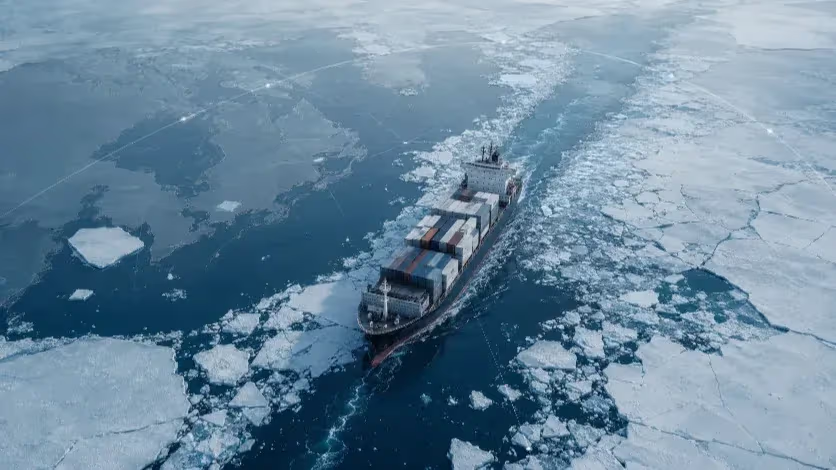
South Korea is preparing to send a container ship from Busan to Europe through the Russian Arctic in 19 days. The voyage will test whether a longer summer opening can support something more demanding than a successful crossing: a timetable that holds, a cargo base willing to pay for the time saved, and an operating model worth repeating after the first ship returns.
If Panstar’s schedule holds, PANSTAR ACRO will leave Busan New Port on Aug. 22 and arrive in Rotterdam on Sept. 10, 19 days later. The company’s booking system is already selling the passage as a direct service, with Hamburg and Gdańsk appearing farther along the European schedule, giving South Korea’s latest Arctic experiment the essential features of a liner product before the ship has entered polar waters: a named vessel, a fixed departure, an advertised arrival and space that has to be filled with paying cargo. Panstar describes the vessel as a 2,800-TEU-class container ship and has opened Arctic bookings across its Northeast Asian network.
The attraction begins with distance. A passage along Russia’s northern coast can substantially shorten the voyage between Northeast Asia and northern Europe compared with the conventional southern route through Suez, while repeated disruptions to established shipping corridors have made route diversification a practical concern rather than a theoretical exercise. South Korea’s Ministry of Oceans and Fisheries plans to use the 2026 round trip to collect polar-navigation and logistics data for a possible Korea-Europe express service, alongside longer-term investment in Arctic shipping technology and Busan’s role as a logistics base.
Distance, however, is only the first variable that enters the voyage. Once the ship leaves Busan, the shortcut has to survive sea ice, weather, vessel-specific operating limits, freight demand, insurance and a Russian administrative system before the time saved on the map becomes a product a shipper can use.
South Korea has already learned something about that difference. In 2013, Hyundai Glovis chartered a tanker carrying 44,000 tons of naphtha from Ust-Luga in Russia to Gwangyang through the Northern Sea Route. The vessel covered about 15,000 kilometers in 35 days. The government had initially expected a passage of roughly 30 days, but adverse weather and waits for Russian icebreaker assistance in frozen sections extended the voyage. The crossing succeeded; the timetable did not perform as planned.
A container service imposes a harder discipline than a tanker moving one homogeneous cargo. Boxes arriving in Rotterdam are tied to terminal windows, truck and rail connections, inventory plans, manufacturing schedules and subsequent vessel departures. Five unexpected days can propagate through several businesses that never see the Arctic themselves. The 2026 experiment therefore begins with a narrower question than whether a commercial ship can cross the Russian Arctic. It has to establish how much of the route’s geographic advantage remains after the operating system required to deliver a scheduled container service is placed around it.
The Window That Warming Created
The physical environment makes that experiment more plausible than it was thirteen years ago. The change is visible not only in the amount of Arctic sea ice but in the age and thickness of what remains. NOAA’s 2025 Arctic Report Card found just 95,000 square kilometers of ice more than four years old at the September minimum, a 95 percent decline from the 1.72 million-square-kilometer average recorded during 1985–2004. Multiyear ice, which survives summer melt and tends to become thicker through successive winters, is now concentrated largely north of Greenland and the Canadian Arctic Archipelago.
The seasonal calendar has lengthened with that transformation. Research published in Communications Earth & Environment in April found that the Arctic sea-ice melt season had expanded by roughly 40 days since 1979, driven mainly by later autumn freeze-up. The same study found a less linear pattern in the most recent period: since 2010, the melt season has averaged about 108 days without a consistent further lengthening trend, while varying by roughly 11 days from year to year. The background state has become markedly more favorable to navigation without producing a fixed commercial season that carriers can assume months ahead.
The latest forecast puts PANSTAR ACRO close to that boundary between longer access and persistent variability. On July 21, Japan’s National Institute of Polar Research projected the 2026 Arctic sea-ice minimum at about 4.47 million square kilometers around Sept. 12 and expected the Northern Sea Route along the Russian coast to open in late August. The forecast also indicates that ice is likely to remain into the summer in parts of the East Siberian Sea and eastern Beaufort Sea, using observed June 30 ice thickness and its historical relationship with subsequent ice concentration to estimate conditions through September.
A vessel does not navigate the Arctic-wide minimum, however; it navigates the ice lying across its intended track. Winds and currents can compress remaining ice into a corridor even when basin-wide conditions appear favorable, while thinner first-year ice is mobile enough for local conditions to change as a ship approaches. Greater stretches of open water can also allow waves to develop across longer fetches, replacing some of the constraints created by continuous ice with a different set of operating conditions.
Modern polar navigation manages that uncertainty with far better information than crews had several decades ago. Satellite observations and updated ice forecasts can guide routing decisions, but those decisions remain constrained by the capabilities of the ship itself. The International Maritime Organization’s Polar Code requires applicable vessels operating in polar waters to hold a Polar Ship Certificate based on the range of conditions for which they have been assessed and to carry a Polar Water Operational Manual describing their operational capabilities and limitations. Category A, B and C designations correspond to different levels of ice capability, and the certificate may include additional operating restrictions.
For PANSTAR ACRO, those vessel-specific limits are more useful analytically than the general description of the ship as Arctic-ready. Panstar has confirmed the ship and its 2,800-TEU class, but the publicly accessible material available before departure does not provide enough detail to establish the exact Polar Ship Certificate category, class notation, permissible ice regime or conditions under which escort would become necessary. Those parameters will determine how much of the forecasted opening can actually be converted into usable water for this particular vessel.
Timing the trial near the expected seasonal minimum reduces the probability that the ship will confront the Arctic at its most restrictive. A scheduled service operating in future summers will face a more difficult planning problem because cargo has to be sold and arrival dates published before the precise ice distribution of each voyage is known. The commercial significance of a longer melt season will therefore be measured less by the area of missing ice than by the amount of schedule margin PANSTAR ACRO still possesses after it has crossed the region.
Reliability Is the Product
The advertised 19 days matter because liner shipping sells time together with space. A manufacturer considering an Arctic booking is deciding when inventory can be released, when components may reach a production line and when onward transport should be arranged. A shorter passage acquires economic value when those decisions can be made with enough confidence to reduce inventory or accelerate delivery; variability erodes that value even when the average voyage remains faster than the conventional route.
A sequence of voyages arriving between 19 and 21 days would therefore constitute a different freight product from a sequence with the same average transit time but occasional passages stretching toward 30. The latter might still outperform Suez on mean speed, yet shippers would have to preserve larger buffers against the possibility of a late arrival. Part of the inventory advantage created by the Arctic shortcut would then disappear into the contingency required to use it.
The 2013 Korean voyage offers a useful scale for that risk. Five additional days represented an overrun of roughly 17 percent against the anticipated 30-day passage. A tanker could still deliver its naphtha and demonstrate that the route shortened the journey overall, while a regular container operation has to consider the downstream effect on terminal reservations, feeder connections and customers whose cargo is scheduled against a specific date.
South Korea’s single round trip cannot establish how often that schedule risk will materialize. China’s program this year is beginning from a different experimental design. Sea Legend Shipping plans eight weekly Arctic voyages between August and October using seven vessels, with the first scheduled to leave Ningbo-Zhoushan on Aug. 15 for Felixstowe in about 20 days. The service consolidates freight from several Chinese ports, including Dalian, Qingdao, Shanghai, Fuzhou, Taicang and Nansha, before the Arctic leg.
Eight sailings remain a small sample by liner-shipping standards, but the sequence can reveal information that one voyage cannot: whether later departures encounter more restrictive ice, how tightly arrival times cluster and whether customers continue booking as the season advances. The distinction between the Korean and Chinese programs is therefore less useful as a ranking than as a comparison of what each experiment can measure. Korea is testing a ship, a market and a round-trip structure; China is beginning to test frequency.
That matters because the cargo most capable of paying for Arctic speed is often the cargo most exposed to delay. Panstar said after a July shipper briefing that secured or prospective freight included automotive parts, synthetic resin, used vehicles, food products, liquid cargo, beauty products and steel, while inquiries and reservations for Japanese and Chinese transshipment cargo were increasing. More than 150 representatives of manufacturers, logistics companies, insurers and shipping businesses attended the briefing.
For an automotive supplier trying to prevent a line stoppage or a manufacturer carrying expensive inventory, several days saved at sea can have an identifiable financial value. Those customers gain less from an express service whose arrival range is too wide to incorporate into production planning. The premium market that could make a smaller Arctic ship viable consequently demands more from schedule reliability than a low-value bulk trade does.
The voyage record will show whether the 19-day proposition survived the Arctic with room to spare. Average speed by segment, prolonged periods of slow navigation, deviations from the planned track, ice concentrations encountered, weather delays, waiting and any external assistance will all reveal how the final arrival time was produced. Reaching Rotterdam on Sept. 10 after retaining a substantial schedule buffer would provide stronger evidence for repetition than arriving on the same day after nearly exhausting the contingency built into the plan.
Once the timetable is measured that way, the next constraint becomes harder to avoid. Every hour saved has to be delivered by a ship far smaller than the vessels that dominate the conventional Asia-Europe trade.
Distance Saves Days. Scale Saves Money.
The Northern Sea Route derives much of its advantage from geometry; the Suez system derives much of its advantage from scale. Asia-Europe carriers can deploy vessels of 20,000 TEU or more through the established southern network, distributing crew, capital, insurance, fuel and many port-related expenses across an enormous number of containers. Arctic operations presently require much smaller ships and introduce costs that do not disappear simply because the voyage is shorter.
A 2025 study in the Korea Maritime Institute’s Ocean Policy Research quantified that trade-off for Busan-Rotterdam container shipping. Its modeled Suez case used a 20,000-TEU ultra-large container vessel and produced an estimated cost of $726 per TEU. A 4,300-TEU ice-class ship using the Northern Sea Route came to $1,128 per TEU, while the modeled non-ice-class Arctic case reached $1,404. The analysis incorporated fuel, chartering, insurance, icebreaking and transit charges as well as EU carbon costs. Under those assumptions, the ice-class Arctic case remained about 55 percent more expensive per container than the Suez alternative.
Those figures do not describe PANSTAR ACRO’s actual voyage. The study used different vessels and assumptions for utilization, fuel, chartering, insurance and polar operations, so treating $1,128 as a forecast for the August sailing would overstate what the model can tell us. Its structural finding is harder to dismiss: the shorter route has to overcome the unit-cost penalty created when thousands fewer containers share the cost of the ship.
PANSTAR ACRO is smaller still, at about 2,800 TEU according to Panstar. That increases the importance of utilization in both directions. Empty space on the westbound sailing raises the cost carried by every paying box, while a strong outbound load can still produce weak round-trip economics if Europe supplies too little freight for the return.
The last government figure that can be treated as a dated cargo benchmark came from early July, when the Ministry of Oceans and Fisheries said approximately 1,300 TEU had been secured and that return cargo from Europe still had to be developed. Panstar subsequently reported that bookings and quotations increased after its dedicated Arctic booking system opened on July 22, but it did not publish a new aggregate TEU count in its July 27 release. As of Aug. 8, the 1,300-TEU figure is therefore evidence of the cargo position disclosed in early July, not a reliable statement of the final load that will leave Busan two weeks from now.
The support scheme makes the round trip explicit. Panstar was selected to receive up to 4 billion won from a fund created through the Korea Shipping Association, with 3 billion won tied to successful completion of the Arctic voyage and an additional 1 billion won available if round-trip container volume reaches at least 2,000 TEU. The structure matters because the larger component is attached to completing the experiment, rather than paid mechanically for every container carried; dividing the entire 4 billion won by the cargo threshold would therefore create a misleading “subsidy per TEU.”
Policy support can finance information that the market does not yet possess. Preparing a vessel, obtaining polar certification, arranging insurance, planning an unfamiliar route and structuring the legal and operational relationships needed for an Arctic passage all create costs that would discourage a carrier from conducting the experiment entirely at its own risk. The commercial question begins after those learning costs have been separated from expenses likely to recur on another voyage.
A useful post-voyage account would make that separation possible. Total round-trip operating cost, paid TEU in each direction, freight revenue, fuel consumption, insurance, Russian navigation charges and other Arctic-specific expenses would allow the cost of the service to be calculated against revenue-producing cargo rather than nominal ship capacity. Removing exceptional support from the same calculation would show the freight rate a subsequent voyage has to earn under more normal conditions.
That rate need not fall to the level of the cheapest Suez service. An Arctic container product can occupy a narrower part of the logistics market if the days saved are worth enough to the shipper. Urgent automotive components, high-value electronics or industrial inputs competing with air or rail transport may sustain a premium that ordinary container freight cannot. The route then becomes an express-ocean product rather than a direct substitute for the mass liner network: faster and smaller, seasonal and more expensive, but potentially useful for a specific class of cargo.
The size of that class of cargo becomes the central question for Busan because a 2,800-TEU ship cannot rely on distance alone to overcome the scale it gives up at sea.
Busan Has to Fill the Ship
Busan’s Arctic advantage, if one develops, will come from aggregation rather than latitude. The city cannot make an Arctic ship as cheap per container as a 20,000-TEU vessel simply by placing the departure farther north on a map. It can attempt to assemble a regional cargo base that allows a smaller, faster vessel to leave on a fixed date with enough paying freight to support the premium service being offered.
Panstar’s booking system provides unusually concrete evidence that the company is already trying to build that regional architecture. Current schedules connect Japanese ports to the same European arrival dates advertised for PANSTAR ACRO. A Yokohama shipment leaving Aug. 12 is listed to reach Rotterdam on Sept. 10 after one transshipment; Tokyo cargo leaving Aug. 17 and Nagoya cargo leaving Aug. 18 are shown with the same Rotterdam arrival. Osaka offers a particularly tight connection: cargo departing Aug. 21 is listed for Rotterdam on Sept. 10 in 20 days with one transshipment, one day before PANSTAR ACRO’s direct 19-day Busan departure.
Those schedules establish the existence of a Japan-Europe connecting product within Panstar’s Arctic sales network. They do not establish how many Japanese containers will physically board PANSTAR ACRO or, from the public timetable alone, prove the precise transfer point for every booking. Panstar’s own July statement goes one step further by saying that inquiries and reservations involving Japanese and Chinese transshipment cargo were increasing as preparations moved toward departure.
The distinction matters because a regional logistics network is more valuable to Busan than a single nationally sourced load. Japan has several major manufacturing markets but no individual origin necessarily needs enough Arctic cargo to support a dedicated ship; Busan can potentially combine those smaller flows with Korean exports and selected Chinese freight before the mainline vessel heads north. Panstar already operates Korea-Japan and Korea-China-Japan connections and presents its Arctic service as linking Europe with Korea, China and Japan through Busan.
China enters the same problem from a different scale. Sea Legend can consolidate freight from several Chinese manufacturing regions into Ningbo-Zhoushan before each Arctic departure, drawing on a much larger domestic cargo base. Busan cannot replicate that advantage inside Korea. Its plausible counterweight is transshipment: making the port useful to a wider Northeast Asian catchment area whose combined time-sensitive cargo is larger than the Korean market alone.
This is where conventional measures of port strength become insufficient. Total annual throughput, terminal depth and crane capacity establish that Busan can physically handle the cargo, but they do not show whether the right boxes will arrive during the narrow weeks in which an Arctic service can sail. The relevant numbers are more specific: Korean-origin paid TEU, Japanese-origin feeder TEU, Chinese-origin volume, the proportion booked before the cutoff and the freight secured for the European return leg.
The backhaul may prove more revealing than the inaugural westbound load. A first sailing can attract unusual attention from exporters, logistics companies and public institutions interested in testing the route, while the return voyage has to persuade European shippers that the eastbound product is useful in its own right. An Arctic ship that departs Asia well utilized and returns largely empty may demonstrate demand for speed in one direction without demonstrating the economics of a round-trip liner service.
A sustainable backhaul also tests Busan’s role from the opposite direction. European cargo has to arrive in Busan with onward connections into Korea, Japan or neighboring markets that are sufficiently useful to justify choosing the Arctic sailing in advance. The feeder network becomes valuable only when it can collect cargo before the westbound departure and distribute freight after the eastbound return.
Frequency raises that requirement further. One experimental vessel can be organized around the cargo that organizers are able to assemble. A scheduled liner eventually has to depart because the calendar requires it to depart. Every additional sailing reduces the carrier’s ability to wait for freight and increases its dependence on feeder schedules, terminal cutoffs and repeat customers arriving in Busan at predictable intervals.
The first voyage will therefore produce a more useful measure of Busan’s Arctic prospects than the language of “gateway” or “hub” can provide. The cargo manifest can show whether the port is functioning merely as the place from which a Korean trial ship sails or as the point at which Northeast Asian freight is being assembled into a new European service. The booking behavior that follows the voyage will show whether that function survives once customers know the actual price and performance.
Even a full ship, however, still has to pass through an Arctic corridor whose institutional structure is unusually concentrated.
The Shortcut Still Runs Through Russia
The Northern Sea Route follows Russia’s Arctic coast and operates within a Russian system of permissions and maritime services. Navigation through the corridor can involve Russian ice information and, depending on conditions and the vessel’s capabilities, pilotage or icebreaker assistance. A carrier considering repeated sailings must therefore manage a set of institutional dependencies alongside the physical problem of ice.
The 2013 Hyundai Glovis voyage showed how those two layers can meet. Icebreaker waiting contributed to the additional time consumed on a passage that remained successful overall, illustrating how an external service can affect a schedule even when the ship ultimately reaches its destination.
The geopolitical environment surrounding those services is substantially more difficult in 2026. Federal State Unitary Enterprise Atomflot, the operator of Russia’s nuclear icebreaker fleet, remains on the U.S. Treasury’s Specially Designated Nationals list under the Russia-related Executive Order 14024 sanctions program. The OFAC database listed Atomflot as an SDN in its July 24 update.
That designation does not establish that every Korean transit of the Northern Sea Route is prohibited, nor does it establish that PANSTAR ACRO will contract directly with Atomflot. It does make the contingency structure important. If the ship needs Russian assistance, the carrier has to know which entity provides the service, how a contract is structured, how payment is processed, what sanctions screening is required and whether the arrangement remains acceptable to the banks and insurers involved in the voyage.
The resulting risk is commercial even when no legal violation occurs. A payment that requires additional review, an insurer that narrows the conditions under which the ship may operate or a service arrangement that cannot be reproduced under the next season’s sanctions environment can alter the cost and predictability of a future sailing. The Arctic shortcut removes nautical miles without necessarily reducing the number of institutions whose decisions affect the voyage.
Insurance translates the physical remoteness of the route into another price. The IMO notes that polar operations face distinctive hazards, including limited charts and navigational aids in some areas, poor weather, ice loads on hull and machinery and the difficulty and cost of rescue or cleanup far from dense support infrastructure. Panstar’s July shipper briefing included polar cargo insurance and operating safety among the issues presented to potential customers, indicating that risk allocation is already part of the freight product being sold.
None of these constraints makes the route commercially unusable. A liner network already operates through numerous regulatory, insurance and geopolitical risks. The question is whether those risks can be made sufficiently stable to quote before the ship sails. If the carrier can identify likely Russian services, obtain insurance on repeatable terms, structure compliant payments and incorporate the resulting cost into a predictable rate, the institutional friction becomes part of the business model. If those arrangements have to be rebuilt for every departure, frequency becomes harder to sustain.
Avoiding Suez or the Red Sea therefore changes the geography of exposure rather than eliminating geopolitical exposure from Asia-Europe shipping. The value of the Arctic option will depend on whether that different risk structure is more manageable for a specific cargo and season once its costs are counted alongside the days saved.
What Would Prove a Route Exists?
PANSTAR ACRO reaching Rotterdam on Sept. 10 would answer the most visible question surrounding the trial and leave most of the commercially important ones unresolved.
Transit performance should begin with the difference between scheduled and actual arrival, but the headline number needs an operating history beneath it. Speed through individual sections of the route, hours of reduced-speed navigation, deviations around ice, weather delays, waiting and any outside assistance will show how much pressure the Arctic placed on the timetable. The amount of schedule margin remaining after the ship leaves the difficult sections will indicate how much worse conditions could have become before the advertised service failed.
Cargo performance requires the same precision. Paid westbound TEU should be separated from paid eastbound TEU, while Korean-origin freight should be distinguished from Japanese, Chinese and other feeder cargo where possible. Revenue matters alongside volume because a full ship does not establish viability if its freight rates cannot cover the smaller vessel’s unit costs and Arctic operating expenses.
The voyage accounts can then test the academic cost models against an actual Korean container operation. Fuel, insurance, vessel preparation, certification, Russian charges and other identifiable Arctic expenses should be allocated against the amount of revenue-producing cargo carried. Calculating the same result before and after exceptional support would show what part of the economics belongs to the experiment and what part is likely to remain on the next sailing. The $726-versus-$1,128 comparison from the Korea Maritime Institute establishes the structural problem; PANSTAR ACRO can supply the empirical record that the model lacks.
Environmental claims should face a similar accounting standard. Fewer nautical miles can reduce voyage-level fuel consumption, yet emissions per container depend on actual fuel use, vessel speed, cargo load and any additional resistance or assistance encountered in polar waters. A smaller ship can burn less fuel in total while still performing poorly per TEU relative to a fully utilized ultra-large vessel, particularly if load factors differ sharply.
Carbon dioxide also does not capture every Arctic-specific consequence. The IMO has adopted guidance aimed specifically at reducing black-carbon emissions from international shipping in or near the Arctic, reflecting the concern that soot deposited on snow and ice can increase absorption of solar energy and contribute to warming and melt. Environmental performance should therefore be demonstrated from voyage data rather than inferred from the shorter route alone.
South Korea’s longer-term policy implicitly recognizes that the 2026 vessel is an experiment rather than a final architecture. The Ministry of Oceans and Fisheries has committed to developing core technology for an icebreaking container ship by 2030, while expanding polar-mariner training and other support systems. Data from PANSTAR ACRO can reveal where an existing commercial vessel loses speed, capacity or operating freedom and provide evidence for how much additional ice capability and capital a future ship actually requires.
No engineering improvement can resolve the final uncertainty from one voyage: repetition. A single crossing cannot establish the probability that a later sailing will encounter comparable ice, maintain the same transit time, attract the same cargo or obtain the same operating arrangements. China’s eight planned departures will begin accumulating observations across one season. South Korea’s equivalent evidence will begin with the decision made after PANSTAR ACRO returns.
That decision will also provide the clearest early test of Busan’s position. One departure demonstrates that an Arctic container voyage can be organized from the port. A network starts to appear only when Korean and regional shippers, having seen the first voyage’s actual time and price, commit cargo to another one, and when European exporters supply enough freight to support the economics in the opposite direction.
The threshold for success is therefore narrower than the opening of a new global shipping corridor and more demanding than a safe arrival in Rotterdam. The voyage has to reveal how much of the Arctic’s distance advantage survives real operating conditions, how much customers will pay for the time that remains, what that performance costs per paying container and whether Busan can gather enough regional cargo to make the proposition repeatable.
If PANSTAR ACRO reaches Rotterdam on Sept. 10, South Korea will have evidence that a late-summer Arctic window can support a scheduled 19-day container passage from Busan under the conditions encountered in 2026. The more consequential judgment will come after the ship returns, when Panstar has the operating record, cargo composition and round-trip accounts in hand and must decide whether another departure can be offered on terms that shippers are prepared to buy.
Continue this reporting
Reporting on the same issue
Related coverage selected from the article's desk, topics and newsroom relationships.
 NewsSep 26, 2026
South Korea’s 490 Regional Doctor Seats Begin a Longer Route to Care
South Korea’s first 490 regional-doctor seats tie medical-school admission to...
 NewsAug 30, 2026
The Hidden Economics of South Korea’s Public Transport
Busan’s latest transport review exposes a wider national problem: South Korea...
 NewsAug 11, 2026
Korea’s Innovation Cities Did Not Grow the Same Way
Nearly two decades after South Korea began relocating public institutions, th...
More from the author
More from this byline
Stay with the same line of reporting through more work from this byline.
 NewsOct 4, 2026
Zelensky, South Korea and the Limits of Wartime Pressure
Reader Signal
Community readWhat did this report leave you with?
Choose the signal that best reflects your reading. Select it again to remove it.
One response per article
No response selected
A moderated conversation about the reporting.
One-level replies and newsroom moderation keep the conversation anchored to this article.
Discussion Status
Open
Please sign in to join the discussion.
Newsletter
Weekly reporting and context from Busan and Korea.