The Moon’s Industrial Future Begins With What Missions No Longer Need to Carry
Water, sunlight, safe landing terrain, communications and power do not naturally coincide near the lunar south pole. The next phase of lunar industry will depend on whether infrastructure can connect those conditions reliably enough for later missions to carry less from Earth.

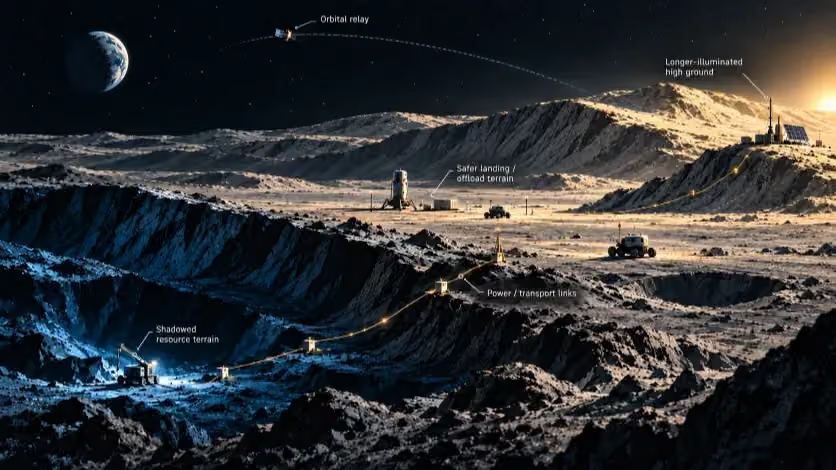
Near the lunar south pole, water, sunlight, safe landing terrain, communications and power do not naturally coincide. Plans for reactors, relay networks, cargo landers and resource systems will matter most when later missions can rely on them — and leave some of their own hardware on Earth.
NASA has asked reactor developers to design around a hard physical limit. If the lander carrying Lunar Reactor-1 can take no more than eight metric tons, what does that mean for a 20-kilowatt-electric fission system expected to operate on the Moon? The question appears in NASA’s 2026 sources-sought and draft procurement work for LR-1, alongside plans to mature nuclear-system technologies that remain well short of a completed flight system. Eight tons is a design constraint rather than the confirmed payload of a selected LR-1 lander, but it immediately ties the reactor to everything required to deliver it, place it on the surface and turn its electricity into useful work.
NASA and the Department of Energy have used 2030 to describe several stages of that effort. One formulation speaks of developing a lunar surface reactor by then, while a later NASA directive calls for LR-1 to be ready for launch by 2030; other agency material has associated the same year with a lunar landing. Development, launch readiness, landing and sustained operation are different engineering milestones even when public descriptions attach them to the same date. Treating 2030 as a guaranteed start date for an operating lunar power plant would claim more than the program has established.
Space Reactor-1 Freedom is meant to remove one class of uncertainty before LR-1 approaches the Moon. The 20-kilowatt-electric reactor is targeting a late-2028 flight toward Mars, allowing NASA to operate nuclear hardware in space without combining the test with lunar descent, unloading and surface emplacement. The flight is intended to build experience in reactor operations, regulation, supply chains and the workforce needed for later nuclear missions. Part of the technical path to a lunar reactor therefore runs through a reactor mission that never lands on the Moon.
LR-1 would still have to cross a different set of interfaces after reaching the lunar surface. Public program material describes reactor performance and some lander constraints, but it does not yet show a complete chain for delivery, unloading, emplacement, electrical connection and distribution of power to users elsewhere on the surface. Those omissions do not prove that the work is absent inside the program. They do mean that an operating reactor and an operating lunar power system remain different engineering accomplishments.
Heavy cargo makes the gap between landing and use easier to see. NASA has identified a cargo-lander capability gap between roughly 500 kilograms and 12,000 kilograms for which significant demand exists, while human-class cargo landers are intended to extend delivery into roughly the 12-to-15-metric-ton range. Getting that mass onto the Moon does not necessarily put it where it will operate: NASA surface-mobility work considers blast-ejecta separation of more than a kilometer and equipment aggregation several kilometers from available landing areas. Large-scale lunar logistics therefore continues through offloading, relocation and emplacement after descent has already succeeded.
NASA’s Moon Base planning assumes shared utilities will arrive gradually. Early surface assets are expected to manage much of their own power and survival, while later phases introduce common power stations, charging, dust-tolerant connectors, cable deployment and other shared functions, with operational fission and broader distribution farther along. Sophisticated machinery can therefore be present on the Moon while common services remain too immature for another vehicle to discard its own redundancy. The first years of a lunar build-out may contain more duplication, not less.
The South Pole Does Not Put Everything in One Place
Permanently shadowed regions near the lunar south pole can preserve water ice at temperatures low enough to trap volatile material for immense periods of time. Higher terrain nearby can receive much longer intervals of sunlight and therefore offers advantages for solar generation. Between them lie crater walls, steep slopes, moving shadows and obstructions that complicate landing, rover travel and direct communication with Earth. A location can be scientifically valuable because of the same environment that makes sustained operations difficult.
NASA’s planning for VIPER showed those conflicts at rover scale. The solar-powered vehicle had to travel toward terrain likely to contain ice while retaining enough energy to retreat from advancing shadows, and route planners also had to account for slopes that increased wheel slip. Communications geometry imposed another constraint because the rover depended on a workable radio path to Earth and needed access to safer areas where sunlight could preserve its energy margin. Finding the right material was only one requirement among several that changed across the terrain.
Orbital instruments can narrow the search without establishing whether the material can become a usable resource. Hydrogen-rich terrain and cold traps indicate where ice may survive, but a production system needs to know how much water is present, how deeply it lies, how it is distributed and what physical form it takes. Those measurements determine how much regolith must be handled for each kilogram recovered, which excavation methods are plausible and how much energy the operation will consume. Detected water, a characterized resource, technically recoverable material and a produced commodity belong to different stages of the problem.
Japan and India’s LUPEX mission is designed around part of that gap. Its rover is intended to investigate lunar water and subsurface conditions after landing in the south-polar region, with drilling and sampling concepts reaching roughly 1.5 meters below the surface. Mobility allows the lander to favor a safer operating area without requiring the most valuable sampling target to sit directly beneath it, while the rover must still work within limits imposed by slopes, illumination, batteries and communications. Movement creates room to trade among constraints; it does not make them disappear.
ESA’s planned Moonlight network tackles a different part of the same geography from orbit. Its architecture calls for a communications satellite and four navigation satellites, with priority given to the south-polar region and service planned to emerge toward the end of the 2020s. A surface vehicle using such a network could work where direct Earth visibility is poor without reproducing every communications and navigation function onboard. The terrain beneath the rover does not improve, but one condition that once had to be provided locally can instead be supplied from orbit.
Power can be separated from its point of use in much the same way. The terrain with the best illumination may not contain the material an operator wants to investigate, while deep shadow can preserve ice precisely because sunlight rarely reaches it. Storage, distribution and eventually fission can extend activity beyond the locations and hours that favor direct solar generation, alongside other approaches to moving or retaining energy. The amount of water in the soil and the slope of a crater remain unchanged; engineers gain more freedom over where energy has to be generated.
From Water Ice to an Operating Supply Chain
NASA engineers have modeled what happens when those separated functions are treated as one production chain. One polar-water study placed extraction at one location and propellant production at another, with tankers carrying water between them. Under its baseline assumptions, collecting and processing 15 metric tons of water to produce 10 metric tons of oxygen required roughly five metric tons of ISRU hardware and about 68 kilowatts of power before the surface power system itself was counted. Two tankers accounted for roughly 1.8 metric tons.
Those figures are not a forecast of the first lunar mine. They depend on an assumed resource concentration, a particular production target and selected technologies, so another site or mission could produce a very different system. The study is more revealing as an inventory of what appears after water is treated as feedstock rather than as evidence of ice: excavation, thermal processing, power, storage, transport and the machinery linking them. Finding a resource and closing the chain that turns it into a useful product are different engineering achievements.
A resource operation can occupy several pieces of lunar geography at once. A safer landing point may sit away from a survey target, extraction may take place in deep shadow, and processing may be easier where power and thermal conditions are less severe. Rovers, tankers, relays and power links can connect those locations, but every connection carries mass and imposes another performance requirement. The relevant system extends well beyond the patch of regolith containing the resource.
Connecting those locations also moves failure around. A rover operating beyond direct Earth visibility becomes dependent on a relay; a processing plant separated from its power source depends on the equipment carrying energy between them; long transport between extraction and processing increases demands on mobility, storage and maintenance. Dust, thermal cycling, terrain and distance then act on the systems introduced to work around the original limitation. A difficult site can become usable only by creating several new components whose failures can propagate through the operation.
Lunar geography therefore remains consequential after infrastructure arrives. A relay cannot make a steep slope safe, a larger battery cannot increase the concentration of water in the regolith, and a reactor cannot shorten the route that heavy machinery must travel after landing. Better systems can enlarge the operating envelope substantially, but they pay for that freedom in mass, energy, complexity and reliability. The surface becomes more usable without becoming uniform.
A rover, relay or power source built for one expedition may transform that expedition and leave the spacecraft that follows essentially unchanged. A more demanding transition begins when another operator can assume that the capability will still be available, understand how to connect to it and design its own vehicle around that expectation. Equipment then starts influencing hardware that belongs to somebody else. Repetition and external dependence become more useful measures of infrastructure than the mere presence of machines on the surface.
What the Next Mission Can Leave on Earth
ESA plans its first Argonaut cargo landing around 2030 and intends later missions on a cadence of roughly two to three years. Each lander is designed to carry cargo in the low-tonne range, with possible payloads ranging from scientific instruments and rovers to equipment for communications, power and resource use. One successful landing establishes a technical capability, while a predictable series begins to alter decisions made by payload teams years before launch. A customer can design differently when delivery becomes an expected service instead of another unique demonstration.
Repeating the vehicle is not enough by itself. Payload teams need to know how much mass can be delivered, which destinations are reachable, how cargo will be offloaded, what interfaces are available and how much delay their own program must absorb if a flight slips. A recurring lander becomes useful infrastructure when enough of those assumptions are stable for customers to stop solving transportation from the beginning. Its maturity is reflected in work that another organization no longer has to do.
Moonlight asks a future rover to make an even deeper version of that trade. A vehicle designed to obtain communications or navigation from an external network can devote less mass and engineering effort to reproducing those functions onboard. Its designers can make that choice only after coverage, continuity and resilience are dependable enough for service loss to enter the rover’s accepted risk calculation. A satellite can operate successfully and still fall short of infrastructure if other missions are unwilling to depend on it.
NASA’s phased surface-power architecture supplies the counterexample. Early assets remain relatively self-supported precisely because common services have not yet earned that level of confidence, while shared charging, connectors and distribution appear farther into the surface build-out. Later hardware may eventually arrive with less independent generation, storage or charging capability, but only after operators accept the common system as part of their own mission architecture. The road to shared infrastructure therefore passes through a period of deliberate duplication.
China is arranging many of the same physical dependencies through a different institutional model. Public plans for the basic International Lunar Research Station around 2035 combine Earth-Moon transportation, energy supply, communications and navigation, surface operations and resource utilization within a more integrated, state-directed architecture. Chang’e missions are intended to contribute technologies and demonstrations to that build-out rather than simply accumulate isolated landings. The ownership and procurement system differs sharply from European service models while confronting many of the same requirements for transport, energy and connectivity.
European and Chinese architectures distribute ownership, procurement and risk differently, but neither can bypass repeated performance and usable interfaces. A commercial network, a recurring institutional cargo service and a state-directed station may compete, coexist or remain partly separate while still having to move mass, supply energy and connect surface users. Institutional differences change who builds and controls the system, not the physical requirement that its parts work together. Later spacecraft will reveal which capabilities have become trustworthy enough to influence their design.
A Lunar Economy Needs Repeat Customers
A lunar water plant faces another test after engineers prove that extraction works. Producing oxygen or water locally can replace material that would otherwise have to be launched from Earth, but the plant must first justify its own delivery mass, power demand, development cost and operating risk. In one NASA breakeven analysis, the modeled result depended strongly on campaign scale and duration, with autonomous ISRU lifetime becoming critical to whether local production could outperform continued delivery from Earth. Technical feasibility and economic advantage therefore do not arrive at the same time.
A short-lived plant returns part of the Earth-launch burden to every production cycle. Replacement machinery has to travel through the same expensive logistics chain that local production is intended to reduce, while a system that operates for years can spread its development and delivery costs across much more output. In the NASA analysis, service life beyond five years became important under the modeled campaign rather than functioning as a universal cutoff for every lunar architecture. Longevity creates value only if enough demand exists to use the additional production.
Demand itself has a geography. Oxygen or propellant produced close to the missions consuming it can remove part of the Earth-Moon transportation chain, while material sent onward to another location in cislunar space acquires additional transport requirements after production. The same kilogram of product can therefore have very different value depending on where the customer is, how often the customer returns and what infrastructure stands between production and use. A resource map does not reveal where the market will form.
Communications, navigation, cargo delivery, surface mobility, charging and power can serve that market before large-scale resource production becomes routine. Each can remove hardware, propellant or engineering work from a customer’s mission if the service is dependable enough to replace something that otherwise would have left Earth. A navigation network does not need to export a commodity to create value, and a logistics provider does not need to own the payload it moves. Early lunar economic activity may therefore form around recurring services and avoided Earth-launched mass before it resembles a commodity-export industry.
Those savings come with exposure to somebody else’s system. A rover leaving communications hardware on Earth becomes more dependent on an external network, and a lander using outside navigation accepts another provider’s performance as part of its safety case. Common power or logistics can also concentrate failures that once remained inside individual vehicles. Reducing duplication can improve efficiency while increasing the consequences when a shared service fails.
Interfaces Become a Question of Access
Two systems can operate around the Moon without being useful to one another. Radios, timing standards, data protocols, navigation references, electrical connectors and operating procedures have to be compatible before one operator’s infrastructure can replace hardware on another operator’s spacecraft. Work around LunaNet and related interoperability efforts matters because interfaces determine whether investment in one architecture actually creates options for users outside it. An operator does not need to own the entire lunar stack for control over an interface to acquire strategic value.
The shared environment also produces conflicts before anyone makes a territorial claim. A landing plume can throw dust and debris toward another operator’s hardware, rover routes can cross working areas, radio systems can interfere and excavation can disturb terrain on which nearby operations depend. As surface activity increases, engineering decisions made by one program become operating conditions for another. Coordination becomes necessary because the machines can affect one another physically.
The Outer Space Treaty already prohibits national appropriation, establishes state responsibility for national space activities and requires due regard for the activities of others. Those obligations provide a legal baseline without supplying a complete operating code for notification, landing separation, excavation, radio interference or consultation among multiple lunar operators. COPUOS work on space-resource principles remains recommendatory rather than a completed binding mining regime, while international work on consultation and coordination continues. The unresolved problem lies between broad legal obligations and the detailed procedures repeated operations may require.
South Korea is entering that environment by assembling selected capabilities rather than reproducing every layer of the largest lunar programs. KASA’s current sequence includes communications and navigation development, a roughly 500-kilogram-class lunar communications demonstration satellite around 2029, an industry-led small lander of roughly 700 kilograms around 2030, mobility and logistics work aimed at demonstration around 2031, and a separate national landing program toward 2032. These projects do not constitute a Korean lunar mining architecture. They do place Korea directly inside the question of which capabilities a middle space power needs to own and which it can obtain through wider systems.
One connection already goes beyond architectural discussion. KASA and NASA have arranged for the Korean-developed Lunar Vehicle Radiation Dosimeter to fly on a CLPS commercial lander for a south-polar radiation mission currently targeted around 2030, subject to the mission schedule. The payload depends on a delivery, integration, surface-operation and data-return chain that Korea does not itself provide. Small compared with a lander or relay network, the arrangement still shows what participation through another operator’s infrastructure can look like before Korea possesses an independent full lunar stack.
That route lowers some barriers while creating dependencies of its own. South Korea does not have to duplicate every relay, lander, rover, power source and processing plant to conduct meaningful lunar operations, but hardware connected to outside systems becomes sensitive to standards, access conditions, schedules and services beyond national control. The more capability a country obtains through interoperability, the more consequential those interfaces become. Entry into a shared architecture and dependence on it develop together.
Korean law is also moving before a detailed lunar operating regime exists. A pending Basic Space Act proposal would provide a basis for government support, guidance and supervision of activities including space-resource mining, but the bill remains in committee rather than constituting an enacted operational code for lunar resource activity. That legal development sits alongside communications, landing, mobility and international integration because actual participation creates questions of authorization and supervision before Korea has to decide whether it wants to own every layer of the system. Governance becomes concrete as national hardware begins relying on infrastructure operated by others.
Moonlight has not yet become a service on which lunar surface missions routinely depend, Argonaut has not established its delivery cadence, the ILRS basic model remains a future architecture, and resource-processing systems remain demonstrations, studies and planned missions. NASA’s own surface plans still retain substantial self-support while common utilities mature. Later operators cannot yet routinely eliminate their own alternatives simply because these systems appear on architecture diagrams. The emerging chain is real enough to influence engineering decisions without being mature enough to treat as an established lunar industry.
LR-1 began with a question about what could fit within the mass available to a lunar lander. A more consequential measure will eventually appear on the manifest of a later spacecraft, where engineers can see which radios, navigation equipment, power hardware, consumables or logistics systems are absent because something already operating on or around the Moon has become dependable enough to do the job instead. One mission making that choice would show confidence in a service, while repeated missions making it would begin to change the architecture of lunar operations. The strongest evidence of an emerging lunar industrial system may ultimately be found in the equipment those missions no longer have to carry from Earth.
Continue this reporting
Reporting on the same issue
Related coverage selected from the article's desk, topics and newsroom relationships.
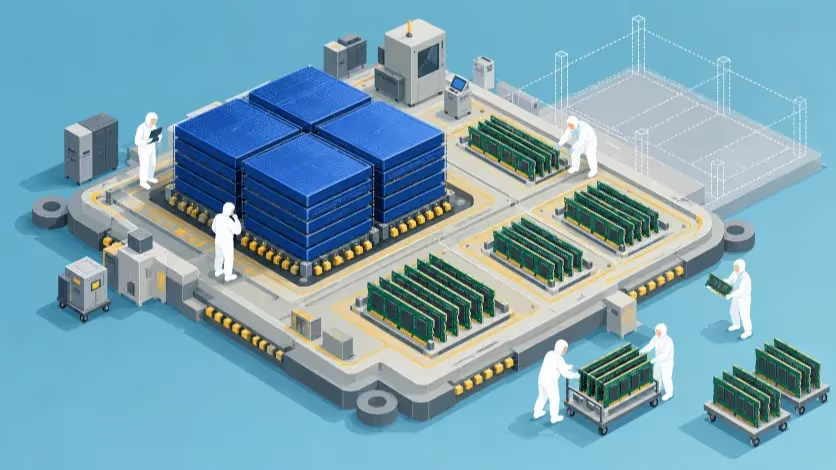 NewsOct 2, 2026
AI Is Reallocating the World’s Memory Factories
AI demand is forcing memory makers to decide how scarce DRAM capacity is divi...
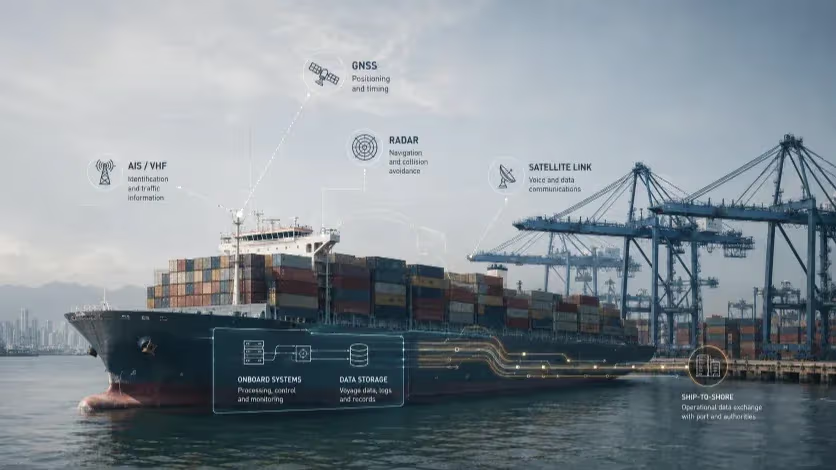 NewsSep 2, 2026
The Ship Is Already a Sensor
Modern merchant ships already carry dense networks of sensors, radios and com...
 NewsAug 23, 2026
When Smart Glasses Stop Looking Like Computers
The most successful smart glasses are learning to disappear. Their next chall...
More from the author
More from this byline
Stay with the same line of reporting through more work from this byline.
 NewsOct 4, 2026
Zelensky, South Korea and the Limits of Wartime Pressure
 NewsSep 24, 2026
Taiwan’s AI Boom Is Surging, but Wealth Follows a Different Map
Reader Signal
Community readWhat did this report leave you with?
Choose the signal that best reflects your reading. Select it again to remove it.
One response per article
No response selected
A moderated conversation about the reporting.
One-level replies and newsroom moderation keep the conversation anchored to this article.
Discussion Status
Open
Please sign in to join the discussion.
Newsletter
Weekly reporting and context from Busan and Korea.