Pollock Roe in Busan: Food History, Texture and Fermentation
From Busan’s curing industry to Korean myeongranjeot, Japanese mentaiko and new fermentation research, pollock roe reveals how texture, history and protein chemistry shape a food.

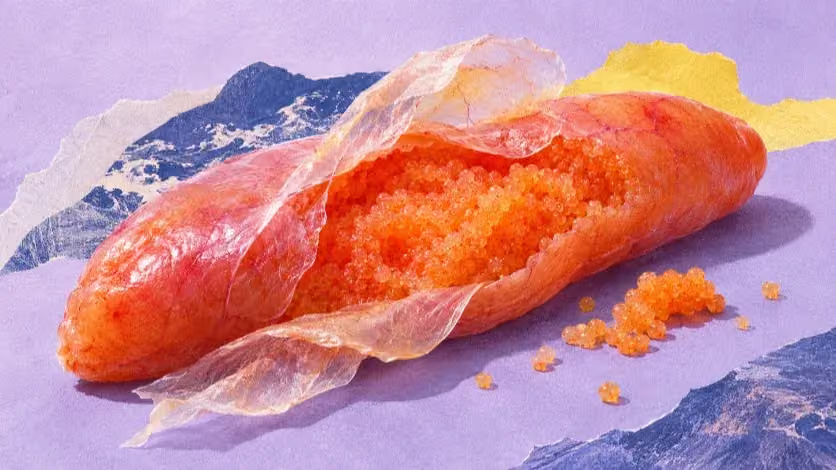
From the granular bite of salted roe to the proteins that help hold an emulsion together, a familiar food connects Busan's processing industry with a longer history of trade, craftsmanship and experiments in what fish eggs can become.
A pollock roe sac can lose its shape without losing every quality that makes its eggs desirable. The thin ovarian membrane holds thousands of grains together, giving the roe a form that matters to the appearance of a finished salted product. Once the membrane is torn, the sac may be assigned a different grade, although the eggs remain available for preparations in which an unbroken exterior is less important. The distinction is more than an argument about appearance. It reaches into the texture of the food, the choices made by processors and the different ways a valuable marine ingredient moves through the Korean and Japanese food industries.
In 2019, researchers working with Busan-based Deokhwa Food examined Alaska pollock roe across eight grades, including intact, cut and immature material. Some of the eggs recovered from partly cut sacs retained an instrumental firmness comparable to eggs from larger intact grades. The researchers concluded that two cut categories could also be suitable for high-quality roe products. A ruptured membrane and the properties of the eggs inside it could be evaluated separately, leaving the commercial consequences to be determined by the product being made. The qualities preserved by curing, the appeal of an intact piece and the usefulness of separated roe belong to overlapping but different assessments of the same food.
The Texture Made by Salt
The familiar bite of myeongranjeot begins with the anatomy of an ovary. Each egg has a delicate envelope of its own, while the larger membrane surrounding the mass gives a cured sac its recognizable form. The maturity of the fish affects the development and size of the eggs before processing begins. Differences in maturity and membrane condition are important because salted roe is often eaten in pieces that make individual grains perceptible: the tongue encounters their resistance even as the surrounding tissue and seasoning supply a softer, more savory texture. An intact sac can be visually attractive yet unsuited to the desired bite if the eggs themselves are poorly developed.
For their 2019 grading study, the Korean researchers described 32 cases of raw roe in eight categories, with a separate instrumental texture assessment comprising 72 observations across those grades. The measured material was removed from its enclosing membrane and placed in a testing cell. Eggs in the cut KA category registered a mean reading of 78.3 grams per square centimeter, close to 81.6 for the intact L grade and 77.9 for M. Within that experiment the three averages were not statistically distinguishable. The smaller intact S and 2S grades, along with more severely cut KC material, registered much lower averages. The instrument measured resistance under a specified protocol, while a tasting panel and a buyer would assess additional qualities. Exterior damage and loss of egg firmness were separate properties within the tested material.
When a cut sac still tests firm
Instrumental texture of roe eggs removed from their enclosing membrane, across eight raw-material grades. The ranges plotted are each published mean ± one standard deviation—not confidence intervals.
Read across categories: intact L and M and cut KA carry the same significance letter (d) in this experiment. The letter indicates no statistically detected difference in this test, not proof of equivalent quality, price or consumer preference.
The study examined 32 raw-roe cases for its grade characterization. Table 7 separately reports 72 instrumental texture observations across the eight groups. These are different counts and must not be conflated.
Full data table (mean ± SD, n and test group)
| Grade | Texture; n; group |
|---|---|
| L | Intact sacs · 81.6 ± 8.2 g/cm²; n=9; group d |
| M | Intact sacs · 77.9 ± 10.4 g/cm²; n=8; group d |
| S | Intact sacs · 13.1 ± 3.5 g/cm²; n=11; group b |
| 2S | Intact sacs · 12.6 ± 3.4 g/cm²; n=10; group b |
| KA | Cut sacs · 78.3 ± 8.1 g/cm²; n=11; group d |
| KB | Cut sacs · 46.2 ± 6.7 g/cm²; n=7; group c |
| KC | Cut sacs · 13.3 ± 2.0 g/cm²; n=10; group b |
| G | Immature · 1.9 ± 0.1 g/cm²; n=6; group a |
Salt provides the processor with a way to change that firmness. As dissolved salt enters roe tissue, the distribution of water shifts, modifying the conditions under which proteins interact and membranes resist pressure. The resulting changes depend on concentration, temperature and duration, as well as on the condition of the eggs when curing begins. Additional seasonings alter flavor and introduce their own dissolved components; freezing and thawing before or after particular treatments can change what the process ultimately preserves. A successful cure develops a consistent granular texture from raw material whose biological and storage history may vary from carton to carton. Traditional salting and maturation should not be confused with fermentation by an intentionally added, identified bacterial culture, even though both may be described informally as methods of developing flavor.
Researchers have been able to change the texture of salted roe by acting directly on its proteins. A 2019 Food Chemistryexperiment tested microbial transglutaminase, an enzyme that promotes bonds between protein chains. Under its specific curing conditions, treatment increased the firmness of salted roe and the resistance of individual eggs to rupture; the strongest result was reported at an enzyme concentration of 0.5 percent among the levels tested. The experiments help explain a familiar sensory quality in molecular terms, without supplying a standard recipe for all manufacturers. They concern modifications to salted roe, a different objective from recovering proteins for use elsewhere in food manufacturing.
Reduced salt levels and altered freezing schedules present further challenges for the texture of roe. The membranes must retain enough strength to deliver the expected texture, while seasonings have to penetrate without producing an unpleasantly uneven cure. A 2022 experiment comparing seasoning and frozen-storage sequences found differences in mechanical and protein properties according to when treatment occurred. The results illustrate how a producer can obtain different textures from broadly similar raw material by changing the order of processing. The material encountered at final inspection has undergone measurable change since its first grading, with the best sequence dependent on the product and raw-material grade.
The Japanese company Kanefuku describes a manufacturing sequence in which thawed roe is washed and graded, salted to develop its grains, sorted again after curing and immersed in seasoning liquid for a later maturation lasting at least 48 hours. Sorting after the first cure is particularly revealing. The company is examining material already altered by salt before deciding how it will be presented. Kanefuku's published process offers one manufacturer's account of how curing and repeated inspection are organized. It illustrates the continuous relationship between raw-material judgment and the physical transformations on which a premium roe product depends.
A Northern Catch, a Busan Industry
In April 2026, a Busan seafood wholesaler advertised Russian pollock roe packed in cartons of approximately 23 kilograms. The offer distinguished consignments by fishing company, production date, warehouse and trade codes including PG and OFF. Prices depended on order size; the grades were identified by code without published specifications. The offer captures the commercial condition in which the ingredient arrives: a frozen product of distant fisheries, already sorted into specifications that may differ from those used in academic experiments, awaiting further judgments by traders and processors near Busan's coast.
Busan International Fish Market identifies frozen pollock roe among its traded imported seafood. Refrigerated warehouses, low-temperature trading facilities and manufacturing operations occupy the city's southwest coastal seafood district, creating places where raw material can be stored, traded and transformed. The municipality's premium-seafood registry, updated in October 2026, identifies four certified makers of salted pollock roe: Deokhwa Food, Daekyung F&B, Heechang Trading and Samyang Seafood. The designation covers certified producers, while the size of the wider manufacturing industry requires a separate count. An academic study published in 2022 described Busan as a leading manufacturing area and, drawing on national production records, reported 4,535 metric tons of myeongranjeot produced across South Korea in 2020 with an output value of 53.6 billion won. The current output of Busan's roe plants remains a separate statistical question.
By the time roe reaches a Busan processor, maturity, handling and the freezing history have already influenced the condition of its eggs and membranes. A processing plant must then decide how the material responds to thawing, salt, seasoning and time, and which finished food its characteristics will support. In a 2024 Koreana profile, Deokhwa chief executive Jang Jong-su described workers adjusting curing mixtures to the condition of incoming roe and sorting again after maturation. The account comes from a published interview with the company, but the practice it describes is consistent with the need to reevaluate a changing biological material. Machinery can standardize parts of production while sensory and physical judgments remain necessary at particular stages.
Busan manufacturers have also supplied Japanese retailers under commercial contracts. An account of Deokhwa's business history records the company's supply of private-label roe to the Japanese retail group Seven & i from late 2008 through 2015. Kanefuku describes another model, with control over raw-roe purchasing and initial salting retained inside the company while some competitors procure already salted material from specialized suppliers. A retail brand, a curing operation and the origin of the fish may therefore occupy different countries or firms. The division of labor matters to how a producer manages quality, where manufacturing knowledge accumulates and which company performs the transformations that consumers ultimately recognize as a particular taste.
The Taste That Crossed the Strait
Pollock roe was part of Korean food supply long before the emergence of Japan's modern mentaiko companies. In 1652, the Seungjeongwon Ilgi, the royal secretariat's diary, recorded a dispute over a shipment in which pollock roe was delivered in place of the cod roe specified as a substitute for another item. The officials were checking the identity of an item in a royal supply obligation. Their record nevertheless shows that pollock roe had a distinct identity in the food trade. It would be centuries before a frozen consignment could arrive at a Busan warehouse with commercial grade codes attached to the cartons.
On the northeastern coast of the Korean peninsula, the winter pollock catch generated products that required different kinds of preservation. The fish could be dried, while its perishable roe was salted. A fisheries survey around Wonsan in 1900 described salted eggs being sold far beyond their source and characterized them as desirable but not cheap. A Korean periodical in 1907 reproduced a Japanese fisheries account referring to roe salting among communities along the Hamgyeong coast. The account was written from the standpoint of Japanese commercial expansion, which limits its authority on working conditions and the distribution of profits. As evidence of a preexisting practice, however, the description accords with the earlier record of salted roe moving away from the coast. Korean culinary histories also trace preparations in which roe was served with rice, steamed or accompanied by scallion and vinegar, reminding us that commercial curing was only one part of the ingredient's life as food.
Busan's position in that trade developed through geography and commercial organization. The Academy of Korean Studies recounts how the Higuchi shop moved from Wonsan to Busan in 1907 to take advantage of the route to Shimonoseki. Japan's Asian Historical Records Center identifies pollock roe as a separate commodity in colonial trade statistics from 1914 and, in its discussion of a 1917 trade handbook, describes manufacturers and sellers centered on Busan whose customers extended to Japan's Kansai region and Dalian in northeastern China. The published historical interpretation rests on a 1917 trade handbook and related records cataloged by the Japanese archive. Its commercial picture nonetheless has a clear geographical logic: fish caught in northern waters could acquire new buyers through a southern port connected to Japanese markets.
The expansion was conducted under colonial rule, and contemporary claims that organized processing improved an allegedly crude traditional product must be read alongside the economic interests of the institutions making them. A historical study of 1930s fisheries in Hamgyeong describes larger interests and fishing associations gaining leverage over processing and marketing at the expense of smaller participants. The research concerns the northern producing region, where an expanding trade also changed the bargaining position of people who caught and prepared the roe. Trade could enlarge a market while changing who controlled access to it.
The businesses that made chili-seasoned mentaiko a familiar Japanese food emerged amid the upheaval after 1945. The Japanese archival account describes Kozo Yamane, who had returned from Busan, preparing chili-coated roe in Shimonoseki around 1946 or 1947. Toshio Kawahara, who had grown up in Busan, developed a separate business in Fukuoka, where his company Fukuya dates its first mentaiko sales to January 10, 1949. Company records and archival accounts describe different stages in the subsequent evolution of particular seasoning methods; the date of a firm's first sale is not proof that it invented every form of chili-seasoned roe. Korean myeongranjeot, Japanese salted tarako and karashi mentaiko reflect a connected ingredient and distinct manufacturing cultures, each shaped by available raw materials, processing preferences and markets.
As recipes diversified, the difference between salted roe and chili-seasoned preparations also became part of the food’s identity. A relatively plain salted tarako presents the character of the grains differently from karashi mentaiko matured in a pepper-based seasoning liquid, while Korean myeongranjeot has its own range of salt levels, added seasonings and serving practices. Food historian Joo Young-ha has pointed to a 1934 Korean cookbook that described roe served uncooked or steamed, with scallion and vinegar among the accompaniments. The domestic preparation illustrates a culinary setting quite different from a modern factory's chili-seasoned product. Such differences in how roe is eaten help explain why the same raw eggs can be subjected to distinct treatments without producing interchangeable foods.
Changes in fishery access, commercial refrigeration and overseas procurement later altered the relationship between catching grounds and the places where roe is salted and seasoned. Busan's present-day factories operate within the later international supply system, shaped by refrigerated transport and overseas raw-material purchases. The cultural exchange remains visible in the food, but the processes that determine whether a shipment becomes a whole cured sac, a portioned convenience product or another manufactured ingredient are contemporary industrial decisions.
What Becomes of an Imperfect Sac
At Marukyu Foods in Fukuoka, a 2024 factory account published by the Japanese consumers' cooperative Co-op Mirai described workers using ruptured seasoned sacs to make bite-sized, individually frozen karashi mentaiko. Handling pieces of different sizes and softness required judgment; the manufacturer explained that cutting by hand could reduce loss compared with an entirely mechanical operation. The roe retained the granular texture and seasoned flavor for which it had been prepared, while the broken sac no longer needed to be displayed as a whole. Rupture during production and deliberate cutting for a finished portion are not the same process, but both demonstrate why appearance alone is a poor description of the material's remaining uses.
Deokhwa sells seasoned and chopped roe in South Korea under the name motnani myeongran, commonly translated as imperfect roe. The product brings loose or cut roe into a prepared-food market, where flavor and convenience carry more weight than the intact shape of the sac. A patent filed jointly by Deokhwa and Gyeongsang National University's industry–academic cooperation foundation in 2021, and granted in 2023, explored another kind of food. The disclosed experiments selected less marketable material—including immature or overmature eggs, small sacs and eggs separated from ruptured membranes—then cured and steamed the roe, removed remaining membranes and formulated canned products with flavored oils and sauces. The patent describes experimental formulations and manufacturing conditions, while commercial sales remain outside its documented results.
Another Korean company investigated a different way to make separated roe into food. A patent filed by the Korean company Chamfood in 2017 and granted in 2019 described collecting loose roe grains, combining them with glutinous-rice and agar powders, forming the mixture and steaming it into a cohesive food. Where the Deokhwa patent used oil or sauce to create a prepared product, the earlier method sought to reconstruct an edible shape from eggs that had lost their original enclosing membrane. Both records establish devised processes, with actual uptake and financial performance requiring evidence from manufacturing and sales. Together with Japanese portioned mentaiko and Korean chopped-roe retail products, the records show several distinct attempts to match the physical condition of the ingredient to a desirable finished food.
Whole-roe pieces, seasoned chopped products and isolated protein ingredients draw on overlapping pools of food-grade material, yet their manufacturing requirements diverge. A cut roe product may retain the grains' defining texture, while an oil-based preparation asks how seasoning and heat treatment change flavor and shelf life. An extracted protein ingredient demands yet another set of properties, and may have no need for recognizable eggs at all. The alternatives cannot be compared simply by lining up retail prices, since starting-grade costs, processing losses, distribution requirements and sales quantities differ. Nor does the word broken establish that a batch was destined for disposal. Certain food-grade material may be poorly suited to whole-sac presentation and still have an established buyer; any ingredient outside food-safety requirements remains ineligible for edible applications regardless of the processing route.
A New Job for the Protein
When roe proteins enter a sauce or a foam, their molecular behavior matters more than the shape of the sac they came from. Proteins can move toward the interface between oil and water, or between air and liquid, and help maintain the boundary around droplets or bubbles. Their effectiveness depends partly on solubility, molecular flexibility and the distribution of regions that interact differently with water and fat. Hydrolysis breaks links between amino acids in protein chains, producing smaller fragments that may disperse or adsorb differently. A moderate change can assist an ingredient's performance, while excessive breakdown can weaken the cohesion of the film required to keep an emulsion or foam stable. The useful outcome is measured in the final behavior of the system, not in the amount of hydrolysis alone.
Pollock roe already had measurable properties of this kind before the newest fermentation experiment. Research published in 2018 demonstrated emulsifying behavior and pronounced variation in protein solubility across pH conditions, with a minimum near pH 5 in the tested material. In 2020, a Korean research team that included a Deokhwa scientist examined freeze-dried concentrates made from pollock and other fish roe, reporting foaming and emulsifying functionality under its own test conditions. Different starting materials and assays place their numerical results on separate scales. They did establish a scientific foundation for exploring roe as a functional food ingredient independent of its customary role as salted eggs.
A paper published online in Food Chemistry on November 11, 2026, examined a more specific intervention. Researchers affiliated with the Korea Food Research Institute, Pukyong National University and Deokhwa fermented broken Alaska pollock roe with Lacticaseibacillus paracasei YM7. According to the published abstract, the optimized experimental conditions were 18.5°C, 17.33 hours and an inoculum level of 11.62 percent, with reported protein extraction efficiency of 59.87 percent. Compared with an uninoculated material subjected to the same process, the fermented samples showed greater protein hydrolysis and more low-molecular-weight fractions. Spectroscopy and analyses of particle size and surface properties indicated changes in the proteins' arrangement. The authors also reported improvements in selected oil-holding, foaming, emulsifying and interfacial tests, with some measures comparable to those of commercial whey protein isolate.
Odor was another target of the experiment. The researchers reported 41.9 percent less trimethylamine, a volatile compound associated with fishy smell, than in the process-matched uninoculated control, and described supporting volatile-compound and sensory assessments. The percentage measures a chemical difference under the authors' experimental conditions, rather than a proportional change in how strongly people perceived the smell. Interpretation depends on the method used to assess the compound, whose volatility changes with acidity, and on the sensory assessments reported alongside the chemical result.
Laboratory comparisons raise a further question about how fermentation changes a protein. Acid-producing bacteria can affect the acidity of their surroundings as they break down substrates, and acidity influences the charge, aggregation and solubility of proteins. In the earlier 2018 roe study, solubility varied substantially across the tested pH range even without YM7. A useful test of the new method therefore distinguishes the effects of incubation and the chemical environment from changes requiring the organism's particular metabolic activity. The journal abstract identifies a process-matched uninoculated comparison, leaving the scope of additional controls to be established from the complete experimental methods. Protein fragments of different sizes may improve one measure while compromising another; the ultimately valuable effect is a reproducible benefit in a specified food.
The new ingredient would enter a market that already has alternatives for the same raw roe. A protein ingredient must be separated, prepared to consistent specifications and tested for its performance in foods containing other salts, fats and proteins. Heat, storage and acidity can change the stability of an emulsion long after an initial laboratory measurement. Food-safety controls, fish-allergen considerations and any concentration or drying stage add requirements before a protein becomes a saleable ingredient. The 59.87 percent extraction efficiency cannot be translated into 59.87 kilograms of finished powder per 100 kilograms of frozen roe without the underlying mass balance, purity and downstream processing data. Similarity to whey protein in selected assays likewise does not establish an interchangeable ingredient for every recipe.
The market value of roe makes that comparison consequential. In NOAA's figures for U.S. Alaska pollock product exports in 2025, roe represented 6.3 percent of product weight and 13.0 percent of export value. The figures concern the entire export category, across its grades and destinations, rather than the price of a damaged sac in Busan. The observed commercial value of roe provides a necessary context for judging the raw material entering a protein experiment. For a processor with a buyer for good-quality chopped roe, the opportunity cost of extraction may be substantial; a consistent supply of safe, food-grade roe poorly suited to existing products could present a different calculation. A claim of economic or environmental gain requires the grade, quantity and present destination of the material, as well as the yield and resource demands of the alternative process.
A whole roe sac and a spoonful of extracted protein face different tests of quality. Salted roe must deliver its characteristic grains and flavor; a protein ingredient must provide a reproducible function inside another food. The same manufacturer may be capable of preparing both, but the successful treatment of one batch says little about the proper destination of the next. Busan's role in this story comes from the decisions made between the arrival of frozen eggs and the creation of foods with different specifications. The 2019 measurements showed that a torn outer membrane need not determine the firmness of the eggs. The 2026 experiment suggests that deliberate microbial treatment may give proteins separated from those eggs another useful function. The unresolved commercial question is precise: which condition of roe, presently going to which use, can be transformed into which food ingredient with a measurable improvement in value? Until a factory can answer with actual batches and finished products, the most compelling promise of the research lies in the new capability it has begun to test.
Continue this reporting
Reporting on the same issue
Related coverage selected from the article's desk, topics and newsroom relationships.
 NewsOct 26, 2026
What It Took to Feed Busan
Busan’s food history stretches from river-clam vendors and wartime rice marke...
 NewsApr 4, 2026
Why Alcohol Is Losing Ground Among Young Adults in South Korea
South Korea’s younger adults are not simply turning away from alcohol. They a...
 NewsJan 11, 2026
The Return of Poetry in the Age of AI
Generative AI has standardized language and accelerated communication. Poetry...
More from the author
More from this byline
Stay with the same line of reporting through more work from this byline.
 NewsNov 16, 2026
Busan’s Sea Taxi and the Economics of a Connected Coast
 NewsNov 14, 2026
Who Pays to Host Busan’s Waste?
Reader Signal
Community readWhat did this report leave you with?
Choose the signal that best reflects your reading. Select it again to remove it.
One response per article
No response selected
A moderated conversation about the reporting.
One-level replies and newsroom moderation keep the conversation anchored to this article.
Discussion Status
Open
Please sign in to join the discussion.
Newsletter
Weekly reporting and context from Busan and Korea.