South Korea’s Semiconductor Cluster Dilemma
South Korea, as a powerhouse in the global semiconductor industry, has recently launched an ambitious project, the "semiconductor cluster," set to invigorate its leadership position. A total of 120 trillion won will be invested in this project over the next decade, aiming to establish specialized industrial parks for semiconductor production. SK Hynix, the world's second-largest DRAM market player, spearheads this ambitious project, in collaboration with more than 50 partner companies. The commi


South Korea, as a powerhouse in the global semiconductor industry, has recently launched an ambitious project, the "semiconductor cluster," set to invigorate its leadership position. A total of 120 trillion won will be invested in this project over the next decade, aiming to establish specialized industrial parks for semiconductor production. SK Hynix, the world's second-largest DRAM market player, spearheads this ambitious project, in collaboration with more than 50 partner companies. The commitment to this endeavor illuminates South Korea's strategy to leverage the semiconductor sector, considering the crucial role it plays in today's digital economy.
The competition to host the semiconductor cluster was intense, with contenders ranging from Icheon, home to SK Hynix's headquarters, and Yongin, in close proximity to Seoul, to regional cities like Cheongju, Cheonan, and Gumi. However, in a significant turn of events, SK Hynix opted for Yongin over other locales. Factors influencing this decision included the ability to attract top domestic and international talent, ease of creating cooperative ecosystems among various-sized businesses, proximity to existing semiconductor establishments, and infrastructure readiness. Gumi, despite its eagerness, was ruled out due to its less appealing residential conditions and challenges in securing skilled professionals.
This decision became more profound in light of Samsung Electronics' recent announcement. The tech giant revealed a 300 trillion won investment plan for a 20-year period, intending to erect a system semiconductor cluster in Yongin. This news surfaced only three months following SK Hynix's confirmation of its similar initiative in Yongin. The convergence of these two tech behemoths in Yongin is likely to transform the city into the heart of global semiconductor manufacturing.
Both Samsung and SK Hynix's plans for Yongin are ambitious and far-reaching. Samsung aims to construct five semiconductor factories by 2042, seeking to draw approximately 150 companies specializing in materials, parts, equipment, and fabless semiconductor design. The potential economic impact of this "semiconductor belt" is immense, with projections suggesting a boost of around 400 trillion won to the economy and the creation of 1.6 million jobs.
SK Hynix is already advancing in setting up the semiconductor cluster in Yongin, with plans to invest 120 trillion won in building four semiconductor factories on an industrial site spanning approximately 415 million square meters. Construction on the first factory is set to commence in early 2025, with production beginning in 2027. This move is expected to create over 31,000 jobs, attract approximately 5,000 new residents, and generate a production effect worth 513 trillion won, along with a value-added effect of 188 trillion won.
While the unfolding of the semiconductor clusters in Yongin certainly underscores South Korea's industrial prowess, it raises questions about the country's regional socioeconomic divide. The majority of South Korea's major corporations and investments are concentrated in the capital region, leaving other areas in a relative economic shadow. This concentration has driven young people to the capital region in search of better employment opportunities, exacerbating regional disparities. Local governments, while advocating for balanced development, are facing resistance from companies reluctant to relocate due to the difficulty of securing high-quality talent in rural areas.
The current situation presents a conundrum for South Korea. The nation, eager to reinforce its leading position in the semiconductor industry, is at risk of further amplifying the economic and social imbalances across its regions. Therefore, the South Korean government needs to adopt a comprehensive national strategy that promotes balanced and inclusive economic development. This could include initiatives to improve regional infrastructure, invest in local education and talent development, and offer incentives for companies to set up operations outside the capital region. Only then can the benefits of the thriving semiconductor industry be equitably shared across the country.
Continue this reporting
Reporting on the same issue
Related coverage selected from the article's desk, topics and newsroom relationships.
 NewsOct 21, 2026
What a Small Mackerel Is Worth
Busan’s catch is dominated by small mackerel even as some buyers need larger...
 NewsSep 21, 2026
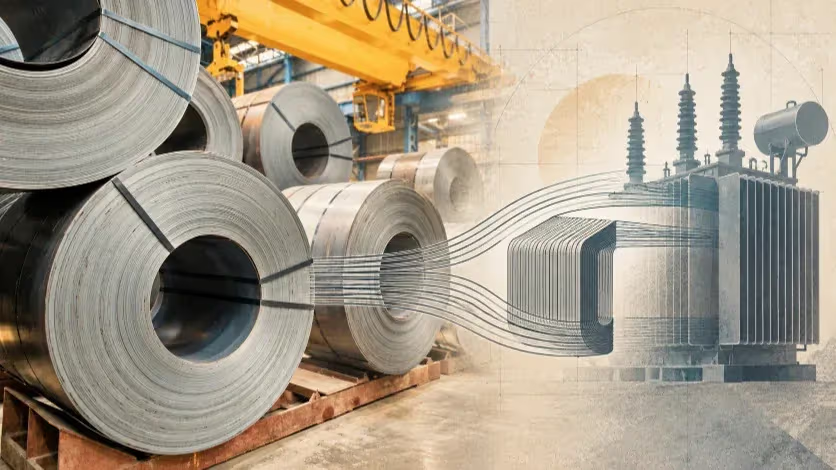
Europe’s Electrical-Steel Safeguard Now Reaches Inside the Transformer
A new EU safeguard follows electrical steel into certain finished transformer...
 NewsSep 14, 2026
Foreign Tourist Spending Is Reshaping Busan’s Nampo District
Foreign spending is making long-empty commercial space valuable again in Namp...
More from the author
More from this byline
Stay with the same line of reporting through more work from this byline.
 NewsOct 9, 2026
Why “Busan Is Good” Falls Short as a City Brand
 NewsSep 18, 2026
The Other AI Race Is for the Freedom to Change Course
Reader Signal
Community readWhat did this report leave you with?
Choose the signal that best reflects your reading. Select it again to remove it.
One response per article
No response selected
A moderated conversation about the reporting.
One-level replies and newsroom moderation keep the conversation anchored to this article.
Discussion Status
Open
Please sign in to join the discussion.
Newsletter
Weekly reporting and context from Busan and Korea.