Why “Busan Is Good” Falls Short as a City Brand
“Busan Is Good” now reaches public transport, city institutions and local businesses. As Busan considers a change, the larger issue is whether its civic identity can outlast a mayor’s term.

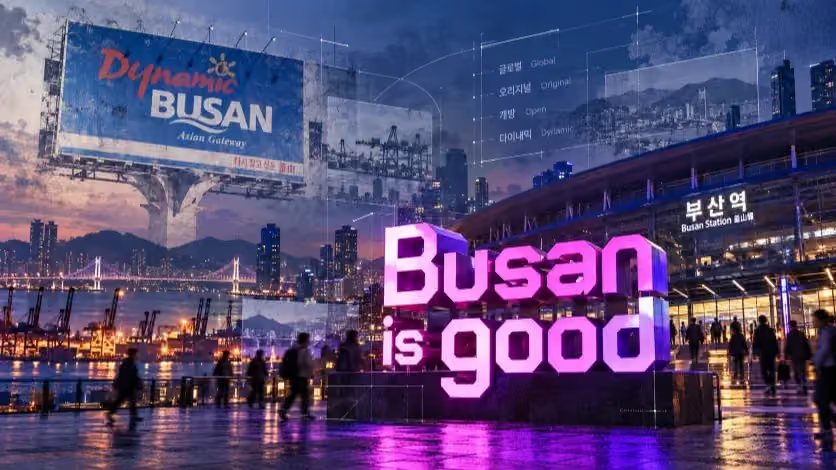
From “Dynamic Busan” to a statement of approval, the city extended its brand through public institutions and transport. A possible change now tests what that identity says about Busan—and the cost of maintaining or replacing its visible forms.
Busan once called itself Dynamic Busan. Since 2023, its official slogan has been Busan is Good. Both are English phrases, and neither could contain the experience of an entire metropolis. But they do different rhetorical work. The former described a quality the city aspired to embody: movement, energy and openness to change. The latter offers a verdict, one that can be attached to almost anything without explaining what makes Busan distinctive. A port city with an industrial hinterland, an aging urban core, new western neighborhoods and sharply varied everyday geographies was given a statement of approval broad enough to function as a tourism message, a civic reassurance or a municipal signature. That flexibility was the slogan's selling point. It is also the limitation that a citywide identity must answer for. Unlike a governing agenda, a civic identity must be able to make sense beyond the term of the mayor who commissioned it.
The earlier slogan, adopted in November 2003, was itself a generalized aspiration, not a full account of Busan's identity; nostalgia cannot turn Dynamic Busan into a perfect civic narrative. Yet the 2023 replacement moved from even an aspirational characteristic to the adjective good. In Korean, 부산이라 좋다 evokes the satisfaction of belonging; rendered literally in English, it can read as a generic endorsement. Whether foreign audiences actually misunderstand it requires research rather than anecdotes. More important is the municipality's decision to make such a broad statement serve so many roles. The original brand was presented as a citywide expression of pride and as a vehicle for global ambitions, not solely as a tourism slogan. That makes its narrowness a problem of civic description, not proof that its designers cared only about tourists.
The possibility of changing Busan is Good, raised again in early October 2026, now confronts Mayor Chun Jae-soo's administration with the accumulated consequences of an inherited public system. Chun has governed since July 1; the debate is taking place during an active mayoral term, not in the interval between administrations. No replacement of the official civic symbol has been adopted, and the extent of a possible brand review remains unsettled. Yet the earlier slogan is already present in municipal publications, the rules governing public symbols, commercial collaborations and transport design. Revising it would require an account of which uses should continue, what problems a change would actually solve and how that decision relates to the maritime and civic priorities the current administration has begun to set. The challenge is to distinguish a durable account of the city from the governing priorities that inevitably change with an election.
The Public Life of a City Brand
In January 2023, Busan reported that 25,220 people had participated in its preference survey among three shortlisted slogans; Busan is Good received 11,373 votes, just 392 more than Bridge for All, Busan. The city connected the winning phrase to civic pride and satisfaction and supplied Global, Original, Open and Dynamic as the meanings behind the letters of GOOD. That last word is telling: the characteristic named in the previous slogan was not abandoned so much as relocated inside an acronym invisible to anyone who sees only the English sentence. The redesign thus provided many possible interpretations but few distinctions visible in the phrase itself. The public vote was real, yet a voluntary choice among three shortlisted options did not establish representative, enduring agreement on what the city should stand for.
The new identity was commissioned as a public design system, not a free-standing copywriting exercise. Busan's policy-disclosure record identifies a municipal-symbol renewal project running from November 2022 through October 2023 with a budget of KRW 800 million. It covered candidate designs, an action plan, trademark matters, guidelines and promotion strategy. This is a specified project budget, not a complete accounting of the city's subsequent branding activities, and it cannot be described as the final sum spent on the identity. Once a municipal government commissions a symbol intended for repeated use, the financial question also extends to its adoption, maintenance and future replacement.
The legislative record raises a wider accounting question. During a November 2024 Busan City Council hearing on proposed design expenditure, Councilor Lee Bok-jo said that production of Busan is Good had cost KRW 1.5 billion. Kim Yu-jin, then head of the Future Design Headquarters, agreed in the exchange concerning the renewal. That acknowledgement deserves public examination, but it does not show that KRW 1.5 billion was spent on top of the KRW 800 million assignment. The scope and overlap of the amounts have not been reconciled in the published records examined here. The stronger criticism is not an invented grand total; it is the absence, in the materials considered for this article, of an itemized public account connecting the original design contract with the wider implementation and promotion that followed.
Two amounts. No verified combined total.
Once chosen, the identity acquired a standing that went beyond the campaign that introduced it. On May 17, 2023, Busan promulgated an amendment to its ordinance governing municipal symbols, changing the city's symbol mark and brand slogan and updating the title of its official municipal publication to match. The government did more than standardize advertising. It incorporated a selected expression into a regulated public identity used in municipal communication. That institutional step matters as the current Chun administration considers how to handle the inherited symbol. The ordinance process was itself disputed. In April 2023, civic and design organizations objected to the proposed changes to Busan's municipal emblem and flag, questioning the lack of a public hearing and the shortened notice period. The city replied that cumulative preference surveys across the branding and design process had involved approximately 100,000 participants, that legal advice treated those surveys as consultation under the ordinance, and that an abbreviated notice was permissible for the flag-related amendment. These were competing positions over the consultation and ordinance process, not a finding that the January slogan preference vote had been invalidated or that the eventual amendment was unlawful. The dispute illustrates how consultation over a public symbol can remain contested even after a preference vote, particularly when notice, official adoption and treatment of existing materials become part of the decision. The 2023 amendment also permitted items and forms made under the previous symbol to remain in use until replacement, making phased transition a documented precedent rather than a speculative cost-saving promise. Any new change must account for that legal and administrative history.
The shift from a phrase into everyday institutions is visible in both small goods and vehicles with longer service lives. In November 2024, the Busan Design Promotion Agency opened Big Shop on Gwangbok-ro as a retail and exhibition outlet for city-brand products and local partnerships. In a 2025 anniversary release, it reported 53 partners, 261 products from 63 companies and around 67,000 cumulative visitors through October. The initiative gave companies and visitors a recognizable point of contact with the design. Those figures describe participation and foot traffic, not verified additional business income or deepened civic attachment. A logo's ability to travel through retail channels is one form of reach, but it is not proof that its message says enough about the city.
The planned reach into everyday infrastructure was more lasting still. In December 2024, the city unveiled BIG BUS, a new design for municipal buses that explicitly drew its name from Busan is Good. The redesign was not restricted to paint: it addressed exterior route numbers, onboard maps, notices and advertising surfaces. At the time Busan reported a fleet of 2,517 buses and announced that the new visual system would be applied gradually as roughly 200 to 300 vehicles were replaced each year, with a 2033 target for fleetwide adoption. That was a phased plan, not evidence that all vehicles now display the design. It illustrates something more important than sheer saturation: an identity chosen for the flexibility of its wording had entered a routine capital-replacement cycle. A later slogan change would encounter not just existing posters and merchandise but schedules for publicly used assets whose useful lives extend well beyond one mayoral term.
Busan did not stop measuring public reaction when the slogan was selected. In a city-commissioned telephone survey conducted on December 23–24, 2024, among 1,000 adult residents, 45.1 percent reported awareness of Busan is Goodand 58.6 percent were recorded as satisfied with the slogan. The poll reported a sampling margin of ±3.1 percentage points at a 95 percent confidence level. The figures complicate both the contention that residents never accepted the identity and any claim that its reception was entirely unmeasured. They do not establish whether the English phrase communicates its intended meaning to visitors overseas, whether recognition led to additional travel or commerce, or whether branding improved municipal services. Any new review has an existing empirical starting point: the wording, sample and findings of those surveys, alongside later evidence gathered on comparable terms.
The controversy is therefore larger than a question of whether a catchphrase is memorable. Busan is Good was deliberately designed to be extended—to living, tourism, business, an exposition bid and countless other municipal initiatives. That versatility allowed the same words to accompany achievements with very different purposes, but it also diluted their descriptive content. A citywide brand can legitimately create recognizable consistency; residents may value that continuity even without sharing an identical view of city policy. Yet when the words travel from visitor promotion to official publications, transport and civic partnerships, clarity about what belongs to the identity—and what is a claim about governmental performance—becomes a public responsibility. The more comprehensive the visual system, the more important it is that the city account for the choices embedded in it.
The Metropolis Behind Its Image
Busan has ample grounds to describe itself as an internationally connected port city. In 2025, Busan Port handled 24.882 million twenty-foot-equivalent units of container cargo, an increase of 2 percent from the preceding year and another annual record. The port's significance is not confined to the volume of South Korean exports and imports passing through its terminals. It is also a major point of connection within the international shipping system, handling cargo transferred between services whose origins and destinations may lie outside Korea. This is an economic function of genuine international importance, maintained through infrastructure investment, operational capacity and the work of maritime and logistics industries. Its international economic role is a working reality, independently of how the city promotes itself.
The composition of that traffic reveals the character of Busan's international role more clearly than the record total. Approximately 14.097 million TEU, about 57 percent of its 2025 volume, consisted of transshipment cargo. Transshipment rose 4.4 percent over the year even as import-export container traffic fell approximately 1.1 percent. Busan therefore functions in substantial part as a transfer point within routes linking economies beyond the city's own production and consumption. That role creates demand for terminal operations and a larger ecosystem of trucking, warehousing, ship services, forwarding and technology, while contracts, capital and routing decisions may belong to organizations elsewhere. The important unresolved question is how these different functions translate into local wages, business opportunities, professional expertise and durable decision-making capacity. Throughput identifies a network's scale; it does not trace where the resulting value is captured.
Busan's economic geography is not identical to the terminal map. The New Port handled about 18.638 million TEU in 2025, compared with 6.244 million at North Port, reflecting distinct operational and urban settings within a single maritime system. Beyond their waterfront, manufacturing, business services, tourism, education and commerce support a much wider metropolitan economy. The question is how such activity becomes durable local capability. The Korea Exchange has its headquarters in Busan, and the Busan International Finance Center houses significant public and financial institutions; the city cannot reasonably be portrayed as devoid of decision-making functions. Neither should the location of a prominent institution be treated as a complete account of corporate authority, professional employment or the regional supply of high-value services. These are observable dimensions of an economy, but they require measures other than cargo volume.
The same cargo, counted two ways
Evaluating the port's contribution to metropolitan opportunity requires tracing more than container volume: maritime-related occupations and wages, the growth and survival of local suppliers, where commercial and technical decisions are made, how research capabilities reach operating companies, and whether firms in higher-value services establish substantial functions in Busan. None of these measures can be inferred from an annual terminal record. Nor does their absence from a port announcement prove the absence of benefit. They identify the evidence necessary to determine whether a globally connected asset also strengthens the range of careers and institutions available inside the metropolis.
Population statistics reveal another urban geography, although they explain less than is sometimes claimed on their own. Busan's registered population stood at 3,241,600 at the end of 2025, 24,998 fewer than a year earlier. The citywide total cannot, by itself, establish how the change was distributed across Busan's sixteen districts and counties; that requires comparable local registration tables rather than an inference from the metropolitan aggregate. Total population is affected by births, deaths and migration; a shrinking total cannot all be assigned to departing young workers. The 2024 Busan Social Survey, however, asked young residents aged 15 to 39 whether they planned to move. Among those planning to leave, employment or work was the most frequently reported reason. That is evidence of stated intention among a defined subgroup, not a count of people who actually moved or proof that any particular mayor's program caused the pressure. It nonetheless makes local career opportunity a legitimate part of the city's identity as a place to build a life.
The emerging neighborhoods of Gangseo show how future economic geography meets the timetable of everyday public services. In Eco Delta City, three schools opened in March 2025; later that year the city introduced two bus routes using six low-floor electric buses, describing them as a response to residents' transport difficulties. Those are observable acts of service delivery, not mere development graphics. They also mark the different calendars on which new homes, school capacity, routes and employment destinations become available. A projected reduction in waiting time does not by itself measure how an individual resident's journey changed. An evaluation would need occupancy schedules, school catchments, service frequencies, observed trips and utilization across time. Responsibility is dispersed among developers, transport operators and education authorities, though the resident experiences their combined timing as one city.
Older residential areas present a different coordination problem. Streets and facilities built over decades are harder to reorganize than services added to a new town, and a short distance on a map may cross a steep slope or a difficult road junction. Such conditions make local access relevant, particularly for residents with limited mobility, but they do not eliminate the need for travel across the metropolis. Specialized hospitals, universities, industrial employment and major cultural institutions cannot be replicated within walking distance of every home. Busan consequently needs two scales of connectivity: reasonably usable access to everyday essentials and reliable links to opportunities concentrated across a much larger urban region. A city identity rooted in residents' lives should recognize both rather than promote proximity as a complete substitute for metropolitan reach.
Metropolitan governance is partly the capacity to coordinate systems that City Hall does not fully control. The city's 2040 basic urban plan, finalized in March 2023, explicitly proposed a polycentric structure of ten specialized urban cores, six intermediate living zones and a strategy to connect station areas around 130 urban-rail stations with those centers. The plan recognized that Busan's economic functions and daily services could not all be organized within a single neighborhood or a single downtown. It is evidence of a spatial strategy, not evidence that the proposed links were completed or that travel became easier. Global shipping demand, national infrastructure, corporate decisions and education administration follow separate authorities and schedules. That limits what a mayor can promise; it does not remove the public responsibility to show how port capacity, industrial policy, transport and local services fit together. International networks already operating, connections still proposed and residential benefits not yet measured occupy different stages of the city's development. Mayor Chun's maritime-capital agenda can be examined against those stages: which initiatives have begun, which institutions are responsible and which changes in employment, connectivity and services residents can actually observe.
The Uneven Geography of Fifteen Minutes
The promise of a 15-minute city has an intuitive appeal in a place where the geography of daily life is difficult to compress into a single image. In Busan, proximity is shaped by far more than the distance between two points on a map. Hillside streets, industrial corridors, waterways, arterial roads and the uneven concentration of services complicate what it means for a resident to be 'close' to a school, clinic, library or place to meet neighbors. The local test lies in actual routes, service provision and which residents can use them. That is particularly important in a city where a short map distance need not mean a short or accessible journey.
Busan did give the idea an administrative form, and it attempted to adapt the concept to its terrain. In a March 2022 policy briefing, then-mayor Park Heong-joon acknowledged the limits of walking and cycling in hillside residential areas and proposed distinguishing compact pedestrian living areas from broader public-transport living areas, with different kinds of service hubs. That proposal is a substantial answer to the charge that Busan merely imported a foreign concept without modification; whether the dual structure translated into reliable access is a separate empirical question. Under its long-range planning framework, the city identified 62 local living areas as the basic units of its 15-minute-city program. It also described a pedestrian-access reference of 750 meters, derived from a walking speed of three kilometers per hour over 15 minutes. Those specifications matter because they turn an attractive policy label into something that can, at least in principle, be tested. The framework also differentiates among residential, commercial, industrial-mixed and natural-area living zones. Myeongji is not classified in the same way as Garak–Noksan, and the residential area of Jwa–Jung is not the same planning type as Bansong–Seokdae. The city's own categories recognize differences that a metropolitan slogan tends to smooth over. Yet those categories describe planning conditions; they do not, by themselves, reveal how individual residents experience the services within them.
The policy has produced more than plans and publicity. The city's Happy Challenge initiative identified three principal and four pilot living areas for projects scheduled across 2023–2027, with a multiyear program budget specified at KRW 99.1 billion. In the first round, the Dangam–Gaegum area of Busanjin District moved into operation after completion of improvements that included linear and neighborhood park spaces. By March 2025, the city was describing programs there ranging from mobile health-and-welfare consultations to walking groups and library-related activities. The second round included the industrially classified Sinpyeong–Jangnim area of Saha District and Gwaebeop–Gamjeon in Sasang District, with works initiated in 2025. These projects document the movement from a citywide concept into selected places, physical works and ongoing programs. Their effects on residents' journeys remain a separate question.
Official polling provides another kind of evidence, but not the missing measure of access. In a telephone survey conducted in December 2025 among 1,000 adult Busan residents, the city reported 66.0 percent awareness of its 15-minute-city policy. Respondents also identified components they regarded as helpful, including park development and mobile health services. Such answers register familiarity with a program and perceptions of particular initiatives. They do not establish that a resident's actual journey to a service became shorter, that a clinic or library could accommodate demand, or that improvements reached groups with the greatest mobility constraints. Awareness is worth measuring, especially for a program promoted across the city. The city's 15-minute-city website also presents pilot indicators for three representative living areas—Dangam–Gaegum, Gwaebeop–Gamjeon and Sinpyeong–Jangnim—including facility use rates, travel-mode shares and visualizations of service coverage. The city explicitly cautions that these experimental indicators may differ from actual data and remain subject to correction. Their publication documents a measurement attempt, but does not establish a validated before-and-after change in access. Neither policy awareness nor provisional pilot indicators should be confused with a completed evaluation of residents' journeys.
The combination of recognizable programs, completed outputs and provisional pilot indicators is still only the beginning of an outcome evaluation. A completed park or neighborhood facility can be meaningful without establishing that the promised fifteen-minute access has improved across the relevant population. That requires knowing who could reach what before construction, who can reach it afterward, how the journey is made and whether the destination is genuinely usable. A new space might be valuable to residents close to it while making little difference to someone separated by a steep road, an unsafe crossing or a limited bus connection. Conversely, a modest change to a route or a facility's hours might be more consequential than a visually prominent construction project. The distribution of benefits matters as much as the record of what was built.
An October 2025 study by Pusan National University researchers, published in the Journal of Korean Society of Transportation, tested a different way of drawing Busan's walking catchments. It used 2022 administrative-dong origin-and-destination records from the Korea Transport Database, in which walking and cycling were initially combined, and applied distance filtering and network community detection before refining the resulting areas with land-use and topographic data. The method initially yielded 45 clusters among 192 administrative neighborhoods; removing a cluster entirely classified as natural green space left 44 analytical catchments. Gangseo and Gijang had been excluded at the preprocessing stage. Busan's official 15-minute-city framework contains 62 planning areas citywide, of which 53 lay in the geography studied by the researchers. The resulting 44 and the corresponding 53 therefore offer spatial boundaries to compare, not interchangeable totals or evidence that the city had miscounted its neighborhoods. The network method models relationships between administrative areas; it does not reconstruct each resident's actual walking route.
The study's facility definitions and denominators are essential to interpreting its findings. The researchers treated senior centers and senior learning facilities as proxies for services to older residents; for children's facilities, they used public, private and small libraries as available substitutes for the city's proposed children's multipurpose cultural spaces. Sports facilities covered venues including pools, playing grounds, gyms and training facilities. Around each mapped facility they drew a 750-meter radius and measured the share of each analytical catchment's area lying within those buffers. On that basis, average spatial coverage was 95.6 percent for senior facilities, 82.0 percent for the library-based children's category and 36.0 percent for sports facilities; eight catchments recorded less than 10 percent coverage for sports. These are shares of modeled area, not percentages of residents using a service, nor measures of daycare provision, school access or journey time along actual streets. Differences by local socioeconomic composition, particularly for senior- and library-related coverage, nevertheless make the distribution of public facilities a serious question.
A service radius is not a resident's journey
53 official areas in the study geography
The more revealing result concerned which areas had less coverage, not only the citywide averages. In the study's comparisons, catchments above the median share of basic-livelihood assistance recipients had lower coverage of both senior facilities and the library-based children's proxy than those below it. Catchments with higher proportions of residents aged 65 or older had lower senior-facility coverage; a similar difference for senior and library-proxy facilities appeared when the authors grouped areas by the share of registered residents with disabilities aged 65 or older. The statistical tests established differences between groups of areas, not the actual journeys or individual service use of poorer, older or disabled residents. These were cross-sectional spatial associations, not evidence that the 15-minute-city projects caused the gaps. They nonetheless raise a concrete distributional question for a policy presented as serving everyday life: facilities may be least spatially available where the need for public provision is greatest.
The limits are material. The study drew on 2022 origin-and-destination travel records, before much of the later Happy Challenge construction and programming, and the source data initially mixed walking with bicycle trips. The researchers filtered the records, but acknowledged the possibility of imperfect separation. Their network method identified pedestrian catchments; their separate 750-meter facility buffers did not reproduce every actual route, gradient, crossing, opening hour, service capacity or user cost. Gangseo and Gijang were excluded from the catchment analysis because their administrative areas and travel characteristics did not fit the preprocessing criteria. The findings are valuable for identifying spatial problems and better evaluation methods, but they cannot serve as a before-and-after verdict on projects completed after the underlying travel data were collected—or as a complete map of all sixteen districts and counties.
A useful post-implementation assessment would begin where those limitations leave off. For each completed project, the city could publish the intended catchment population and service change, document actual opening and use, and compare conditions before and after work on comparable measures. Walking access should be tested on passable routes with gradients and crossings, not only against a circular distance threshold; the review should also account for people who move more slowly, opening times, capacity and affordability. In dispersed or steep areas, better feeder buses or mobile services may achieve the policy's purpose more effectively than concentrating every intervention inside a literal fifteen-minute boundary. This approach would test the program on the city it is meant to serve, without denying completed work or assigning causal effects to unrelated baseline data.
Busan's hillside streets and dispersed settlements make proximity planning more demanding, not dispensable. The city has defined living areas, invested in selected places and opened identifiable facilities. Those accomplishments establish a public program that can be evaluated rather than a purely verbal ambition. Its next measure of credibility will be whether the completed interventions changed which services residents can actually reach, particularly where steep routes, age or mobility needs make the assumed distance inadequate. Such evaluation would not replace the city's wider urban identity. It would give one of its promises a discernible meaning in the neighborhoods where people live.
From Civic Preference to Civic Authority
If the design of a living area determines which facilities are accessible, deciding what to provide there is also a question of authority. A bus connection in an expanding western district, safer pedestrian access in a hillside neighborhood and the use of public space along a visitor-oriented commercial street compete for attention, budgets and jurisdictional cooperation. These are not competing claims to be more authentically Busan. They are different ways residents encounter the same metropolitan government. The 15-minute-city record makes the physical variation visible; the incumbent administration's emphasis on maritime industry and livelihood recovery adds another set of priorities competing for resources and coordination. Neither, on its own, tells us who should set priorities when improvements in one place require money, land or administrative attention that cannot be used elsewhere. A credible account of civic identity must therefore examine not just the language residents prefer but how their distinct interests enter continuing decisions.
The 2023 branding process began with more than a final preference poll. City records describe input from roughly 10,000 people on how Busan should be characterized, a slogan call that received 3,248 suggestions from 2,757 participants, a citizen group and specialist advice before three finalists reached voters. That process matters: it was an attempt at public consultation, not simply an image imposed from behind closed doors. The objections raised later in 2023 over the emblem and city-flag amendment, and the administration's defense of its surveys and procedure, also show that civic organizations and City Hall disagreed over what adequate consultation required. The controversy does not nullify the earlier slogan vote. It demonstrates that the number of people expressing a preference and the opportunity to deliberate over an official symbol's adoption are related but distinct measures of legitimacy. Yet a survey about which of three phrases people prefer has a deliberately narrow mandate. Participation counts do not establish statistical representativeness by neighborhood, age or income, and they cannot be stretched into consent for future choices about land use, care or industrial development. Residents may approve of a slogan and disagree sharply about the priorities attached to it. The vote retains its value as a record of preference without becoming a permanent mandate for later policy decisions.
Official Busan social surveys show why choosing an official expression, feeling attached to a place and judging its material conditions are separate matters. In the 2024 Busan Social Survey, conducted among 31,144 people aged 15 or older in sampled households, 46.8 percent said they felt proud to be citizens of Busan. A different survey the following year reported that roughly 77 percent wanted to continue living in the city, while 25.9 percent said they were satisfied with their income. The two survey waves asked different questions and cannot be read as a single longitudinal test of civic sentiment. A separate city telephone poll at the end of 2024 found 67.8 percent selecting jobs and the economy and 43.9 percent choosing youth policy among up to three areas for future municipal priority. Those responses do not demonstrate opposition to tourism or establish what respondents thought about the slogan; they place the practical concerns of urban life alongside the city's symbolic self-description. Nor do these results measure support for Busan is Good or establish that branding caused any change in residents' views. They do reveal why civic attachment, intention to remain and satisfaction with economic circumstances should not be compressed into one statistic. A city can be valued by residents even when some conditions of living there remain difficult to improve.
The sixteen district and county boundaries are themselves too coarse to capture all of these differences. A district contains neighborhoods that may differ as much from one another as they do from areas elsewhere in Busan. Gangseo combines major logistics and industrial functions with expanding residential districts, while older urban areas may contain commercial streets, transit hubs and steep residential terrain in close proximity. The appropriate policy scale also changes with the service. A safer crossing can be addressed at a street or neighborhood level; specialized medical care, higher education, industrial employment and regional transport require institutions and networks extending beyond the neighborhood. These different scales call for distinct decisions about neighborhood provision and metropolitan coordination, even under a single citywide identity.
That coordination is political because public resources and urban space are limited. Additional tourism promotion may benefit restaurants, cultural businesses, accommodation providers and employees; it can also generate pressure on public space or neighborhood mobility, depending on where and how visitor activity grows. Industrial development can create opportunities while raising questions about housing, transit, environmental exposure and infrastructure responsibilities. Residents do not divide neatly into pro-tourism and anti-tourism groups, or into supporters and opponents of urban growth. A shopkeeper may welcome visitors and resent congestion. A family may depend on manufacturing wages and also want better protection from industrial traffic. A civic identity that claims to speak for everyone should not manufacture unanimity out of these differences. Its public value depends partly on whether conflicting interests can be acknowledged without treating one group as less authentically Busan than another.
Busan does have institutions through which some of those competing needs enter public finance. Its participatory-budget system takes resident proposals through departmental review, committee deliberation and an annual process before budget submission. Busan's published 2026 budget includes 65 participatory-budget projects with KRW 5.581 billion appropriated. In August 2026, the city assembled a separate slate of 113 projects totaling KRW 7.7 billion for the 2027 budget, subject to subsequent budget submission and council review rather than money already appropriated or spent. Neither figure demonstrates representative influence or effective completion. The mechanism's significance lies in what can be traced: which residents proposed a change, which office had authority, why it was accepted or rejected, what was actually funded and what happened after delivery. This cannot replace elected decision-making or solve interagency disputes, but it makes 'civic voice' more than a count of people asked to express a preference.
A preference is not a budget decision
The participation figures also need a denominator. Citywide totals make it possible to report how many residents answered a survey or entered a proposal, but they do not show which residents had practical access to those channels. Shift work, disabilities, care responsibilities, language and digital literacy can alter who has time and opportunity to participate. Those are plausible sources of selection bias, not established defects of Busan's 2023 brand process. Assessing representativeness would require participant characteristics, outreach methods, accessible alternatives and evidence of how disagreement affected the options before a final vote. The relevant design depends on the decision: choosing among slogans is not the same participatory task as deciding where services should be placed or how a scarce budget should be allocated.
Civic identity also encompasses cultural and historical attachments. Symbols can sustain shared memory across generations and places that have very different needs; Busan's port history, cultural institutions, dialects, streets and waterways carry meanings that cannot be measured like a bus route. That is a serious argument for a citywide identity, not a weakness to be dismissed. The difficulty starts when a common image is made to stand for consensus about contested policies. An identity that belongs to citizens should permit them to challenge the government's use of it, including when the policies promoted in its name fall short. The public authority to select a symbol and the public ability to contest what it claims are complementary, not competing, sources of legitimacy.
A Standard That Can Outlast an Administration
Mayor Chun Jae-soo entered office on July 1, 2026, and had reached the first hundred days of his term by October 8. The official city-brand system he inherited was not an empty canvas. Under former Mayor Park Heong-joon, a February 2024 ordinance revision consolidated Busan's branding and municipal-symbol rules. Article 19 of the ordinance in force from April 16, 2025, provides for public consultation, City Brand Committee deliberation and reporting to the city council when an official municipal symbol is added or changed. The committee's published remit includes planning, coordination and evaluation. These provisions establish a framework through which the incumbent mayor can examine a change; they do not, by themselves, prove that previous consultation was sufficient or that the committee has independently tested the costs and benefits of the brand. Nor can the obligations for changing an official symbol automatically be imposed on a separate tourism campaign without knowing the proposed change's legal scope.
An April 2025 amendment further clarified the freedom to use official symbols and adjusted use-fee rules to encourage private adoption. These provisions helped make a city identity available beyond municipal offices, while the government's own visual standards spread across materials encountered in daily life. Such circulation creates a real argument for continuity: recognition may become more useful with repeated exposure, and businesses may incorporate the design into their ordinary operations. It also creates dependence on established symbols and routines. The cost of changing the words and colors is no longer confined to a design agency's fee; the practical question is how many public and private applications have been made, who owns or maintains them and when they would otherwise need renewal. An inventory would reveal both the usable value of the old identity and the avoidable expense of prematurely replacing it.
The present administration has already defined some of its own public language. During the transition, a citizen-input process selected the governing vision —a maritime capital at the center of future transformation. In July, City Hall formed task forces for tourism-linked economic activity and North Port redevelopment, among other priorities; the mayor also announced a package of emergency livelihood measures. At the hundred-day mark, the administration continued to emphasize maritime industry and residents' everyday economic conditions. These are documented decisions about agendas and administrative organization, not proof of long-term employment gains, successful regeneration or improved household income. The governing vision is also not the same legal object as the official Busan is Good municipal symbol. Their coexistence makes the relationship between the city's lasting identity and an elected government's priorities a matter of present administration, not a hypothetical future dispute.
The larger institutional question is why an elected mayor's governing vision should become so closely entangled with the language through which the city identifies itself. An administration needs a public mandate and a coherent account of the priorities it intends to pursue. That mandate does not make the city itself a four-year project. In March 2023, Busan introduced its new city brand alongside the former administration's global-hub vision, presenting the two as parts of a shared metropolitan future. Three years later, Mayor Chun's government has adopted a maritime-capital vision through its own transition process while the status of the existing official brand is again under discussion. City Hall's July 2026 account even described the new governing vision as a 'city vision (slogan)'. That label is not evidence of an official amendment to Busan is Good: the administration's governing vision and the statutory municipal symbol remain distinct. But the ease with which the same vocabulary can describe each reveals an institutional vulnerability. The enduring language of a city can become difficult to distinguish from the program of the administration temporarily responsible for governing it.
There is no contradiction in the current mayor placing maritime industry at the center of an economic strategy. Busan's port, shipping networks and related industries are fundamental parts of its metropolitan economy, and the administration's published vision also includes innovation, balanced development and citizen well-being. A maritime-capital strategy is an orientation for policy, however, not an exhaustive definition of the city. Busan also exists through its manufacturing workforce, universities, cultural institutions, commercial neighborhoods, hillside communities and residents whose daily lives depend on systems extending beyond the waterfront. A governing program can legitimately assign priorities among these interests. A civic identity carries a different responsibility: to remain intelligible to people whose place in the city is not defined by the administration's leading economic project. Replacing generic positivity with a single dominant policy label could change the vocabulary while leaving the underlying problem intact.
Durability does not require preserving an unsatisfactory slogan indefinitely. Dynamic Busan remained in use for roughly two decades across different mayoral terms, despite its own limits as a description of the city. That longevity shows that a municipal identity can survive political changes; it does not prove the brand was successful or that Busan is Good should now be retained simply because public money was invested in it. The distinction is between revision justified by an identifiable public need and revision that merely follows a change in the governing agenda. A city can adjust its communication when a symbol no longer serves its audiences or its people, but the decision should be grounded in evidence that remains available to the next administration. Without that continuity, each new political vision risks producing another publicly financed identity that successors must inherit, reinterpret or discard.
What would actually change?
Mayor Chun's administration has already made the visitor economy an explicit administrative concern through its tourism-economy task force. That is a concrete policy priority, not evidence that Busan is Good is poorly understood abroad. The Korean phrase behind the slogan suggests attachment, while the English may be received as little more than a positive adjective; neither widespread foreign misunderstanding nor the superiority of a replacement has been demonstrated by a comparative audience study cited here. Tourism communication can reasonably be revised for the audiences it addresses. But a citywide identity must also encompass the industrial and maritime networks that support Busan's economy and the residents whose lives do not revolve around tourism. The administration needs to explain whether it is proposing a better visitor campaign, a revised civic symbol or both.
Those purposes call for different evidence. Overseas comprehension can be tested with representative samples of the audiences being addressed, comparisons with plausible alternative expressions and explicit questions about what respondents think the message says. Recognition is not the same as preference, and preference is not the same as a subsequent travel decision. Resident identification would require a different sample, attention to the city's diverse districts and an opportunity to explain disagreement rather than merely rank three choices. A project justified by private-sector benefits would need more than a count of participating products; additional business revenue, repeat participation and costs matter. No single percentage could certify the authenticity of Busan's identity. Each measure should correspond to the objective for which the campaign or civic symbol was adopted, with its limits stated publicly.
The two administrations now have different kinds of records to examine. Former Mayor Park Heong-joon's government held consultation, adopted a new official symbol, revised the legal framework and extended the brand into public and commercial settings. Those actions establish the scale of the undertaking, but not the success of each investment or the adequacy of the resulting description of Busan. Mayor Chun Jae-soo's government has already set a maritime-capital vision, launched policy task forces and begun its first hundred days of livelihood and economic initiatives. These are actions for which the incumbent can be questioned now. Their eventual effects on jobs, household conditions or regional accessibility remain to be measured. The same evidentiary discipline thus applies at different points in the policy cycle: completed decisions and expenditures can be audited, operational programs can be monitored, and announced long-term outcomes should not be reported as achieved.
Cost now connects the rhetoric of renewal to an identifiable set of public decisions. The KRW 800 million project budget and the KRW 1.5 billion figure acknowledged in council questioning are not additive accounts, nor is the latter a certified total of all branding expenditure. What remains necessary is a project-by-project reconciliation of development, promotion, public applications and associated operating costs. For a potential change, City Hall would also need to distinguish investment already made from the incremental cost of transition: signs and publications due for ordinary renewal, vehicles entering service under existing contracts, third-party merchandise and municipal assets that would otherwise remain usable. A complete replacement has a different fiscal profile from selective updating. The old investment should not veto change, but neither should a new political term make the residual value of public assets disappear from the balance sheet.
Busan has at least three analytically distinct options. It could keep the citywide symbol while creating more precise tourism-facing campaigns for different international audiences. It could retain the identity's core and correct weak aspects of its language or application, using existing public materials until normal renewal points where feasible. Or it could pursue a replacement of the wider civic system after a documented review of public purpose, statutory procedure, expected benefits and implementation costs. Each course has merits and disadvantages. Separation can reduce disruption but may complicate coordination; partial revision can preserve recognition while failing to address a deeper conceptual problem; comprehensive replacement can offer a coherent reset but carries greater demands for evidence, consultation and transition planning. Choosing among them is a matter of public judgment, not an equation with a result supplied by the city's political succession.
There is a concrete decision path available before a new phrase is chosen. The city has already published resident-poll measures of brand recognition and satisfaction. Those records should be examined for their wording, sampling and comparability instead of assuming that no evidence exists or that any favorable rating settles the case for continuity. City Hall can publish which parts of the existing identity have been evaluated, the audiences and measures used, the locations and partners using it, and the costs and practical consequences of the alternatives. Where the proposal adds or changes an official municipal symbol, Article 19 supplies an explicit route of public consultation, committee review and a report to the council. A tourism-only campaign may fall outside that particular procedure; its governing arrangements should be established from the concrete proposal rather than assumed in advance. None of these steps guarantees a perfect identity or universal agreement. They would make the change intelligible as a public decision rather than a competition between the tastes of successive administrations.
Busan enters this debate with a phrase already embedded in its public institutions, but without a consolidated public accounting of its development, promotional reach, business use and long-lived applications. That gap matters regardless of which administration first commissioned the work. A different slogan may be warranted, and the existing phrase has recognition and residual value that the current government cannot ignore. Publishing the scale, purpose and renewal cycle of the current system would give future administrations—and residents—a record against which both continuity and change could be evaluated. It would make the life of the city's identity less dependent on the political calendar.
The deeper failure would be to let Busan's civic identity change with the political vocabulary of each administration while leaving the idea of that identity unquestioned. Dynamic Busan tried to characterize the city; Busan is Good turned that character into an adaptable statement of approval. A future emphasis on maritime capital could reflect a genuine economic strength, yet still fall short as a comprehensive civic identity if the metropolis were defined through one administration's leading project. Busan is a transshipment hub and an industrial economy, but also a city of aging neighborhoods, expanding residential districts, cultural histories, unequal access to services and citizens with competing public priorities. None of those lives fits neatly into a visitor itinerary or a mayoral program. Mayors have terms of office; the city has a longer life. A durable civic identity should be open to change without becoming the property of whoever temporarily governs. Mayor Chun Jae-soo's administration faces a question larger than the survival of Busan is Good: whether the next expression of Busan will be accountable to the city that endures, or primarily to another period of governing it.
Continue this reporting
Reporting on the same issue
Related coverage selected from the article's desk, topics and newsroom relationships.
 NewsSep 18, 2026
The Other AI Race Is for the Freedom to Change Course
Korea’s HBM strength gives it unusual leverage inside the AI stack. The harde...
 NewsAug 27, 2026
South Korea Has Outgrown Washington’s Nuclear Rules
The U.S. once constrained South Korea’s nuclear fuel cycle over real prolifer...
 NewsAug 7, 2026
North Port’s New Ministry and the Unfinished Work of Busan’s Old Downtown
Busan has secured a permanent center of national maritime administration at N...
More from the author
More from this byline
Stay with the same line of reporting through more work from this byline.
- NewsSep 18, 2026
The Other AI Race Is for the Freedom to Change Course
 NewsSep 5, 2026
How a Political Appointment Becomes a Judgment of Character
Reader Signal
Community readWhat did this report leave you with?
Choose the signal that best reflects your reading. Select it again to remove it.
One response per article
No response selected
A moderated conversation about the reporting.
One-level replies and newsroom moderation keep the conversation anchored to this article.
Discussion Status
Open
Please sign in to join the discussion.
Newsletter
Weekly reporting and context from Busan and Korea.