What a Small Mackerel Is Worth
Busan’s catch is dominated by small mackerel even as some buyers need larger fish. Korea exports frozen mackerel to West Africa while Norwegian imports grow costlier. What a fish is worth depends on where it is caught, how it is sold—and whether it is left to grow.

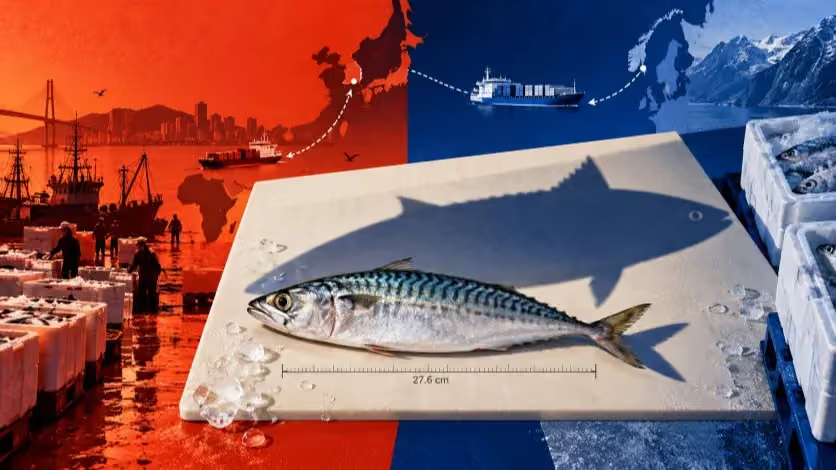
South Korea exports frozen mackerel to West Africa while importing Atlantic mackerel from Norway at rising prices. At Busan’s auction, the smallest commercial grade now dominates the catch—raising questions about what processors can sell today and what fishermen can catch tomorrow.
In August 2025, the Korean government had two quite different things to say about mackerel. By the middle of the month, landings were nearly 50 percent higher than a year earlier. Yet the supply of medium and large fish—the sizes used for some familiar fresh and salted products—had fallen by more than two-thirds. The Ministry of Oceans and Fisheries counted 83,774 metric tons of mackerel landed through August 14, against 55,997 tons in the comparable period of 2024. Medium and large fish accounted for just 2,806 tons, down from 8,895. In a fishery that appeared abundant by its most prominent measure, a particular kind of fish was becoming scarce.
Retail prices recorded the difference imperfectly but tellingly. On August 19 the ministry reported frozen mackerel selling for an average of 3,981 won per fish, 3.9 percent below the previous year, while fresh and salted products had become more expensive. It pointed to released government stocks, tariff-quota supplies and discounts as possible reasons the frozen price had stayed down. The government's account was not a test of how much each measure reduced prices. It did establish that the number of tons caught and the price paid for a particular fish could move in opposite directions.
A landing weighs fish before they have been divided among the uses that give them commercial value. At an auction the same species is graded by size and condition; further along the chain it becomes a frozen whole fish, a salted portion or a fillet whose saleable weight is smaller than that of the raw material purchased. An increase in landings therefore enters several markets at once. The important question is not simply how much mackerel Korea catches, but which fish have entered a market that needs particular sizes, forms and prices.
South Korea · cumulative landings
More fish. Fewer of the sizes in demand.
National production through August 14, compared with the same point a year earlier. Each bar shows total landed weight; its dark segment represents medium and large mackerel.
Medium and large: 8,895 tons · 15.9% of the total
Medium and large: 2,806 tons · 3.3% of the total
All mackerel +49.6%
Medium and large −68.5%
At the Busan Cooperative Fish Market, that difference takes the form of four commercial grades. A September 2026 study by National Institute of Fisheries Science researchers examined the market’s grade-by-grade auction records alongside biological samples and the fishing blocks from which catches had arrived. The separation in value was pronounced. In 2024, the largest grade averaged 9,752 won per kilogram, against 1,355 won for Grade 4, the smallest. Individual fish sampled within the two grades averaged 694 and 251 grams respectively. The sevenfold difference in price reflected the grades' very different commercial uses, without establishing how much processors ultimately earned from either one.
Small mackerel were already the foundation of this fishery long before the disruption of Norwegian supplies became a concern for Korean importers. Throughout the twelve biological years examined, Grades 3 and 4 together represented at least 92 percent of the weight auctioned at Busan. The change occurred within that longstanding concentration: Grade 4 alone rose from 77 percent of landed weight in 2014 to 97 percent in the biological year running from March 2025 through February 2026. Its share of auction revenue rose from 47 to 89 percent. The share rose as far more of the catch flowed through its trading channel, not because buyers began paying a premium for the smallest grade. Although Grade 4 prices rose in absolute terms, its price relative to Grade 1 had scarcely changed across the period.
Commercial grades conceal important differences within the boxes. The sampled Grade 4 fish averaged 27.6 centimeters in fork length, measured to the fork of the tail; 83 percent were shorter than 30 centimeters and one-quarter weighed less than 200 grams. The research associates this part of the catch with export, canning and, at the lightest weights, feed markets. That classification is a guide to established commercial outlets rather than a shipment-by-shipment account; small mackerel can also be eaten in Korea. Still, they show why a growing share of the lowest grade changes more than the auction’s average size. It alters the raw material available to businesses serving different markets.
The remarkable change in the mix did not come with a comparably clear decline in the average size of fish landed. Mean fork length moved from 28.7 centimeters in 2014 to 27.9 in the final biological year, but fluctuations were substantial and the long-term trend was not statistically significant. The smallest annual mean occurred in 2022. A shift in auction grades measures what the fleet brings ashore under the prevailing sorting rules; it does not, on its own, reveal whether individual fish in the sea have begun growing more slowly. Nor does the national mid-August production snapshot describe precisely the same fish and period as the twelve years of Busan auction records. Their different scopes matter because the industry's short-term shortages and its long-term catch composition are related questions, not interchangeable measurements.
Busan Cooperative Fish Market
One grade. Two measures of dominance.
Grade 4, the smallest commercial grade, gained a greater share of both auctioned weight and revenue.
2014*
Share of landed weight
77%
Share of auction revenue
47%
2025*
Share of landed weight
97%
Share of auction revenue
89%
The price per kilogram of the smallest grade remained far below that of the largest. Its growing revenue share reflects the volume sold through Grade 4, not a premium for smaller fish.
A separate price study published in August 2026 gave the distinction an economic test. Researchers at the Korea Maritime Institute used monthly observations from 2019 through 2025 and estimated the supply of fish weighing at least 300 grams by applying Busan's size mix to national production. In their statistical model, a 10 percent decline in that estimated medium-and-large supply was associated with an increase of roughly 0.2 percent in mackerel consumer prices over the following three months; total production contributed no additional statistically detectable relationship when entered alongside it. The effect was modest, the national size breakdown depended on Busan being representative, and the model did not establish causality. Its value lies in showing why the composition of a catch can carry information lost in the total.
Busan's smallest commercial grade also acquired a deeper market. The 2026 fisheries study documented a sharp increase in exports of frozen chub mackerel after 2022, as overseas food buyers sought supplies that Korean wholesalers could sell in volume. Grade 4's contribution to auction revenue expanded over the same broad period, but the relationship weakened sharply once the shared upward trend was removed. The records support a change in the economic usefulness of smaller fish; they do not show that export demand caused vessels to choose a particular fishing ground. Whether the new market helped redirect the fleet is a question to which the fishing-block evidence will later provide a partial answer.
A kilogram of Grade 4 fish sold at Busan could therefore be a viable commodity even while manufacturers serving other consumers struggled to obtain the larger sizes they needed. The auction separates the fish by commercial grade. It cannot tell how much useful product a processor obtains from each kilogram, how consistently that product can be made or what a household will pay for it. The difference is determined in the passage from the catch to the finished food.
After the Auction
For a processor, size is a specification rather than a mere description. A 251-gram fish can move efficiently through a whole-frozen trade, while a larger specimen offers the flesh and dimensions needed for substantial, uniform fillets. Cutting and packaging the larger fish require work, but they also allow a retailer to sell several convenient servings from one animal. What a fish is worth at the Busan auction depends partly on those possibilities; what it is worth after processing depends on how much usable product survives the work and what buyers want to do with it.
The weight on an auction ticket is only one of the characteristics a processor purchases. Korean chub mackerel taken at different points in the year do not contain the same proportions of fat and water. In a study by scientists at the National Institute of Fisheries Science, crude lipid content in coastal samples ranged from an average of 4.99 grams per 100 grams in March to 19.27 grams in December. The researchers also examined body size and reproductive condition, finding seasonal changes tied to the fish’s life cycle. The season of capture can therefore matter to a buyer planning a salted or grilled product alongside the commercial grade: fat contributes richness and affects the flesh during cooking, even though these laboratory measurements do not themselves tell us which prepared fish a consumer would prefer.
Atlantic mackerel from the northeastern Atlantic is another species, with its own cycle of feeding, spawning and fat accumulation. Studies summarized in the FAO’s technical guidance find wide seasonal variation within Atlantic mackerel as well. What a Korean buyer encounters as a rich Norwegian fish consequently reflects the season and the particular product reaching the market, as well as the species. Fat content helps explain texture, but a national label alone cannot establish how a fish will taste after storage, salting or grilling.
Quality can be lost long before processing begins. Oily fish are particularly sensitive to time and temperature after capture, when inadequate chilling allows deterioration. FAO technical guidance emphasizes the need for prompt cooling, and notes that mackerel is commonly handled whole rather than gutted aboard fishing vessels. Without the temperature history of actual consignments, the claim that one country's fish is invariably preserved better than another's remains unproved. A processor instead purchases a combination of size, season, condition and consistency that determines the work required to meet a promised standard.
Processing changes the economics of a kilogram. Whole frozen fish retain most of their original mass as the saleable product; a boneless fillet sheds heads, bones, skin and trimmings, with additional labor and possible losses. Historical FAO yield tables show how widely the edible share can vary, but their mixed species, samples and processing methods are inadequate for comparing the current costs of Korean and Norwegian factories. The important calculation is nevertheless clear: the lowest auction price per kilogram need not produce the cheapest fillet per kilogram. Consistency in the dimensions and condition of incoming fish matters as much as the nominal cost of the raw material.
The capacity to deliver a defined product repeatedly helps explain the imported fish’s place in Korea. A 2025 comparison of the two mackerel value chains, based on interviews with 32 industry participants and a survey of 400 consumers in Seoul, described Norwegian suppliers arranging grading, quality management, processing in China and Southeast Asia, and marketing around the demands of destination markets. Its account of the Korean chain pointed to uneven raw-fish quality, labor costs, an aging processing workforce and gaps in reaching consumers directly. The comparison was drawn from the businesses and respondents studied rather than from direct tests of every shipment. What it captured was an industrial advantage: the ability to keep delivering a predictable product even when the catch available to processors changes.
Korean customers have not treated nationality as their only guide to quality. A 2017 study using consumer and food-service surveys found that taste and perceived quality could matter more than price in choosing an origin, with supply reliability particularly associated with Norwegian mackerel and trust with domestic fish. Restaurants and households did not necessarily weigh the attributes alike. Regularity of supply has commercial value to an operator planning repeat servings; origin and confidence in the product may matter differently to somebody selecting fish for a meal at home. Neither a preference expressed in 2017 nor a reputation earned in one sales channel establishes a permanent ranking of every product now on sale.
A 2025 conjoint study of processed mackerel found preparation form to be the most important attribute in respondents’ stated choices, ahead of origin. Chilled and frozen fillets were preferred to ready-to-eat products; domestic origin remained attractive, Norwegian fish was favored among imports, and larger fish were preferred. The authors identified distinct groups of buyers, including those attached strongly to domestic origin, those who wanted chilled products for home cooking, and a smaller group drawn to ready-to-eat convenience. The experiment elicited choices among proposed products; it did not follow the same households through the import-price upheaval of 2026.
The apparent contradiction between a desire for large fish and a desire for small, convenient meals dissolves at the cutting table. A substantial fish can supply two or more manageable portions, while a smaller fish may be sold whole or salted for a different meal. Consumers who avoid bones or preparation time may be choosing processing rather than origin alone. A domestic processor need not imitate a large imported fillet to make useful food from smaller Korean landings; it does need a format whose yield, labor, preservation and final price work together. The studies reveal the dimensions of that problem but cannot calculate a factory's margin.
The price of imported raw material is part of that calculation, and in 2025–26 its place changed abruptly. A supplier able to deliver standardized Norwegian mackerel had built an advantage among certain Korean buyers, but sourcing it became more expensive as the North Atlantic fishery tightened. Whether domestic processing could gain from the shock depended as much on the existing export outlets for small Korean fish as on the cost of imports.
The Fish Korea Sells—and the Fish It Buys
In the first four months of 2026, Korea's mackerel trade moved in opposite directions. Customs figures presented by the Korea Maritime Institute put imports of all mackerel at 19,947 metric tons, 42.1 percent below the equivalent period a year earlier; frozen imports from Norway fell still more sharply, by 61.1 percent, to 7,129 tons. Korea meanwhile exported 73,625 tons of mackerel, 93.7 percent more than in January–April 2025. Overseas demand for fish Korea could supply in quantity had not disappeared as imported fish grew difficult to secure. Import scarcity was real, but it affected a different part of the market from the one expanding outward.
The two flows had been built around different customers and different fish long before the shortage. In 2025, South Korea reported 143,573 tons of frozen mackerel exports, worth approximately $196.3 million, under the internationally comparable customs heading used by UN Comtrade. Ghana received 38,154 tons and Nigeria 32,831; Côte d’Ivoire and Benin together bought another 28,723. The four West African markets took close to 70 percent of the frozen exports; China purchased another 15,446 tons. The customs heading covers multiple mackerel species and includes fish held in storage, so the totals cannot be read as a record of Grade 4 boxes going directly from Busan's auction to African destinations.
Across the incoming trade, the same frozen-mackerel customs heading recorded 52,711 tons worth $145.7 million in 2025. Norwegian-origin consignments supplied 40,392 tons of that total. The implied average declared value was about $1.37 per kilogram for all Korean frozen mackerel exports and $2.76 for all imports; the Norwegian-origin portion of imports averaged about $3.03. Import declarations and export declarations are valued at different stages, and the fish within them are not matched for species, size or processing. The figures therefore cannot establish how much more a comparable Norwegian mackerel cost than a Korean one. What they reveal is a trading system able to sell frozen fish in bulk at one aggregate unit value and buy a differently constituted frozen-fish supply at another. It is a difference in commercial baskets, not a price tag attached to an identical fish on two continents.
Korea's import history complicates a simple narrative in which a global shortage immediately meant fewer foreign fish on Korean docks. Its frozen-mackerel imports rose from 38,877 tons in 2024 to 52,711 tons in 2025. Within them, consignments reported as Norwegian increased from 34,762 to 40,392 tons. Norway’s overall mackerel export volume nevertheless fell 34 percent in 2025, according to its seafood export authority, while export earnings edged upward. Korea was securing more Norwegian-origin frozen fish during a year in which Norwegian exporters were shipping less mackerel globally. Contracts signed earlier, inventories and the allocation of scarce exports among countries could produce such a sequence. The customs record cannot separate those possibilities, but it shows why the global catch reduction did not immediately translate into fewer Norwegian fish entering Korea.
The limits on future supply were already becoming much tighter. Norway's authorized national mackerel quota had been 211,827 tons in 2024 and 165,298 tons in 2025. Under the regulation effective in October 2026 it stood at 81,375 tons, less than half the 2025 allowance. The Norwegian Seafood Council, which represents the exporting industry, described intense bidding for raw material as purchasers anticipated further restrictions. It reported 207,927 tons of mackerel exports across its published product coverage for 2025; that figure should not be confused with the narrower frozen-mackerel customs heading. In the trade itself, the value of Norwegian exports held up as fewer tons changed hands. Scarcity was changing the cost of acquiring fish before the full effect appeared in the quantities delivered to Korean consumers.
The acceleration became harder to miss in 2026. The Korea Maritime Institute's analysis of Korean customs figures put the unit value of Norwegian frozen mackerel imports at approximately $3.00 per kilogram in 2025, up from about $2.40 in 2024; the figure for the early months of 2026 reached about $4.90. That is an average declared import value, affected by the composition and timing of shipments, not a retail price or a controlled comparison of identical fish. It nevertheless places the subsequent fall in Norwegian volume in a more intelligible sequence. Importers faced rising costs for the fish that had become important to particular Korean processing and retail products, and fewer shipments were arriving as the year progressed.
Competition extended beyond Korean importers. The FAO reported in May 2026 that Asian buyers were altering where they sourced and processed Atlantic mackerel as prices climbed. Some Norwegian fish were processed in Vietnam or China before reaching consumer markets; tariff differences helped shape particular routes, while importers also considered other small pelagic species. Changing the path of a shipment or the species in a product was another response to scarcity, alongside buying less. No aggregate trade figure reveals which option an individual Korean processor chose.
A Korea Maritime Institute comparison of selected KAMIS retail categories showed the gap between domestic and Norwegian mackerel prices shrinking from 3,134 won per kilogram in January 2025 to 130 won in April 2026. The Norwegian series rose from 8,446 to 10,621 won per kilogram over those sixteen months as the domestic comparator declined; in January 2026 the imported category briefly became the dearer one. Such comparisons are affected by product format and specifications as well as origin. Still, the narrowing gap mattered: a supplier once favored partly for its price could no longer rely on that advantage in the products being tracked.
Not every retail measure recorded a rise. The institute also reported a 13 percent annual decline in the average price of its general frozen-mackerel item in January–April 2026, to 3,678 won per fish. Government stocks, discounts, inventories and differences among salted, frozen and refrigerated goods complicate the transmission of higher import costs to particular store prices. A 2026 study using monthly data through 2025 likewise found an immediate statistical association between import unit values and the overall mackerel consumer-price index, but no significant cumulative pass-through in its tested two-month window. Rising import costs had made procurement difficult; they had not repriced every product in the same way.
The Korean government answered part of the opening with promotional products made from smaller domestic mackerel, including roughly 300-gram fish and a salted version offered in 2026. The promotions demonstrated that a different portion and price could be offered from available raw material. They did not measure whether consumers kept buying it, whether exporters relinquished shipments to domestic manufacturers or whether higher processing costs could be covered without public discounts.
For a Korean business considering that opportunity, the relevant choice is not simply domestic fish or foreign fish. It is whether the price and yield of a reliably supplied domestic product can compete with the imported alternative, taking account of buyers abroad who already want the smaller catch. The prospect of selling more fish at home changes what a vessel's landings might earn, but it does not change which sizes the vessel can find. That is determined in the grounds the fleet actually fishes—and increasingly by an ocean and a stock whose condition cannot be read from the price of a frozen package.
The Waters Behind Busan’s Catch
The fishing blocks that supplied Busan during the winter of 2024–25 were unusually close to home. Between December 2024 and February 2025, the southern East Sea accounted for 83.8 percent of the recorded winter chub mackerel catch of the large purse-seine fleet. In none of the preceding ten winters had its share exceeded 36.7 percent. The catch-weighted distance from Busan had contracted to 117 kilometers, compared with 402 kilometers in the winter of 2022. The shorter voyage brought the fleet into grounds holding a strikingly different mix of commercial grades. The shift helps explain why a market can be well supplied in weight yet receive less of the raw material some processors want.
Grade 4 represented 97 percent of the chub mackerel caught in the southern East Sea that winter, against 75.3 percent in other fishing grounds. Fish already classified as Grade 4 were not smaller in the southern area; the difference lay in how many fish entered that classification in the first place. A box at the same auction could therefore reflect an entirely different part of the stock, depending on where the vessel had set its nets. The connection between geography and grade is observed; the reason the fleet selected those grounds remains open.
Winter fishing grounds · December 2024–February 2025
An exceptional concentration of the catch
Share of the fleet's recorded winter catch from the southern East Sea
83.8%
In each of the preceding 10 winters, this region accounted for no more than 36.7%.
The size mix differed by fishing ground
Southern East Sea
97.0%
Grade 4 by catch weight
Other grounds
75.3%
Grade 4 by catch weight
The southern East Sea has a particular place in the life history of Korean chub mackerel. Spawning occurs mainly around Jeju, Tsushima and western Kyushu, from where the Tsushima Warm Current carries eggs and larvae northeast through the Korea Strait. Young fish develop in the East Sea and move south as the water cools, passing through the southern East Sea on their way toward wintering areas farther south, around the South Sea and Jeju. This makes the southern East Sea a staging area beside nursery waters rather than the fleet's traditional winter fishing ground. Fish from a strong cohort can be present there in substantial numbers at sizes quite different from those available elsewhere; their arrival, however, may reflect spawning and transport that began a year or two earlier.
The waters along that route have also been staying warmer later into autumn. Over the period examined in the September 2026 study, mean sea-surface temperature in the southern East Sea during October–December increased by approximately 0.35 degrees Celsius per decade. The date on which autumn cooling crossed the researchers' reference threshold shifted later by about 3.6 days per decade. A longer warm autumn can extend the time migratory mackerel are available in the area. But the autumn preceding the exceptional winter of 2024–25 was not exceptionally warm or late-cooling against the long-term trend; several earlier years had comparably delayed cooling without producing a similar concentration of fishing. Temperature describes conditions under which an opportunity existed, rather than identifying the decision or biological event that made that particular winter different.
Choosing those grounds also changes a vessel's economics. A nearer trip may reduce time and travel costs, while an established export market can make a heavy catch of lower-priced fish saleable. Researchers found that the export market and Grade 4's share of revenue grew over the same decade, but year-to-year changes did not move together after the common trend was removed. Fishing-block records identify the selected grounds rather than the fish that would have been available elsewhere. Neither the market data nor the ocean observations can tell how much of the winter shift followed new fish availability, a strong young cohort, the cost of the voyage or buyers' demands. A warmer sea made the movement biologically plausible without establishing what caused the vessels to be there.
For processors, the consequence appears in purchasing schedules and inventories. An offshore concentration of small fish can keep cold stores and whole-fish exporters busy while forcing businesses needing larger cuts to source raw material elsewhere. Storage may bridge a temporary interruption but cannot convert one commercial grade into another. A procurement contract written around a particular size thus depends partly on the migration of schools and the economic decisions of the fleet, neither of which is guaranteed by a national catch forecast.
The National Institute of Fisheries Science's outlook for October–December 2026 gives this uncertainty a current expression. Issued on September 29, it anticipated roughly 54,000 metric tons of chub mackerel from the large purse-seine fleet, compared with 61,490 tons reported for the corresponding quarter of 2025, and expected fishing grounds to form around Jeju. It combined past catches, observed and forecast ocean conditions, and operating constraints in a prediction. Its autumn estimate cannot establish whether the exceptional winter concentration of 2024–25 was repeated or reversed. The forecast can inform purchasing plans, but neither its volume estimate nor the expected location establishes what sizes processors will actually receive once the quarter has ended.
A second uncertainty lies beneath the question of where a fleet will fish: how many fish remain available to support catches in later years. A productive season measures landings, which depend on stock abundance, the distribution of fish, fishing effort and the fleet's capacity to locate and capture them. The same landings can be sustained for a time by more effective fishing even as the underlying biomass falls. An assessment published in May 2026 attempted to account for that possibility, using a catch-based model and a second model incorporating fishing-activity data adjusted for improving fishing efficiency. For 2024 the two approaches estimated chub mackerel biomass at approximately 63 and 59 percent of the level associated with maximum sustainable yield.
The numerical estimate depends materially on how much fishing efficiency is assumed to improve. In the second model, a sensitivity test with no annual improvement in catchability put the 2024 biomass ratio at 0.79; assuming a 2 percent annual improvement lowered it to 0.59. The authors did not directly establish a yearly efficiency gain of precisely 2 percent for the Korean fleet, and earlier assessments have differed in their treatment of stock boundaries and fishing activity. Each of the tested scenarios nevertheless placed estimated biomass below the model's reference level. The two published studies are answering different questions: auction and fishing-block records explain which sizes of fish were caught in particular places, while stock models use a longer history of catch and effort to estimate the population supporting such catches. Neither record substitutes for the other.
The stock-model results cannot be substituted for Busan's auction series. The auction reveals the grade and location of fish actually landed; the models attempt to estimate the larger population, including fish not encountered by the fleet. A period of abundant small landings can coexist with a depleted stock, just as a temporary decline in landings need not prove a failed year class. The business question about the sizes available for next season leads to a longer one about the fish that will remain. Managing only the weight landed cannot, by itself, describe what is being taken from the population at different stages of growth.
The Value of Fish Left in the Sea
In June 2026, South Korea extended a rule that gives large purse-seine vessels participating in the total allowable catch system an exemption from the normal minimum-size restriction on mackerel. The exemption had operated since March 2023 and will continue through June 2027. The government presents the waiver as part of an experiment in managing the total weight removed rather than maintaining every rule governing the manner of capture; vessels remain subject to their catch limits and program conditions. Officials said they would continue to examine compliance and effects on fishery resources. For an industry whose catch has become concentrated in small commercial grades, the decision brings the measurement of a harvest into sharper focus: the quota records the weight removed, while the biological consequences also depend on the fish within it.
One metric ton of Grade 4 mackerel, calculated at the average individual weight of 251 grams in the Busan study, represents approximately 3,984 fish. The same weight made up of fish averaging 694 grams, as in Grade 1, represents about 1,441. No actual vessel is assumed to land precisely either group; the exercise uses the sampled means to show what a weight-based allowance can contain. Both figures are hypothetical, using the study's average weights, yet they show why equal weight does not mean equal numbers of fish or equal stages of development. A weight limit constrains the quantity harvested without, by itself, describing the life stages removed from the population.
What one metric ton can contain
The same weight does not mean the same number of fish.
Illustrative conversion using average individual weights from biological samples at Busan's auction—not an actual one-ton landing.
At these sample means, a ton of Grade 4 contains about 2.8 times as many individual fish.
The Busan biological samples provide a more useful measure of that distinction than commercial grades alone. Grade 4 fish averaged 27.6 centimeters in fork length. From measurements of females collected during the spawning season, the researchers estimated 29.5 centimeters as the fork length at which half had reached sexual maturity. They then combined grade-specific landing weights with the measured length distributions to reconstruct how many landed fish fell below that reference. The proportion was 66 percent in the first biological year of the series and 78 percent in the last, fluctuating widely between intervening years; its long-term trend was not statistically significant. The most extreme annual share, 85 percent, occurred in 2022 rather than 2025. The fishery's repeated reliance on specimens around this size warrants scrutiny of when they are harvested. It does not demonstrate that every successive year has yielded a younger or biologically smaller population.
The length at which half of the sampled females were mature is a reference point in a gradual biological process. Some fish mature earlier; others remain immature at larger sizes. The proportion caught below that length is consequently not a count of fish that would certainly have reproduced if left at sea, and it is distinct from the statutory minimum-size provision waived for the fleet. Even with those limits, the measurements make the management question more precise. A small fish brought ashore no longer has the chance to grow into another commercial grade or contribute to subsequent spawning, while one left at sea has only a probability—not a guarantee—of doing either.
The market offers an enticing but incomplete way to calculate that lost opportunity. A Grade 1 mackerel fetched far more per kilogram at Busan in 2024 than a Grade 4 specimen. If a smaller fish survived and grew, its later weight and grade might make it more valuable, with a different contribution to reproductive output. Survival is the missing term. Some fish would die naturally, move beyond the grounds where they could be caught profitably or be taken by another fleet; the boats and buyers that depend on current landings would also bear the cost of waiting. The difference between today's auction prices is therefore neither a forecast of future revenue nor a measure of the biological benefit of delaying capture.
Norway's supply disruption has increased the commercial usefulness of some domestic raw fish, but market opportunity and fishing pressure need not move in lockstep. With a binding and enforced catch allowance, domestic processors can bid for fish that exporters previously bought without increasing the permitted weight removed. Their bids might nevertheless make smaller grades worth pursuing in particular grounds or at particular times. The outcome depends on how vessels respond and whether the total catch controls work in practice. The same price movement that encourages investment in better food products can also change the incentive to land fish early.
Scientists are trying to make the choice of grounds more informed. In September 2026, the National Institute of Fisheries Science described a smartphone-accessible forecast showing, among other things, the expected proportion of mackerel shorter than 28 centimeters in different areas. It is guidance about where small fish may be concentrated, rather than a legal minimum size or the study's 29.5-centimeter female maturity reference. A forecast can influence fishing decisions only when crews trust and use it. Avoiding one concentration could shift effort toward larger fish, toward another small-fish aggregation or away from fishing altogether. The service's effect on catches and the stock had not yet been measured.
The minimum-size exemption remains a policy experiment rather than a demonstrated improvement or failure in conservation. Officials pointed to TAC participation and monitoring requirements when extending it through June 2027. The 2026 biomass estimates were not an evaluation of the waiver's effects; they describe stock condition in 2024 under different modelling assumptions. Assessing the waiver would require observed compliance, the sizes removed under the arrangement and evidence about later growth and spawning. Neither a regulatory announcement nor a stock estimate by itself can provide that counterfactual.
Busan possesses pieces of the information needed. Auction records link weight, commercial grade and price; fishing-block records locate the landings; biological samples measure the individuals within a grade. Matched with vessel effort, age and survival estimates, those sources could identify whether efforts to avoid certain concentrations actually change the number and life stage of fish caught. Product and export records could establish which catches are redirected toward Korean consumption and at what processing cost. Without those links, a processor's margin on a new product and a fisheries manager's estimate of future yield remain separate calculations.
The distinction matters most where the two calculations meet. More efficient use of a fish already landed can raise food value without increasing the number of tons taken. A choice to catch that fish before it grows changes what may be available to the fleet later, but estimating the change requires accounting for survival, growth and the possibility that fishing effort simply moves elsewhere. Demand, fishing grounds and biological timing all enter the same economy. They are connected by decisions that an auction price alone cannot explain.
At Busan's auction, the market can assign a price to a 251-gram mackerel and to a fish nearly three times its weight. Processors can calculate the portions and products each might yield; overseas buyers and Korean households can choose among them as supply and prices change. A more difficult value belongs to the small fish that has not yet been caught: the chance that it will survive, grow and join the spawning population or a later harvest. The new opportunity to sell Busan's small mackerel more intelligently is real. Whether it lasts depends partly on the value the fishery leaves in the sea.
Continue this reporting
Reporting on the same issue
Related coverage selected from the article's desk, topics and newsroom relationships.
 NewsSep 21, 2026
Europe’s Electrical-Steel Safeguard Now Reaches Inside the Transformer
A new EU safeguard follows electrical steel into certain finished transformer...
 NewsSep 14, 2026
Foreign Tourist Spending Is Reshaping Busan’s Nampo District
Foreign spending is making long-empty commercial space valuable again in Namp...
 NewsSep 11, 2026
Busan-Jinhae’s New Industrial Strategy Meets a Jobs Divide
As BJFEZ prepares to add AI, data and advanced energy to its industrial prior...
More from the author
More from this byline
Stay with the same line of reporting through more work from this byline.
 NewsOct 4, 2026
Zelensky, South Korea and the Limits of Wartime Pressure
Reader Signal
Community readWhat did this report leave you with?
Choose the signal that best reflects your reading. Select it again to remove it.
One response per article
No response selected
A moderated conversation about the reporting.
One-level replies and newsroom moderation keep the conversation anchored to this article.
Discussion Status
Open
Please sign in to join the discussion.
Newsletter
Weekly reporting and context from Busan and Korea.