Why Busan Is Rebuilding Haeundae as Its Population Shrinks
Busan’s Haeundae renewal plan could replace ageing apartments with more than 13,000 additional homes. It also shows how property value can shorten the life of usable housing while weaker districts wait longer for essential improvement.

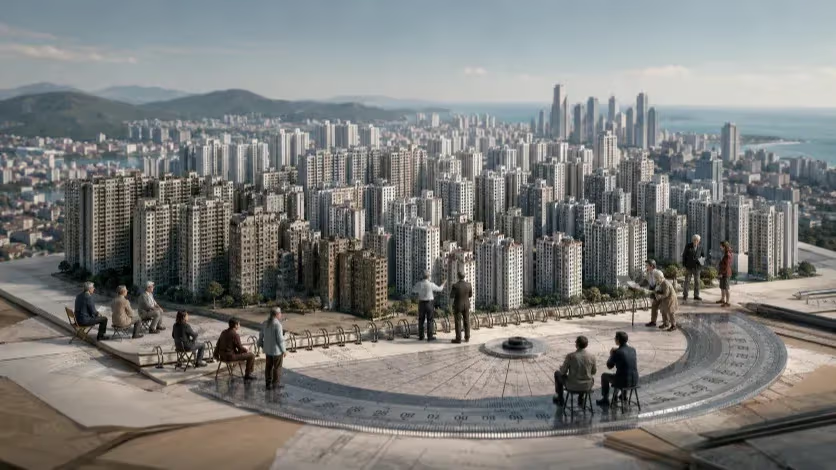
Busan has approved the large-scale reconstruction of Haeundae Green City, a 1990s new town whose ageing apartments can be converted into new floor space and development revenue. The plan may improve tens of thousands of homes, but it also exposes a divide that will shape the city’s future: valuable buildings can be replaced before their structures are exhausted, while inadequate housing survives where renewal cannot pay for itself.
Haeundae Green City still carries the confidence of the period in which it was built. Apartment estates occupy broad, orderly blocks beneath Jangsan, with schools, parks and shopping streets arranged as parts of a single residential plan. The district, completed in the 1990s, offered many families the qualities that older parts of Busan could not easily provide at the time: modern apartments, organised roads, open space and the expectation that public services would expand with the city around them.
Three decades later, the new town has become an old one in the daily experience of its residents. Pipes and waterproofing have deteriorated, lifts require repeated attention, parking has fallen behind the number and size of contemporary vehicles, and buildings designed around younger families now have to serve a rapidly ageing population. Poor insulation, condensation, noise and inaccessible entrances do not necessarily make an apartment structurally unsafe, but they can make continued occupation expensive and uncomfortable. Residents seeking a comprehensive solution are responding to accumulated housing problems, not simply to the possibility of a more valuable address.
Busan has now given that demand a route towards reconstruction on a scale unavailable to most neighbourhoods in the city. In April 2026, the city formally designated the first phase of its Basic Plan for Aging Planned City Renewal after receiving central-government approval. The plan covers Haeundae Green City and Hwamyeong–Geumgok in Buk-gu, making Busan the first municipality outside the capital region to move an ageing planned-city programme into formal implementation. A second phase covering Dadae, Mandeok, Mora and Gaegum–Danggam is intended to follow later in the year.
For Haeundae, the benchmark floor-area ratio rises from about 250 percent to 360 percent. Planning documents envision 42,623 homes within the principal renewal area, 13,371 more than the existing 29,252, and raise the district’s planning population from about 84,000 to 112,000. Hwamyeong–Geumgok receives a benchmark ratio of 350 percent and room for another 22,000 residents. Together, the first two plans envisage roughly 50,000 additional people in apartment districts that were originally built during an era of urban expansion.
The scale is easy to understand through the arithmetic of redevelopment. More permitted floor space produces more apartments; the sale of those apartments helps finance demolition, construction, parking, public facilities and replacement homes for existing owners. The same arithmetic is less capable of explaining whether Busan needs the resulting increase in housing, how much useful life remains in the buildings scheduled to disappear, or what happens to the parts of the city from which future residents may arrive.
These questions are becoming inseparable. Busan is approaching the end of a period in which smaller households could continue to lift housing demand despite persistent population loss. Its public infrastructure was built for a larger and younger city, while climate change is increasing the cost of maintaining buildings, drainage, power systems and coastal protection. A reconstruction programme designed principally around what a strong property market can finance may still deliver excellent homes. It may also allow market value to decide which buildings leave the city early and which remain in service long after residents need substantial improvement.
The Arithmetic of a Second New Town
Haeundae’s additional population is derived from the amount of growth the district’s infrastructure is considered able to absorb. The planning summary compares the current population with spare capacity in water supply, sewerage, parks, schools, reservoirs and energy systems. Parks emerge as the limiting factor after the plan assumes additional green space created through redevelopment, producing an allowable increase of 28,000 people. The figure is therefore a measure of physical capacity: it shows how much larger the district could become if the required homes were built and occupied.
That calculation would have fitted comfortably within the assumptions of the original new-town era. Busan was still adapting to decades of industrialisation and urban migration, while rising incomes and the formation of new households generated demand for modern apartments. A district with spare school, road or utility capacity could reasonably expect population growth to use it. Haeundae New Town itself was created to absorb a city that appeared likely to continue expanding.
The demographic setting has since reversed. Statistics Korea projects that Busan’s ordinary households will rise from 1.442 million in 2022 to around 1.473 million in 2032, after reaching their peak in 2031, and then fall to 1.268 million by 2052. The reduction would amount to about 175,000 households from the 2022 level, even as the average number of people in each household declines from 2.20 to 1.79. Long-range projections inevitably change as migration, employment and family behaviour change, but the official series establishes the planning environment in which the replacement buildings are expected to spend most of their lives.
A declining household count does not remove the case for new housing. Existing units will be demolished during reconstruction, and projects may unfold over decades. A large share of Busan’s stock may no longer meet the needs of one- and two-person households, older residents or families seeking better energy performance. New apartments can also help the city retain people who might otherwise move to newer housing in neighbouring municipalities.
The source of that demand, however, determines what the project does to Busan. Households arriving with new jobs from outside the region enlarge the city’s residential and economic base. Households that choose a rebuilt Haeundae instead of leaving Busan slow the city’s decline. Those moving from another district fill the same apartments and support the same redevelopment finance, but their arrival leaves another part of the city with fewer residents, customers and users of public services.
Recent migration data offer little basis for treating future growth as an extension of current trends. Haeundae-gu, the administrative district that includes Green City as well as several other neighbourhoods, recorded a net loss of 2,493 residents in 2025 after losing 2,669 in 2024. Buk-gu, which contains Hwamyeong and Geumgok, lost 3,944 residents in 2025. Only Gangseo-gu and Busanjin-gu gained population among Busan’s 16 districts and counties, while the city as a whole recorded a net outflow of 12,181 people.
The figures cover entire administrative districts rather than the renewal boundaries, and a single year cannot determine demand for a programme extending to 2035 and beyond. They nevertheless reveal the gap between the capacity written into the plan and the population movement occurring around it. Busan has shown that Haeundae could accommodate another 28,000 residents; it has not yet published an equally developed account of how many would arrive from outside the city, how many would be retained, and how many would relocate from elsewhere within Busan.
That distinction should shape the phasing of reconstruction. Early projects could replace housing whose condition makes intervention urgent, while later approvals respond to observed migration, occupancy, vacancies and school enrolment. Without such feedback, an infrastructure-capacity calculation made at the beginning of the programme can gradually become a housing target that subsequent projects are expected to deliver, regardless of how the city’s household base changes.
Why Haeundae Can Renew Itself
The ability to contemplate district-wide reconstruction begins with the form of the original new town. Haeundae’s apartment complexes occupy large, contiguous sites within a planned network of roads, schools and parks. Thousands of owners must still reach difficult agreements, but their property is organised within estates whose boundaries, buildings and common facilities can be incorporated into an integrated plan.
Much of older Busan presents a different problem. Central and hillside neighbourhoods contain smaller plots, mixed residential and commercial uses, steep or narrow roads and buildings completed at different times. Their housing may be older and their access problems more severe, yet improving them requires negotiations across fragmented ownership and public works that cannot easily be funded through the sale of additional apartments.
The special national law reinforces this geography. Its accelerated procedures apply to large planned districts created through a particular development history. The programme did not begin with a citywide survey of the homes facing the greatest structural, energy or accessibility problems. It began with a legal definition that favours a recognisable type of urban fabric, making Haeundae and Hwamyeong–Geumgok eligible for a pathway unavailable to many neighbourhoods with equally urgent needs.
Eligibility alone does not produce a project. Reconstruction becomes workable when additional development rights can be converted into enough revenue to cover construction and financing costs. A higher floor-area ratio allows a complex to replace existing homes and sell additional units, reducing the contribution required from current owners. The mechanism depends on the expected price of the completed apartments: concrete, labour, mechanical equipment and underground parking remain expensive across Busan, while the revenue available to pay for them varies sharply by location.
Haeundae enters that calculation with advantages accumulated over decades. Urban rail, schools, retail, the coast and the wider Centum corridor sustain demand for housing in the east of the city. Public investment in roads, parks, convention facilities and commercial centres has strengthened the location beyond the boundaries of any individual apartment estate. A buyer is paying for the replacement home and for access to an urban system that already concentrates amenities and employment.
Hwamyeong–Geumgok provides a more useful comparison than a simple opposition between wealthy Haeundae and a neglected west. It is included in the same first phase and receives a similarly large density increase, yet its projects will face a different housing market, household profile and relationship to employment. The law grants both districts a formal route to renewal; the eventual pace and scale will depend on sale prices, borrowing conditions, existing density and the amount owners must contribute.
Those burdens will not be distributed evenly inside either district. Some older residents may own apartments that have appreciated considerably while lacking the income or borrowing capacity to finance reconstruction. Tenants face relocation and rising rents without receiving any share of the development gain. A completed district can offer better housing and still become less accessible to some of the people whose living conditions helped justify the intervention.
The approval process adds another advantage to places capable of acting collectively. Resident consent received a dominant weight in the selection criteria discussed during Busan’s planning process, reflecting the practical need to avoid designating projects that will remain paralysed by opposition. That approach rewards large estates with active owner organisations, clear redevelopment expectations and the resources to coordinate technical and legal work. A neighbourhood with greater physical need can remain behind if it cannot organise that need into a project acceptable to lenders, builders and public authorities.
The result does not require deliberate favouritism. The law selects planned-city form, redevelopment finance selects locations with sufficient future sale value, and administrative procedure selects organised ownership. Haeundae passes through all three filters more readily than much of Busan. Its buildings are old enough to qualify and valuable enough to make replacement plausible.
Where that combination is absent, ageing follows another path. Owners may wait for higher density or better market conditions, while major repairs appear difficult to justify if reconstruction remains a future possibility. Essential maintenance continues, but expensive work on pipes, façades, insulation and shared facilities can be postponed. The building remains occupied, its residential quality declines, and the absence of a viable project becomes one more reason to delay the investment that might extend its useful life.
What Has Actually Worn Out
A redevelopment date gives an apartment complex a common age, but it does not give every part of the building a common lifespan. Reinforced-concrete frames, waterproof membranes, pipes, lifts, electrical systems and windows deteriorate at different rates. Parking and apartment layouts can become functionally obsolete even when the main structure remains safe, while a poorly maintained or exposed structure can require serious intervention before a better-managed building completed in the same year.
The distinction is familiar within South Korea’s own long-life housing standards. The Ministry of Land, Infrastructure and Transport defines long-life housing through durability, adaptability and ease of repair: the structural system should remain usable, internal space should respond to changing needs, and services should be replaceable without excessive damage to the building. The definition recognises that a home lasts longer when its shorter-lived parts can change independently of its frame.
Many mass-produced apartments do not perform well against that ideal. Load-bearing walls restrict the rearrangement of rooms, while pipes embedded in floors or walls make renewal disruptive. Parking may be impossible to expand without major excavation, and current expectations for fire safety, accessibility and energy performance can require work reaching far beyond ordinary maintenance. In some complexes, the cumulative cost and disruption of adaptation will make full reconstruction the most credible outcome.
Busan’s published planning materials do not prove the opposite. Their weakness lies in the uneven precision applied to the two futures. The replacement district is described through floor area, apartment numbers, population, infrastructure, green space and construction waste. Publicly available summaries do not present comparable, complex-by-complex accounts of structural condition, major repair history, deep renovation, partial retention and full reconstruction.
Detailed engineering will occur later, and some alternatives may already have been considered outside the public summaries. By that stage, however, the district plan has established the population, density and public facilities associated with comprehensive redevelopment. A complex that retains much of its structure may improve its homes without producing the additional apartments assumed in the wider financing and infrastructure programme, making preservation harder to reconcile with the future already drawn for the district.
The economics reinforce the preference for replacement. New floor space creates apartments that can be sold, giving owners a direct source of project revenue. Retaining a structure produces benefits in another form: avoided construction, lower waste, reduced disruption and continued use of material already standing. Those savings matter to the city and the climate, but they do not enter an owner association’s accounts as readily as the proceeds from additional units.
Reconstruction expectations can also affect the condition later used to justify demolition. Once owners believe that a building will disappear, a major investment designed to last another 20 or 30 years can appear irrational. Necessary repairs may be approved while deeper work is deferred, allowing visible deterioration to accumulate during the planning period. A building does not fail as a single object, yet the financial system encourages its structure, systems and layout to be treated as though they reached one expiry date.
A credible decision would compare several futures against the same standard of housing quality. Continued maintenance, deep renovation, structural retention with extensive remodelling, partial replacement and full reconstruction should each be assessed for safety, accessibility, energy performance, cost, relocation, remaining service life and adaptability. Retention cannot mean asking residents to tolerate substandard homes, and reconstruction cannot be judged solely through the value of what will be built.
Some Haeundae complexes will probably perform poorly under any retention scenario. Their structural condition, site arrangement or parking constraints may justify complete replacement. Others may contain buildings whose frames can support substantial improvement. The purpose of a residual-life assessment is not to impose preservation; it is to ensure that demolition follows the evidence rather than preceding it.
New Homes in a Shrinking City
The demographic issue extends beyond the number of homes. Busan’s 2025 migration loss was driven most heavily by employment, which accounted for a net outflow of 9,063 people. The largest losses occurred among people in their twenties and thirties, and the principal net destinations included Seoul, Gyeonggi Province and neighbouring South Gyeongsang Province. Haeundae-gu and Buk-gu also recorded their largest negative movements under the employment category.
Better housing can help retain residents at the margin. A family considering a move to Gimhae or Yangsan may choose Busan if modern housing is available near schools and transport. A professional returning to the region may prefer Haeundae because its residential environment is familiar and its amenities are established. The effect will remain limited where the decisive job, income or career path lies elsewhere.
The renewal plan seeks to connect Haeundae more closely with Centum City and future industrial, research and transport projects in the eastern corridor. That strategy could allow housing and employment to reinforce one another, but the two do not advance with the same certainty. Apartment numbers can be calculated once density and finance are settled; the arrival of companies, laboratories and durable jobs depends on investment decisions that a land-use plan cannot guarantee.
If employment expands sufficiently, reconstructed housing can accommodate workers who add to Busan’s economy. If the housing arrives first, demand may come primarily from families already living in the city. The apartments can sell successfully in either case, while the citywide consequences differ greatly.
Internal movement redistributes more than registered population. New housing attracts households able to raise deposits, borrow, sell existing property or carry reconstruction contributions. Families with children bring school enrolment and private education spending; working-age residents support retail, health care and other local services. Their former neighbourhood loses the same demand even when the vacated home is later occupied by a smaller or older household.
Busan’s school data already show how uneven demographic change can become. The city can face overcrowded schools in growing new-housing areas while maintaining small schools and declining enrolment elsewhere. A classroom added near a redevelopment district and an underused school retained in a departure district belong to the same urban account, although they appear in different budgets and planning processes. Roads, water systems and bus routes produce a similar problem because their fixed costs do not fall in proportion to the number of residents who leave.
Residential mobility should not be constrained to protect existing institutions. Families have good reasons to seek safer and more suitable homes, and a city that cannot offer them risks losing residents altogether. Busan’s responsibility is to determine whether a successful project has retained or attracted households, or simply moved them across district boundaries, and to plan for both the destination and the place they leave.
That assessment cannot be completed through sales rates alone. A project may sell every apartment and still add no households to Busan, while leaving another district with weaker schools, commerce and infrastructure utilisation. Tracking the origins of residents, the composition of their households and the condition of the homes they vacate would allow later phases of redevelopment to respond to observed change rather than to a fixed assumption of growth.
The Environmental Account
The environmental provisions in Busan’s plans concentrate largely on the buildings and waste streams that will follow demolition. They call for energy-efficient construction, improved infrastructure, separated waste, recycling and the use of recovered aggregate. These measures can reduce the environmental impact of redevelopment and should produce homes that perform substantially better than much of the existing stock.
The starting material burden remains large. Planning summaries estimate about 5.33 million tonnes of construction waste from Haeundae and 4.42 million tonnes from Hwamyeong–Geumgok, figures that may change as projects become more detailed. Waste tonnage cannot be treated as a carbon estimate, but the combined total approaching 9.75 million tonnes indicates the volume of urban fabric the first phase expects to remove.
Recycling preserves only part of that value. Concrete can be crushed and used again, often in a lower-value application, while steel must be transported and processed before returning to production. Retaining a safe frame avoids a portion of the cement, reinforcement and construction energy required for a replacement, though it may also demand extensive strengthening and new material.
A new building gains ground during operation. Better insulation, windows, ventilation and equipment can reduce energy consumption, while modern fire systems and accessible circulation improve safety. Whether those gains compensate for the emissions released during demolition and construction depends on the scale of the improvement, the material retained, the carbon intensity of future energy and the number of years the new building remains in use.
A 2025 life-cycle study of a reinforced-concrete building in Seoul compared continued use, renovation and reconstruction and found lower emissions for renovation under its case-specific assumptions. The study cannot determine the appropriate choice for Haeundae, where structures, sites and redevelopment density differ. It demonstrates the need to measure construction and demolition alongside operating energy rather than using the superior efficiency of a new building as a complete environmental verdict.
A whole-life comparison would reveal the carbon payback period of reconstruction: the point at which lower annual energy use compensates for the emissions produced before residents move in. It would also test whether retaining some buildings, replacing selected blocks or postponing later phases can achieve much of the residential improvement with less immediate material consumption.
Planning systems elsewhere have begun placing that comparison before demolition approval. Westminster’s adopted Retrofit First policy requires substantial-demolition proposals to examine structural condition, alternative uses, whole-life carbon and public benefits through a pre-redevelopment audit. The policy still permits replacement when retention cannot deliver a viable outcome; it requires the developer to demonstrate the trade-off rather than assume it.
Busan need not import London’s rules to adopt the underlying discipline. The city can require project-level comparisons of credible retention and reconstruction options before granting exceptional increases in density. A project that still favours full replacement would then have a stronger environmental and public-interest case.
The buildings that follow must also avoid recreating Haeundae’s current problem at a greater scale. A structure designed for a long physical life offers limited value if pipes, façades and internal layouts cannot change without destructive work. Higher towers and extensive basements increase dependence on lifts, pumps, ventilation, backup power and flood protection, making accessibility and maintenance more important as residents age.
Climate exposure varies across Busan’s planned districts. Haeundae faces coastal wind, salt and the concentration of valuable property near the sea; Hwamyeong–Geumgok occupies a landscape shaped by the Nakdong River and surrounding slopes; Dadae and the inland districts will bring their own drainage, road and emergency-access constraints. A common density incentive can therefore create very different costs for public infrastructure.
Density can support low-carbon urban life where housing is connected to rail, work and daily services. Its advantage weakens when additional population requires expensive road, drainage, energy or protective infrastructure, or when residents continue to travel long distances for employment. The appropriate density should emerge from future climate conditions and the capacity of the surrounding systems as well as from the amount of floor space needed to finance construction.
The City Busan Chooses to Keep
The benefits of Haeundae’s renewal will be concentrated and visible. Existing owners can receive modern homes, new residents gain access to a desirable district, parking and public space can improve, and construction may support a broader transformation of the eastern corridor. Busan has legitimate reasons to protect the competitiveness of one of its strongest residential centres.
The costs will unfold across a wider geography. Transport and utility networks may require reinforcement, schools may expand in one district while shrinking in another, and climate protection will remain a public responsibility long after the redevelopment associations and construction companies have completed their work. Neighbourhoods unable to finance reconstruction will continue to need investment in pipes, lifts, insulation, access and safety even as private capital concentrates in the areas where replacement produces the highest return.
Busan’s housing policy should therefore distinguish between a standard of living and a method of financing it. Every district needs safe, efficient and accessible housing; every district does not need to reach that standard through taller towers and the sale of additional apartments. Strong markets can carry demanding requirements for adaptability, repair access, carbon assessment and public infrastructure contributions. Weak markets require direct renovation finance, targeted grants, selective rebuilding and public works that do not depend on a redevelopment surplus.
The OECD’s recent examination of demographic contraction in South Korea describes a similar shift from growth-oriented housing supply towards place-specific management of existing stock, housing quality and more efficient land use. Its analysis notes that demand for newer housing can remain strong even in shrinking cities such as Busan, creating a mismatch between the location and condition of homes rather than a simple absence of demand.
That mismatch is the centre of Busan’s reconstruction problem. Valuable housing can be demolished while some of its structural life remains because replacement is financeable and attractive. Elsewhere, buildings with more urgent functional problems remain in use because the market cannot generate the money required to transform them. The same city can consume materials through early replacement and waste energy through delayed renovation.
Haeundae’s market strength gives Busan an opportunity to impose a more disciplined standard before that pattern spreads across the other planned districts. The city can require evidence of remaining building life, identify the likely source of future residents, compare whole-life environmental outcomes and account for infrastructure costs beyond the project boundary. Those tests may support full reconstruction in many complexes; they may also lead to partial retention, slower phasing or different densities in others.
The harder work will remain outside the strongest markets. It will be visible in an apartment complex whose frame survives after its systems and envelope are renewed, in a hillside neighbourhood where access improves without a profitable redevelopment scheme, and in an older resident who can remain safely housed near established care and social networks. Such projects will produce fewer saleable homes and less dramatic skylines, but they may preserve more of the city’s function at a lower long-term cost.
Busan cannot retain every building or rebuild every district. A shrinking and ageing city will have to choose where additional housing serves a credible economic and demographic purpose, where existing structures can be adapted, and where homes or infrastructure should gradually be consolidated. The quality of those choices will determine whether contraction creates a more manageable urban form or a divided city in which highly valued districts are repeatedly renewed while the cost of decline accumulates elsewhere.
Haeundae may need to be rebuilt. The greater test is whether Busan can learn which parts of the city are still worth keeping.
Continue this reporting
Reporting on the same issue
Related coverage selected from the article's desk, topics and newsroom relationships.
 NewsOct 22, 2026
Busan Port’s LNG and Methanol Plan: Who Pays to Keep Fuel Ready?
Busan already supplies ships with LNG and methanol, drawing on regional and i...
 NewsOct 16, 2026
What Is Still Worth Going to See?
Busan’s biennale faces questions of artistic judgment and institutional care....
 NewsOct 14, 2026
What Became of Busan’s University Streets?
From 2015 to 2023, registered businesses grew near Pusan National University...
More from the author
More from this byline
Stay with the same line of reporting through more work from this byline.
- NewsOct 22, 2026
Busan Port’s LNG and Methanol Plan: Who Pays to Keep Fuel Ready?
 NewsOct 12, 2026
Bukangi, the Shark That Stayed in Busan’s North Port
Reader Signal
Community readWhat did this report leave you with?
Choose the signal that best reflects your reading. Select it again to remove it.
One response per article
No response selected
A moderated conversation about the reporting.
One-level replies and newsroom moderation keep the conversation anchored to this article.
Discussion Status
Open
Please sign in to join the discussion.
Newsletter
Weekly reporting and context from Busan and Korea.