Busan’s Smart Senior Centers and the Social Geography of Aging
Busan’s smart senior center plan meets an uneven city: older residents’ access to learning, work and community depends on more than devices or distance.

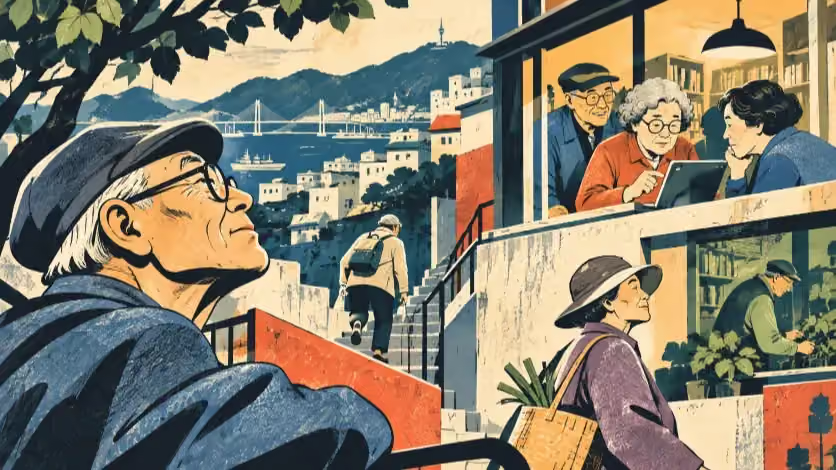
Busan plans to equip 90 neighborhood senior centers with digital systems. The city's experience with mobility, learning, employment and care shows why a nearby service is only part of what makes participation possible.
Busan's plan to equip neighborhood senior centers with video-conferencing systems and digital health devices reached a city council committee in September with a smaller first-year target than officials had originally proposed. The number had fallen from 100 centers to 90 following a survey of demand. Council members asked why some facilities had not applied. Their concern went beyond the eventual location of new equipment. An application records the preference and capacity of an institution; it offers no account of older residents who seldom enter that institution, including those who live nearby.
The distinction matters in a city where 25.9 percent of residents were projected to be at least 65 years old in 2026, against a national average of 21.6 percent. Aging on this scale changes the demands placed on streets, services and neighborhood organizations. It does not produce a single pattern of later life. A familiar district may contain work, friendship and regular activity within a few blocks. Elsewhere, retirement can remove a workplace and the relationships sustained through it; illness or an inaccessible route can turn a routine outing into a considerable undertaking. The radius in which someone moves and the reach of that person's social life need not coincide.
Busan is responding with new equipment, established welfare services, community employment and increasingly sophisticated digital education. These programs enter lives shaped by different histories of work, learning and social participation. Their relevance cannot be understood solely from the number of sites or courses provided. The more revealing differences concern the journey to a facility, the activities that bring a person back, the people available when a task becomes unfamiliar, and the routes into public life for those who have never belonged to a neighborhood group.
A Short Distance, a Difficult Journey
The city has confronted the problem of maintaining neighborhood facilities before. A survey of 95 community spaces developed through hillside-regeneration projects found some still supporting local activities and others affected by aging buildings, difficult access and declining use. They were not uniformly senior centers, and their condition says little about the eventual performance of the proposed digital installations. A building can remain on the public inventory after its place in neighborhood life has weakened.
Research into Busan's streets adds substance to that finding. In 2023, researchers at Pusan National University studied walking conditions in three hillside residential areas with relatively high proportions of older people. Steep gradients, parked vehicles, inadequate separation of pedestrians and traffic, and insufficient places to rest complicated ordinary journeys. These were selected neighborhoods, not a survey of the entire city. A short distance on a map can still demand considerable physical effort.
A separate study published in 2025 used pedestrian trips, land use and topography to identify 44 functional walking catchments across Busan. Its analysis of public-service access found significant disparities for facilities serving older residents and children in lower-income areas and areas with higher proportions of residents with disabilities. The researchers modeled spatial coverage rather than observing individual senior-center users. Nevertheless, the analysis adds a crucial dimension to decisions about where to place public services: municipal boundaries are imperfect substitutes for the routes people actually travel.
A center with a capable instructor and an active membership may be difficult to reach for someone who can no longer manage a steep climb or a complicated connection. Another resident may spend most days close to home by choice, sustained by familiar shops, neighbors and friends. Increasing the distance traveled is not a meaningful objective in itself. Access acquires value through the activities it enables, and those activities may be personal, social, economic or civic.
Existing senior centers offer one obvious advantage as technology arrives: they contain relationships and habits built over time. Those same characteristics shape whom they encounter. Members can express preferences about new classes or equipment; people who have no connection to the room are absent from those discussions. The city's reduced installation target might reflect differing needs, available space, staffing, administrative capacity or simple preference. The September hearing did not determine which explanations mattered at the nonapplicant sites. It revealed why institutional demand should not be mistaken for a map of residents' needs.
The Work That Gives Learning a Place
Many older Koreans have already lived through several technological transformations. Those born in the 1950s encountered expanding educational opportunities alongside substantial differences in schooling, occupation and access to equipment. Office work, industrial production, commerce and household responsibilities offered different reasons to learn new systems. Such histories provide knowledge that can remain valuable even when the interface used to apply it is unfamiliar. Someone experienced in organizing records may understand the substance of a task better than a computer novice, yet still need assistance with a digital account. Another person may be comfortable with smartphones and see no reason to attend an AI course.
Different social activities make different demands on the people who join them, a distinction borne out by research on digital use. A 2024 study of 9,297 older Koreans, using the 2020 National Survey of Older Koreans, found that participation across several types of offline activity was associated with wider digital use. The association differed sharply by activity. Clubs, including alumni or reading groups, were strongly associated with greater use; regular participation in senior community activities showed the opposite association, while learning activities were not significantly associated after adjustment. The data were self-reported and cross-sectional. They cannot establish that one kind of group improves skills or another holds people back. They suggest instead that activities attract people with different circumstances and make different demands on their members.
A small qualitative study published in 2026 examined six people attending digital education programs at senior schools, lifelong-learning centers and welfare facilities in Busan. Its author described some participants moving from seeking help toward assisting others. The interviews cannot establish how common or lasting this change is. They do, however, bring into view an outcome that course-completion figures seldom express. Learning to perform a task and acquiring the confidence to help another person are related achievements with different implications for social life.
The use of a skill after instruction matters particularly when technology changes. Research involving older adults trained on simulated technology-based financial, travel and medication tasks found that many retained gains at follow-up, while a minority needed additional practice for more complex functions. A qualitative study of a smartphone program in a low-income Singapore neighborhood recorded another experience: participants valued volunteer instruction but sometimes lacked reasons or opportunities to apply what they had learned. Neither result invalidates classroom teaching. Structured lessons can be effective; their usefulness depends partly on the tasks to which the learning is subsequently applied, and on assistance when those tasks change.
A familiar procedure may fail after an application alters its menus or introduces new authentication requirements. Further learning then involves recognizing the changed part of a task and finding credible help. It need not require a permanent class, nor can it be guaranteed by repeated practice on an unchanged demonstration screen. People who regularly organize a club, manage a small project or communicate with others may encounter such problems within activities they already value. Those who have no such activity may have fewer occasions to make a new skill part of ordinary life.
Busan has a local example of public facilities organized around work rather than instruction. In September, the city announced the opening of its ninth and tenth Our Neighborhood ESG Centers, in a former nursery school in Choryang and a former administrative building in Yeonsan. The centers combine material recovery with senior employment, children's environmental education and other community activities. The city's description establishes their purpose and opening, not the quality of the jobs or the participants' longer-term experiences. Here, the central activity is work that people have been recruited to perform. Technology, where useful, would serve that activity rather than supply its purpose.
Such employment has its own exclusions, including physical demands and eligibility conditions, and cannot substitute for companionship or care. Its relevance alongside the smart-center proposal is organizational. A program can gather older residents to receive a service, to learn a procedure or to contribute to work shared with others. These functions often overlap, but their different demands matter when a city tries to sustain participation beyond the opening of a new facility.
When Technology Begins With a Conversation
Generative AI changes the way some digital tasks begin. A person can describe a problem in ordinary language instead of finding a sequence of menus or mastering unfamiliar commands. That flexibility may allow accumulated knowledge of work, family or local affairs to become more useful. Yet a conversational answer can introduce a different kind of difficulty: it may appear authoritative while getting a crucial detail wrong. The user still needs a reliable way to assess the answer, protect private information and reach a person or official service when the consequences matter.
A 2026 study involving 40 older participants in two Shanghai towns reported the growing importance of articulating needs and evaluating results when people interact with generative AI. The participants were already relatively experienced smartphone users; their experiences cannot establish how people with little digital contact would fare. Korean research points to another variable. A 2026 analysis of 1,239 older respondents in the 2023 national digital-divide survey classified people by their patterns of seeking help with technological problems. Those accustomed to resolving difficulties independently and those who frequently used assistance had broader experience of AI-related services than a group with low engagement and little support. The index covered many AI-enabled technologies, not mastery of current conversational systems, and its correlations do not establish the effect of receiving help. They indicate that technical experience and human assistance form part of the circumstances in which new tools are encountered.
The design of the tool also matters. An experiment with 200 Chinese adults aged 60 or older found that source cues and verification reminders on AI-chat screenshots increased participants' reported intention to check responses. The study did not establish lasting verification behavior. A person taught to scrutinize a convincing answer still needs a service that displays uncertainty and provides a usable route to a source. Responsibility for reliable access belongs partly to providers and public agencies, as well as to individuals learning to use their products.
Busan's digital education has already begun to address these problems. Gijang County's published 2026 program covers generative AI, everyday applications, misinformation, ethics and technological limitations. Other city offerings include permanent learning hubs, dispatched teaching and help desks. The public syllabus establishes what is offered, not how well individual classes are taught or whether skills persist. It also rules out the easy claim that older residents are being taught only outdated smartphone routines.
The smart senior-center plan is a separate undertaking. At the September council hearing, officials described video-conferencing and instruction systems, health-measurement equipment, some exercise facilities and a common platform for content and data. These were not identified as generative-AI services. The proposed equipment might bring instruction closer to people whose mobility makes travel difficult, or allow different neighborhood groups to participate in a shared activity. Those possibilities depend on the form of the session, the support available in the room and what participants choose to do afterward. A video link used to connect people with family, instructors or other groups has a different social function from a machine used principally for conversation. Research on digital social interventions suggests benefits in some circumstances, but studies of AI companions have not consistently established reductions in loneliness. The technologies and the relationships they support should not be combined under one promise of connection.
Who Enters the Network
Busan's 2026 elder-education plan envisages teaching and visiting support across welfare facilities, senior centers and university-linked programs. It identifies more than 2,700 senior leisure and welfare sites as neighborhood bases and provides for roving program managers. The plan brings instruction close to existing gathering places, though the location count says nothing about which lessons are delivered, how regularly people return or what occurs between visits.
The proposed smart-center network would enter these existing institutions. During the September hearing, officials said a basic installation could fit into a relatively small area of an ordinary senior room; committee members asked how the systems would coexist with existing programs and what evidence would support extending the scheme. The administration described a further 106 locations in its proposal for 2027. The committee deferred consideration of the related public-agency delegation until it received a fuller account of progress in 2026. The deferral concerned that proposal, not a cancellation of the first year's work, whose eventual installation and operating totals require separate confirmation.
For residents outside organized groups, another part of the city's system begins at a different point. Busan's customized elder-care service works through 45 designated local organizations and includes home visits, telephone and digital safety checks, accompanied outings, social activities and support for peer groups. Relatives, interested neighbors and service organizations may initiate applications as well as older residents themselves. Eligibility is restricted by age, income-related conditions, assessed need and rules against overlapping benefits; it is not a universal channel for everyone who feels disconnected. Its importance is the different route of contact it makes possible. Rather than waiting for someone to attend a class or club, a service can reach certain people within the circumstances that make attendance difficult.
These functions could complement each other. An instructor can teach a useful tool, a familiar group can provide occasions to use it, and a care worker may help someone overcome the immediate barrier to attending an activity. There may already be effective referrals and shared programs in parts of Busan. The published plans do not establish how frequently they occur, which agencies arrange them or what happens when a resident has no wish to participate. Nor do they show whether a class or group can accommodate someone whose needs change after enrollment. The distinction between a network of institutions and the paths people can travel through it remains consequential.
The city's own online survey of 500 residents aged 65 or older, conducted around the turn of 2026, placed healthcare, employment and daily assistance ahead of digital inclusion when respondents chose a priority for new support. The sample was collected online and cannot represent people unable or unwilling to answer that way; a first-priority question does not measure the full demand for technical education. It does show why residents may approach technology through another concern altogether. Someone seeking paid work, help with a medical appointment or a continuing relationship may welcome a digital tool without wanting a course built around the tool itself.
A public system organized around older residents must also accommodate those whose lives do not fit a program's assumptions. Some prefer solitude and have dependable relationships at a distance. Others need help with movement rather than technology, or with identifying an activity worth joining rather than with learning an application. Existing members have a voice in the institutions they attend; the people absent from those rooms have fewer opportunities to shape what is offered there. Applications and participation counts are therefore useful administrative records, but incomplete descriptions of the community around a facility.
The September council exchange began with the gap between a target of 100 centers and a revised plan for 90. The missing applications deserve an explanation, yet they are only one visible part of the city's changing social geography. Busan already has places where older people learn, work, meet and receive assistance. Its next decisions about digital infrastructure will affect how those places serve their members. Whether the benefits extend further depends on the connections among them, the conditions of entry and the room residents have to determine what they will do there. A neighborhood becomes more accessible through better routes and useful services; its social reach grows through activities and relationships that people can sustain on their own terms.
Continue this reporting
Reporting on the same issue
Related coverage selected from the article's desk, topics and newsroom relationships.
 NewsNov 2, 2026
Where Busan’s Patients Go—and What Its Hospitals Can Provide
Busan is expanding university hospital capacity as cancer patients travel for...
 NewsOct 27, 2026
Where Busan’s New Density Meets the Old City
Busan’s Beomil and Munhyeon districts are gaining homes and financial offices...
 NewsOct 25, 2026
The Long Bill for Busan’s Apartment City
Busan has about 958,000 apartments even as its population declines. Elevators...
More from the author
More from this byline
Stay with the same line of reporting through more work from this byline.
- NewsOct 27, 2026
Where Busan’s New Density Meets the Old City
- NewsOct 25, 2026
The Long Bill for Busan’s Apartment City
Reader Signal
Community readWhat did this report leave you with?
Choose the signal that best reflects your reading. Select it again to remove it.
One response per article
No response selected
A moderated conversation about the reporting.
One-level replies and newsroom moderation keep the conversation anchored to this article.
Discussion Status
Open
Please sign in to join the discussion.
Newsletter
Weekly reporting and context from Busan and Korea.