Busan Wants to Be a Global Medical & Wellness Hub—But Can It Deliver?
Busan is pushing to become a global wellness and medical tourism hub, but is its strategy truly effective? Critics argue that grouping wellness and medical tourism under one policy could weaken the city’s competitiveness in both industries.


BUSAN, South Korea – Busan has long sought to establish itself as a global wellness and medical tourism hub, drawing international visitors seeking both advanced healthcare services and holistic wellness experiences. With its coastal landscape, natural hot springs, and expanding network of medical institutions, the city has actively marketed itself as a destination for those looking to heal, rejuvenate, and relax.
On paper, these efforts appear to be gaining traction. The city recently secured 500 million won in government funding after ranking first in Korea’s Wellness & Medical Tourism Cluster Assessment, a recognition that officials claim reinforces Busan’s growing influence in the industry. Yet beyond the official announcements, the reality remains less clear. Critics argue that Busan’s approach—grouping medical and wellness tourism under a single umbrella—fails to acknowledge the fundamental differences between the two industries and risks diluting the city’s competitive potential in both sectors.
While both wellness and medical tourism fall under the broader category of health tourism, their economic impact, target audience, and industry structure are entirely distinct.
Medical tourism is driven by patients seeking specialized treatments, surgeries, and medical procedures that require expertise, cutting-edge technology, and world-class healthcare facilities. This sector generates high-value spending, with patients often paying significant sums for procedures such as cosmetic surgery, regenerative medicine, and advanced diagnostics. Cities that have successfully established themselves as medical tourism hubs—such as Seoul, Bangkok, and Singapore—have done so by investing heavily in hospital branding, specialized care, and partnerships with international insurance providers.
Wellness tourism, in contrast, is focused on lifestyle choices rather than medical treatment. Visitors seek relaxation and preventive health experiences such as spa retreats, yoga programs, meditation, and holistic healing therapies. Unlike medical tourists, whose spending can amount to millions of won per procedure, wellness travelers typically engage in lower-cost activities and shorter stays, making the industry far less profitable unless scaled significantly. Cities that dominate this market—such as Bali, Thailand, and Japan—have developed long-stay luxury wellness retreats that combine high-end hospitality with curated health programs, such as detox therapies, anti-aging treatments, and integrative medicine.
Busan, however, has chosen to market these two vastly different industries together under a single health tourism framework. Industry experts warn that this could lead to a lack of clear identity and weaken the city's ability to compete effectively in either sector.
"Medical tourists seek advanced healthcare solutions, while wellness tourists prioritize relaxation and personal well-being. Trying to market them under the same strategy not only confuses the target audience but also limits the potential of each sector," says an international tourism consultant.
Without a clear differentiation in policy and investment, Busan risks falling behind in both industries—losing high-spending medical patients to Seoul and international wellness travelers to more established destinations like Bali and Japan.
City officials have been eager to highlight Busan’s expanding wellness tourism sector, recently designating ten official wellness tourism sites that include spas, nature retreats, and yoga centers. Yet, a closer look at these locations reveals that many are not fundamentally different from ordinary tourist attractions and lack the high-value wellness programs seen in leading global destinations.
Unlike Thailand and Bali, which have built entire economies around long-stay wellness resorts, Busan’s approach appears to be a rebranding of existing sites rather than the creation of specialized, immersive wellness experiences. Critics argue that without distinct, high-value wellness offerings, Busan’s strategy may struggle to generate meaningful economic returns.
A hospitality industry analyst puts it bluntly:
"Busan’s wellness tourism, as it stands, is just a repackaged version of its existing tourism industry. Without distinct high-value experiences, the city will struggle to position itself as a global wellness hub."
Further compounding the issue is visitor spending behavior. While medical tourists are willing to spend significant sums on advanced treatments, wellness tourists typically have lower per-capita spending. In cities where wellness tourism thrives, it is supported by high-end, long-term stay facilities that attract affluent travelers. Busan, however, has yet to develop a premium wellness infrastructure capable of drawing in such clientele.
Even as Busan tries to market itself as a medical tourism hub, the reality on the ground presents another challenge—many local residents themselves continue to seek treatment in Seoul. Despite government efforts to brand Busan as a center for advanced healthcare, leading hospitals and specialized medical services remain concentrated in the capital. Patients requiring cutting-edge procedures, robotic surgery, or complex medical interventions often prefer Seoul’s top-tier hospitals, which offer stronger international reputations, better foreign patient infrastructure, and access to advanced medical technology.
If Busan struggles to retain domestic patients, it is unclear how the city plans to convince international visitors to choose it over better-established medical tourism destinations. A healthcare industry analyst remarks:
"No matter how much Busan promotes itself as a medical tourism hub, the reality is that many patients—both domestic and foreign—still prefer the top-tier medical facilities in Seoul."
Competing with major cities like Bangkok and Singapore, which have spent years cultivating a strong international medical reputation, requires more than just branding. Without a foundation of globally recognized hospitals, specialized treatments, and world-class patient care, Busan risks being overshadowed by cities that have already cemented their status as premier medical destinations.
To truly compete in the global health tourism industry, Busan must reassess its strategy and take a more specialized approach. Instead of grouping wellness and medical tourism together, the city must differentiate the two and invest in separate, targeted strategies for each.
Wellness tourism should focus on developing high-end, long-stay wellness retreats that offer curated, premium experiences beyond basic spa treatments. Medical tourism should emphasize high-value, specialized healthcare services, with a focus on hospital branding and cutting-edge treatments that can compete with Seoul’s leading institutions.
The 500 million won in government funding may help sustain short-term marketing efforts, but it remains unclear whether it will translate into tangible industry growth. Unless Busan takes steps to define its unique value proposition, develop globally competitive medical and wellness services, and differentiate itself from domestic and international competitors, it risks remaining a second-tier player in an increasingly competitive global market.
Ultimately, titles and branding alone do not make a city a global health tourism hub. Real transformation requires substance, investment, and a clear strategic vision—one that goes beyond rebranding and delivers real value to visitors and patients alike.
Continue this reporting
Reporting on the same issue
Related coverage selected from the article's desk, topics and newsroom relationships.
 NewsOct 16, 2026
What Is Still Worth Going to See?
Busan’s biennale faces questions of artistic judgment and institutional care....
 NewsOct 14, 2026
What Became of Busan’s University Streets?
From 2015 to 2023, registered businesses grew near Pusan National University...
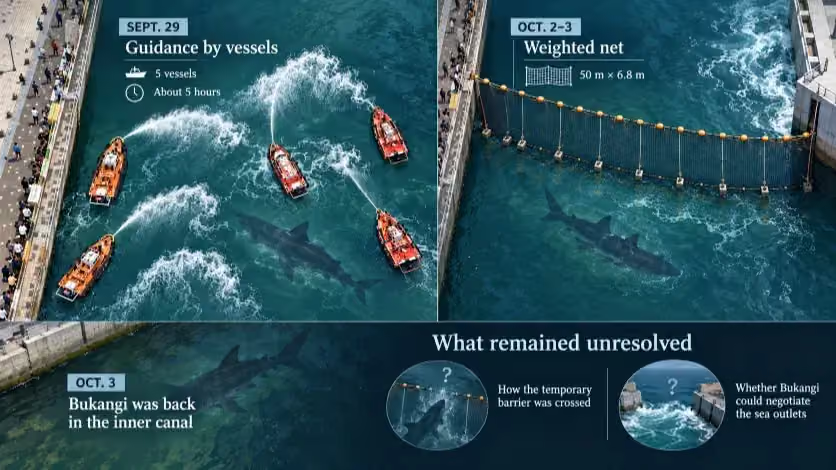 NewsOct 12, 2026
Bukangi, the Shark That Stayed in Busan’s North Port
A rescue net guided Bukangi toward the sea, but the dusky shark returned to B...
More from the author
More from this byline
Stay with the same line of reporting through more work from this byline.
 NewsOct 9, 2026
Why “Busan Is Good” Falls Short as a City Brand
 NewsSep 18, 2026
The Other AI Race Is for the Freedom to Change Course
Reader Signal
Community readWhat did this report leave you with?
Choose the signal that best reflects your reading. Select it again to remove it.
One response per article
No response selected
A moderated conversation about the reporting.
One-level replies and newsroom moderation keep the conversation anchored to this article.
Discussion Status
Open
Please sign in to join the discussion.
Newsletter
Weekly reporting and context from Busan and Korea.