Busan Offers Special Visas to Foreign Talent—But Will They Stay?
Busan is addressing population decline and labor shortages with the 2025 Regional Talent Visa Program, offering F-2-R, E-7-4R, and F-4-R visas to attract foreign professionals, skilled workers, and ethnic Koreans to its underpopulated districts like Seo-gu, Dong-gu, and Yeongdo-gu.


BUSAN, South Korea - With South Korea’s declining birth rates and regional depopulation, the Busan Metropolitan Government is launching the 2025 Regional Talent Visa Program to attract skilled foreign workers and overseas Koreans to its struggling districts. The initiative is part of a national strategy to counteract population decline, revitalize local economies, and encourage foreign professionals to settle in underdeveloped regions.
At first glance, the program appears to be a progressive step toward a more globalized Busan. It introduces special visa categories for foreign professionals, skilled laborers, and overseas Koreans willing to relocate to Busan’s underpopulated districts, including Seo-gu, Dong-gu, and Yeongdo-gu.
The Busan government has high expectations, presenting the initiative as a transformative policy that will not only address labor shortages but also revitalize struggling districts such as Seo-gu, Dong-gu, and Yeongdo-gu. Officials believe that by encouraging foreign workers to establish roots in these areas, Busan can prevent further economic decline. However, whether the plan can truly counteract the city’s long-term demographic and economic challenges remains to be seen.
The Regional Talent Visa Program introduces three distinct visa categories, each designed to attract different groups of foreign nationals to the city’s population-declining areas.
The Regional Special Talent Visa (F-2-R) is intended for highly skilled professionals who can contribute to Busan’s workforce in specialized fields. Under revised 2025 guidelines, applicants must demonstrate proficiency in the Korean language (TOPIK Level 4 and above), meet income requirements, and commit to residing in designated districts for at least five years. This visa offers greater employment flexibility compared to previous policies, with fewer restrictions on industry sectors.
Meanwhile, the newly introduced Regional Specialized Skilled Worker Visa (E-7-4R) focuses on attracting foreign laborers to support Busan’s key industries, including manufacturing, shipbuilding, agriculture, and logistics. This visa is open to those who have already worked in South Korea for at least two years and are willing to relocate to Busan’s declining districts. The program’s long-term success will depend on whether it can provide fair wages and career growth opportunities, ensuring that these workers remain in the city rather than seeking better conditions elsewhere.
Lastly, the Overseas Korean Visa (F-4-R) targets ethnic Koreans living abroad, encouraging them to return to Korea and settle in Busan’s struggling areas. While this initiative aligns with South Korea’s broader strategy to engage its diaspora, the challenge lies in whether Busan can offer sufficient economic and lifestyle incentives to make it a competitive alternative to Seoul, where the job market is stronger and better connected to international businesses.
While the visa program appears promising, critics argue that immigration policies alone cannot resolve Busan’s economic challenges. Without competitive wages, improved infrastructure, and a sustainable job market, there is a significant risk that foreign professionals and workers will view Busan as a temporary stop rather than a long-term home.
One of the major concerns is that Busan’s job market lacks diversity and competitiveness. While the visa program opens opportunities for foreign professionals, the reality is that Busan’s economy is still heavily reliant on traditional industries like shipbuilding and logistics, which have struggled with volatility in recent years. In contrast, cities like Seoul and Incheon have positioned themselves as hubs for finance, AI, and global startups, making them far more attractive to foreign talent.
Additionally, Busan’s regional economic divide poses another significant challenge. The visa program specifically targets areas like Seo-gu, Dong-gu, and Yeongdo-gu, where economic stagnation and urban decay are prevalent. Yet these areas lack key infrastructure, convenient public transportation, and modern housing options, making them far less appealing compared to Haeundae, Centum City, or Seomyeon. While Busan has invested heavily in tourism development in the east, the western districts remain underfunded and disconnected.
Beyond job market concerns, transportation and accessibility remain a significant barrier to Busan’s tourism and residency appeal. While well-developed areas like Haeundae and Centum City boast efficient subway systems, English-friendly transit services, and direct connections to major business hubs, western districts and declining neighborhoods suffer from poor connectivity.
In particular, Busan’s public transportation system does not effectively link its less-developed districts to key employment zones, making daily commuting a challenge for both locals and newcomers. Foreign residents have long struggled with unclear bus routes, limited multilingual transit support, and inefficient intercity connections. While KTX and intercity buses serve major hubs like Busan Station, smaller but equally significant districts remain underserved, limiting job access and economic opportunities.
If Busan wants to retain foreign professionals and workers, the city must prioritize major infrastructure investmentsto improve urban accessibility and public services in its declining districts.
Visa Categories Overview
| Visa Type | Target Applicants | Eligibility Requirements | Residency Obligation | Employment Sectors | Family Accompaniment |
|---|---|---|---|---|---|
| F-2-R (Regional Special Talent Visa) | Highly skilled professionals | - Domestic associate’s degree+ OR - Annual income ≥ 70% of Korea’s GNI - Korean proficiency (TOPIK Level 4+) - 5-year commitment to designated districts |
Seo-gu, Dong-gu, Yeongdo-gu (Relocation to another Busan district after 2 years allowed) |
All industries (except restricted sectors) | ✅ Spouse & minor children allowed |
| E-7-4R (Skilled Worker Visa) | Foreign laborers (manufacturing, agriculture, logistics, shipbuilding) | - 2+ years work experience in Korea (E-9, E-10, H-2 visa holders) - TOPIK Level 2+ - Annual salary ≥ 26M KRW |
Seo-gu, Dong-gu, Yeongdo-gu, Jung-gu, Geumjeong-gu (Relocation to another Busan district after 2 years allowed) |
Designated sectors: manufacturing, shipbuilding, construction, agriculture, logistics | ✅ Spouse allowed to work (industry-limited) |
| F-4-R (Overseas Korean Visa) | Ethnic Koreans abroad | - Lived in an eligible district for 2+ years OR - Relocate with family - Priority for applicants under 60 |
Seo-gu, Dong-gu, Yeongdo-gu (Relocation outside Busan may revoke visa) |
No employment restrictions (except restricted sectors) | ✅ Spouse & minor children allowed |
| Step | Action Required | Notes |
|---|---|---|
| 1. Document Preparation | Gather required documents | Passport, work proof, TOPIK certificate, employment contract (if applicable) |
| 2. Submission | Apply in person at district office | Seo-gu, Dong-gu, Yeongdo-gu, Jung-gu, Geumjeong-gu offices only |
| 3. Processing & Payment | Submit application & pay fees | Processing time: 4-6 weeks |
| 4. Decision Notification | Receive results via SMS | Sent by May 11, 2025 |
| 5. Visa Activation | Move to Busan & start work | Visa activates immediately upon approval |
| Office | Contact | Services Provided |
|---|---|---|
| Busan Population Policy Office | 📞 051-888-1844 | General inquiries (no applications) |
| Seo-gu District Office | 📞 051-240-4356 | Application & processing inquiries |
| Dong-gu District Office | 📞 051-440-4111 | Application & processing inquiries |
| Yeongdo-gu District Office | 📞 051-419-4491 | Application & processing inquiries |
| Busan Global City Foundation | 📞 1577-7716 | Support services for foreign residents |
Busan’s push to attract foreign professionals and overseas Koreans through the 2025 Regional Talent Visa Programmarks an ambitious step toward revitalizing its struggling districts. However, without meaningful incentives and structural improvements, the city risks losing these newcomers to more competitive destinations. A visa alone is not enough to secure long-term residency; housing, economic incentives, and improved infrastructure will be critical in determining whether Busan can truly transform into a global hub.
One of the biggest barriers to attracting and retaining foreign talent is the lack of modern housing and urban development in Busan’s aging downtown areas. Districts such as Nampo-dong and Yeongdo have long suffered from economic stagnation and urban decay, making them far less appealing compared to the city’s more developed eastern areas. To encourage settlement in these districts, the Busan government must implement housing incentives, including subsidized rent programs, tax deductions, and direct financial support for visa holders willing to commit to long-term residency. Without affordable and well-maintained living spaces, foreign professionals will continue to gravitate toward areas like Haeundae and Centum City, where modern infrastructure and lifestyle conveniences are already established.
Urban renewal must also be a top priority if Busan hopes to make its declining districts attractive to a new generation of skilled workers and entrepreneurs. Investing in revitalization projects—such as converting abandoned buildings into co-living spaces, tech incubators, and cultural hubs—would not only enhance the city’s appeal but also foster a dynamic, innovation-driven economy that aligns with global urban trends. A Foreign Resident Settlement Grant, offering financial support for those who commit to living in Busan for more than five years, could further incentivize long-term integration and prevent population turnover.
For Busan’s F-4 visa holders—ethnic Koreans from abroad—the need for tailored economic incentives is even greater. Many overseas Koreans return to Korea with international business experience, yet they often struggle to integrate into Korea’s corporate environment due to differences in work culture, limited networking opportunities, and a lack of government-backed support systems. To make Busan an attractive alternative to Seoul or Incheon, the city must introduce business-friendly incentives, including startup grants, mentorship programs, and tax breaks for F-4 visa holders who launch businesses in urban renewal zones. Additionally, offering fast-tracked permanent residency or citizenship options to those who make significant economic contributions could be a game-changer in securing long-term commitment from overseas Koreans.
Beyond economic incentives, transportation and infrastructure remain a major obstacle to Busan’s vision of a thriving, interconnected global city. While Haeundae and Centum City boast direct subway access, foreigner-friendly public transit, and well-marked English signage, western districts such as Seo-gu and Yeongdo continue to suffer from poor transportation links. Without efficient transit connections to key economic and commercial zones, foreign professionals settling in these areas will face daily commuting challenges, making long-term residency less practical. The expansion of subway and bus networks, the introduction of multilingual transit systems, and the creation of smart mobility services tailored for international residents would go a long way in making Busan a truly accessible and inclusive city.
Yet the bigger question remains: Can Busan compete with Seoul? The reality is that Busan is not only competing with other cities in Korea but also with global destinations that offer higher salaries, better business incentives, and superior quality of life. To stay competitive, the city must go beyond its current visa program and rethink its entire economic approach. This means investing in high-growth industries such as AI, fintech, and biotech, implementing bold urban infrastructure projects, and ensuring that foreign professionals receive competitive compensation and career development opportunities.
The 2025 Regional Talent Visa Program is undeniably a step in the right direction, but immigration policies alone will not be enough to transform Busan into a truly global city. For long-term success, the city must focus on sustainable economic reforms, private-sector partnerships, and a commitment to improving urban infrastructure. If Busan truly wants to attract and retain global talent, it needs more than just a visa—it needs a bold, strategic vision that makes it an undeniable choice for international professionals, entrepreneurs, and overseas Koreans.
Continue this reporting
Reporting on the same issue
Related coverage selected from the article's desk, topics and newsroom relationships.
 NewsOct 16, 2026
What Is Still Worth Going to See?
Busan’s biennale faces questions of artistic judgment and institutional care....
 NewsOct 14, 2026
What Became of Busan’s University Streets?
From 2015 to 2023, registered businesses grew near Pusan National University...
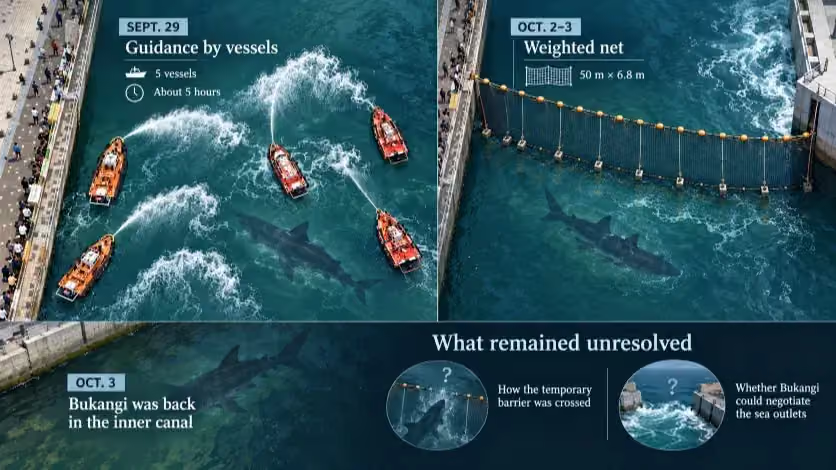 NewsOct 12, 2026
Bukangi, the Shark That Stayed in Busan’s North Port
A rescue net guided Bukangi toward the sea, but the dusky shark returned to B...
More from the author
More from this byline
Stay with the same line of reporting through more work from this byline.
 NewsOct 9, 2026
Why “Busan Is Good” Falls Short as a City Brand
 NewsSep 18, 2026
The Other AI Race Is for the Freedom to Change Course
Reader Signal
Community readWhat did this report leave you with?
Choose the signal that best reflects your reading. Select it again to remove it.
One response per article
No response selected
A moderated conversation about the reporting.
One-level replies and newsroom moderation keep the conversation anchored to this article.
Discussion Status
Open
Please sign in to join the discussion.
Newsletter
Weekly reporting and context from Busan and Korea.