Bukangi, the Shark That Stayed in Busan’s North Port
A rescue net guided Bukangi toward the sea, but the dusky shark returned to Busan’s North Port canal. Her familiar appearances offered no clear answer to why she stayed—or whether another rescue would help.

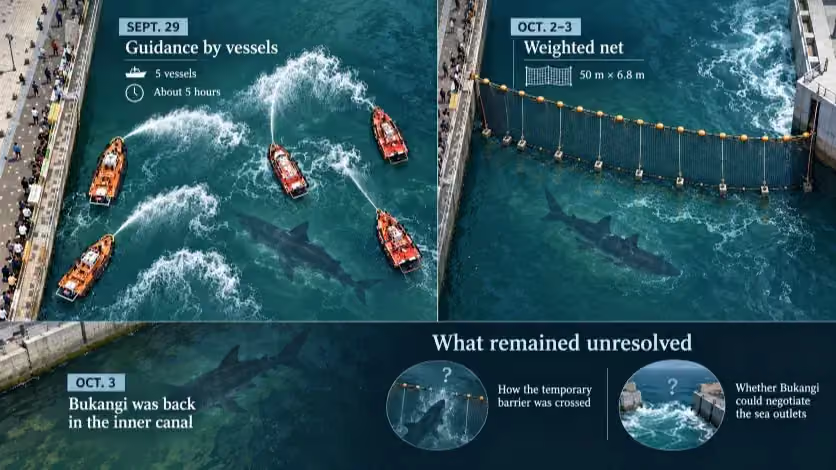
Two attempts to guide a wild dusky shark out of an artificial canal brought it closer to the sea but never completed the journey. As crowds followed its movements and scientists monitored its condition, the prolonged stay raised questions about what people had actually observed—and whether another intervention would help.
On October 2, rescue crews at Busan’s North Port were drawing a large net through an artificial canal, hoping to guide a shark toward the open sea without capturing it. The barrier stretched 50 meters across the waterway and stood 6.8 meters high, with weights along its lower edge to prevent the animal from slipping underneath. Moving slowly, the crews advanced from the section between the fourth and fifth pedestrian bridges, where the shark had often been seen, toward the canal’s seaward end. For a time, the operation worked as intended. The animal moved ahead of the net, leaving its familiar viewing area behind, while the crews adjusted their pace whenever it approached the barrier.
The arrangement depended on keeping the net properly positioned across the waterway. Its weights were meant to close a gap below the barrier, but as the crews advanced they began catching on the uneven bottom. The shark continued moving near the net, requiring repeated pauses, and daylight was running out. At about 5:35 p.m., after roughly an hour and a half of advancing the barrier, the operation was stopped short of the outlet. The crews secured the net and withdrew, leaving the animal on the seaward side of a temporary obstruction, close enough to the end of the canal for the authorities to hope it might continue toward open water on its own.
By around noon the next day, the shark was back in the inner canal. Contemporary reports suggested that the rising tide had created an opening above the net, allowing the animal to cross the barrier and return to the water between the fourth and fifth bridges. How the crossing occurred was not independently established in the published accounts, but its consequence was plain. The previous afternoon’s progress had not resulted in a departure, and the net had failed to preserve the separation the crews had created. At about 4:20 p.m. on October 3, officials removed the barrier to keep the route outward open and announced that they would suspend further forced relocation while scientists continued observing the shark’s movements and condition.
The animal was by then known as Bukangi, and its return supplied a new episode in a story that had acquired an extraordinary audience. People could recognize the stretch of water where it had repeatedly appeared, follow reports of its movements, and watch rescue crews struggle to guide it away. An animal that returned after such an operation seemed almost to have expressed a preference, as though it had decided that the canal was where it wanted to remain. Yet Bukangi had crossed a temporary barrier inside the waterway, while the actual connections with the sea lay beyond it. That movement revealed neither what the shark encountered near those openings nor whether it could negotiate them under ordinary conditions.
The Routes the Boats Could Not Control
The operation with the net had followed an earlier attempt on September 29, when five Coast Guard and rescue vessels spent roughly five hours trying to guide the shark outward with water pumps. The crews sought to create a disturbance that would encourage Bukangi to move away from the approaching vessels toward the sea. Instead, the shark repeatedly submerged, swam near the shallower margins of the canal, and reappeared behind boats that had already advanced. The crews turned and repositioned themselves, only to find that the animal had moved through water the vessels could not follow as easily. Spectators watching from the bridges sometimes called out when Bukangi surfaced, helping the rescuers recover sight of it as the operation continued.
The movements were widely described as evasive, although fisheries researchers questioned whether the water, foam, and noise had produced the intended behavioral response. The accounts were not necessarily incompatible. The animal had moved around the vessels, but the observations did not isolate what prompted each movement. The crews were attempting to establish a continuous route toward a fixed destination, while Bukangi encountered boats whose positions changed as they approached and turned. A course that carried it away from one vessel could take it along a shallow edge or behind another, undoing the progress the crews were trying to maintain. The problem for the operation was immediate and practical: the boats could provoke or accompany movement without reliably determining where that movement would lead.
The net provided a different way of controlling the available route. Prepared as a contingency before the first operation, it restricted the passages through which Bukangi could return to the inner canal instead of relying principally on the animal’s response to approaching vessels. The crews reportedly proceeded without the additional water jets originally contemplated for the second attempt, seeking to avoid unnecessary disturbance. The method brought the shark farther toward the sea, but only as long as the barrier could be advanced and maintained. Its weighted lower edge became an obstacle to the crews, while the changing tide appears to have created an opportunity for the shark to cross above it. The two methods had encountered different limitations of a waterway that was familiar from the bridges but far more complicated at the level where the animal and the rescue equipment moved.
What each rescue attempt could control
Boats could influence nearby movement. A net could obstruct a return—only while the barrier remained effective.
Water pumps and vessels
Bukangi submerged and reappeared behind boats; the crews could not maintain an outward course.
A weighted moving net
The 50 m × 6.8 m net advanced seaward until its weights snagged. Bukangi returned past it overnight.
The attempts unfolded before people who had already begun to think of Bukangi as a recognizable individual. On September 29, the same day as the first operation, Busan announced the shark’s appointment as an honorary ambassador after an online consultation involving approximately 8,200 participants, 91 percent of whom supported the designation. Visitors had gathered expecting what might be a farewell, some wishing the animal a safe return to the sea and others worrying that the effort to move it could cause harm. The city’s ceremonial recognition and the authorities’ plans to relocate Bukangi reflected different consequences of the same unexpected arrival. The shark had become an object of public affection at a time when marine officials believed that remaining in the canal could eventually endanger it.
The Familiar Water Between the Bridges
Bukangi’s first reported appearance at North Port was on September 18, although the date did not establish when the shark entered the canal or what drew it inside. The artificial waterway extends for approximately 1.5 kilometers through the redeveloped waterfront, crossed by pedestrian bridges and connected to the surrounding sea. Early explanations for its appearance included the possibility that the animal had followed fish into the channel or become disoriented by the configuration of the exits. Such suggestions offered plausible starting points for investigation, but no confirmed sequence of observations described the shark’s arrival. By the time people had become accustomed to seeing it, the evidence available to explain how it entered was already different from the evidence being collected about its continuing stay.
The shark’s subsequent movements presented several questions that could not necessarily be answered by a single explanation. Conditions that might have attracted an animal into the canal would not have to be the same conditions encouraging it to remain. Its repeated appearances near the fourth and fifth bridges could reflect the resources or physical characteristics of that stretch, an established pattern of movement through the waterway, or difficulties encountered elsewhere. The fact that the animal had not been seen leaving through an outlet was another observation requiring its own explanation. Without a record of movements across the whole canal, the extent to which these possibilities overlapped remained difficult to determine.
One possibility became particularly attractive after the rescue attempts: Bukangi might have learned to avoid the seaward end of the canal. There is a sound biological basis for considering spatial learning in sharks. In a controlled experiment published in 2012, eight gray bamboo sharks learned routes to food through a maze and retained that information over interruptions lasting as long as six weeks. The findings demonstrated that sharks can remember spatial relationships, although the experiment involved a different species and a task unlike the encounter with a moving net at North Port. More importantly, Bukangi had already appeared frequently near the inner bridges before either rescue attempt. Its return to that area might have reflected a familiar pattern of use, even if the experience of the operation had affected some of its subsequent movements.
Testing that possibility would require knowing how often Bukangi approached the seaward sections before the interventions and whether those movements changed afterward. The rescue operations had supplied unusually detailed observations, but they were observations made while vessels and equipment were altering the animal’s surroundings. Ordinary sightings offered a different problem. The shark could remain beneath the surface or pass through stretches of water where no one was watching, while visibility from the bridges depended on depth, water conditions, and the animal’s position. The places where Bukangi appeared most frequently in the public record were therefore a useful starting point for examining its spatial behavior, though they were not a complete account of the waterway it used.
How the Crowd Learned Where to Look
The public had begun constructing a shared history of Bukangi’s appearances well before the rescue operations ended. On September 22, a researcher at Pukyong National University launched a website through which visitors could report where the shark had been seen and submit photographs for review. The service provided access to recent observations, allowing people planning a visit to learn where others had found the animal. It was an inventive response to the uncertainty of an encounter that could not be scheduled. An individual who had missed Bukangi could consult reports from other visitors, while photographs taken at different times helped build an increasingly detailed account of where the shark had appeared.
By October 11, people were arriving at North Port with more specific expectations. In a field report published that day, Yonhap News Agency described visitors discussing favored viewing locations and exchanging advice about the shark’s recent movements. Some had learned where it was commonly seen and would wait along those stretches rather than searching the entire canal. When Bukangi appeared, people raised phones or moved along the walkway to follow it. Another account described visitors returning after earlier trips that had ended without a sighting. The unpredictability of the animal’s appearance remained central to the experience, but the visitors had become more practiced at finding it.
That growing familiarity could be useful to researchers as well as spectators. A photograph with a reliable time and location might establish the shark’s presence, document a visible injury, or identify a change deserving closer examination. Yet a concentration of reports around the inner bridges could reflect the distribution of observers as well as the distribution of the shark’s movements. As sightings were shared and people gathered where others had recently seen Bukangi, well-known locations might acquire increasingly detailed records while less frequently watched areas remained comparatively obscure. How strongly such uneven observation affected the public record had not been established.
For people following Bukangi, the repeated sightings created a sense of familiarity that extended beyond any one encounter. A visitor might know which stretch of railing offered a good view or recognize the latest appearance from a photograph shared earlier that day, yet still have little direct knowledge of where the shark had traveled in the intervening hours. This was a distinctive feature of the North Port story: an individual wild animal had become unusually accessible to the public without becoming continuously observable. The expanding record of encounters had real value, but the movements connecting those encounters remained a separate object of investigation.
What Was Bukangi Eating?
Food offered another possible reason for continued residence. Fish had been observed in the canal, and Bukangi might have been feeding during hours or at depths beyond the view of people waiting above. Officials had expressed concern that prolonged residence could limit feeding opportunities, but the absence of a witnessed feeding event did not demonstrate that the shark had gone without food. Its continued activity was encouraging as an observation of immediate function, though insufficient to establish whether it was obtaining the nourishment needed to sustain itself over time.
Research around Norfolk Island, Australia, offers a useful comparison because it examined the relationship between repeated visits to a coastal site and the food obtained there. Scientists followed 18 dusky sharks and 16 Galapagos sharks near fishing piers where discarded fish provided an identifiable feeding opportunity. Acoustic receivers recorded the animals’ visits, while fatty-acid and stable-isotope analyses supplied evidence about their diets. The sharks returned intermittently, but the discarded fish contributed only a limited proportion of their food overall. Some individuals more closely associated with the piers consumed considerably more of the scraps than others, illustrating how animals using the same location could differ in their dependence on its resources.
At the same piers, very different diets
Estimated share of fish species commonly discarded at the piers, based on stable-isotope analysis of sampled dusky and Galapagos sharks.
Nothing in the Norfolk Island findings established that Bukangi was feeding on discarded fish or using North Port in the same way. The settings were different, and no comparable dietary analysis had been reported for the shark in Busan. The research nevertheless demonstrated why the relationship between repeated appearances and feeding cannot be inferred from location alone. Around Norfolk Island, researchers could compare the sharks’ movements with evidence of what they had consumed. In North Port, the availability of prey, Bukangi’s actual feeding behavior, and any change in its nutritional condition remained questions requiring different kinds of observation.
Why Officials Tried to Move a Shark That Seemed Well
The first decision to move Bukangi had been made while the animal still appeared capable of swimming normally. On September 28, after consultations among city and marine agencies, the fisheries institute reported that the shark’s activity and respiration showed no obvious signs of immediate distress. Officials nevertheless worried that the dimensions of the canal and its connections with the sea could constrain movement and feeding over time, gradually weakening an animal adapted to a much larger marine environment. Their concern was directed toward the consequences of continued residence rather than a condition already known to be critical.
The proposed operations had acknowledged the risks of intervention from the outset. The first used boats and water pumps instead of attempting to restrain Bukangi, and a fisheries researcher accompanied the crews to assess its condition during the work. The second was also adjusted to limit unnecessary disturbance as the net advanced. When authorities suspended forced relocation on October 3, they were not discovering for the first time that intervention could be hazardous. They had encountered the practical limits of two methods intended to move the animal without capturing it, while the concerns that had prompted the attempts remained unresolved. The decision to observe left open the possibility of another response if changes in the shark’s behavior or health made it necessary.
On October 6, the National Institute of Fisheries Science resolved a more fundamental uncertainty about the animal itself. Close-range imagery showed a ridge between Bukangi’s dorsal fins that allowed researchers to identify it as a female dusky shark, Carcharhinus obscurus, approximately three meters long. Earlier identifications had been provisional, based on less conclusive images. The species is classified as endangered on the International Union for Conservation of Nature’s Red List, a measure of its conservation status rather than a diagnosis of the individual animal in Busan. The revised identification made knowledge of dusky shark ecology more directly relevant, although it did not establish whether Bukangi had found adequate food, how it used the canal’s connections to the sea, or why it continued to occupy the inner waterway.
The fisheries institute was pursuing those concerns through observations more systematic than the encounters recorded by visitors. Researchers followed swimming behavior and visible body condition, examined closer imagery, and measured environmental conditions including water temperature, salinity, and dissolved oxygen. Such observations could help identify changes over time, particularly when repeated under comparable conditions. The monitoring was a substantial scientific activity rather than a passive decision to wait, even though the published accounts did not supply a continuous movement record or a sufficiently detailed series of measurements to resolve every question about the shark’s stay.
An Injury, and the Risk of Capture
A more immediate concern emerged on October 7, when researchers identified an abrasion near Bukangi’s snout. Reports from the same period described nighttime visitors directing strong lights toward the water and the shark making abrupt movements near the canal’s structures. The fisheries institute considered whether a sudden response to artificial illumination could have contributed to the injury, though its precise cause was not established. These reports introduced a different dimension to the public’s growing interest. Most of the people watching from bridges were trying simply to catch a glimpse of the animal, but certain attempts to make it visible could introduce stimuli into the environment through which it was swimming. A response to a concentrated light might be brief, yet in a confined waterway a sudden turn could carry risks of its own.
The discovery of the wound did not lead the authorities to capture Bukangi for treatment. On October 8, officials said the abrasion appeared relatively limited and that the shark’s swimming did not show conspicuous signs of deterioration. Restraining a large wild shark and transferring it into an artificial treatment environment could produce severe stress and potentially fatal consequences, making the risks of reaching the point where treatment could begin part of the decision itself. Officials favored continued observation while allowing an opportunity for natural departure, with the wound’s progression and the animal’s behavior remaining under scrutiny. The new injury had made the assessment more specific without making the available response any simpler.
The decision was necessarily tied to the animal’s condition as it developed. Continued swimming and an apparently limited abrasion could support observation for the time being, while worsening injury or impaired movement might require the authorities to reconsider. The difficulty was that another attempt at treatment or relocation would still involve handling or directing a large wild animal through a waterway where previous methods had encountered practical limits. The relevant comparison was therefore between the risks of continued residence and those of the interventions actually available, rather than between an injured shark and an imagined treatment without hazards.
What Autumn Could Change
Autumn brought another element into that calculation. Officials suggested that cooling conditions in the canal might encourage Bukangi to move toward relatively warmer waters offshore. The dusky shark’s preferred temperature range was generally reported as approximately 18 to 26 degrees Celsius, but that range was not a demonstrated threshold for death or an exact point at which this individual would leave. A prediction about the shark’s response would also depend on conditions outside the canal and on whether the routes between the two environments were usable at the time the animal approached them.
A study published in September 2026 demonstrated how such relationships could be investigated in a different coastal setting. Researchers in Israel used acoustic telemetry to follow 35 dusky sharks and 23 sandbar sharks around coastal infrastructure, including a power station with a distinctive warm-water discharge. The animals showed substantial residency near the facility within individual seasons, while their body temperatures increased during visits in a pattern consistent with use of the warmer environment. Comparatively few returned to the broader region in later years. The findings offered evidence that large sharks can repeatedly use human-modified coastal habitats and that their movements may be associated with conditions those habitats provide. North Port had no demonstrated thermal relationship of this kind, and the Israeli study could not predict Bukangi’s departure.
North Port had been monitored and maintained for environmental reasons long before Bukangi appeared. In May, the Busan Port Authority had undertaken work to remove aquatic vegetation and floating debris carried into the canal by tidal currents. In August, the authority reported that the waterway’s marine water-quality index had improved by approximately 30 percent compared with the corresponding quarter of the preceding year. The work included vegetation removal, debris collection, and floating barriers designed to intercept incoming litter, while wastewater from older surrounding districts remained a longer-term concern. These records described meaningful efforts to improve the canal’s condition, but the indicators used for water-quality management did not directly establish whether a three-meter shark was finding sufficient prey or how it experienced the depth, currents, and changing conditions along the routes it used.
The canal’s physical characteristics had already played an important role in the relocation attempts. Its irregular bottom impeded the weighted net, while a change in water level appears to have affected the barrier’s effectiveness overnight. Routine maintenance records also documented the influence of tides on material moving through the waterway. None of this proved that the actual outlets were impassable to Bukangi, and the floating equipment used to collect debris could not be equated with the temporary rescue net. The unresolved questions about passage nevertheless mattered to any future operation. A plan to move the animal toward the sea would have to account for the conditions along the route and the effects of equipment or vessels introduced to change its movements.
The City Watching from Above
The response also depended on a public waterfront whose ordinary operation had been organized for purposes very different from observing a wild shark. The park and adjacent marine waterway had distinct management arrangements, with the port authority responsible for the canal and other bodies involved in maintaining the surrounding public space. These divisions had been discussed in municipal records before Bukangi’s arrival. In September and October 2026, the authorities demonstrated their ability to work together through meetings, rescue operations, scientific monitoring, and public-safety measures. The division of responsibilities offered no evidence, by itself, that the response had failed. What another intervention would require was a practical connection between information about the animal’s condition, the route available through the canal, and the circumstances in which personnel could safely operate.
Public use of the surrounding park had meanwhile changed rapidly. By 6 p.m. on October 11, the Busan Facilities Corporation had recorded 1,348,800 cumulative entries since September 19, including 205,000 over the three-day Hangeul Day holiday. The figures measured entries, not distinct people who had seen Bukangi, and could not determine how many visitors had come primarily because of the shark. The scenes recorded by reporters gave the attention a more particular character. Visitors returned after unsuccessful attempts to see the animal, families gathered along the bridges, and people exchanged practical knowledge about its appearances. One tourist from Germany told a Newsis reporter that her father had learned about Bukangi at home and encouraged her to visit while traveling in South Korea. For some of the families gathered there, seeing a large shark moving through an open waterway carried a fascination different from watching one through the glass of an aquarium.
The experience was appealing partly because nobody could guarantee it. The animal might remain beneath the surface throughout a visit, or emerge briefly and send people along the railing in pursuit of another view. Its movements organized a form of public activity that the park’s operators had not scheduled and could not control. The resulting demands were not confined to the water. On October 11, a warning restricted access to part of the area between the fourth and fifth pedestrian bridges because a damaged glass barrier posed a risk of falling. The cause of the damage was not established. Researchers were separately asking visitors to avoid directing strong lights toward Bukangi. Maintaining safe viewing places and limiting unnecessary disturbances were measures that could continue without another attempt to force the shark toward the sea.
By the second week of October, the decision to keep watching Bukangi involved more than following its location. Scientists were observing an injury and looking for changes in movement or body condition, while the season brought environmental conditions that could alter the animal’s prospects. The waterway remained connected to the sea, with no temporary rescue net across the route, but the fact of that connection did not settle how readily the shark could use it. Officials had to consider what could be learned through continued observation and what might justify accepting the risks of another intervention. The earlier operations offered a clearer picture of the difficulties of moving Bukangi than they did of the reasons it had remained.
On October 11, Bukangi was still appearing in waters that had become familiar to the people who waited above them. Another sighting could be enough to reward a long visit, particularly for someone who had previously come to North Port without seeing the shark. For researchers, the significance of another encounter depended on what it revealed about the animal’s condition or movement and how that observation compared with what had come before. There was no reliable basis for predicting whether Bukangi would leave on its own, remain as the water cooled, or require another operation. The next consequential change might be visible in its swimming, the wound near its snout, or conditions in the canal and the sea beyond it.
The net had been removed, but the questions that led the crews into the water had not disappeared with it. Bukangi was again moving without that temporary barrier, watched by people who had become unusually familiar with its appearances and by scientists trying to establish what those appearances meant for its health. A return to the bridges could still be an ordinary part of the shark’s movements; a deterioration in condition might make the same continued presence more troubling. The difference would become important when the authorities next had to decide whether leaving Bukangi alone was still the safer course, or whether the evidence had changed enough to justify another attempt to move it.
Continue this reporting
Reporting on the same issue
Related coverage selected from the article's desk, topics and newsroom relationships.
 NewsOct 6, 2026
Busan’s Water System Is Entering a Harder Era of Renewal
Busan spent decades building a water system that can absorb major failures. N...
 NewsSep 28, 2026
Why Some Commercial Space in Busan Is Hard to Reuse
Two empty commercial spaces exposed to the same broader economy can have very...
 NewsSep 20, 2026
What It Takes for U.S. Navy Repair Work to Become a Busan Industry
HJ Shipbuilding has brought U.S. Navy maintenance work to Yeongdo. Whether it...
More from the author
More from this byline
Stay with the same line of reporting through more work from this byline.
- NewsOct 6, 2026
Busan’s Water System Is Entering a Harder Era of Renewal
Reader Signal
Community readWhat did this report leave you with?
Choose the signal that best reflects your reading. Select it again to remove it.
One response per article
No response selected
A moderated conversation about the reporting.
One-level replies and newsroom moderation keep the conversation anchored to this article.
Discussion Status
Open
Please sign in to join the discussion.
Newsletter
Weekly reporting and context from Busan and Korea.