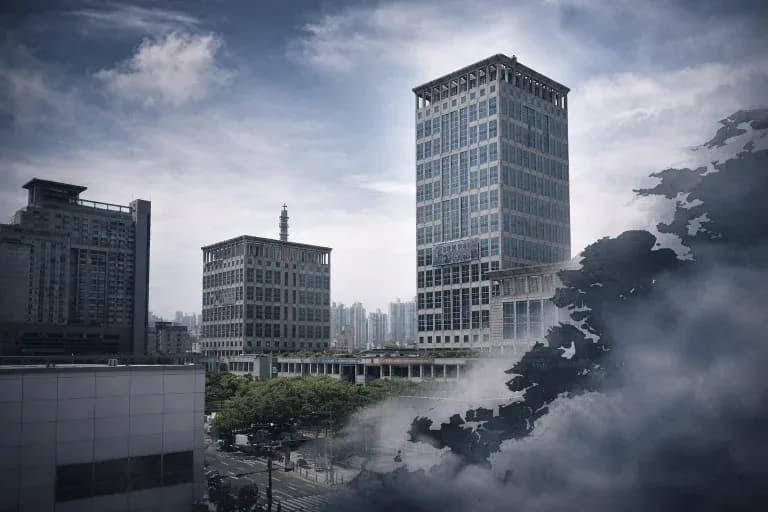
The End of Expansion as Busan Becomes a Shrinking Port City
Busan’s shift from growth to shrinkage exposed a planning system unable to adapt to demographic and industrial decline.

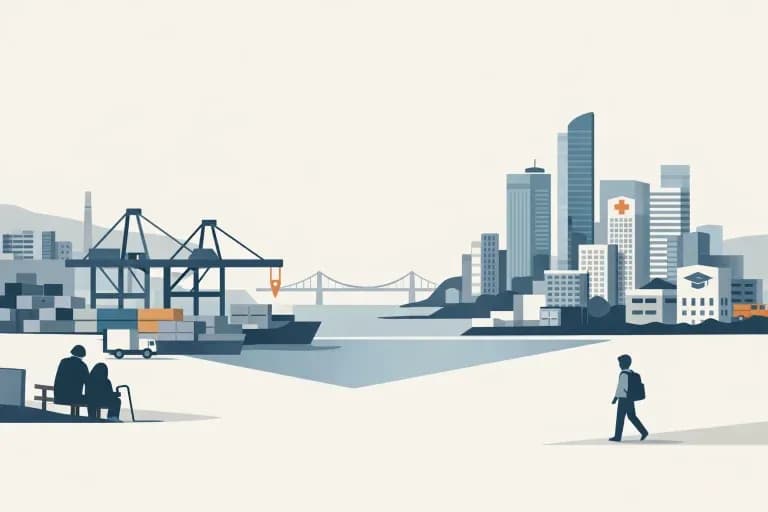
Busan’s shift from expansion to shrinkage revealed a structural failure in urban planning and governance. City institutions continued to deploy redevelopment, regeneration, and infrastructure investment under growth-oriented logics even as demographic contraction, industrial devaluation, and spatial fragmentation dismantled the conditions that once sustained urban reproduction. Instead of consolidating territory, redirecting resources, or restructuring planning priorities, Busan preserved the grammar of expansion while operating under the realities of shrinkage. The mismatch between tools and conditions prevented the city from generating new demographic inflows, labor absorption, or urban clustering—leaving shrinkage to unfold ungoverned.
Busan entered a post-growth phase after a sequence of demographic, industrial, and spatial inflection points accumulated between 2020 and 2026. The resident population declined to approximately 3.27 million at the end of 2024, down by 26,764 persons over the calendar year, continuing a contraction that began after the mid-1990s peak of roughly 3.88 million. Net domestic out-migration intensified among the 15–34 age cohort and among university-educated workers, while the share of residents aged 65 and over exceeded 30 percent by 2023. The number of women aged 20–39, a cohort critical to labor and fertility, decreased by double-digit percentages over the past decade, accelerating natural population decline. Vital statistics confirmed sustained deaths-over-births imbalance across the southeastern metropolitan region, producing a demographic deficit that combined natural decrease with selective out-migration.
Industrial restructuring compounded the demographic contraction. Manufacturing once accounted for more than 30 percent of Busan’s regional GDP but fell toward the low-20 percent range by the mid-2010s and approached the 20 percent boundary after 2020. Container and logistics functions shifted toward the New Port in Gangseo, reducing labor absorption in older industrial districts in Saha, Seo-gu, and Yeongdo. The transition to automated container handling and long-distance trucking weakened the port’s traditional role as a source of secondary industrial linkages and localized employment. The tertiary economy failed to compensate; finance, business services, ICT, and creative sectors remained below the 15–20 percent share typical of post-industrial port cities in Japan and Europe. Headquarters concentration remained negligible, with the Seoul–Gyeonggi corridor capturing more than 90 percent of major corporate headquarters. Startup formation, R&D clusters, and university–industry transfer mechanisms exhibited limited capacity to produce higher-value growth.
Demography and industry jointly altered consumption and labor market structure. Total employment increased modestly in 2025, but job creation concentrated in medical services and wage employment within central districts. Self-employment contracted, retail corridors declined, and consumption shifted toward large consolidated commercial nodes. Aging households altered expenditure composition and reduced urban consumption dynamism, while youth out-flow weakened labor force replenishment. The combination of selective migration, low fertility, industrial stagnation, and aging produced a structural narrowing of Busan’s economic and demographic base.
Spatial fragmentation accompanied the demographic and industrial shifts. Haeundae, Centum City, and Gijang consolidated a high-income consumption and services belt, while Seomyeon and Busanjin retained residual commercial and medical centrality. Gangseo assembled the city’s industrial-logistics axis, capturing port restructuring and container flows. Saha, Seo-gu, Yeongdo, and the Nakdong delta entered a shrinking trajectory marked by aging, population loss, and weakened labor absorption. The spatial division reduced the coherence of urban flows and weakened metropolitan centrality. Expansion-oriented urban growth mechanisms ceased to operate; redevelopment and regeneration no longer induced multiplier effects in consumption, labor demand, or firm clustering.
Between 2020 and 2026, Busan crossed its urban threshold. Population shrinkage, aging, industrial devaluation, and spatial fragmentation converged to shift the city from an expansion model to a shrinkage model. Conventional urban policy instruments—redevelopment, regeneration, and SOC investment—functioned as maintenance tools rather than growth engines. The city no longer possessed the demographic or industrial capacity to regenerate its own expansionary cycle. Busan now shares developmental characteristics with post-industrial shrinking port cities such as Osaka, Kitakyushu, Nagasaki, and Ruhrgebiet cities in Germany, where industrial decline and demographic contraction redefined the role of the city within national and regional systems.
Industrial Decline, Aging Cohorts, and the Breakdown of Urban Morphology
Busan transitioned from a labor-absorptive industrial port to a logistics-driven and partially automated maritime node between 2000 and 2026. The shift dismantled the spatial-industrial relationships that once anchored the city’s morphology. Manufacturing accounted for more than 30 percent of regional GDP during the late twentieth century, but its share declined toward the 20 percent boundary after 2020. Shipbuilding supply chains dispersed toward Ulsan, Geoje, and Changwon; container and bulk cargo handling relocated to the New Port in Gangseo; and port logistics adopted standardized, high-throughput, and capital-intensive operations that reduced secondary spillovers to adjacent neighborhoods.
The post-industrial transition removed labor demands that historically tied production sites to nearby residential belts. During the industrial peak, Seo-gu, Yeongdo, and Saha operated as worker–housing catchment zones. The collapse of this spatial contract deactivated neighborhood renewal mechanisms that previously relied on youth inflow, household formation, small business creation, and local consumption. The disappearance of labor-intensive port activity eliminated the primary urban driver that reproduced industrial-era density and morphological continuity.
Demographic contraction reinforced the shift. The resident population fell to approximately 3.27 million by the end of 2024, compared to a mid-1990s peak of nearly 3.88 million. The decline disproportionately affected the 15–34 age cohort and university-educated youth. The 20–39 female cohort shrank by double-digit percentages during the 2010s and early 2020s, undermining both fertility and labor supply. The share of residents aged 65 and over surpassed 30 percent by 2023, producing a demographic inversion that altered consumption patterns, service demand, and household structure. Natural decrease accelerated as deaths exceeded births; selective migration removed high-potential cohorts; and domestic migration flows favored Seoul and Gyeonggi Province.
Urban consumption corridors weakened in parallel. Self-employment counts decreased and small-scale retail contracted. Consumption power concentrated in eastern high-income districts and consolidated commercial nodes. Peripheral districts lost demand density, dismantling the transactional underpinnings of local urbanism. Street-level commerce—an indicator of morphological vitality—dissolved in older industrial districts as the interplay between labor and retail collapsed. Logistics growth at the New Port created no equivalent retail corridor or consumption spillover; value was captured within container terminals and long-haul transport chains rather than within walkable districts.
The erosion of labor–housing synchronicity disrupted the city’s morphological continuity. Busan no longer operated as a single industrial metropolis but as a fragmented assemblage of consumption, logistics, and aging districts. Residential towers in Haeundae, Centum City, and Gijang formed high-income enclaves; Seomyeon and Busanjin retained residual medical-commercial centrality; Gangseo became an industrial-logistics axis; and western districts (Saha, Seo-gu, Yeongdo, Dadaepo, the Nakdong delta) transitioned into shrinking urban belts with aging households and diminishing demographic replenishment.
Real estate markets internalized the shift. Housing demand stabilized or appreciated in eastern consumption belts, while older western districts evidenced depreciation, low redevelopment premiums, and selective abandonment. The absence of inbound population eliminated the demographic pressure necessary to sustain the expansionary housing cycle—an inflection point observed earlier in Kitakyushu and Nagasaki, where condominium construction confined itself to narrow viable zones while peripheral stock aged without renewal. Busan reproduced similar patterns: limited densification in affluent districts contrasted with spatial vacancy and under-occupancy elsewhere.
The combined effects of industrial displacement, aging cohorts, and demographic deficit dismantled the growth-oriented urban morphology that defined Busan during its industrial peak. An expansionary city produces density through labor absorption, family formation, and commercial adjacency; a shrinking city dissolves density through aging, migration, and spatial fragmentation. By 2026, Busan’s demographic and industrial fundamentals aligned with the latter condition.
Urban Regeneration, Redevelopment, and SOC as Misaligned Tools in a Shrinking Trajectory
Urban policy in Busan during the early twenty-first century operated on the assumption of continued demographic and economic expansion. Regeneration, redevelopment, and social overhead capital (SOC) investments were deployed as growth-inducing instruments rather than shrinkage management tools. The policies targeted physical renewal and amenity upgrades without altering the fundamentals of demographic replenishment, labor absorption, or firm formation. As shrinkage pressures accumulated, the mismatch between policy assumptions and urban conditions expanded.
Urban regeneration programs primarily addressed the surface condition of aging districts—building stock, streetscape, walkability, and community facilities. These interventions improved local quality of life but did not restore the reproduction mechanisms of an expansionary city. Regeneration did not produce inbound migration, tertiary clustering, or demographic replacement. Aging households remained, youth departure continued, and household formation stagnated. In the absence of labor-intensive industry and family formation, regeneration functioned as maintenance rather than renewal.
Redevelopment produced enclosed residential enclaves rather than city districts. High-rise complexes internalized amenities, retail, and consumption, reducing transactional spillover into surrounding neighborhoods. Local commercial streets declined as residents redirected consumption internally or toward consolidated commercial nodes. Fragmented redevelopment compounded urban segmentation: density increased within towers while older stock outside these perimeters depreciated. The model echoed shrinkage-era redevelopment patterns observed in Japanese cities such as Kitakyushu and Nagasaki, where condominium construction did not reverse population loss or restore centrality.
SOC investment also diverged from its historical function. During industrial growth, SOC expanded labor–transport connectivity and industrial throughput; during shrinkage, SOC increasingly served care and accessibility functions—elder mobility, pedestrian improvements, and incremental road upgrades—without inducing economic multipliers. Large-scale SOC investments in logistics and port infrastructure concentrated value in Gangseo and the New Port but did not diffuse across the metropolitan structure. The logistics chain remained capital-intensive and spatially insulated, with long-haul trucking bypassing older districts rather than activating them.
Urban policy frameworks did not transition from growth governance to shrinkage governance. City institutions continued to allocate resources on the premise of balanced territorial development and physical renovation rather than selective consolidation. Shrinking districts received regeneration funds insufficient to reverse demographic decline, while growth districts absorbed high-income demand without redistributing benefits. The absence of selective concentration—common in European and Japanese shrinkage policy—forced Busan into a pattern of diffuse interventions with low macro-urban impact.
The mismatch between tools and conditions extended into real estate and planning systems. Housing policy incentivized supply despite declining demographic demand; redevelopment targeted districts without consumption anchors; regeneration prioritized physical environment over demographic replenishment; and SOC remained oriented toward network upgrades rather than economic restructuring. None of these measures restored the core variables that sustain urban growth: youth inflow, firm formation, tertiary clustering, labor absorption, or family formation.
The policy mismatch produced a structural outcome: Busan possessed the institutional apparatus of a growth city but the demographic and industrial profile of a shrinking city. The city preserved the grammar of expansion—redevelopment districts, regeneration zones, balanced investment, and SOC allocation—while the underlying system transitioned to shrinkage. The gap between policy grammar and urban reality widened, rendering intervention tools insufficient to alter macro-urban trajectories.
By the mid-2020s, regeneration, redevelopment, and SOC functioned as life-extension mechanisms rather than growth engines. The interventions improved comfort, accessibility, and local amenity but did not modify the fundamental variables of urban reproduction. Shrinkage proceeded through the demographic-industrial chain, while policy instruments postponed but did not prevent the spatial-material manifestation of decline.
The Western Belt as the Spatial Manifestation of Urban Shrinkage
The western districts of Busan became the spatial manifestation of shrinkage dynamics that accumulated across demographic, industrial, and policy domains. Saha, Seo-gu, Yeongdo, Dadaepo, and the Nakdong delta transitioned from industrial-residential zones to aging districts with diminishing reproductive and labor cohorts. The absence of industrial renewal removed the original economic rationale for local population density. Without youth inflow, household formation, or labor absorption, these districts could not regenerate internally.
Demographic data reflected this transition. The proportion of elderly residents in the western belt surpassed citywide averages and exceeded levels typically associated with natural replacement. Youth out-migration reduced the reproductive cohort, producing negative fertility and thinning the future labor base. Family formation weakened as the number of households with children declined, and single-person and elderly households increased. Population decline concentrated in areas with aging building stock, low redevelopment premiums, and weaker educational catchments. Natural decrease amplified spatial disparities as births disappeared and deaths concentrated.
Labor market dynamics reinforced the demographic shift. The western belt no longer offered urban labor entry points for youth and new households. The disappearance of port-adjacent employment removed the connection between labor markets and residential districts. Logistics activity at the New Port did not generate neighborhood-scale employment or consumption. As labor absorption diminished, local consumption collapsed, eroding retail corridors and accelerating business failure. The decline of self-employment and street-level commerce weakened the micro-urban economy and eliminated a significant source of neighborhood resilience.
Housing and real estate markets internalized the contraction. Aging multifamily stock and 1970–1990s-built low-to-mid rise apartments depreciated. Redevelopment premiums remained insufficient to justify comprehensive renewal due to weak demographic demand and low future consumption projections. Selective redevelopment formed isolated enclaves that did not anchor urban districts. Unlike Haeundae or Centum City, the western belt could not generate condominium-driven market densification. Housing valuation shifted from scarcity to depreciation, reflecting the absence of competitive demand. Vacancy and under-occupancy emerged in pockets of the belt, mirroring patterns seen in Kitakyushu and Nagasaki during similar periods of demographic contraction.
Spatial image and urban reputation interacted with demographic and economic decline. Shipping, industrial residues, and aging topography defined the western waterfront. Urban marketing narratives of waterfront living—common in North American and European port redevelopment—could not override the built reality of a logistics-industrial coastline. Tourism and consumption functions lacked anchor assets capable of rebranding the area. As the symbolic and material gap between industrial and urban waterfront widened, the western belt lost eligibility for the global waterfront redevelopment model that transformed Yokohama or Hamburg.
Education and status signaling reinforced spatial divergence. High-status educational districts emerged in eastern consumption belts, while the western belt provided neither educational premium nor residential distinction capable of attracting young families. The absence of school-driven real estate demand eliminated one of the few remaining demographic drivers in low-fertility cities. Residential choice concentrated in districts where education, consumption, and amenities overlapped, and aging districts fell into demographic equilibrium characterized by low turnover and declining cohort replacement.
Commercial and institutional functions eroded alongside demographic retreat. Retail corridors dissolved as purchasing power weakened, and medical functions, while expanding in absolute terms due to aging, did not restore urban dynamism. Care infrastructure—long-term care centers, rehabilitation clinics, and senior services—replaced commercial vibrancy. The western belt transitioned toward a geriatric service economy with limited capacity for innovation, labor entry, or consumption-based renewal.
Urban governance lacked a shrinkage management framework. Regeneration programs improved micro-environments without altering macro-trajectory; redevelopment proceeded selectively without generating urban spillovers; and SOC investment increased accessibility without restoring economic purpose. The western belt became the urban laboratory in which the failure of growth-oriented intervention tools became visible. The districts did not collapse; they aged, stabilized, and settled into low-demand equilibrium.
By the mid-2020s, the western belt embodied the end-state of Busan’s transition to a shrinking city. The area’s morphology displayed the canonical attributes of shrinkage: aging households, negative demographic replacement, spatial vacancy, consumption collapse, redevelopment fragmentation, and the substitution of care infrastructure for commercial corridors. The belt functioned as the spatial record of a metropolitan system that could no longer reproduce density, youth, or expansion. As in other post-industrial port cities—Osaka, Kitakyushu, Nagasaki, and Ruhrgebiet cities—the shrinkage became territorial rather than abstract, enoded into the building stock, street economy, and demographic composition of specific districts.
The End of Expansion and the Rise of Shrinkage Governance
Busan crossed the threshold separating growth-oriented urban expansion from managed shrinkage. The city no longer possessed the demographic, industrial, or spatial mechanisms that reproduced density, youth cohorts, or economic clustering during its industrial peak. The fundamentals that once sustained urban expansion—labor absorption, family formation, small business creation, and consumption corridors—dissolved between 2000 and 2026. Industrial restructuring, demographic inversion, and spatial fragmentation transformed the city from a port-industrial metropolis into a post-industrial agglomeration without the capacity to regenerate its own growth cycle.
The dynamics observed in Busan correspond to the patterns documented in shrinking cities in Japan, Germany, and Eastern Europe. Kitakyushu and Nagasaki experienced demographic contraction, industrial dislocation, and condominium-led redevelopment without restoring metropolitan centrality. Ruhrgebiet cities transitioned from coal and steel to logistics and services without achieving demographic reversal. In all cases, municipalities that maintained growth-governance frameworks failed to alter shrinkage trajectories. Cities that adapted to shrinkage developed new governance principles based on selective concentration, compactness, and the reconfiguration of care infrastructure.
Busan entered a similar stage. The western belt—Saha, Seo-gu, Yeongdo, Dadaepo, and the Nakdong delta—became the territorial expression of shrinkage dynamics. The eastern consumption belt—Haeundae, Centum City, and Gijang—remained economically viable but did not produce spillovers that revitalized peripheral districts. The city fragmented into belts differentiated by age structure, consumption density, and industrial relevance. SOC, regeneration, and redevelopment prolonged life cycles but did not restore reproduction mechanisms. Urban policy emphasized physical renewal but did not secure new industrial anchors, educational premiums, or demographic replenishment.
A post-expansion city requires a different governance paradigm. Growth governance allocates resources evenly, expands infrastructure, and assumes demographic replacement. Shrinkage governance consolidates territory, manages decline selectively, and restructures public goods toward care and longevity. Cities that recognize shrinkage do not attempt to redevelop aging districts uniformly; they identify zones of consolidation, zones of care, and zones of strategic concentration. The policy frontier shifts from expansion to selection, from density creation to density management, and from real estate-led regeneration to demographic and social sustainability.
By 2040, Busan will operate as a polycentric and partially consolidated metropolitan system. The city’s competitive functions will concentrate in logistics, consumption, medical services, and marine-linked industries. Shrinking districts will not recover population but will stabilize as care and maintenance territories. The tertiary economy will consolidate into high-income enclaves and medical corridors, while the logistics-industrial axis remains anchored in Gangseo and the New Port. The shift will reduce the city’s territorial complexity but increase functional clarity.
The contemporary challenge is not to restore growth but to govern shrinkage. Demographic contraction, aging cohorts, and industrial transition will not reverse through redevelopment, regeneration, or SOC investment. Urban resilience will depend on the city’s ability to redesign governance around demographic reality. In this respect, Busan offers a case study of post-industrial shrinkage in East Asia, illustrating the necessity of replacing expansion-oriented urban policy with selective, compact, and care-oriented strategies. Busan’s trajectory is neither anomalous nor terminal; it is consistent with the emerging typology of 21st-century shrinking port cities.
The Weekly Breeze
Keep pace with Busan's deep narratives.
Delivered every Monday morning.