Gadeokdo New Airport Wins Rail Approval, but Not a Dedicated Line
The 6.58-kilometer connector advances airport access through the Busan New Port corridor, but stops short of creating a dedicated airport railway.

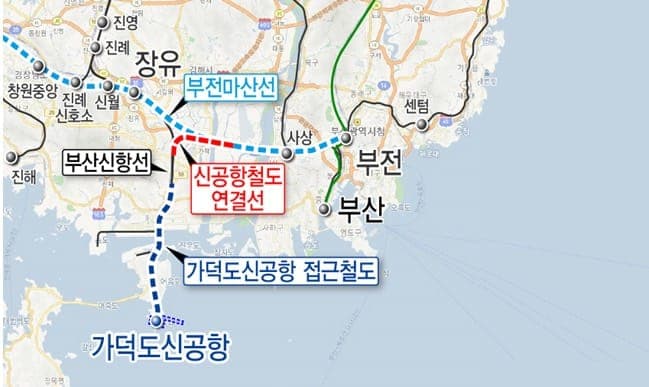
South Korea has approved the rail link for Gadeokdo New International Airport, advancing a project that Busan has long treated as essential to the airport’s viability. The approved work itself is limited: a 6.58-kilometer connectionlinking the under-construction Bujeon–Masan railway to the airport approach via the Busan New Port line, at a stated cost of 602.5 billion won. What matters is not the length of the new track, but the form of the system it confirms. Busan is not getting a self-contained airport railway.
The new airport will be tied to an existing heavy-rail corridor that already carries the weight of other policy goals, including regional integration and port access. That choice makes the project cheaper and easier to defend. It also means the airport’s rail connection will be shaped from the outset by conditions beyond the airport itself.
That is the point at which the official narrative becomes less straightforward than the approval headline suggests. A short connecting line can be presented as a breakthrough in access. It can also be read as confirmation that the state has chosen to fold the airport into a pre-existing corridor rather than build a passenger line around the airport’s own requirements. Those are not the same thing. One concerns funding. The other concerns what kind of service this line will ultimately be able to provide.
The distinction is especially important because the approved segment does not stand on its own. Its value depends on infrastructure that remains unfinished, above all the Bujeon–Masan line, where the government in February launched an independent investigation into the causes of delay and broader safety questions. The airport link has now cleared a political threshold. Its practical meaning will depend on whether the larger corridor it relies on can deliver the stability the project still does not control for itself.
This is why the rail approval deserves closer scrutiny than the usual language of progress invites. The issue is no longer whether Gadeok will have rail access. It will. The issue is what Busan has chosen to build in place of a dedicated airport railway, and what that decision implies for the line’s purpose, its limits, and the case for expecting passengers to use it at the scale planners need.
Why the Airport Was Tied to the Port Corridor
The first point to understand is that the newly approved link did not create the airport’s rail geography. It confirmed it. Long before this week’s decision, government planning had already placed the airport access railway on a 16.5-kilometer double-track line branching from the Busan New Port line toward Gadeokdo. The 6.58-kilometer segment now approved does not replace that alignment. It makes that alignment reachable from the inland network by connecting it to the Bujeon–Masan railway.
That sequence matters because it shows where the project began. The airport was not first conceived as the endpoint of a direct passenger railway extending outward from central Busan. It was placed on the nearest workable heavy-rail base on the New Port side, then brought into a wider regional frame. In planning terms, the corridor came first; the through-service story came later.
There were clear reasons for that choice. The first was proximity. The airport’s approach infrastructure was always going to be built from the Gangseo–New Port side, where both the access road and the rail corridor could be tied into existing transport assets. The second was cost. Using the Busan New Port line as the spine of the airport approach kept new-build mileage limited and avoided the far greater expense of constructing a long, dedicated airport railway from scratch. The third was institutional logic. A line routed through the New Port corridor could be defended not simply as airport access, but as part of a wider state project linking the future airport, the port, and the southeastern rail network.
That broader framing was not rhetorical ornament. It was part of the project’s political utility. The same alignment that gives the airport a rail connection also strengthens the case for improved freight movements between the port corridor and the inland network. Official materials and related reporting have repeatedly highlighted the expected reduction in freight rail distance between Busan New Port and Ulsan New Port, presenting the rail link as an asset for logistics as much as for air travel. In other words, the line was easier to approve because it could be described as doing several jobs at once.
That choice, however, settles the project on terms that are not primarily those of an airport passenger railway. The Busan New Port line was not laid out to maximize airport legibility, terminal-oriented service patterns, or the kind of operational simplicity associated with dedicated airport access. It was part of a freight-facing corridor. Once the airport is attached to that corridor, the rail service inherits its underlying logic. The line may serve airport passengers. It was not built around them. That is the distinction on which the rest of the project turns.
The approved connector therefore solves a specific problem, but not a neutral one. It allows trains from Busan and, in the official concept, from Ulsan to reach the airport approach without the awkward reversals or fragmented routing that would otherwise weaken the case for direct service. What it does not do is change the character of the base corridor itself. The airport remains tied to a rail spine chosen first for practicality and policy coherence, not for the purity of passenger access. That is why the line’s physical form cannot be treated as a technical footnote. It is the central fact from which the project’s later advantages and constraints both follow.
If that planning logic explains why the project passed, it also points to the next question. A line built on top of a port-facing corridor can be justified on paper. The harder issue is what kind of service such a corridor can sustain once airport access, regional passenger flows and existing rail functions begin to compete for space on the same system.
A Passenger Service on a Line Built for Other Priorities
The weakness in the approved scheme does not lie in the connector alone. It lies in what the connector joins. Once the airport is folded into the wider rail system, the question shifts from construction to use. The issue is no longer whether trains can be routed toward Gadeok. It is whether the corridor can absorb a new passenger function without losing coherence under the demands already placed upon it.
That problem begins at the point of movement rather than the point of map design. On a schematic diagram, the alignment promises reach: Busan to the airport, Ulsan to the airport, and a cleaner link between the port corridor and inland lines. On an operating railway, reach is not the same as capacity. Every additional path through a junction reduces flexibility elsewhere. Every claim of direct service has to survive the discipline of timetable construction, conflict management and recovery from delay. A line may be connected in theory and still prove brittle in regular service.
This is where airport access differs from ordinary rail expansion. A commuter line can tolerate some variation in spacing. Freight can sometimes be re-timed around congestion. Airport service is less forgiving. Passengers traveling with luggage and fixed departure times do not evaluate a rail link by its existence alone. They judge it by dependability: whether the train comes when expected, whether the journey is legible, whether the service remains intact when the rest of the corridor is under pressure. Those are not secondary questions. They are the essence of whether an airport railway succeeds.
The official case points to through-service and headline journey times, including 26 minutes from Bujeon and 92 minutes from Taehwagang under the government’s operating concept. Those figures are politically useful because they make the project legible at once. They also compress a more difficult reality. A passenger does not experience a corridor as a planning concept. A passenger experiences paths, intervals, delay propagation and service hierarchy. If the airport trains are fitted into a system already balancing regional movements and port-related functions, the published travel time tells only part of the story. The more important question is how often those timings remain dependable once the corridor is doing what it is meant to do all day, not only on a clean schedule.
The dependence on the Bujeon–Masan line sharpens the risk. That railway is not a settled foundation beneath the project. It is an unfinished and previously disrupted corridor whose delays and safety questions were serious enough to prompt a government investigation in February. That history matters because the airport connection is not autonomous. It inherits exposure from a line outside its own project boundary. A stand-alone airport railway would carry its own risks. This one carries borrowed risk as well. Approval of the connector does not eliminate that condition; it institutionalizes it.
The same logic applies to demand. The project may well attract riders. That is different from saying it will generate the kind of passenger base associated with a classic airport railway. Road access will remain a strong competitor, especially for group travel, heavy luggage and late-hour departures. The line’s long-term case therefore rests on more than airport passengers alone. It depends on whether a mixed-use corridor can persuade travelers that rail is not merely available, but preferable. That is a higher threshold than the approval narrative implies.
This is why the project should be read as a state-backed compromise rather than a pure passenger-rail decision. It is cheaper than a dedicated airport line. It is broader in policy scope. It can be defended as transport access, regional integration and port support at the same time. Those are precisely the qualities that make it intelligible in government terms. They do not guarantee that the line will feel coherent from the passenger’s side. A system assembled to satisfy several state objectives at once may still struggle to present a clear service identity to the people expected to use it.
The unresolved point, then, is not whether the railway has strategic value. It plainly does. The unresolved point is whether strategic value can be translated into a service pattern robust enough to shape behavior. That is where the project will stand or fail: not in the symbolism of access, but in the daily discipline of a corridor asked to do more than it was originally built to do.
Not an Airport Railway in the Classical Sense
What the state has approved for Gadeok is not a classic airport railway. It is a more improvised and more revealing piece of infrastructure than that. Rather than build a dedicated passenger line around the airport, the government chose to insert the airport into a corridor already burdened with other tasks: regional through-service, port access and wider network integration.
That choice explains both the project’s appeal and its limits. It made the scheme cheaper, more defensible and easier to package within national planning. It also ensured that the airport would enter the rail network on terms not entirely its own. The line will not be judged in the abstract, or by the neatness of the approval itself. It will be judged by whether a corridor assembled for several public purposes can function with enough clarity and reliability to serve one of them well.
That is the meaning of this approval. Busan has secured rail access to its new airport. It has not secured a dedicated airport railway, nor the simplicity that usually comes with one. What it has secured is a more contingent arrangement: a line whose value lies in the state’s ability to make a mixed-use corridor perform like a coherent passenger service when the airport finally opens.
Continue this reporting
Reporting on the same issue
Related coverage selected from the article's desk, topics and newsroom relationships.
 NewsOct 22, 2026
Busan Port’s LNG and Methanol Plan: Who Pays to Keep Fuel Ready?
Busan already supplies ships with LNG and methanol, drawing on regional and i...
 NewsOct 16, 2026
What Is Still Worth Going to See?
Busan’s biennale faces questions of artistic judgment and institutional care....
 NewsOct 14, 2026
What Became of Busan’s University Streets?
From 2015 to 2023, registered businesses grew near Pusan National University...
More from the author
More from this byline
Stay with the same line of reporting through more work from this byline.
- NewsOct 22, 2026
Busan Port’s LNG and Methanol Plan: Who Pays to Keep Fuel Ready?
 NewsOct 12, 2026
Bukangi, the Shark That Stayed in Busan’s North Port
Reader Signal
Community readWhat did this report leave you with?
Choose the signal that best reflects your reading. Select it again to remove it.
One response per article
No response selected
A moderated conversation about the reporting.
One-level replies and newsroom moderation keep the conversation anchored to this article.
Discussion Status
Open
Please sign in to join the discussion.
Newsletter
Weekly reporting and context from Busan and Korea.