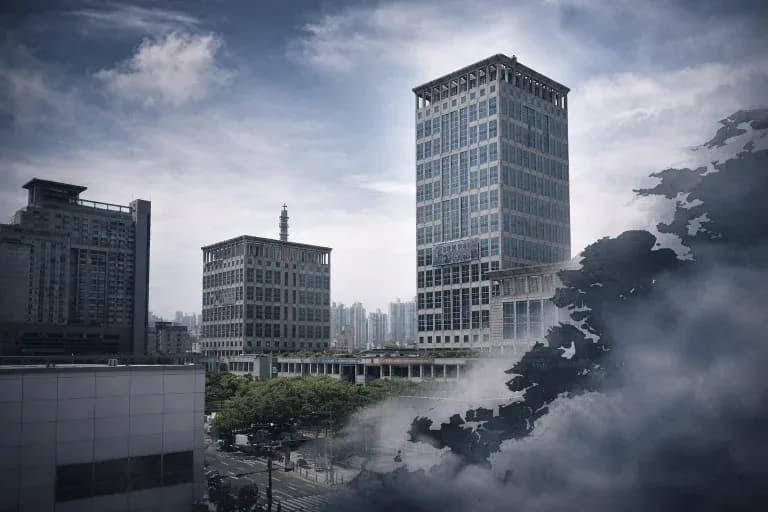
Busan Modernized Its City, but Lost Its Industry
Redevelopment reshaped the city, but industrial substitution never arrived. The next decade will test whether maritime innovation and physical AI can anchor a second industrial turn.


Busan, South Korea’s principal port city, is undergoing a transformation that exposes the limits of urban redevelopment in the absence of industrial replacement. Over the past decade, the city has pursued one of East Asia’s most ambitious spatial strategies—reorganizing itself around waterfront districts, smart-city enclaves, and a polycentric urban framework designed to reduce dependence on Seoul and diversify economic gravity. Yet the redesign has unfolded alongside demographic contraction, the erosion of its manufacturing base, and a quiet loss of national economic rank.
Incheon, a city once considered peripheral to Seoul, overtook Busan in gross regional product in 2023 and is projected to surpass it in population by the early 2030s. While Incheon’s ascent has been driven by high-value manufacturing, logistics, and biopharma clusters feeding off the capital region’s labor and capital pools, Busan has undergone a different trajectory: youth outmigration, venture capital retreat, and a rising share of low-productivity domestic services. National demographic statistics placed Busan as the first metropolitan municipality to meet the threshold for “extinction risk,” with aging advancing faster than either economic substitution or in-migration.
The contradiction is most visible at the interface between urban hardware and industrial software. North Port redevelopment and the Eco Delta City smart district signal competence in infrastructure delivery, and Gadeok Airport promises new international connectivity. Public waterfronts along Haeundae and Gwanganli illustrate how coastal amenities can be activated through planning. But none of these projects have replaced the functions once provided by manufacturing—jobs that retain talent, justify R&D investment, and anchor corporate headquarters. Without such functions, urban improvements raise consumption value but not productive capacity, leaving the city vulnerable to demographic shrinkage and downward shifts in economic specialization.
Busan’s predicament mirrors patterns observed in Kobe and Yokohama after the 1990s: port cities that executed large-scale redevelopment while struggling to secure new industrial drivers in logistics automation, maritime services, and advanced manufacturing. Rotterdam and Hamburg avoided similar stagnation by integrating port modernization with supply chain digitization, maritime R&D, and energy transition programs tied to hydrogen and ammonia bunkering. Busan modernized its spaces before modernizing its production ecosystem, and the sequencing matters.
The city now stands at a juncture where industrial policy, maritime geopolitics, and AI-driven automation converge. South Korea’s participation in U.S. naval and commercial shipbuilding reconfiguration under the MASGA program, the projected expansion of MRO and defense maritime markets, and the emerging category of physical AI—AI systems that interact with logistics, port handling, autonomous vessels, and sensor-dense industrial environments—introduce a strategic possibility that did not exist at the time of Busan’s 2040 urban plan. Whether that possibility can offset demographic decline and restore productive specialization is no longer a question of urban design but of industrial execution and global positioning.
Maritime geopolitics, defense MRO, energy transition, and physical AI now offer a second chance—if Busan can convert infrastructure into specialization.
Urban Hardware Without Industrial Software
Busan’s 2040 masterplan reimagined the city as a polycentric coastal hub built around ten functional cores, continuous waterfront access, and a fifteen-minute network of residential and civic amenities. The approach rejected the single-center hierarchy that had defined the Korean metropolitan system since the 1980s and attempted to distribute gravity away from the Haeundae–Seomyeon axis. The plan aligned with prevailing global urban doctrines drawn from Barcelona, Paris, and Copenhagen: shorten the distance between housing and service, reallocate road space, and monetize waterfront land through redevelopment rather than industry.
The physical results became visible by the mid-2020s. North Port progressed through its first redevelopment phase, and Eco Delta City emerged as a smart-city district equipped with digital water management, robotics pilots, and low-carbon systems. Public waterfronts improved in continuity and design quality, generating a coastal leisure belt that strengthened Busan’s position as a domestic tourism market. Gadeok Airport advanced past legislative hurdles, forcing new alignment between air and sea logistics. Local government demonstrated capacity to deliver projects at a scale that many advanced economies struggle to approve, let alone build.
Yet the plan contained an omission that would later shape economic outcomes. The spatial strategy presumed that improved livability, coastal amenities, and connectivity would attract talent, stimulate innovation, and catalyze new investment. That causal chain rarely materializes in the absence of industry. Cities that successfully converted urban hardware into economic specialization—Singapore’s digital port strategy, Rotterdam’s maritime R&D ecosystem, and Hamburg’s renewable logistics cluster—first secured high-value corporate functions and research institutions before they redesigned districts around them. Busan reversed the sequence: leisure and housing cores gained depth before the industrial ecosystem clarified its next domain.
The mismatch between hardware and software widened as manufacturing declined. Footwear, textiles, and ship components—the industries that supported employment and trade during the late twentieth century—contracted without generating successors capable of anchoring R&D, corporate headquarters, or venture investment. The service sectors that expanded in their place—tourism, retail, and hospitality—raised consumption but added little to productivity or export capacity. Urban space filled with amenities while the city’s economic specialization shifted toward activities that neither retain young workers nor reward higher education.
Population behavior confirmed the imbalance. Youth outmigration accelerated despite improvements in public space and coastal districts, and the age structure skewed faster than expected toward retirement cohorts. Demographic analysts traced the trend not to the absence of livability but to the absence of productive opportunity. Urban amenities can attract visitors and short-term residents, but they do not compensate for weak labor markets, thin corporate ecosystems, or the dominance of the capital region in venture capital, research, and headquarters functions. Upgraded waterfronts did not interrupt Seoul’s monopolization of innovation economics, and the polycentric plan did not prevent Busan from slipping into the national “extinction risk” category years ahead of other metropolitan jurisdictions.
The divergence between spatial improvement and economic contraction became clearest in district-level outcomes. Haeundae and Gwanganli achieved a form of gentrified coastal success, but North Port and older hillside neighborhoods exhibited the characteristics of post-industrial shrinkage: aging residents, stagnant retail, and limited capital inflows. Instead of producing distributed gravity, the polycentric model produced re-concentration. The city kept redesigning its surface while its industrial substrate continued to fade.
Loss of Industrial Specialization and the Hollowing Out of the Second City
Busan’s descent from South Korea’s second city to a demographically contracting coastal metropolis did not originate in urban form. The decisive shift occurred in the composition of its industrial base and the disappearance of a credible successor to the labor-intensive manufacturing that had once linked the port to global value chains. Footwear, textiles, and ship components supported exports and blue-collar employment through the late twentieth century, but none of these sectors accumulated the research, corporate, and financial functions required to sustain metropolitan specialization in the twenty-first. When these industries contracted, the void was not filled by higher-value maritime services, logistics technologies, or advanced manufacturing—functions that cities such as Rotterdam and Hamburg aggressively cultivated during their own port transitions.
The economic data captured the structural change. Busan’s gross regional product fell behind Incheon in 2023 and 2024, an inversion that symbolized the city’s failure to translate its coastal advantages into high-value production. Incheon leveraged its proximity to Seoul to attract corporate headquarters, biopharma, and semiconductor logistics, while Busan expanded consumption services—retail, hospitality, tourism, and domestic F&B—that upgraded amenities without raising productivity. Venture investment contracted sharply, with annual VC flows collapsing during the mid-2020s and startup formation losing momentum. The absence of headquarters and research institutions removed the corporate hierarchy that typically anchors human capital and absorbs graduates from local universities, producing a metropolitan labor market with limited professional depth.
Population movements confirmed the economic diagnosis. Young workers increasingly migrated to the capital region or overseas labor markets with higher wage gradients, stronger innovation ecosystems, and clearer advancement paths. Busan’s statistical designation as the first metropolitan “extinction-risk” jurisdiction reflected not only aging but also the erosion of its role as an internal migration destination. The city retained retirees and tourists, not engineers or entrepreneurs. Economic geographers have noted that demography follows opportunity, not built environment; the trajectory in Busan aligned precisely with that principle.
The loss of industrial specialization altered the city’s global relevance. Ports traditionally derive influence from their position in logistics networks and the maritime industries that surround them: ship finance, insurance, legal services, classification societies, MRO, naval procurement, and bunkering. Busan modernized the physical infrastructure of the port but did not capture the higher-value layers of the maritime economy. While Rotterdam and Singapore converted logistics into financial and technological services tied to energy transition, cybersecurity, and route optimization, Busan relied on container throughput without integrating corporate or research functions. Throughput alone generates activity, not accumulation.
The absence of accumulation explains Busan’s difficulty retaining firms and talent. Urban competitiveness depends less on amenities than on the capacity to build stacks of interdependent functions—headquarters, R&D labs, design units, brokers, funds, and regulatory interpreters—that convert industry into knowledge. When such stacks fail to form, cities default into consumption economies that reward tourism and hospitality but do not produce technological specialization, exportable services, or supply chain influence. The shift from production to consumption destabilized Busan’s position in the national hierarchy, allowing Incheon to surpass it in growth, youth retention, and industrial substitution.
South Korea’s metropolitan structure amplified the divergence. Seoul monopolized venture capital, research, corporate decision-making, and cultural markets, while Incheon benefited from adjacency to the capital region’s labor and capital pools. Busan lacked such adjacency, and the city’s attempt to compensate through urban hardware failed to counteract the structural concentration of innovation in the capital corridor. Modern cities do not grow by adding space; they grow by adding functions.
The gap between Busan’s physical modernization and its economic downgrading revealed the limits of waterfront redevelopment in post-industrial ports. Without a clear successor industry, the city lacked a mechanism to convert public investment into productive specialization. The infrastructure remained impressive, but the engine that gives infrastructure purpose did not arrive.
Maritime Geopolitics, Supply Chains, and the Physical-AI Turn
The industrial vacuum that followed Busan’s post-manufacturing transition did not close on its own. The next possible substitutions have emerged not from tourism or consumer services but from the reconfiguration of maritime geopolitics, supply chain realignment, and the automation of physical industries—domains that align with Busan’s structural endowments rather than its recent consumption economy.
The first signal came from defense maritime and shipbuilding. The United States’ attempt to rebuild commercial and naval ship capacity under the MASGA framework opened a channel for Korean yards and marine equipment suppliers to enter MRO and specialized construction markets that had been dormant for decades. Ship repair, naval MRO, sensor suites, and propulsion systems form a chain of activities that combine engineering, procurement, and regulatory expertise. Such functions are not mass-employment drivers, but they concentrate technical labor and create retention effects in cities able to supply engineers and technicians. Busan possesses the remnants of this ecosystem, and the MASGA shift marked one of the first geopolitical developments in which the city’s industrial past became relevant to its future.
Energy transition strengthened that relevance. The decarbonization of shipping under IMO timelines and the eventual introduction of ammonia, hydrogen, and methanol bunkering require specialized infrastructure and technical services that few ports can supply. Rotterdam leveraged that inflection to integrate maritime logistics with energy research, finance, and climate technology. Busan has not yet executed an equivalent strategy, but the structural opportunity exists: decarbonized shipping transforms ports from transshipment nodes into industrial coordination platforms linking shipyards, fuel producers, insurers, classification bodies, and data operators. Ports that adopt that role accumulate value; ports that do not become equipment landlords extracting rent from container volumes.
The second signal came from the rise of physical AI—systems that control robots, cranes, vehicles, sensors, and industrial processes in real-world conditions. Logistics, port handling, ship maintenance, naval systems, and urban utilities form some of the densest physical domains in any modern economy. Unlike digital AI, which produces network effects through data, physical AI produces returns through the control of matter: movement, precision, timing, and safety. The maritime sector represents one of the highest-friction environments in which these systems can operate. Singapore, Rotterdam, and several Japanese ports have treated automation as an industrial strategy, not an operational cost-savings exercise, using it to bind software firms, shipyards, insurers, energy majors, and logistics operators into a single maritime value chain.
Busan sits inside that domain, but the city has not yet converted geographic position into technological specialization. The port remains globally important in throughput ranking, but throughput alone does not determine maritime power. Maritime power now emerges from logistics software, safety automation, fuel transition, defense procurement, and ship services—functions that rely on research, engineering talent, and financial coordination. Busan modernized its quays and waterfronts but did not shape the maritime stack that defines competitiveness in the 2020s and 2030s.
A third signal emerged in the ecosystem-level approach seen in Eco Delta City and the maritime-oriented WAVE initiative. The projects outlined a framework in which AI, robotics, digital twins, and environmental systems could be tested on physical infrastructure. Such sites matter because industrial transformation depends on real-world validation, not laboratory demonstration. The physical city becomes a testbed, but only if the experiment produces industries rather than exhibitions. Without a pipeline to firms, capital, and procurement markets, smart districts become technological gardens—orderly, visually impressive, and economically inert.
Opportunities and constraints are symmetrical. Demographic contraction reduces the domestic labor pool for high-precision technical fields; the absence of headquarters limits capital allocation and decision-making; and the concentration of research and venture capital in Seoul restricts industrial clustering. Successful port transformations require accumulation: engineers, classification bureaus, marine insurers, specialized legal functions, OEMs, naval assets, and energy producers. Busan owns geography, port infrastructure, and historical industrial memory, but those inputs are insufficient without the organizational forms that convert them into market power.
The question is no longer whether Busan can remain a livable coastal city—redevelopment already answered that. The more consequential matter is whether the port can serve as the foundation for a second industrial turn in which maritime logistics, defense, energy transition, and physical AI converge into a specialization capable of retaining talent and attracting capital. Cities that fail to conduct such substitutions become consumption hubs that age gracefully but cease to participate in national growth. Kobe stands as the clearest parallel; Rotterdam and Singapore represent the alternative outcome. Busan has reached the point where the distinction matters.
The Limits of Spatial Planning and the Conditions of a Second Industrial Turn
Busan’s transformation as of the mid-2020s reveals the limits of spatial planning when industrial substitution and demographic renewal do not occur alongside it. The city upgraded its waterfronts, expanded civic amenities, and restructured its urban geometry, yet those improvements did not arrest the outflow of young workers or prevent the erosion of its national economic rank. Urban hardware cannot compensate for the absence of industrial software, and physical modernization does not automatically yield productive specialization. Busan rebuilt the stage before it secured the actors.
The failures embedded in the 2040 plan were not errors of ambition but of sequencing. The city assumed that livability and redevelopment would attract human capital, which would in turn attract firms, research, and investment. The causal chain never materialized. Manufacturing declined before a successor industry emerged; consumption services filled the void but lacked the accumulation properties—headquarters, research labs, design centers, and venture funds—that metropolitan economies require to reproduce themselves. The result resembled Kobe more than Rotterdam: redevelopment without reindustrialization.
Yet the possibility of a second industrial turn has not disappeared. Maritime geopolitics, defense MRO, energy transition, and the emergence of physical AI have reintroduced functions that favor port cities with technical labor pools and industrial memory. Unlike tourism or retail, these domains bind engineers, shipyards, classification societies, insurers, and software firms into clusters that retain talent and attract capital. If Busan can assemble such clusters, the city could regain relevance not as a consumer hub but as a node in the reconfiguration of global supply chains and maritime technologies.
The outlook depends on execution rather than vision. Industrial substitution requires headquarters, research institutions, and venture capital as much as it requires cranes and quays. Demographic retention requires labor markets rather than amenities. Ports generate leverage only when connected to energy transition, defense procurement, and logistics automation; otherwise they function as infrastructure without strategy. Seoul’s gravitational pull over capital and headquarters remains the largest structural constraint, and Busan must choose between alignment with the capital corridor and differentiation through maritime specialization.
Busan will not fail because it lacks waterfronts, airports, or smart districts; it will fail if it cannot convert geography into specialization and specialization into accumulation. Cities that escape post-industrial stagnation do so by anchoring themselves to industries that retain talent, not to amenities that attract visitors. The distinction will determine whether Busan becomes a second Singapore or a second Kobe—or whether it stabilizes as a coastal city that redeveloped successfully but ceased to matter economically.
If Busan fails to conduct a second industrial substitution, it will follow Kobe’s path: a well-redeveloped coastal city with shrinking relevance. If it succeeds, it could become the first major maritime hub in which physical AI defines economic power.
The Weekly Breeze
Keep pace with Busan's deep narratives.
Delivered every Monday morning.