Busan Welcomes Tourists but Loses Residents
Busan’s international content targets visitors rather than residents, investors, researchers, or entrepreneurs, limiting the city’s long-term international capacity.

Busan, South Korea — Busan launched a digital tourism archive this month, expanding a network of English-language platforms built for foreign visitors. The new site files photographs, videos, and festival brochures under the banner of “global outreach.” It joins Visit Busan, medical tourism campaigns, and workation portals that frame the city through beaches, cafés, and itineraries.
The city’s international content remains concentrated in tourism. English appears in guides and slogans but not in policy briefs, business procedures, zoning regulations, or university admissions. Foreign audiences are addressed as travelers, not residents, investors, or collaborators. The approach reflects a long-standing administrative convention in which global communication is treated as a form of hospitality.
Institutions as Attractions
The new tourism archive reflects a broader shift inside city hall. Projects that enter the administration as cultural or industrial initiatives exit as visitor-facing content. The international film festival becomes a photo-driven attraction, its programming reduced to red carpets and celebrity sightings on promotional channels. BEXCO’s conference calendar is rewritten as hotel-and-dining packages rather than sectoral meetings. Medical tourism advertisements focus on waterfront views and clinics without disclosing protocols, insurance requirements, or standards of care. Workation materials highlight rooftop decks and coffee shops while omitting visa rules, taxation, or employment restrictions.
English follows the same trajectory. The city translates menus, tour descriptions, and booking information, but not housing regulations, business licensing procedures, academic admissions, or cultural policy briefs. Foreign applicants for university programs must navigate Korean-only forms, deadlines, and administrative notices. Rental contracts, healthcare registration, and driver’s licensing remain opaque to anyone without Korean proficiency. The city speaks English for a week-long trip, not for a year-long stay.
Digital platforms reinforce the pattern. Visit Busan segments users into couples, families, and first-time visitors, then directs them to beaches, cafés, and seasonal festivals. Industrial areas in Yeongdo and Gijang, home to shipyards, logistics firms, and maritime research facilities, do not appear on the map. Neighborhoods with working populations are missing from itineraries because they offer no photogenic vantage points. Tourist-facing content organizes the city around consumption, not production or residence.
The archive’s metadata system confirms the approach. Images are tagged by scenery, event, and color palette. There is no tagging for sector, cost, congestion, accessibility, or governance. Records that cannot be translated into visual appeal are excluded. Traffic bottlenecks, visitor complaints, and environmental impacts remain undocumented. The archive records what is shown, not what is experienced or contested.
Language, imagery, and policy converge on the same audience. Foreigners are framed as temporary consumers who require guidance, discounts, and translated menus. They are not addressed as potential residents, investors, or collaborators. The tourism apparatus does not support enrollment, permitting, contracting, research affiliation, or hiring. It assists with booking, photographing, and departing.
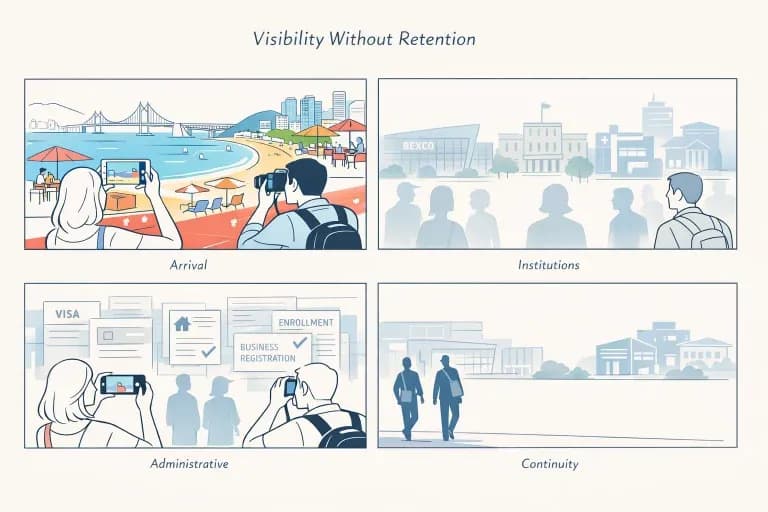
Visibility Without Retention
City departments evaluate tourism through visible metrics. Visitor counts, hotel occupancy rates, campaign impressions, and photo uploads generate numbers for annual briefings. Events that produce quantifiable attendance receive priority over programs that build institutional partnerships or long-term capabilities. Cultural funding flows toward seasonal festivals and waterfront installations because these projects generate imagery and crowds. Film commissions, research labs, and creative firms operate without equivalent visibility and therefore occupy a lower administrative tier.
Budget lines mirror the hierarchy. BIFF funding appears alongside tourism promotion despite the festival’s industrial and artistic functions. BEXCO reports attendance and bookings, not deal volume or sectoral outcomes. Workation programs are financed under tourism development rather than labor or housing policy. Medical tourism sits between healthcare promotion and destination marketing, with no budget category for treatment evaluation or patient outcomes. Institutions that could serve as nodes for research, investment, or creative production are accounted for as attractions.
The reporting system produces a loop. Platforms generate imagery; imagery produces impressions; impressions justify budgets; budgets expand platforms. Complaints about congestion, housing pressure, and service work precarity remain off-record because they cannot be converted into promotional numbers. Foreign students, remote workers, and entrepreneurs are absent from tourism statistics and therefore absent from tourism policy. Their needs fall into unassigned jurisdictions with no coordinating office.
Administrative procedures reinforce the visitor frame. Foreigners who want to enroll in universities, rent apartments, apply for residence permits, or register businesses must navigate paperwork with no English documentation. Immigration offices lack translation for forms beyond basic visa categories. Housing contracts are written for domestic tenants. Healthcare enrollment requires Korean intermediaries. The city supports short stays but offers no pathways for settlement, affiliation, or collaboration.
Tourism compresses time. Policies are organized around seasonal peaks—summer beaches, autumn festivals, winter lights—rather than multi-year strategies. The city communicates in campaigns and quarters, not in planning cycles. Industrial and research institutions operate on longer timelines that do not translate into visitor statistics. Without a metric that rewards continuity, sectors that rely on sustained cooperation remain disconnected from international-facing budgets.
Tourism also affects institutional language. Press releases, signage, and English-language websites rely on simplified vocabulary that guides rather than explains. Verbs cluster around visiting, exploring, tasting, and discovering. There is no register for regulation, negotiation, or governance. International communication functions as customer service. Policy remains monolingual.
The structure narrows Busan’s external audience. The city attracts tourists but does not retain students, researchers, or creative workers. Firms attend conventions but do not open offices. Film crews use locations but leave no studios or training programs. The platform invites arrival and discourages continuation.
Tourism’s reach reshapes the city’s industrial profile. Film crews arrive during festivals, but production facilities, editing studios, and training programs remain thin. Location fees and short-term rentals outpace investment in talent or equipment. Maritime logistics companies operate next to cruise terminals yet appear nowhere in tourism-facing materials. Creative firms rely on seasonal commercial work tied to festivals and brand campaigns. There is no mechanism to convert exposure into sustained employment.
Higher education follows a similar pattern. Universities host exchange students and short-term language programs, but full-degree international enrollment remains limited. Admissions forms, deadlines, and departmental notices are issued only in Korean. Housing for foreign students is insufficient and short-term. Academic conferences held at BEXCO bring researchers to the city, but proceedings are not archived in English, and collaborations seldom continue after delegates depart.
The startup ecosystem faces visibility without infrastructure. Foreign founders attend conventions and demo days but struggle with residency, taxation, and labor law. Accelerator programs target tourists interested in “workation” stays rather than entrepreneurs aiming to relocate. Co-working spaces price daily passes for visitors; monthly leases require paperwork and guarantors unfamiliar to foreigners. Promotional videos show laptops by the sea; they do not show contracts.
Labor conditions inside tourism remain narrow. Jobs concentrate in hospitality, retail, and event staffing with seasonal fluctuation and low wages. Tour guides, café workers, and hotel attendants see demand spike during festivals and collapse afterward. Industrial and cultural sectors that require stable employment operate on separate cycles that tourism policy does not address.
Foreign residents navigate a fragmented bureaucracy. Immigration procedures operate on national rules with minimal local support. Healthcare enrollment requires Korean intermediaries. Driver’s licenses, bank accounts, and municipal services lack English documentation. Foreigners may study, work, or invest in Busan, but none of these activities are recognized within the tourism-based understanding of international presence. The absence of administrative pathways separates the city’s visitors from its residents.
Cultural institutions adapt to the tourism frame. Exhibitions adjust signage and programming to attract non-Korean visitors during festival seasons. Theater and music events market photo zones and souvenirs alongside performances. Art spaces schedule openings around international event calendars. Programming follows the rhythm of festivals, not the needs of local artists or audiences.
The tourism frame also shapes the city’s narrative abroad. International coverage of Busan centers on beaches, seafood, and cafés. Travel guides list “hidden spots” and “must eats.” Media reviews of BIFF mention stars and venues rather than films. Cultural criticism fades behind itineraries. The city circulates as a backdrop rather than a cultural or industrial producer.
The cumulative effect is discontinuity. Foreigners visit but do not remain. Firms attend conventions but do not establish offices. Students enroll in short-term programs but not long-term degrees. Artists exhibit for festivals but lack year-round support. Exposure replaces participation. Busan becomes legible at the level of travel but not at the level of work, study, or collaboration.
Tourism makes Busan visible to foreigners but not legible to people who might live, study, or work in the city. Visitors are guided through beaches, markets, and festivals; residents face untranslated documents and fragmented procedures. Firms attend conventions without establishing offices. Students and researchers leave after short programs. Culture aligns itself with event calendars. The city welcomes arrivals and loses continuations.
The Weekly Breeze
Keep pace with Busan's deep narratives.
Delivered every Monday morning.


