How Autonomous BRT Is Redefining Accessibility in Busan
A late-night autonomous BRT service in Busan highlights a broader shift in urban mobility: from extending networks to sustaining everyday access in aging, post-industrial cities.

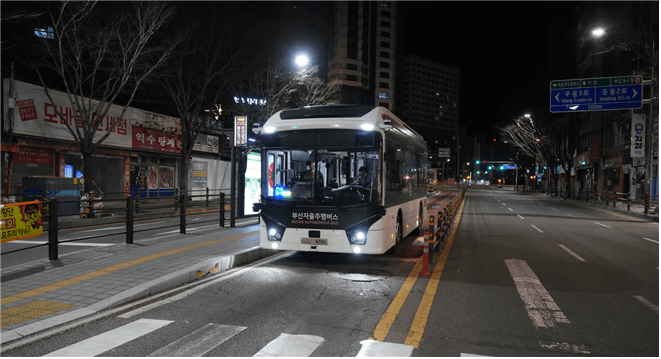
Busan, South Korea — Busan began operating an autonomous bus service on a BRT corridor during late-night hours when conventional public transport is typically reduced or suspended. The route runs on the surface, follows a fixed alignment, and limits boarding to seated passengers under direct safety supervision. The operating window—after 11:30 p.m.—targets a period that has long exposed the limits of labor-intensive transit operations.
The location of the pilot matters as much as the technology. Busan already maintains a dense subway network that reaches coastal destinations and major residential areas. Rail connectivity, however, has not translated into consistent accessibility across adjacent districts. Large sections of the Nakdonggang River industrial corridor remain characterized by aging populations, declining local commerce, and pedestrian environments shaped primarily by freight traffic and private vehicles. Subway stations exist, but daily movement between stations relies on long walks, vertical circulation, and transfers that discourage short, repeated trips.
Recent rail expansion has further complicated the picture. New underground construction has faced delays and rising costs linked to soft ground conditions, high groundwater levels, and complex subsurface infrastructure. Surface subsidence incidents near construction zones have drawn public attention to geological risk, while operating deficits persist on low-density extensions. In such contexts, the long-held assumption that rail connectivity alone can reactivate aging districts has weakened.
The decision to test automation on a surface BRT corridor reflects these constraints. Autonomous operation reduces exposure to labor shortages during low-demand periods. Dedicated lanes limit interaction with mixed traffic. Fixed routes simplify safety management. International transport research has consistently shown that automated public transit stabilizes first in controlled, geofenced environments rather than across general urban road networks.
The late-night autonomous BRT service therefore functions as an operational response to structural conditions rather than a symbolic deployment of new technology. In cities where population growth has slowed and industrial legacies dominate large urban areas, mobility challenges increasingly center on continuity, frequency, and ground-level access. The choice of surface automation signals a shift in how transit, accessibility, and urban regeneration are being reconsidered under mature-city conditions.
What the Autonomous BRT Pilot Reveals About Changing Mobility Demand
Late-night operation exposes weaknesses that daytime peak service often conceals. Across advanced transit systems, ridership declines sharply after midnight while operating costs remain largely fixed. Driver availability, labor premiums, and safety requirements push agencies to reduce frequency or suspend service altogether. The resulting mobility gap disproportionately affects shift workers, service-sector employees, and residents in peripheral districts.
Busan’s autonomous BRT deployment targets this imbalance directly. Automation does not aim to increase peak capacity or shorten travel times. The system preserves service continuity during periods when conventional operations become financially and logistically fragile. Reduced reliance on continuous driver staffing allows minimum frequency to be maintained where service would otherwise collapse. International transit research repeatedly identifies off-peak continuity—not maximum speed—as the primary constraint on equitable mobility in aging urban regions.
The selection of a BRT corridor follows the same operational logic. Dedicated lanes constrain vehicle behavior and limit interaction with mixed traffic. Fixed alignments reduce routing complexity. Boarding restrictions and supervised operation lower exposure during early deployment. Comparable pilots in Europe and East Asia have adopted similar configurations, advancing public transport automation first in environments where spatial and operational variables remain tightly controlled.
Demand patterns in aging districts further reinforce this approach. Short, repeated trips dominate daily travel where local services are dispersed and populations are older. Such trips respond sharply to access time, vertical movement, and waiting penalties. Subway systems, optimized for long-distance and high-volume flows, impose friction at precisely these points. Even where stations exist, platform depth, transfers, and extended walking distances suppress routine use outside peak periods.
The autonomous BRT pilot marks a shift away from network expansion as the primary measure of transit performance. Physical coverage already exists. Usability now determines whether movement remains possible when demand is low, trips are short, and physical tolerance declines. Surface automation addresses this constraint by preserving frequency and reducing access barriers rather than extending infrastructure further underground.
Taken together, the pilot reframes mobility priorities under mature-city conditions. Throughput gives way to continuity. Distance yields to reliability. In that context, autonomous operation functions as an operational instrument shaped by demographic change and uneven demand, not as a symbolic step toward speculative future transport.
Why Subway Connectivity Has Not Revitalized Industrial and Waterfront Districts
Busan’s subway network already reaches coastal endpoints, including Dadaepo. Line extensions have reduced regional travel time and improved access from the urban core. Yet districts between stations—particularly along former industrial corridors—continue to show limited signs of revitalization. Population aging, declining retail density, and weak pedestrian activity persist despite rail presence.
The mismatch lies in the spatial logic of rail systems. Subways operate through nodes rather than corridors. Stations concentrate activity at discrete points, while intermediate spaces remain largely untouched. This pattern suited periods of rapid growth, when station-area development could absorb demand and generate density. Under current demographic conditions, however, large segments of the city lack the population inflow required to trigger such effects.
Industrial districts along the Nakdonggang River illustrate the limitation. Areas spanning Saha District and Sasang Districtcontain long stretches of low-rise factories, logistics facilities, and aging housing stock. Subway stations serve as isolated access points, but daily movement within and between these areas depends on surface conditions. Long blocks, heavy truck traffic, and fragmented sidewalks raise the cost of short trips. Rail connectivity shortens regional journeys without restructuring local circulation.
Vertical access further compounds the problem. Underground stations require additional time and physical effort to reach platforms, particularly for older users. Elevators mitigate but do not eliminate this burden, and maintenance constraints often reduce reliability. Transfer penalties and platform depth discourage discretionary travel, especially outside peak hours. As a result, rail usage concentrates on longer, purpose-driven trips while everyday movement remains car-dependent or suppressed altogether.
Construction and operating conditions have also shifted the cost-benefit balance of rail expansion. Soft ground, high groundwater tables, and dense underground utilities increase construction risk and extend project timelines. Capital expenditures rise while ridership gains diminish in low-density extensions. Operating deficits grow as new segments serve fewer passengers over greater distances. Under such conditions, additional rail connectivity produces marginal accessibility gains while absorbing disproportionate resources.
The assumption that subway access alone can reactivate aging industrial and waterfront districts no longer holds. Connectivity has been achieved in a network sense, but access at the scale of daily life remains constrained. Rail lines pass through these areas without reorganizing how people move within them. Without continuous surface mobility and walkable environments, station-based access fails to translate into sustained local activity.
This pattern does not diminish the role of subways as regional backbones. High-capacity rail remains indispensable for metropolitan movement. The limitation arises when rail infrastructure is asked to perform tasks for which it is poorly suited: activating linear, low-density spaces and supporting short, repeated trips under conditions of demographic decline. Addressing those tasks requires a different layer of mobility, one aligned with ground-level circulation rather than underground throughput.
Surface Transit, Autonomous Operations, and Corridor-Based Regeneration
Surface transit addresses constraints that rail systems cannot resolve alone. Continuous alignment along streets reshapes movement at the scale of daily life. Stops remain visible. Access distances shorten. Walking, cycling, and transit operate as a single sequence rather than separate modes. Along linear districts shaped by industry and logistics, such continuity matters more than speed.
BRT and tram systems operate through corridors rather than nodes. Service lines trace streets block by block, creating multiple points of entry instead of isolated stations. This structure supports short, repeated trips that dominate travel in aging districts. Health care visits, local shopping, and social activities depend on predictable access rather than rapid regional movement. Where population density no longer supports large station-area redevelopment, corridor-based transit sustains everyday circulation without requiring major land-use transformation.
Operational constraints have historically limited the effectiveness of surface transit during off-peak hours. Frequency drops when labor costs outweigh demand, undermining reliability precisely when alternatives are scarce. Autonomous operation alters that equation. Reduced dependence on continuous driver staffing stabilizes service during late-night and low-demand periods. Fixed routes and dedicated lanes simplify supervision. Predictable environments lower safety risk and maintenance variability. Under such conditions, automation functions as a frequency-preserving mechanism rather than a capacity-enhancing one.
The implications extend beyond transport performance. Industrial and riverfront corridors along the Nakdonggang River suffer from long-standing disconnection between movement and place. Freight-oriented road design discourages pedestrian activity. Large blocks and limited crossings suppress local interaction. Transit that remains underground bypasses these conditions. Surface systems, by contrast, reorganize streets as shared civic infrastructure. Stops anchor small-scale activity. Improved crossings and sidewalks follow service demand. Gradual increases in foot traffic support incremental commercial recovery without large-scale displacement.
Tourism benefits emerge only after everyday use stabilizes. Waterfront destinations depend on reliable access across time, including evenings and non-peak seasons. Surface transit that residents trust during routine travel also serves visitors without requiring separate infrastructure. Late-night autonomous operation extends the functional day of waterfront areas while avoiding the cost structure associated with peak-oriented rail service.
Tram systems offer similar corridor effects where demand and funding permit fixed-guideway investment. Rail-based surface transit provides smoother ride quality and stronger place identity but carries higher capital costs and construction disruption. BRT offers greater flexibility and faster deployment, particularly in industrial zones where ground conditions complicate track installation. Both modes operate most effectively when paired with operational models that prioritize continuity over maximum throughput.
The integration of surface transit and autonomous operation therefore supports a form of regeneration distinct from landmark-driven redevelopment. Change proceeds incrementally. Mobility precedes land-value shifts. Daily use rebuilds presence before destination branding takes hold. In districts where large-scale growth is unlikely, this sequence reduces risk while restoring basic urban function.
Surface corridors do not replace regional rail. They complete it. Rail lines move people across the city. Corridor-based transit organizes movement within it. Autonomous operation strengthens that layer by sustaining frequency where conventional models withdraw. Together, these elements align transport investment with demographic reality, operational constraints, and the spatial logic of aging industrial and waterfront districts.
From Expanding Networks to Sustaining Everyday Access
Busan’s late-night autonomous BRT service occupies a narrow operational window, yet the conditions surrounding it are broad and structural. The service does not attempt to redefine urban mobility through speed or capacity. It intervenes where contemporary transit systems consistently falter: periods of low demand, corridors shaped by industrial legacy, and populations for whom access costs outweigh travel time.
The significance of the pilot lies in its alignment with these conditions. Surface operation lowers physical and cognitive barriers. Dedicated lanes narrow operational risk. Automation stabilizes frequency where labor-intensive models withdraw. Each element addresses a constraint that has weakened the ability of rail-centric strategies to support everyday mobility in mature cities.
Subway infrastructure remains indispensable as a regional backbone. High-capacity rail continues to anchor metropolitan movement and connect distant destinations. Yet the expectation that underground connectivity alone can reactivate aging industrial and waterfront districts has proven increasingly unreliable. Station-based access leaves intermediate spaces unchanged. Vertical circulation and transfer penalties suppress short, repeated trips. Rising construction risk and operating deficits further limit the marginal gains of expansion.
Surface transit operates within a different logic. Corridor-based service reorganizes movement at ground level, where daily life unfolds. Stops distribute access along streets rather than concentrating it at nodes. Walking, cycling, and transit converge into a single system of movement. When combined with autonomous operation, this layer maintains continuity across time, extending mobility into late-night and off-peak periods without imposing peak-oriented cost structures.
The implications extend beyond transport policy. Along the Nakdonggang River and similar industrial corridors, mobility functions as a prerequisite for regeneration rather than its byproduct. Continuous access enables incremental change. Local activity returns before large-scale investment. Waterfront areas shift from isolated destinations to lived spaces. Tourism follows stability rather than substituting for it.
The autonomous BRT pilot does not signal a rejection of rail, nor does it promise a technological solution to urban decline. It marks a recalibration of priorities under conditions of demographic aging, uneven demand, and constrained public resources. In such contexts, the central challenge is not extending networks further, but sustaining accessible movement where growth is no longer guaranteed.
Cities confronting similar conditions face a comparable task. Effective mobility systems now require layered roles rather than singular solutions: rail for reach, surface transit for continuity, and operational technologies for resilience. The quiet appearance of a driverless bus late at night suggests that the future of urban transport may be shaped less by expansion and spectacle than by the capacity to maintain everyday access across space, time, and social change.
The Weekly Breeze
Keep pace with Busan's deep narratives.
Delivered every Monday morning.