Busan’s Infrastructure Expansion in an Era of Demographic Decline
Busan’s future will be determined not by how quickly vehicles cross the city, but by whether urban policy allows life to take root where the roads no longer stop.

Busan, South Korea — Busan is expanding its infrastructure at a moment when the city itself is contracting. The population has fallen to roughly 3.25 million, while the proportion of residents aged 65 and older has surpassed 24 percent, the highest among Korea’s metropolitan cities.
Young adults continue to leave for the Seoul metropolitan region, driven not by housing conditions but by employment prospects and long-term opportunity. For many in their twenties and thirties, Busan has become a place to grow up—but not a place to build a future.
The result is a shrinking tax base supporting an increasingly older population, a demographic reality that now defines the city’s economic and fiscal horizon.
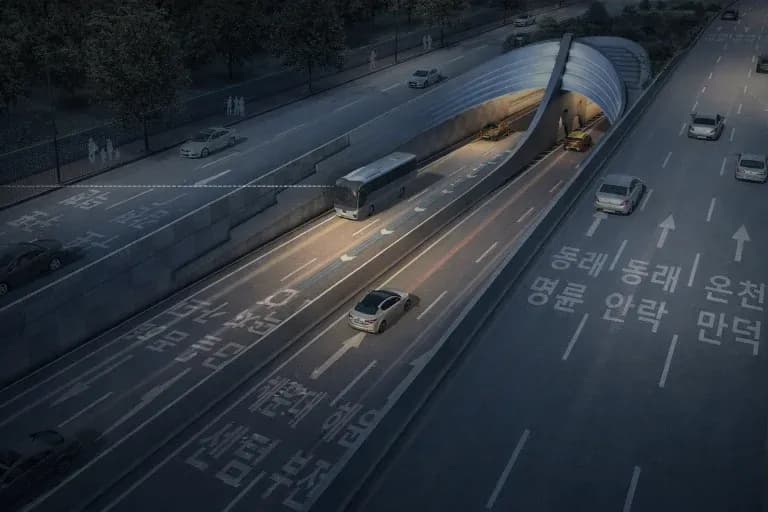
Urban policy, however, remains anchored to assumptions formed in an era of growth. New tunnels, expressways, and large-scale transport projects continue to extend Busan’s physical footprint, reinforcing a development model built on expansion rather than adjustment. The opening of the Mandeok–Centum Underground Expressway in February 2026 captures this contradiction. Travel between western and eastern Busan will become dramatically faster, yet the project enters service at a time when daily urban life is thinning rather than intensifying.
Infrastructure once functioned as a mechanism for integration, binding neighborhoods, labor markets, and commercial districts into a coherent system. In today’s Busan, infrastructure increasingly operates as a mechanism for cost accumulation. Roads and tunnels require decades of maintenance, revenue compensation payments to private operators, and recurring public subsidies, all financed by a population that is both shrinking and aging. The tension is not temporary or cyclical; it is structural. Infrastructure presumes demographic stability, while Busan’s population trajectory points in the opposite direction.
Busan’s infrastructure expansion is unfolding against a demographic backdrop that leaves little margin for error. Population decline has persisted for years, with no indication of reversal, while aging accelerates across nearly every district. This shift reshapes labor supply, consumption patterns, housing demand, and public finance simultaneously. Unlike economic downturns, demographic contraction does not self-correct. Each cohort that leaves or ages out permanently alters the city’s capacity to sustain itself.
Infrastructure, by contrast, operates on long timelines and fixed assumptions. Roads, tunnels, and bridges demand decades of upkeep and predictable revenue streams. In cities that continue to grow, those costs are distributed across a larger population. In Busan, they are concentrated on a smaller and older one. Expansion therefore transforms infrastructure from a growth asset into a fiscal exposure.
The imbalance is amplified by rising social expenditure. Healthcare, welfare, and elderly services claim a growing share of municipal budgets precisely as infrastructure-related costs become locked in. Competition for fiscal resources intensifies, narrowing policy flexibility. Investment in physical networks limits the city’s ability to fund everyday services that sustain urban life, from neighborhood renewal to labor-market support. Over time, expansion ceases to be a strategy and becomes a constraint.
Busan’s dependence on toll roads reflects this structural vulnerability. More than any other metropolitan city in Korea, Busan has relied on public–private partnership expressways to overcome geographic constraints. For years, toll financing appeared to offer an efficient solution, shifting construction costs off public balance sheets while user fees covered long-term operation.
That model rests on sustained demand. In Busan, demand is weakening. Population decline, aging residents, and shrinking commuter flows undermine traffic volumes that toll roads depend on. When projections fall short, compensation mechanisms embedded in concession agreements are activated. Revenue gaps are filled by municipal finances, not by users. Infrastructure initially framed as privately financed gradually reverts into a public liability.
Recent peak-hour toll exemptions illustrate the shift. The policy eases household transport costs, but the expense remains intact. Lost toll revenue is reimbursed to private operators, transferring the burden from drivers to taxpayers, including residents who do not use toll roads. The system ceases to function as a user-pay model and begins to resemble deferred public debt.
Each new expressway extends this exposure. Compensation obligations accumulate, constraining future administrations in a city with limited growth prospects. Declining usage does not lead to downsizing; it leads to greater subsidy. Over time, the toll-road network magnifies fiscal stress precisely when Busan’s capacity to absorb it is weakest.
Faster connectivity has not produced a more integrated city. Instead, transport infrastructure has reinforced a spatial division between production, residence, and consumption. Western Busan has consolidated its role as an industrial and logistics zone, while eastern districts have become increasingly residential and consumption-oriented. Underground expressways now link these two ends of the city directly, compressing distance while bypassing the urban fabric in between.
The Mandeok–Centum Underground Expressway exemplifies this pattern. By connecting western neighborhoods to Centum City in minutes, the corridor accelerates movement between workplaces and high-value residential districts. Districts situated along the surface route—Jung-gu, Dong-gu, Yeongdo-gu, and parts of Busanjin-gu—are increasingly excluded from the flow of people and economic activity. Traffic disappears underground and re-emerges elsewhere, leaving local streets quieter and local economies thinner.
Urban vitality depends on circulation that pauses. Pedestrian movement, local commerce, and informal encounters require friction as much as speed. Deep underground corridors reduce friction by design, turning urban space into a passage rather than a place. Congestion does not disappear in this model; it relocates. Exit points around Centum City and the Suyeong River corridor absorb intensified pressure, concentrating stress where land values are highest.
Housing markets mirror the same logic. Improved accessibility has been capitalized into property prices in eastern Busan, rewarding existing owners without attracting new workers or families. Holding value rises while use value stagnates. Younger households face higher barriers to entry, reinforcing outmigration and demographic imbalance. Selective asset concentration and expanding vacancy elsewhere signal hollowing rather than recovery.
Busan has largely solved the problem of physical connectivity. Mountains no longer dictate travel times, and east–west movement has reached unprecedented speed. Demography, not geography, now defines the city’s constraint.
Infrastructure built for expansion does not shrink gracefully. Roads and tunnels persist as demand fades, drawing resources from a smaller pool of residents and taxpayers. Compensation payments, maintenance costs, and long-term obligations accumulate quietly, even as everyday urban life contracts. The process advances gradually, embedded in budgets rather than crises.
Adapting does not mean abandonment. It means shifting investment from speed to stability, from new corridors to existing neighborhoods, and from movement alone to the conditions that allow people to stay. Infrastructure can mask decline by accelerating movement, or it can deepen decline by eroding cohesion and fiscal capacity.
Cities rarely disappear overnight. They empty over time, as movement replaces settlement and assets outpace people. Busan’s future will be determined not by how quickly vehicles cross the city, but by whether urban policy allows life to take root where the roads no longer stop.
The Weekly Breeze
Keep pace with Busan's deep narratives.
Delivered every Monday morning.