The Structural Split Between Seoul and Busan’s Housing Markets
The widening gap between Seoul and Busan is not a temporary price divergence, but the outcome of two housing markets that now operate under different structural logics.

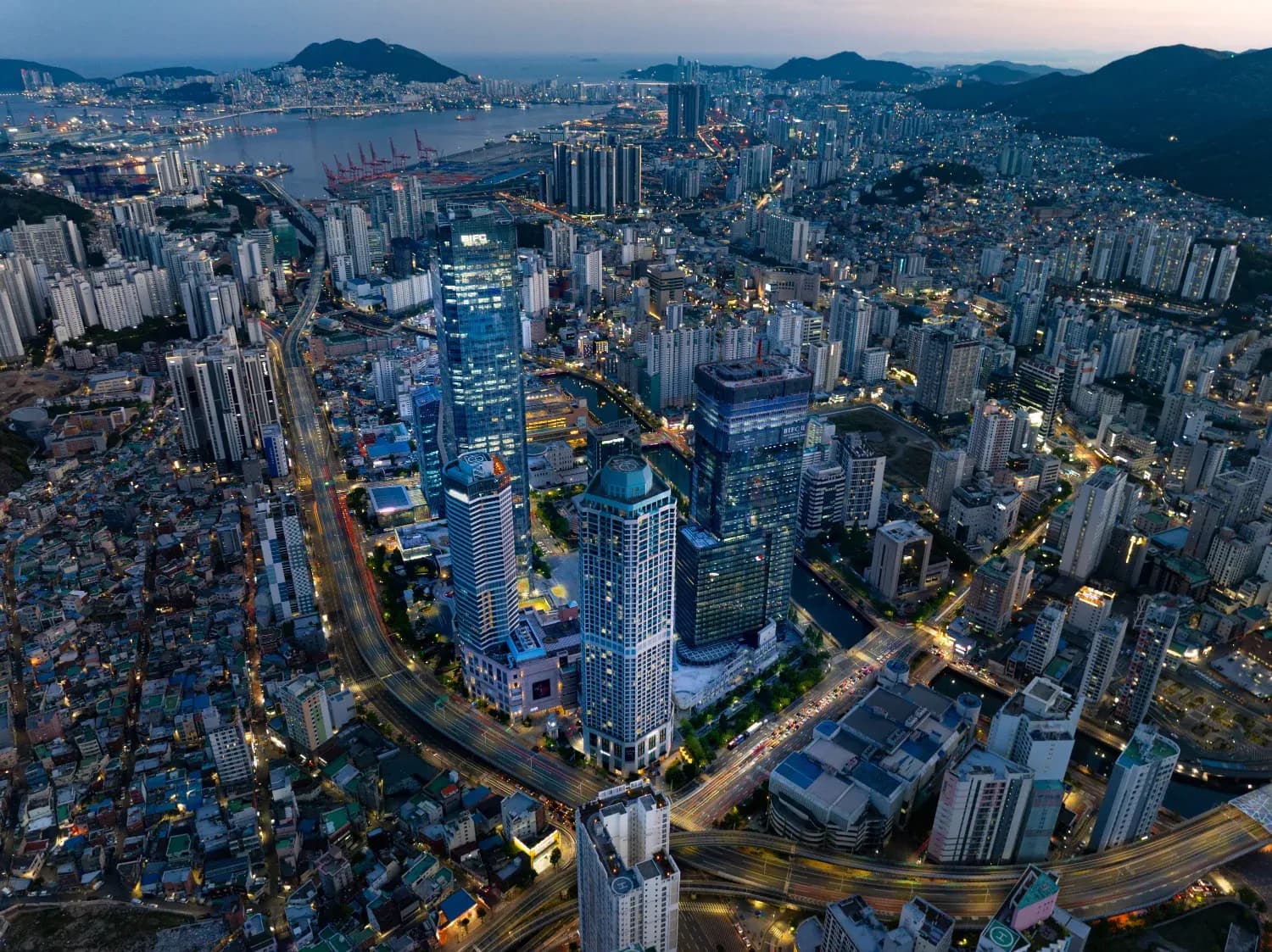
Seoul and Busan now sit in the same national economy but inside different housing regimes. The separation is visible in how quickly each market reconstituted itself after the 2022 credit shock and, more importantly, in what recovered first—turnover or valuation.
The transaction collapse in 2022 was nationwide and severe. Seoul’s apartment trades fell to 41,207 from 166,847 at the 2020 peak; Busan dropped to 38,595 from 132,574. Liquidity disappeared across both cities, compressing differences by force rather than by convergence. When activity returned, the gap reopened immediately. Seoul recorded 83,922 apartment trades in 2023 and 91,302 in 2024; Busan rose to 50,001 and 52,054. The same tightening cycle produced two recoveries: one that restored scale, and one that restored only motion.
Price formation separated even more sharply in 2025. With March rebased to 100, Seoul’s apartment price index rose to 107.49 by December. Busan slipped to 99.35. A gap of 8.14 index points opened in nine months. This is not a technicality of indexing. It is a description of what the marginal buyer is paying for. In Seoul, the marginal price moved higher even under constrained turnover. In Busan, transactions resumed without re-rating the asset.
The divergence also appears inside each city, where market breadth matters as much as market direction. Busan’s transaction map remains structurally narrow. In 2024, the top five districts accounted for 53.1% of apartment trades, a level of concentration that has persisted across cycles and signals reliance on a small residential core and on peripheral supply absorption rather than a citywide repricing. Seoul’s concentration is materially lower—36.3% in the top five districts in 2024—yet the distribution has been drifting toward upper-tier districts over time. The centre of price gravity and the centre of trading gravity increasingly overlap.
The mechanism is straightforward. Seoul prices housing as a scarcity-bound asset held by balance sheets; the market clears through wealth capacity more than through volume. Busan prices housing as residential stock; the market clears through mobility and replacement demand, with limited ability to convert local turnover into durable revaluation. In a single national policy environment, these are two different ways of producing a home price. One system compounds; the other circulates.
Seoul: Price Formation Under Scarcity and Balance-Sheet Power
Seoul’s apartment market recovered without restoring liquidity. The distinction matters. After the 2022 contraction, transaction volumes rebounded only partially, yet prices re-established upward momentum. In 2023, apartment trades rose to 83,922 units from 41,207 a year earlier; in 2024 they reached 91,302. Both figures remain far below the 2020 peak of 166,847. The recovery restored activity, not turnover. Price behaviour adjusted accordingly.
The price response diverged from volume early. During the rebound, Seoul’s price index stabilized first in upper-tier districts and then resumed its ascent, despite thin trading. This sequence points to a market clearing through ownership capacity rather than exchange frequency. Fewer transactions were sufficient to sustain higher prices because sellers faced limited pressure to liquidate and buyers were drawn from balance sheets able to absorb elevated entry costs. Liquidity ceased to be the disciplining force.
Distributional shifts inside the city reinforce the mechanism. While overall transaction concentration in Seoul remains lower than in other metropolitan markets, the allocation of trades has migrated steadily toward upper-tier districts over time. By 2024, the top five districts accounted for 36.3% of apartment transactions, a level that has held through contraction and recovery alike. More telling than the level is the direction: transaction shares moved toward districts where price resilience was already established, even as total market activity stayed subdued. Capital followed certainty.
Lower-tier districts did not collapse. Transactions continued, and prices adjusted modestly rather than violently. The gap widened not through distress but through accumulation. As upper-tier prices recovered first, the relative distance expanded, locking in disparities created during the 2019–2021 surge. Entry into the asset core became a function of accumulated capital rather than incremental income gains. The ladder did not break; it moved out of reach.
This structure explains why policy and macro conditions produced muted effects. Higher interest rates constrained marginal buyers but left incumbent owners largely insulated. Credit tightening reduced churn without forcing repricing. In such an environment, scarcity operates differently. With limited new supply in core districts and long holding periods among owners, price discovery relies on a narrow set of transactions that anchor expectations upward rather than downward.
Seoul’s housing market now behaves less like a conventional urban property market and more like an asset market with residential characteristics. Circulation has slowed, but valuation persists. The city clears through wealth retention, not through exchange. That condition defines the first half of the national divide: a market where housing compounds because it is scarce, held, and increasingly inaccessible to income-based entrants.
Busan: Turnover Without Revaluation
Busan’s apartment market recovered through movement, not repricing. After the 2022 contraction, transactions resumed across the city, yet price formation remained inert. The distinction defines Busan’s current housing regime.
Apartment trades fell sharply in 2022 to 38,595 units, broadly mirroring Seoul’s collapse in scale. The rebound followed in 2023 and 2024, lifting annual transactions to 50,001 and 52,054 respectively. Unlike Seoul, however, the recovery did not alter valuation trajectories. Turnover returned without resetting expectations. Housing changed hands, but prices did not re-rate.
The reason lies in where activity concentrates. Busan’s transaction structure is persistently narrow. In 2024, the top five districts accounted for 53.1% of all apartment trades, a level of concentration that has remained elevated across cycles. This is not a temporary clustering driven by a single project or policy window. It reflects a market dependent on a limited residential core and on peripheral absorption zones rather than on broad-based repricing across the city.
Within that structure, roles are clearly differentiated. Prime residential districts defended nominal price levels, but did not generate outward momentum. Transactions there signaled stability rather than growth. Peripheral districts absorbed new supply and population movement, contributing volume without appreciation. Older urban areas continued to trade at lower levels, supporting mobility but offering little prospect of capital recovery. Each segment performed its function; none altered the aggregate valuation profile.
Income dynamics reinforce the pattern. Unlike Seoul, Busan lacks a concentration of high-growth, high-wage sectors capable of reinforcing housing prices through income expansion. Transaction demand is therefore dominated by replacement and settlement rather than by balance-sheet driven accumulation. Buyers clear the market by matching housing needs to affordability constraints, not by stretching valuations in anticipation of capital gains. In such a system, higher turnover does not translate into higher prices.
Credit conditions amplify the difference. Interest rate tightening reduced speculative leverage nationwide, but its effect in Busan was asymmetric. With fewer balance-sheet buyers and limited external capital inflow, price discovery remained anchored to local purchasing power. Transactions resumed as households adjusted, downsized, or relocated within the city. Valuation remained bounded.
The result is a form of stabilization often misread as weakness. Busan’s housing market did not fail to recover; it recovered into its role. Apartments function primarily as residential stock, circulating to accommodate mobility and demographic adjustment. Without an economic multiplier to convert turnover into durable repricing, appreciation remains episodic and localized. Stability replaces ascent.
This produces a different kind of lock-in. Mobility persists, but reclassification does not. Owners can move; assets do not graduate. The market settles into place rather than compounding forward. That condition defines the second half of the national divide: a housing system that circulates efficiently while remaining structurally capped.
Recovery as a Filter, Not a Reset
The national housing downturn of 2022 briefly compressed regional differences by force. Liquidity vanished across markets, transactions collapsed simultaneously, and price discovery stalled. That phase ended quickly. What followed did not restore balance. It filtered markets according to function.
As credit conditions stabilized in 2023, transactions resumed nationwide. The pace varied, but movement returned in most metropolitan areas. Prices did not follow the same path. Capital re-entered selectively, gravitating toward locations where return certainty outweighed volume risk. Recovery became asymmetric by design.
Seoul absorbed the first wave of repricing. Thin trading proved sufficient to reset benchmarks upward, reinforcing the asset logic already in place. Markets outside Seoul recovered primarily through turnover. Volume returned without valuation following, particularly where income growth and capital inflows remained limited. The distinction widened as normalization progressed.
This pattern extends beyond Busan. Other regional metropolitan markets show similar characteristics: active transactions, restrained price movement, and dependence on local purchasing power rather than external capital. Housing outside Seoul increasingly clears as consumption infrastructure, not as a capital store. The divergence is therefore not a bilateral anomaly. It reflects a national allocation mechanism.
The 2025 price indices confirm continuity rather than reversal. With March rebased to 100, Seoul’s apartment prices advanced steadily through the year. Busan’s index drifted lower in real terms. The gap widened again under stable macro conditions, without policy shock or speculative acceleration. Recovery reinforced separation.
What appears as a widening “price gap” is more accurately a sorting process. Markets capable of compounding retained upward pressure even under constrained liquidity. Markets dependent on circulation stabilized without repricing. Credit tightening and subsequent easing did not equalize outcomes; they clarified roles.
This clarity carries implications for regional policy debates. Efforts to narrow the housing divide through supply adjustments or regulatory symmetry address surface conditions, not underlying allocation. Without mechanisms that alter income generation, capital attraction, or industrial density, price convergence remains unlikely. Recovery cycles will continue to amplify existing differences rather than erase them.
The post-2022 period therefore marks a transition. Housing markets no longer move together during recovery. They separate according to economic function. Asset-centered markets revalue; residence-centered markets circulate. The national divide hardens not through crisis, but through normalization.
Diverging Internal Geographies: How Seoul and Busan Split From Within
The widening gap between Seoul and Busan is mirrored by a deeper split inside each city. The difference lies not in the scale of divergence, but in its form. Seoul fragments through stratification. Busan fragments through segmentation.
Busan’s internal geography remains structurally narrow. In 2024, the top five districts accounted for 53.1% of all apartment transactions, a level of concentration that has persisted across multiple cycles. This is not the result of a single development wave or a short-lived preference shift. The same districts repeatedly absorb the bulk of market activity, while the remainder of the city participates intermittently. Concentration functions as a baseline condition rather than a cyclical outcome.
Transaction flows reveal how this narrowness operates. Between 2019 and 2024, transaction shares increased most sharply in districts such as Nam-gu, Gangseo-gu, Sasang-gu, and Gijang-gun. The pattern does not describe a citywide repricing led by a rising core. It describes a division of roles. Certain districts serve as defended residential anchors, maintaining price levels without transmitting momentum. Others act as absorption zones, accommodating new supply and population movement without altering valuation benchmarks. Older urban areas circulate at lower price points, supporting mobility but contributing little to aggregate revaluation. The city reallocates activity without expanding its asset perimeter.
Seoul’s internal map shows a different dynamic. Overall concentration is materially lower than in Busan, with the top five districts accounting for 36.3% of apartment transactions in 2024. The critical change lies in direction rather than level. Over the past five years, transaction shares have migrated toward upper-tier districts such as Seocho, Seongdong, Dongjak, Mapo, and Gangnam. This shift has occurred despite repeated contractions in total liquidity. The market has not narrowed; it has graded itself more steeply.
In Seoul, transaction survival signals asset status. Districts that continue to transact during periods of tight credit become price benchmarks rather than volume centers. Trading activity there confirms valuation rather than discovering it. Lower-tier districts do not collapse, but their relative position deteriorates as upper-tier prices reset first and hold. The gap widens through accumulation rather than distress. Access to the asset core becomes progressively capital-dependent, while the remainder of the city stabilizes without catching up.
The contrast between the two cities reflects three mechanisms operating simultaneously. First, price formation in Seoul is anchored by capital depth and balance-sheet capacity, while price formation in Busan remains bounded by local purchasing power. Second, spillover operates asymmetrically. In Seoul, repricing in upper-tier districts reshapes expectations across adjacent areas, steepening internal gradients. In Busan, prime districts defend value without generating outward revaluation, isolating gains rather than distributing them. Third, recovery dynamics amplify existing structures. During contraction, differences compress mechanically. During normalization, capital returns selectively, reinforcing stratification where asset logic dominates and segmentation where residential logic prevails.
These internal geographies explain why aggregate comparisons obscure more than they reveal. Seoul’s divergence emerges from a tightening asset ladder within a single, integrated market. Busan’s divergence emerges from a city divided into functional zones that trade without compounding. The gap between the two cities is therefore not only interregional. It is embedded in how each city now produces, distributes, and limits housing value.
Fragmentation Without Convergence
The widening distance between Seoul and Busan is often described as a question of scale. Prices rise faster in one city, stagnate in the other, and the gap grows accordingly. The evidence suggests a different explanation. The gap persists because the two cities no longer fragment in the same way.
In Seoul, internal differentiation takes the form of stratification. Districts do not fall away from the market; they are reordered within it. Upper-tier areas reset benchmarks under constrained liquidity, while lower-tier areas stabilize without catching up. The result is a steeper internal ladder, not a broken one. Housing compounds where capital concentrates, and access tightens without triggering widespread distress.
In Busan, fragmentation follows a different logic. The city divides into functional zones that trade without compounding. Prime residential districts defend value without transmitting momentum. Absorption districts accommodate movement and supply without altering valuation. Older urban areas circulate at lower levels, sustaining mobility while remaining disconnected from asset reclassification. The market reallocates activity, but its perimeter does not expand.
These two forms of fragmentation respond differently to recovery. During contraction, differences compress mechanically as liquidity disappears. During normalization, capital returns selectively. Stratified markets reprice from the top. Segmented markets stabilize without revaluation. Recovery does not correct divergence; it sharpens it.
This distinction matters because it reframes the national housing question. The divide is not simply between an expensive capital and lagging regions. It lies between housing systems that accumulate value and housing systems that circulate without compounding. Policy symmetry cannot reconcile this difference. Supply adjustments and regulatory alignment affect access and turnover, but they do not alter how and where value is produced.
As long as high-value activity remains spatially concentrated, stratification will deepen where asset logic prevails, and segmentation will persist where residential logic dominates. The housing gap will continue to widen quietly during downturns and decisively during recoveries—not as an aberration, but as the normal outcome of a country operating under two incompatible urban housing regimes.
The Weekly Breeze
Keep pace with Busan's deep narratives.
Delivered every Monday morning.