150 Years After Opening, Busan Reveals the Port–City Paradox
Busan’s port thrives, but modern maritime value is captured elsewhere — and without command functions, logistics cannot sustain a city.

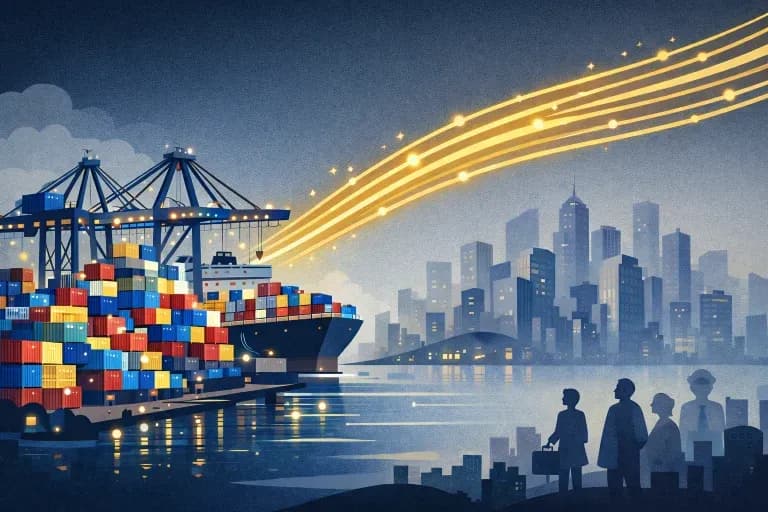
Busan marks the 150th anniversary of its opening as a modern port in 2026 amid an uneasy contradiction: container volumes climb, yet the city itself weakens. South Korea’s second city once handled nearly one in three dollars of national trade; today, it accounts for less than 8% of GDP and sheds young workers at the fastest rate among major metropolitan regions. The cranes at Busan New Port operate around the clock, moving more than 22 million TEUs a year and ranking sixth globally by throughput. No other Korean city has a comparable maritime footprint. Yet the corporate decisions that determine ship finance, insurance, route pricing, ESG compliance, or arbitration rarely occur within city limits. Those functions sit in Seoul, Tokyo, Singapore or London, and increasingly inside multinational carriers’ headquarters.
The divergence between a thriving port and a shrinking city has become too visible for local slogans to conceal. Busan’s population has fallen below 3.3 million from a peak of 3.9 million in the mid-1990s; the share of residents under 30 has dropped by more than a third over two decades. High-value jobs follow the trend. Fewer than 3% of South Korea’s listed companies are headquartered in Busan, down from more than 10% in the mid-1980s, and only one conglomerate among the national top thirty retains a primary executive office in the region. The city’s unemployment rate appears modest on paper—hovering around 3%—but the figure masks a labor market built on low-wage services, logistics contractors, and public-sector stability rather than private R&D or advanced producer services. Industrial policy since the 1970s placed petrochemicals, steel, and machinery in Ulsan, Pohang and Changwon, leaving Busan the role of handling exports rather than shaping them.
South Korean officials now present Busan as a future “maritime capital,” a green-shipping hub linked to the Arctic sea route, offshore energy, and ocean risk. The vision carries strategic merit: global decarbonization will reorder maritime supply chains, and geopolitics around the Korean Strait is tightening. Yet the city’s fundamentals point to a different problem—ports generate volume, not necessarily urban productivity. From Rotterdam to Kobe, containerization and automation have stripped ports of their traditional role as dense employers and decision centers; the value migrated to insurers, financiers, data firms and regulators embedded in capital cities. Busan’s trajectory aligns with that pattern rather than breaking from it.
The question facing Busan in the mid-2020s is not whether the port can expand, but whether the city can reclaim economic functions that matter: headquarters, research, finance, arbitration, or regional governance. Absent those functions, the cranes will keep moving, but the city behind them may continue to lose relevance—an outcome increasingly visible in demographic charts and corporate registries rather than speeches.
| Year | Throughput | Growth Trend |
|---|---|---|
| 2019 | 21.99 | |
| 2021 | 22.71 | |
| 2023 | 23.15 | |
| 2024 | 24.40 | |
| 2025 (Final) | 25.02 |
| Year | Population | % of Peak |
|---|---|---|
| 1990 (Peak) | 3,854,960 |
|
| 2010 | 3,414,950 |
|
| 2024 | 3,266,598 |
|
| 2025 (Final) | 3,246,304 |
|
Maritime Ambition vs. Value Capture
Busan’s maritime ambition rests on undeniable scale. The port handled more containers in 2025 than Kobe, Yokohama and Kaohsiung combined, and remains the only Northeast Asian hub where transshipment accounts for more than half of total throughput. No Korean city disputes its logistical primacy. Yet the structure of the maritime economy has shifted away from the docks. Containerization, automated terminals and standardized freight systems have depressed labor intensity across global ports since the late 1990s. The International Association of Ports and Harbors estimates that productivity per dockworker has multiplied almost eightfold in two decades, while direct port employment fell or stagnated in nearly every advanced port city. Busan mirrors that pattern: cranes, not workers, drive the skyline south of Gadukdo.
The higher tiers of the maritime value chain migrated elsewhere. Ship finance sits in London, Oslo, Hamburg and Singapore; marine insurance remains anchored in Lloyd’s and the P&I clubs; arbitration gravitates to Singapore and London; carbon-intensity disclosures and ESG compliance center on regulators and data firms in capital cities. Even South Korean carriers route key decisions through Seoul. HMM’s executive committee meets in the capital; KSS Line and Sinokor run treasury and chartering from Seoul’s CBD; the large industrial state lenders that underwrite shipbuilding and fleet investment are supervised from Yeouido. The container stacks in Busan may belong to the world, but the spreadsheets governing them belong to headquarters.
Global freight volatility after 2020 briefly raised hopes that logistics hubs would regain strategic power. Freight rates to Europe surged more than 600%, and Korean carriers posted record margins. The boom bypassed Busan’s urban economy. Carriers deployed profits into fleet expansion, foreign terminals, and corporate balance sheets. None shifted headquarters or advanced services to the port city. The disconnect illustrates a structural fact: ports no longer determine the distribution of maritime rent in an industry where capital, insurance, charters, and data dictate margins.
Without command functions, maritime rhetoric struggles to translate into metropolitan resilience. Busan’s shipping cluster offers a cautionary composition: subcontractors, equipment suppliers, and stevedores form a large base, while legal, financial, actuarial and risk-analysis capabilities remain thin. Universities train officers and marine engineers, but few institutions cultivate maritime arbitrators, claims specialists, actuaries or carbon accounting experts. In a sector increasingly defined by emissions regulation, insurance reserves and compliance audits, the absence matters more than the size of the quay.
The city’s renewed focus on Arctic sea routes and green shipping reflects geopolitical awareness, not institutional reality. Arctic cargo volumes remain volatile and heavily state-influenced; green corridors require the participation of insurers, banks and regulators rather than transshipment hubs. The early players in the space—Maersk, NYK, MSC, MOL and COSCO—coordinate ESG transition through head offices and maritime states, not port municipalities. Busan can supply the berths and bunkering, but the strategic decisions that define the industry have already migrated upstream.
The Mega-Region Without Integration
South Korean planners frame Busan as the prospective coordinator of a tri-city economic block linking Ulsan’s industrial base and Gyeongnam’s machinery cluster. The geography appears logical on a map: a contiguous corridor along the southeastern coast containing more than eight million people, South Korea’s densest network of export industries, and a GDP per capita that rivals mid-tier European regions. Manufacturing in Ulsan alone accounts for nearly 6% of national GDP, and Gyeongnam’s machine-tool and robotics firms anchor hundreds of supply chains across East Asia. Such mass should support a regional brain — a city that sets agendas, pools talent and aggregates research.
Integration has not materialized. Administrative consolidation stalled after a cycle of political reversals between Seoul and the provincial governments, and the concept of a “Bu-Ul-Gyeong” metropolitan authority receded to white papers and mayoral speeches. The absence of governance mechanisms is visible in transport: commuter flows between the three jurisdictions remain fragmented by fare systems, time penalties and limited rail frequencies. Labor markets remain segmented; firms in Changwon recruit locally for machinists and process engineers, while engineers in Ulsan circulate primarily within the petrochemical and automotive complex. Few incentives encourage young workers to relocate across the corridor, and no cross-regional strategy links universities to industrial demand.
Corporate geography further limits the metropolitan logic. The heavy industries of Ulsan report to headquarters in Seoul or global capitals; the machine-tool makers of Changwon sell to automakers across the world but seldom lodge design or R&D functions in Busan. The city in the middle becomes a consumption hub — retail, tourism, logistics — rather than a command center. Metropolitan regions prosper when a dominant city captures coordination functions; Greater Tokyo aggregates planning, finance, research and culture for the Kanto basin, and Nagoya performs a similar role for Chubu’s automotive belt. Busan performs none of these roles for its own corridor.
Universities in the region do not yet substitute for metropolitan governance. National research expenditure remains concentrated in Seoul and Daejeon; the southeastern corridor hosts strong engineering faculties but few graduate programs in data, maritime law, energy economics or arbitration — fields that would anchor advanced producer services. Patent activity in Ulsan and Changwon reflects factory-floor innovation rather than knowledge-sector agglomeration. The gap matters: megaregions convert factories into ecosystems only when design, policy, finance and compliance accumulate in the same place.
The political economy behind the impasse predates contemporary megacity rhetoric. Industrial policy in the 1970s placed export manufacturing along the coast but centralized control in Seoul; the legacy persists in regulatory discretion, finance, and national R&D budgets. Without jurisdiction over capital, permits, research, or taxation, Busan cannot claim the coordinator role that European megaregions assume by design. The southeastern corridor thus functions as a supply chain, not a metropolitan organism — productive on paper but institutionally mute.
Events Without Institutions
Busan’s campaign to reinvent itself as a host of global forums and maritime finance gatherings grew more assertive after 2010. The city secured international conventions on offshore energy, climate and shipping compliance; hotel inventories expanded; and the Busan International Film Festival maintained its status as Asia’s most influential film market outside Hong Kong. The strategy aligns with a familiar playbook. Barcelona, Singapore and Dubai all used conferences to brand themselves as connective platforms between industries and regions. Yet those cities entered the MICE market with institutional depth — arbitration centers, specialized courts, research institutes, tax regimes and banks — functioning as the ballast beneath the events. Busan moved in the opposite order.
Conference statistics illustrate the asymmetry. Delegates and exhibitors fill hotels along Haeundae and Centum City for three to five days; the city’s tourism bureau reports healthy room rates and restaurant bookings during major events. The post-event trace is thinner. Corporate registries show no acceleration of headquarters relocations linked to conferences; no major insurer or P&I club has placed underwriting authority in the port city; no global carrier has shifted chartering, treasury or compliance teams south. The film festival brings global media executives every autumn, but the Korean content industry’s legal, financing and distribution decisions continue to pass through Seoul. Conventions supply spectacle without altering where decisions are made.
The attempt to graft niche finance onto the events strategy exposes the jurisdictional constraints facing the port city. Maritime finance requires authority over capital rules, documentation, arbitration, tax and supervision. All of those levers reside in Seoul. The financial cluster in Busan’s International Finance Center reflects the imbalance: public institutions, quasi-governmental organizations and back-office units dominate the tenant roster. Few desks possess direct underwriting power; virtually none hold global mandates. Treasury and risk teams from carriers, shipyards and insurers remain concentrated in Seoul’s CBD, where legal, accounting and regulatory networks co-locate. Office towers do not constitute a financial center; enforcement and specialization do.
The shipping boom during the pandemic underscores the structural gap. Container carriers generated windfall earnings, prompting speculative talk of maritime finance revival along the Korean coast. Capital markets tell a cooler story. Equity and debt issuance, hedging strategies, vessel acquisition financing and ESG disclosures all routed through Seoul or foreign jurisdictions. Funds did not chase office space near Haeundae; lawyers and bankers did not establish permanent teams in the port city. The cycle confirmed that market participants treat Busan as infrastructure, not as an arena for financial judgment.
The city’s MICE ambitions retain promotional value, and major events offer windows into new industries. They do not, however, substitute for institutions. Without judicial competence in arbitration, regulatory discretion in finance, or research scale in maritime technology and climate policy, conferences become temporary populations rather than metropolitan assets. The competitive advantage accrues to the hotel sector, not the command economy.
The Liveability Trap
Busan’s physical profile invites comparisons with Mediterranean coastal cities. The peninsula’s southeastern edge folds into coves and steep urban ridges; housing districts rise toward coastal viewpoints; maritime breezes temper summer heat. Surveys conducted by private research firms show consistently high scores for “ease of living,” “food culture,” and “amenities.” Domestic realtors routinely market the city as a retirement option for Seoul’s middle class. The framing is flattering and economically precarious.
Liveability rarely correlates with metropolitan dynamism in the absence of productive sectors. Busan’s demographic structure exposes the contradiction. Since 2000, the city’s over-65 population has almost doubled, while the cohort aged 20 to 39 has shrunk by more than one-third. Migration flows tell a sharper story. Young residents migrate north toward Seoul and its satellites in pursuit of career trajectories that involve research, finance, design, software or executive tracks; retirees and self-employed workers move to Busan for amenity value and lower housing costs. The result resembles patterns seen in mid-sized European leisure cities: consumption increases, but knowledge-intensive employment does not.
Labor statistics confirm the shift. Roughly seven in ten new jobs created in Busan over the past decade fall within low-wage services — retail, hospitality, tourism, caregiving and logistics subcontracting. Advanced producer services remain thin. The metropolitan region hosts negligible concentrations of venture capital, private equity, maritime law firms, arbitration centers, energy traders or carbon-accounting consultancies. R&D expenditure per capita stands at less than one-third of the national average, and patent activity skews toward mechanical and automotive applications generated in Ulsan and Changwon rather than Busan proper. A city can be pleasant to inhabit while losing the functions that generate metropolitan command.
Property markets reinforce the trajectory. Demand from retirees and investors sustained beachfront districts and older hillside neighborhoods, but the market has not induced substantial commercial development outside of retail and hospitality. Office vacancy in major districts remains elevated, reflecting limited corporate entry and the absence of headquarters relocations. The pattern resembles elements of Barcelona’s evolution after its post-1992 tourism boom, when international allure intensified but corporate governance and high-value industries failed to densify at comparable pace.
The political rhetoric of a “slow city” glosses over the structural stakes. Without mechanisms to retain young talent or attract advanced services, liveability becomes a euphemism for deindustrialization. The city risks functioning as a venue for consumption and retirement, not as an engine of production or coordination. Once a metropolitan region reaches that balance, reversal is costly. Cities that surrender their command functions seldom recover them, regardless of geography or amenity.
Command Functions Decide the Winner
Ports once created cities. Industrial shipping clustered finance, law, brokerage and labor into tight coastal corridors. Busan rose through that logic and peaked when its harbor served as both warehouse and balance sheet for a country rebuilding after war. Contemporary logistics no longer plays by that script. Headquarters, compliance, arbitration, carbon pricing and capital allocation now determine where maritime value settles, and those functions sit far from the quay. The pandemic’s freight supercycle did not raise wages or expand advanced services in Busan, nor did it pull corporate treasuries or risk committees to the shoreline. The money moved, the containers moved, and then the ships left.
Korea’s political economy compounds the structural shift. Industrial policy in the 1970s and 1980s placed steel, petrochemicals and machinery in coastal factory zones while consolidating headquarters, finance and regulation in Seoul. That allocation hardened over time. Capital market licensing, mid-career talent pipelines, and institutional investors orbit the capital’s legal and regulatory core; research expenditure and federal labs concentrate in Seoul and Daejeon; and the country’s most ambitious graduates treat the metropolitan region as the default arena for software, finance and design. Busan absorbs the consumption side of the system — tourism, retail and logistics — but holds little authority over capital, compliance or research. Geography alone cannot counteract jurisdiction.
Demography reinforces the imbalance. A shrinking youth cohort and an expanding retiree base weaken the city’s capacity to accumulate institutions. Universities lose competitive students; firms lose recruiting pools; public agencies adjust priorities toward amenities rather than innovation. The southeastern manufacturing belt remains productive, yet it reports to headquarters in the capital and draws R&D externally. Megaregional rhetoric offers cartographic logic but not metropolitan power. Without shared taxation, research, planning or transport regimes, the corridor functions as a supply chain rather than a political or economic organism.
Geopolitics offers opportunity but not immunity. Arctic shipping, green corridors and emissions regulation will redraw maritime hierarchies in the 2030s. The cities that will capture value from that reordering already invest in standards, arbitration, insurance and carbon analytics. Singapore’s dominance owes less to latitude than to jurisdiction; Rotterdam’s resilience rests on energy transition assets, not container numbers; Hamburg pivoted into media and logistics software rather than anchoring its identity to docks. Busan’s comparative advantage remains visceral and under-utilized — a large port situated on a strategic strait between the Japanese archipelago and the Korean Peninsula — yet no major institution in the city shapes the rules of the sea.
The city’s future hinges on whether it can claim any command function of its region or sector. Headquarters, research institutes, regulatory powers, arbitrators, data firms and capital desks anchor metropolitan relevance more decisively than cruise terminals or conferences. A port without command functions becomes infrastructure; a city without command functions becomes scenery. Busan still possesses the scale, geography and industrial hinterland to avoid that outcome, but the margin narrows. The cranes will keep working regardless of what the city chooses. The question is whether anyone with authority will choose to work in the city behind them.
The Weekly Breeze
Keep pace with Busan's deep narratives.
Delivered every Monday morning.