When Smart Glasses Stop Looking Like Computers
The most successful smart glasses are learning to disappear. Their next challenge may be what everyone else loses when the computer becomes difficult to see.

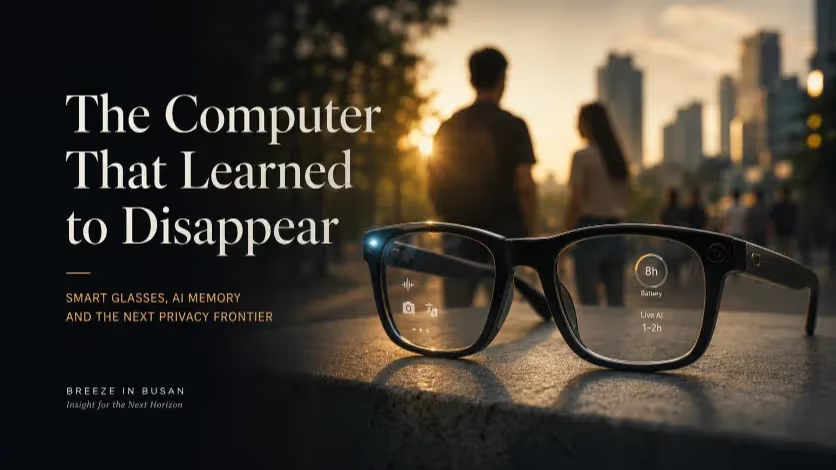
AI eyewear is becoming useful by disappearing into familiar frames. The same engineering choices that reduce weight, heat and interface friction are also erasing the signals that once told everyone nearby when a computer was recording, searching or interpreting the world.
On May 25, 2026, Meta began selling Ray-Ban Meta and Oakley Meta glasses in South Korea, bringing a category long associated with prototypes and early adopters into a market accustomed to rapid adoption of connected consumer devices. Ray-Ban Meta Gen 2 arrived with a 12-megapixel camera, open-ear audio, Meta AI and a claimed battery life of up to eight hours under typical use, yet none of those specifications was as important to the product’s social presence as the object into which they had been fitted. The electronics remained inside frames whose visual language belonged unmistakably to conventional eyewear. At conversational distance, the technological character of the device could recede almost completely. The most commercially established version of Meta’s glasses still placed no display in front of the eye; computing had entered the frame without requiring the wearer to turn toward a screen.
Less than three weeks later, Seoul education authorities were telling schools how to recognize a computer that happened to look like glasses. A June 11 notice instructed schools to include AI smart glasses among prohibited examination items and advised supervisors to pay attention to unusually thick temples or students repeatedly touching the sides of their frames. The immediate trigger lay in a broader examination-security problem: two candidates had been caught using AI glasses during TOEIC tests held on May 10 and May 31, although the devices involved were not established as Meta products. More revealing than the individual cases was the form of the administrative response. Institutions accustomed to removing phones and other recognizable electronics were being asked to infer computational capability from the thickness of an eyeglass frame and the movements of the person wearing it. By August, Korean reporting was already questioning how long such visual checks could remain useful as newer designs moved closer to the weight and silhouette of conventional glasses.
The ambiguity was deepening at roughly the same pace as the usefulness of the devices. Meta added Korean-language live translation on July 6, expanding the feature from six languages to twenty and allowing translated speech to reach the wearer through speakers embedded in the temples. South Korea’s Personal Information Protection Commission had meanwhile joined other privacy regulators at a G7 roundtable in Paris on June 25 and 26, where smart glasses appeared among emerging AI privacy issues. In a July policy plan, the commission placed the category more directly on its domestic agenda, saying it would develop principles for personal-data processing and protection suited to smart-glasses environments. Within weeks of commercial launch, the same form factor had entered three different institutional vocabularies: consumer electronics, examination security and privacy regulation.
Those Korean developments belong to a larger market transition. EssilorLuxottica says sales of the AI glasses it developed with Meta exceeded seven million units in 2025, driven by Ray-Ban Meta and Oakley Meta. IDC estimated that smart glasses without displays shipped about 2.25 million units worldwide in the first quarter of 2026, up 167 percent from a year earlier; under IDC’s market definition, Meta held a 69.2 percent share. The figures should not be confused with estimates for display-equipped augmented-reality devices, which constitute a technically and commercially different segment. Even with that distinction, the direction is clear. The first smart-glasses category to reach millions of consumers is not the one that most closely resembles the augmented-reality future the industry spent years describing. It is the one that leaves the visual field largely alone.
Multimodal AI helps explain why such restraint has become commercially useful. Cameras and microphones no longer serve only as hands-free tools for photographs, video and calls; they can provide context to software capable of translating speech, recognizing objects, reading text and answering questions about the wearer’s surroundings. Yet AI alone does not explain why the form factor is beginning to work. Smart glasses have spent more than a decade confronting a physical problem: how to place sensing, computing, connectivity, power and eventually visual output on the human face without producing something that continually feels like a computer. The current market has advanced in part by declining to solve every part of that problem inside the frame. Displays can be omitted, computation distributed, and interaction shifted toward voice and audio. Those choices reduce weight, heat and optical complexity. They also remove many of the physical gestures through which personal computing once made its presence visible to everyone nearby.
The Computer That Learned to Disappear
For years, smart glasses were measured against a vision of augmented reality in which digital information would occupy the wearer’s field of view as naturally as physical objects. The first sizeable consumer market has developed around a less visually ambitious architecture. Ray-Ban Meta retains the outward-facing camera, microphones, speakers and AI connection while leaving the wearer’s view optically conventional. Google has since formalized a similar distinction within Android XR, separating glasses built primarily around audio and contextual assistance from models that add private visual information inside the lens. The screen-free category can move toward everyday use sooner because it avoids an optical system that remains disproportionately difficult to fit into glasses people are willing to wear for hours.
A smartphone can place a luminous panel behind a sheet of glass and invite the user to look directly at it. Optical see-through glasses have to preserve the physical world while delivering a second image into the eye, usually through some combination of a miniature display, projection optics and a waveguide or comparable optical path. Every stage introduces losses and manufacturing tolerances that ordinary screens do not face. Outdoor visibility demands brightness; brightness consumes power; wider fields of view place greater demands on the optical system, while the image has to remain visible as the frame shifts slightly on the wearer’s face. A useful display therefore arrives with its own burdens of power, heat, alignment, size and yield before the processor has performed any AI inference at all.
A TechInsights teardown of Meta Ray-Ban Display provides an unusually concrete view of the resulting economics. The firm estimated that display-related components represented 50.8 percent of the bill of materials for the glasses-and-Neural-Band system, compared with 15.7 percent for Qualcomm components. The percentages belong to one product rather than to an industry-wide rule, but they correct a common intuition about wearable AI hardware. The most expensive or difficult element need not be the silicon performing inference. In transparent eyewear, an enormous share of the engineering effort can be consumed by the attempt to deliver a small amount of generated light to a moving human eye with sufficient brightness and stability while preserving the qualities that allow the device to remain believable as glasses.
Removing the display leaves many of the functions whose position on the face creates the greatest value. A camera near the eyes can approximate the wearer’s point of view; microphones can receive speech without another object being raised; open-ear speakers can return information without redirecting visual attention. Other parts of the system can reside elsewhere. A paired phone can supply connectivity, applications and additional processing, while remote infrastructure can handle workloads that would be difficult to sustain inside the frame. From the wearer’s perspective, that distribution can almost disappear: looking at an object and asking a question feels like a single local interaction even when the information passes through several pieces of hardware before the answer returns.
Miniaturization in smart glasses therefore differs from the familiar story in which each generation compresses a more complete computer into a smaller enclosure. The frame becomes more convincing partly because some functions have been narrowed, postponed or moved elsewhere. The visible machine grows simpler while the system behind it remains distributed and complex, and the arrangement works best when the person using it no longer needs to think about those seams. Personal computing has long rewarded such disappearance. Eyewear introduces a new consequence because the interface can recede not only from the owner’s attention, but also from the observation of everyone else sharing the interaction.
The Physics of the Face
The human face gives hardware engineers almost none of the spatial freedom available inside a smartphone. Batteries cannot spread across a broad rectangular chassis; heat-producing components remain close to skin; temples still have to fold; lenses have to maintain optical alignment; and mass added at the wrong point can become uncomfortable even when the total weight remains modest. The internal volume is narrow, irregular and divided across two sides of the head, while the exterior has to satisfy expectations attached to an object that is at once optical equipment, something worn on the body and an element of personal appearance. Component size alone therefore tells only part of the story. Shape, weight distribution, thermal behavior and peak power all become properties of the wearable experience.
Meta’s battery program shows how deeply those restrictions reach into components that appear mature elsewhere in consumer electronics. Its engineers developed steel-can cells as narrow as seven millimeters because conventional battery packages waste too much of the limited volume available inside a temple and become increasingly difficult to use efficiently as dimensions shrink. The company replaced a conventional wound internal structure with stacked, die-cut electrode layers that could make better use of the frame’s narrow geometry. According to Meta, capacity increased from about 160 milliamp-hours in the first generation to 210 milliamp-hours in Gen 2, while the underlying chemistry remained essentially unchanged. Longer runtime came from the larger cell together with improvements in hardware, firmware and power management; the display-equipped model, whose screen creates a more sustained electrical load, required a larger battery again.
The contrast between advertised mixed-use endurance and continuous AI makes clear why battery life cannot be understood independently of workload. Meta markets Gen 2 with up to eight hours of typical use, but at its 2025 Connect event the company said its then-current real-time AI could run for roughly one to two hours and that an assistant capable of remaining continuously available throughout the day remained an engineering objective. Occasional photography, audio playback and intermittent commands allow sensors and processors to spend much of their time in lower-power states. Sustained visual or acoustic awareness requires cameras, image pipelines, radios and inference workloads to remain active far more frequently. A pair of glasses can therefore remain powered for most of a day without supporting the strongest version of an ambient computer for the same period.
Putting more intelligence on the frame changes where those constraints are paid rather than removing them. Local processing can reduce latency and limit the amount of raw sensory information sent to a remote service, advantages that matter for both performance and privacy. The processor still consumes energy and produces heat in an enclosure where additional battery capacity and thermal dissipation are unusually expensive. Sending heavier workloads elsewhere relieves some of that pressure while restoring dependence on connectivity and an external data path. Optical systems exhibit the same interdependence: greater brightness requires energy, broader visual coverage demands more complex optics, and a larger battery eventually becomes extra mass on the wearer. Progress consists less in defeating a single bottleneck than in redistributing several of them without allowing any one cost to make the glasses unwearable.
The prominence of traditional eyewear companies follows directly from this engineering reality. Google has repeatedly argued that intelligent glasses become genuinely useful only if people are willing to wear them for long periods, which is why partnerships with companies such as Gentle Monster and Warby Parker belong inside the technical strategy rather than arriving later as an exercise in branding. Meta’s collaboration with EssilorLuxottica rests on the same logic. The chassis cannot first be optimized as a computer and subsequently disguised as eyewear; acceptable weight, battery volume, component placement and external form are already being dictated by what people are prepared to put on their faces.
Screen-free models, distributed computing, narrow batteries and voice-led interaction have emerged from those physical limits. The social consequences come from the same decisions. Every component removed from the visual field, and every action shifted away from a handheld device, makes the machine less intrusive to the person using it while reducing the number of outward signs through which someone else can tell that computation has begun.
The Signals Computing Used to Give Away
Operating earlier personal computers usually required a visible departure from whatever a person was already doing. Photographing someone meant raising a camera or phone. Looking up information during a conversation required reaching for a device, unlocking it and shifting visual attention toward a screen. Translation often placed a handset between two speakers or caused one participant to look down while the other waited. Interface designers reasonably treated those movements as friction because they stood between intention and execution, and much of the history of mobile computing can be read as an effort to shorten or remove them. Their secondary social function received less attention because it had never been part of the design specification: by requiring the operator to do something visible, the machine also provided information to everyone else.
The information was imperfect, but social interaction rarely depends on technical certainty. A phone pointed toward a person does not prove that a photograph is being taken, yet it provides enough evidence for that person to change posture, object or move. Someone turning toward a screen may be reading a message rather than checking a fact, but the physical shift reveals that another informational space has entered the exchange. Such gestures were never reliable privacy mechanisms, and covert recording long predates AI. Their value lay in making computing legible enough for other people to interpret the situation. Part of the friction that personal technology spent years eliminating had been performing this incidental social work.
AI glasses reduce exactly that category of disclosure. The camera is already aligned with the wearer’s head, microphones can receive speech without a device appearing visibly between two people, and translated or AI-generated audio can arrive without interrupting eye contact. Display-equipped glasses extend the asymmetry by allowing private information to appear while outward posture remains largely unchanged. From the perspective of someone sitting across a table, two nearly identical moments can therefore correspond to materially different states of the machine. The glasses may be idle, recording video, obtaining visual context for an AI request or, in a more advanced system, presenting information that remains invisible to everyone except the wearer. The interaction becomes smoother for the owner because transitions among those states require less visible movement.
Meta’s capture indicator restores visibility for one subset of them. Ray-Ban’s documentation says that the front-facing LED signals when the glasses are capturing photographs, video or livestreams that can be shared as media. On newer models, however, the same camera can be used for certain AI functions—including identifying landmarks or plants—without activating the capture light, because Meta distinguishes those operations from the creation of shareable media. The company also says its current consumer glasses do not use facial-recognition technology. An unlit indicator, then, does not mean the glasses are covertly recording video. It means the camera can be active in computational states that Meta does not define as shareable capture.
A routine visual query illustrates the change. A traveler can look toward a building and ask the glasses to identify it; the system can use a camera frame together with the spoken request and return an answer without producing a photograph the wearer intends to keep. A menu can be read and translated in much the same way, or an object classified while the wearer continues walking. To the user, such interactions may feel categorically different from photography because no media object appears in a gallery. The surrounding scene has nevertheless become machine-readable input, and what the system derives from that input—a name, transcription, category or association—can have a different lifetime from the frame that produced it.
Recording, sensing and inference begin to separate for reasons inherent in the architecture. Recording concerns the persistence of media; sensing concerns acquisition of information from the environment; inference concerns what software derives from that information. An AI system can discard an image while preserving something extracted from it, just as a service can distinguish material visible in a user-facing history from information processed, transformed or retained elsewhere under different rules. As cameras acquire several computational roles, a notification scheme built around the binary question of whether recording is taking place describes progressively less of what the sensor can do.
A disclosure system cannot be made adequate simply by multiplying indicators. Separate signals for recording, translation, object recognition, memory and every other camera-assisted function would soon become unintelligible to the people they were supposed to inform, while a single signal tied exclusively to conventional capture leaves important forms of machine perception outside the visible state of the device. The question is increasingly whether someone who does not control the computer can still form a reasonable understanding of what role it is playing in the encounter.
Beyond Recording
Privacy in personal computing has usually been organized around controls presented to the person operating the device. Applications ask for permissions, accounts contain retention settings, histories can be managed and services disabled. Smart glasses preserve that structure for the owner while weakening the assumption that the person holding those controls is also the person most directly implicated by every sensor operation. The owner buys the frame, connects the account and invokes visual AI; someone within the camera’s field of view can become part of the input without possessing any equivalent interface through which to inspect or alter what happens next. In many ordinary uses the discrepancy may be inconsequential, particularly when another person appears only incidentally in navigation, translation or object recognition. It becomes more significant as the setting grows more sensitive and as the people being sensed have less practical freedom to leave or object.
A CHI 2026 study titled Mind the Gap examined that divergence through a survey of 525 participants and paired interviews involving twenty people in China. Bystanders consistently sought stronger transparency and protective measures than people wearing the glasses were willing to provide, with the difference becoming more pronounced in sensitive settings; between 65 and 90 percent of bystander respondents in those contexts said they would take some form of defensive action. The national setting and methodology make those percentages unsuitable as a universal measure of public behavior. More durable is the conflict the study exposes. A warning, delay or restriction can feel to the person wearing the glasses like additional friction in a product purchased partly to remove friction. To the person standing in front of the device, the absence of the same safeguard can mean uncertainty about a system over which there is little control.
The difference becomes particularly visible where leaving is not an equal option. Reporting in the United States has documented service and retail employees being recorded through smart glasses by customers or managers while carrying out work that required them to remain present. Individual cases cannot establish how common such behavior is across millions of devices, but they reveal the weakness of treating physical departure as a general answer to unwanted sensing. A passerby can often change direction; a cashier serving the customer wearing the glasses, a student sitting an examination or a patient receiving care occupies a different position. The relevant distinction is not simply between public and private space, but between people who can readily remove themselves from a sensor’s presence and those whose work, education or care gives them much less freedom to do so.
The architecture itself does not require every scene to become available to the wearer in identifiable form. Another CHI 2026 paper, See Me If You Can, implemented a privacy-by-default system that detected and blurred faces on wearable-class hardware, with additional options for synthetic replacement and restoration after consent. Its qualitative study involved only eighteen participants—nine people wearing the device and nine bystanders—so the attitudes recorded in those interviews should not be generalized broadly. The engineering demonstration carries a wider implication. Privacy can be moved upstream into the acquisition pipeline, protecting identifiable imagery before an ordinary unaltered recording reaches the wearer rather than relying exclusively on deletion or editing after capture.
The costs of doing so explain why technical possibility does not automatically become a commercial default. Automatic blurring can remove expressions or contextual information the wearer legitimately wants; detection can fail; extra processing consumes part of a power budget already constrained by the geometry of the frame. Consent mechanisms become cumbersome in crowds and during brief encounters among strangers. Stronger protection therefore competes with image utility, compute, battery life and the immediacy that makes the product attractive. Once a safeguard consumes resources or slows an interaction, someone has to absorb the cost.
Consumer markets do not distribute that cost evenly. The buyer experiences degraded image quality or additional prompts and appears clearly in sales, retention metrics and product feedback. The stranger whose face was automatically protected may never have any commercial relationship with the manufacturer. A privacy externality does not require deliberate disregard for surrounding people; it can arise from ordinary optimization around the constituency a company can most easily measure. The person receiving the convenience and the person bearing part of the sensing risk are not always the same.
On-device AI can improve one part of that relationship without settling the rest. Processing visual or acoustic information locally can reduce the amount of raw data transmitted to a remote service, limiting exposure to networks, storage systems and external access. Those are meaningful protections. Someone standing in front of the glasses may nevertheless care not only where the data travels, but whether the machine is analyzing the scene at all and whether that analysis can be recognized from outside. A system can become significantly more private for its owner at the infrastructure level while remaining no more intelligible to the person entering its sensors.
South Korean law already reaches part of this terrain. The Personal Information Protection Act defines mobile visual-information-processing devices broadly enough to include equipment worn or carried on the body, and Article 25-2 restricts certain capture of personal imagery in public places by those operating such devices for business purposes. The limitation to business use is important; the provision does not amount to a general ban governing every private consumer use of smart glasses. More revealing for the technology is the law’s continuing focus on capture. A system increasingly valuable for transient visual acquisition followed by inference can produce informational consequences without leaving a conventional photograph as its principal product.
The Personal Information Protection Commission has begun treating smart glasses as a problem requiring more specific attention, placing principles for data processing and protection in smart-glasses environments on its policy agenda after discussing the technology with international regulators. The challenge is no longer merely whether a camera is permissible. Nearly identical hardware can support recording, translation, accessibility, remote communication and increasingly sophisticated inference, while software updates can change those capabilities without altering the appearance of the frame. Regulation built around recognition of the object becomes less stable as the object itself ceases to reveal what it can do.
The Computer That Remembers
The move from camera to contextual assistant becomes more consequential when the system is expected to understand not only what is in front of the wearer now but something encountered earlier. Google has already included memory in its public vision for Android XR, describing glasses paired with Gemini that can use what the wearer sees and hears to understand context and recover information considered important. The attraction requires little speculation. Someone may want to recall where a car was parked, the name of a restaurant noticed during a walk or a detail seen hours earlier without having known at the time that it deserved a photograph or note.
Smartphones already function as vast external memories, but most of their durable records begin with deliberate behavior: taking a photograph, writing a note, saving a location or sending a message. Wearable AI promises to loosen the connection between the moment an event occurs and the moment someone decides it mattered. Asking what a shop is requires perception; asking later which shop was passed that morning requires some representation of past experience. The engineering problem shifts accordingly, from understanding the current scene to deciding what can be retained from an open-ended stream and recovered with enough accuracy to be trusted.
Meta’s S-EMBER benchmark makes that ambition unusually explicit. Published in 2026, it contains 3,141 videos totaling 388 hours of ordinary first-person activity captured with Ray-Ban Meta glasses and 9,448 question-and-answer pairs that require models to locate supporting evidence at the correct point in time. Conventional video question-answering often gives a model a completed recording whose boundaries are already known. A wearable memory system encounters events before it knows which details a future question will make important. It has to preserve enough structure from that continuing stream to retrieve the relevant episode later.
The research also exposes a limit that larger models did not simply remove. Meta’s researchers describe a “localization paradox” in which stronger models improve semantic reasoning without achieving comparable gains in identifying precisely when relevant evidence occurred. An assistant reconstructing personal experience therefore faces a reliability problem different from ordinary factual question answering. If a fluent system assigns a remark to the wrong conversation or retrieves a visually similar location instead of the one actually visited, its answer can sound like recollection even when it is a probabilistic reconstruction. The distinction becomes more consequential as people turn to the machine precisely because their own memory is uncertain.
Privacy changes again once information acquires that temporal dimension. Continuous raw video need not be the product model for an encounter to remain retrievable. An image can disappear while a transcript, object label, location, summary or other machine representation preserves enough information for a later query. Data minimization and forgetting therefore cease to be synonymous. A system may retain much less than a literal recording and still preserve enough semantic structure to reconstruct what occurred, where it occurred or who was present.
Other people inevitably enter such a memory because personal experience is populated by colleagues, relatives, servers, teachers, strangers and everyone else encountered during a day. Human beings have always remembered one another without requesting permission, so the ethical distinction cannot rest on memory itself. Computation alters its practical properties. Human recollection is selective and lossy; chronology blurs, incidental details disappear, and information that technically remains somewhere in memory can become effectively inaccessible. Machine memory is valuable precisely because it promises to make some of that material more durable and searchable.
Those capabilities can provide substantial benefits. People with cognitive or visual impairments may gain contextual assistance that a handheld interface delivers awkwardly, travelers can recover details without documenting every unfamiliar place, and professionals can reduce the constant administrative burden of preserving information they may need later. The benefits and the privacy problem arise from the same improvement. Making one person’s experience easier to search also makes other people within that experience more persistent. A debate that begins with whether a camera is recording eventually extends to a different question: what parts of an encounter can return after the visible act of capture has long since ended?
The Second Constraint
Most physical limits of smart glasses can be expressed with numbers. Battery capacity, thermal output, optical efficiency, field of view, latency and mass can be measured, compared and optimized. Social acceptance has no equivalent unit, yet it can impose an equally practical boundary on a technology whose economic promise depends on continuity. Glasses capable of remaining powered through much of the day do not become an ambient computing platform if users repeatedly have to remove, disable or explain them in the environments through which that day passes.
France offers one indication of the difficulty without suggesting that public opinion has settled. A 2026 CNIL survey of 2,128 adults found that 67 percent associated smart glasses with privacy risk, while 78 percent regarded them as potentially useful as assistive technology for certain disabilities. The coexistence of those responses is more revealing than either number alone. People can recognize meaningful benefits in the same sensor architecture that makes them uneasy when it becomes commonplace in the hands of strangers.
Institutional restrictions are emerging for different reasons. Courts in England and Wales moved to prohibit Meta smart glasses in court buildings, extending established restrictions on unauthorized recording into a form factor harder to distinguish from conventional eyewear. British cinemas have also begun introducing or considering restrictions on camera-enabled glasses over privacy and film-piracy concerns. Examination authorities in Korea confront a third problem: their primary concern is neither piracy nor bystander privacy but whether candidates can receive information or communicate externally during a test. These institutions are not expressing a single moral judgment about the technology. Each has discovered that rules built around recognizable devices become harder to administer when several computational capabilities occupy the same familiar object.
Accessibility prevents a general ban from providing an adequate answer. Cameras, microphones and AI can offer hands-free description, translation and contextual assistance precisely because they remain aligned with the user’s senses while leaving the hands free. An examination room may have strong reasons to exclude outside AI assistance while still needing to accommodate prescription or assistive eyewear; a hospital may distinguish navigation from recording around patients; a workplace may treat open-ear audio differently from persistent capture. Such policies require institutions to regulate capabilities, contexts and purposes rather than merely objects, even though those capabilities can change through software without any visible change to the frame.
South Korea’s first months with consumer AI glasses show how quickly that problem develops. Meta’s products reached stores in late May. Schools received AI-glasses examination guidance in June. The privacy regulator discussed the technology with international counterparts later that month, Korean-language live translation arrived in early July, and smart-glasses data rules subsequently entered the domestic policy agenda. By August, education reporting was already questioning whether clues such as thick temples could remain useful as newer devices became harder to distinguish from ordinary frames. None of these developments amounts to a Korean rejection of AI eyewear, just as rising global sales do not imply acceptance in every setting. Utility and institutional friction are emerging together because both follow from the same technological trajectory.
For the person wearing the device, making the computer less conspicuous is a coherent design objective. Translation loses much of its appeal if every exchange requires looking down at a phone; navigation becomes less natural when visual attention repeatedly leaves the street; accessibility software becomes less useful if another device has to be manipulated before information about the surrounding world is available. Personal computing has repeatedly advanced by shortening the distance between intention and information, and glasses bring that process onto the same perceptual axis through which people already encounter their surroundings.
The complication is that the friction being removed never belonged exclusively to the operator. Taking out a phone, turning toward a screen and raising a camera were inefficient acts, but they also gave other people enough evidence to know that the informational conditions of an encounter had changed. AI eyewear can preserve gaze and posture while the wearer moves among looking, recording, asking and receiving information. The continuity is what makes the interface attractive; some form of legibility may be what allows the same interface to remain acceptable outside the relationship between manufacturer and owner.
Future smart-glasses design will therefore have to reconcile requirements that pull in different directions. The frame has to recede far enough into eyewear that people are willing to wear it for hours, while its computational behavior has to remain intelligible enough that others are not left guessing whether an encounter is being recorded, interpreted or made retrievable. No single indicator or blanket rule will resolve every setting. Privacy-by-default processing, clearer operating states and context-sensitive institutional rules each address part of the problem, and each imposes costs that manufacturers, wearers or institutions will have to absorb.
The first generation of smart-glasses engineering was preoccupied with fitting enough computer onto the face. The market is finding another route: keep on the frame what benefits from sharing the wearer’s senses, move other work elsewhere, and allow AI to make relatively modest hardware increasingly capable.
The computer is becoming easier to make disappear for the person who wears it. How much of everyday life accepts that disappearance may depend on whether everyone else can still tell when the computer has entered the room.
Continue this reporting
Reporting on the same issue
Related coverage selected from the article's desk, topics and newsroom relationships.
 NewsOct 19, 2026
What an Accurate Rainfall Forecast Can Still Miss
AI weather forecasts can capture where rain will fall while underestimating i...
 NewsOct 7, 2026
The Moon’s Industrial Future Begins With What Missions No Longer Need to Carry
Water, sunlight, safe landing terrain, communications and power do not natura...
 NewsOct 2, 2026
AI Is Reallocating the World’s Memory Factories
AI demand is forcing memory makers to decide how scarce DRAM capacity is divi...
More from the author
More from this byline
Stay with the same line of reporting through more work from this byline.
- NewsOct 19, 2026
What an Accurate Rainfall Forecast Can Still Miss
- NewsOct 2, 2026
AI Is Reallocating the World’s Memory Factories
Reader Signal
Community readWhat did this report leave you with?
Choose the signal that best reflects your reading. Select it again to remove it.
One response per article
No response selected
A moderated conversation about the reporting.
One-level replies and newsroom moderation keep the conversation anchored to this article.
Discussion Status
Open
Please sign in to join the discussion.
Newsletter
Weekly reporting and context from Busan and Korea.