Busan Port’s Next Automation Challenge Lies Between the Machines
Busan New Port already runs driverless cargo transport. Its next automation programme will be judged by whether new vehicles, software, perception and charging can work inside an existing terminal without adding another proprietary layer.

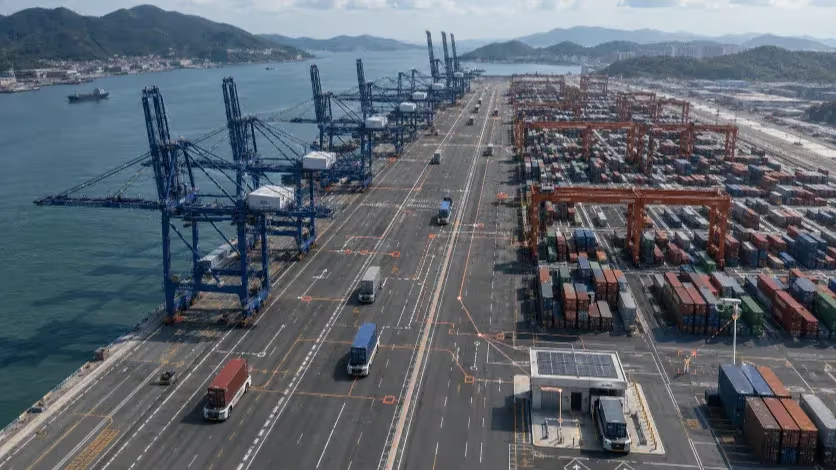
A KRW 45.46 billion research programme will bring another generation of autonomous mobility, electrification and control into Busan New Port. Its significance will depend on how readily new vehicles, existing equipment, external perception and energy infrastructure can be absorbed into a terminal where automation is already part of commercial operations.
At Busan New Port, automation has already settled into the machinery of ordinary terminal work. Containers can move through a handling sequence in which driverless transport operates alongside automated and remotely controlled equipment, while software assigns work and coordinates machinery across the terminal. The seventh container terminal, operated by Dongwon Global Terminal, opened in April 2024 as South Korea’s first fully automated container terminal, establishing commercial driverless horizontal transport as an operating capability rather than a distant research objective.
A new KRW 45.46 billion programme is now entering that environment. Running for 42 months, the project combines port-specific autonomous driving, electrified smart-port mobility and integrated control, bringing together automotive research institutions, Busan Port Authority and companies working across vehicle engineering, electric propulsion, charging, localisation, autonomous-driving validation and terminal software. Its ambitions are substantial, although the technological ground beneath them is already crowded: Korean ports and research programmes have developed or demonstrated many of the individual capabilities now associated with advanced port autonomy.
Accumulated experience changes the standard against which the new work will eventually be judged. An autonomous carrier has to do more than travel through the terminal without a driver; new equipment must enter work sequences governed by software installed before it, while perception originating outside the vehicle has to remain reliable enough to influence physical control. Battery state has to coexist with container assignments and fleet availability, and each additional control layer has to find a stable place among systems whose responsibilities were defined at different moments and often by different suppliers.
As individual capabilities mature, a larger share of the engineering burden falls on the interfaces through which successive generations of machinery, software and infrastructure understand and constrain one another, without allowing each new control layer to harden into another proprietary silo.
A Moving Commercial Baseline
Busan Port Authority’s published inventory for the seventh terminal lists 60 automated guided vehicles among its principal equipment, alongside nine container cranes and 46 transfer cranes. The same inventory gives the terminal an annual handling capacity of 1.95 million TEU. Those figures are useful because they ground discussion of port autonomy in commercial operation rather than a test environment, although they capture only one moment in a system that continues to change after opening.
Hyundai Rotem disclosed in July 2025 that DGT had issued a letter of intent for 57 additional AGVs, together with the control system and charging equipment required to operate them. The company had previously received an order for 43 vehicles from DGT in 2023 and said those units had been supplied for the terminal’s opening. The later 57-vehicle commitment remained subject to the main contract process when Hyundai Rotem announced it, which means the procurement figures cannot simply be added to BPA’s 60-vehicle equipment inventory to claim that 100 AGVs are currently operating.
Their significance lies in the direction of investment. Commercial expansion of the automated transport layer continued after the terminal opened, so the benchmark against which publicly funded R&D will eventually be assessed is moving independently of the research programme itself.
A comparison made near the end of the project will therefore differ materially from oThe authority explicitly said that, after the seventh terminal opened, the organic connection between automated handling equipment and terminal operations, together with system compatibility, had been discussed as a future task; the new ECS is intended to create a unified intelligent interface among major handling equipment while introducing AI-based work allocation and scheduling.ne based on the terminal as it stood in April 2024. Fleet-management software will have accumulated years of operating data, maintenance teams will have learned which faults recur and how local failures propagate through the handling sequence, while charging behaviour, vehicle utilisation and operating rules will have been revised through experience. Additional procurement may change the scale and density of the fleet as well. Research advances against a commercial environment that is learning at the same time.
The difference between technical feasibility and operating maturity is particularly pronounced inside a port. A prototype can be prepared around a scheduled test, inspected immediately before a run and supported by engineers familiar with every component. A commercial fleet works through repeated duty cycles in which vehicles have to remain available, charging has to occur without starving cranes of transport, software faults have to be isolated before they disturb work elsewhere and maintenance has to proceed while cargo continues to move.
Commercial operation also absorbs decisions that a demonstration can leave at the margins. A vehicle encountering an obstruction requires rules governing whether it waits, reroutes or stops; a low battery state has to be reconciled with pending work; the loss of one carrier changes the distribution of assignments across those that remain. As human judgement recedes from routine transport, more of these decisions migrate into software, expanding automated capability while making the terminal more dependent on coordination among components.
By the time the new programme reaches its later demonstrations, basic driverless transport will belong even more firmly to the port’s operating history than it does today. The relevant comparison will be against an automated terminal that has continued to evolve, rather than against the opening-day configuration from which the programme began.
An Automotive R&D Programme Enters the Port
The institutional origin of the new programme offers a useful indication of the technologies being assembled around it. Although Busan New Port supplies the operating environment, the project emerged from the Ministry of Trade, Industry and Energy’s automotive-industry technology development programme, under a second-round 2026 call issued by the ministry’s Automobile Division on May 28. Its three principal development tracks cover port-specific autonomous driving, electrified port mobility, and integrated control and demonstration.
The composition of the selected consortium reflects that intersection. The Korea Automotive Technology Institute and Busan Port Authority sit alongside companies whose established activities extend across vehicle structures, electric-drive components, battery systems, charging, localisation, autonomous-driving verification and terminal software. Public material does not yet disclose a final work-package structure detailed enough to assign every participant confidently to an individual subsystem, and the industrial composition should not be mistaken for a completed technical map. The consortium nevertheless places the project across a broader production environment than the autonomous carrier alone.
Technologies developed for road vehicles can travel surprisingly far into an industrial terminal before their original assumptions begin to break down. Electric propulsion, drive-by-wire control, sensor fusion, localisation, simulation and virtual validation all have direct relevance to autonomous port machinery. The operating environment changes what those technologies are being asked to endure: a container carrier works through repetitive high-load duty cycles, moves near cranes, workers and heavy machinery, encounters large metallic structures that complicate sensing and radio propagation, and participates in a production sequence in which a relatively modest transport delay can leave far more expensive equipment waiting.
The comparatively low speed of a port carrier can obscure the severity of that engineering problem. Lower velocity reduces some hazards, yet heavy payloads, constrained routes and sustained industrial operation introduce others. A machine that performs acceptably during a limited-duration driving test still has to demonstrate that localisation remains stable as container configurations change, braking remains predictable under load, communication failures do not remove critical safety information and the vehicle can continue participating in the terminal’s work-allocation process as surrounding conditions evolve.
Automotive validation methods may become particularly valuable at this boundary. The sector has accumulated techniques for scenario generation, sensor validation, hardware-in-the-loop testing, simulation and systematic examination of difficult edge conditions. Applied carefully, those methods could strengthen the evidentiary discipline around industrial autonomy where safety depends on combinations of onboard sensing and infrastructure-generated information. Their usefulness depends on adapting them to the port’s operating domain rather than treating a terminal as a slower and more orderly public road.
Electrification requires a similar translation. A large battery, a high-power charger and an automated connector can each be engineered as components, but their value inside a terminal depends on the sequence of work around them. Charging determines when a carrier becomes unavailable; changes in transport capacity can alter crane waiting, yard activity and subsequent assignments. Once energy begins influencing the production sequence, vehicle engineering and terminal operations cease to be cleanly separable disciplines.
Busan New Port therefore provides more than a convenient proving ground. It is a brownfield production environment in which automotive technologies encounter machinery, software and operating rules that already exist and cannot simply be redesigned around the research project. Successful transfer requires new components to enter that environment without asking commercial operations to reorganise themselves around the needs of the prototype.
The scale of that requirement becomes clearer when the programme is placed beside the research, commercial deployment and standardisation work that preceded it.
Automation Has a Longer History Than the Programme
South Korea had already begun moving beyond isolated vehicle autonomy before the latest Busan programme was selected. The Connected Autonomous Yard Truck project, known as CAYT, developed a port-specific cooperative transport environment in which the vehicle formed one part of a longer information chain connecting terminal work orders, fleet-level route planning, onboard perception and V2X infrastructure.
Its final field demonstration in July 2025 showed that chain in operation at SM Line’s Gyeong-in Terminal. Transport instructions originating in the Terminal Operating System passed to the Fleet Management System, which calculated routes while accounting for cranes and other transport equipment. Vehicle-mounted sensors handled the immediate driving environment, while V2X infrastructure contributed information beyond the truck’s direct field of view. The demonstration included waiting behind another CAYT, lane changing, stopping and recalculating a route at an intersection, and emergency braking followed by rerouting when a worker approached the operating path.
CAYT’s published development targets should remain distinct from the performance reported at the end of the project. The programme was designed around ambitions that included large-fleet control, improved transport efficiency and highly precise localisation, yet its final public material does not provide a complete numerical accounting showing that every original target was achieved. The available evidence therefore supports the demonstrated architecture more securely than it supports treating every programme target as a final performance result.
By the conclusion of the field work, cooperative autonomy in a Korean terminal context already encompassed considerably more than a vehicle travelling between predetermined points. Terminal instructions, fleet routing, onboard sensing and infrastructure-assisted perception had been connected within the same transport process. The latest Busan programme begins after those functions have already been assembled and exercised at demonstration level.
Interoperability had also entered the earlier project. CAYT’s Fleet Management System applied a TIC4.0 standard interface intended to support connections with terminal operating systems from different suppliers, while a standard API was provided for linking autonomous vehicles with fleet control. A subsequent Korean association standard defined message specifications exchanged between TOS platforms and internal transport equipment including yard trucks, AGVs and autonomous yard trucks.
The standards addressed one layer of interoperability while leaving harder questions of state interpretation, decision authority and failure handling for production deployment. Their existence nevertheless changes the starting point for subsequent research. Exchanging data between a newly developed autonomous vehicle and its accompanying fleet controller can no longer define the frontier by itself.
A second stream of public R&D has been developing through maritime policy rather than the automotive sector. The Ministry of Oceans and Fisheries launched a KRW 31 billion smart-port technology programme for 2025–2028, covering localisation of automated handling and unmanned transport equipment while also including autonomous-driving technology for unmanned transport machinery, control and operating systems, and demonstration aimed at domestic smart-port adoption.
The technical proximity between that programme and the newer automotive-led project creates functional overlap, although the available evidence does not justify treating them as duplicates. Similar headings can conceal meaningful differences in technology readiness, component ownership, intended markets, supply chains and validation objectives. Automotive R&D may bring vehicle-control, electrification and testing capabilities developed through a different industrial lineage. The overlap still raises the standard of explanation: autonomous transport, control software and field demonstration cannot establish novelty merely through their presence in a new programme.
Busan Port Authority’s separate work on Jinhae New Port adds another stage to this history. In August 2025, BPA announced an 18-month project to build an Equipment Control System and marine-infrastructure digital twin for Jinhae New Port. The authority explicitly said that, after the seventh terminal opened, the organic connection between automated handling equipment and terminal operations, together with system compatibility, had been discussed as a future task; the new ECS is intended to create a unified intelligent interface among major handling equipment while introducing AI-based work allocation and scheduling.
Seen in sequence, the programmes describe a gradual migration of the engineering problem. Commercial AGVs established automated horizontal transport as working port equipment; CAYT extended the field into cooperative driving, fleet management and V2X-assisted perception; maritime R&D began developing autonomous transport and control systems through another institutional channel; BPA then elevated compatibility among equipment and terminal software into an engineering objective of its own.
By the time the new programme arrived in 2026, many of the capabilities commonly grouped under the language of smart-port automation already had technical predecessors. The unresolved work had moved increasingly toward the boundaries separating them.
The Brownfield Problem
A newly built terminal can begin from a comparatively clean architectural premise. Equipment suppliers, data interfaces, communication networks and control boundaries can be selected before commercial operations begin, allowing designers to decide how information and authority should move through the terminal before thousands of daily container movements depend on those decisions.
Busan New Port is progressively losing that luxury. Commercial AGVs already operate under established fleet software; terminal applications already issue and sequence work; charging infrastructure supports automated transport; and separate projects are adding new equipment-control and scheduling functions. The next generation of autonomy has to enter an environment containing technical decisions made years earlier for machinery that may remain in service well beyond the present R&D cycle.
International terminal standardisation has increasingly focused on this brownfield condition. TIC4.0 identifies fragmented technologies, inconsistent data models, limited interoperability and bespoke project designs as obstacles to scalable terminal automation. Its recent work adapts IEC 62264 and ISA-95 concepts to the port environment through shared data semantics, functional layers and process models intended to support both greenfield and brownfield terminals.
The value of those industrial frameworks lies less in assigning individual port products to rigid hierarchical levels than in making boundaries explicit: which function owns a decision, what information crosses into another layer and how that information should be interpreted when the systems on either side were not built together. TIC4.0 itself frames legacy IT/OT fragmentation and interoperability as practical barriers to progressive automation.
The most visible boundary appears on the terminal pavement. A homogeneous AGV fleet operating inside a strictly segregated zone presents a narrower coordination problem than an environment where autonomous carriers, conventional yard vehicles, maintenance equipment and workers occupy intersecting portions of the same space. Braking behaviour, turning radius, payload, sensor coverage and response policy vary across machines; equipment developed under different assumptions may therefore reach different conclusions about the same encounter.
Fleet scale alone gives an incomplete account of this complexity. One hundred identical AGVs governed by a tightly specified control environment may present a simpler engineering problem than a smaller mixed population whose suppliers, dynamics and safety assumptions differ. Density increases the number of interactions, while heterogeneity changes their character, especially when the terminal seeks to expand autonomy without preserving permanent physical separation between equipment classes.
Physical coexistence does not ensure that the machines can understand one another operationally. Position, route, battery state, job assignment, availability and fault status can all be represented as data, but successful transmission says little about whether the receiving software attaches the same meaning to each state.
A vehicle described as “ready” illustrates the difficulty. One implementation may use the state to signify immediate availability for another container move; another may reserve the same term for a vehicle that has completed its previous task but still requires a local check. A battery percentage takes on different operational significance when reserve policies vary between fleets. A route update can function as an instruction within one control model and as advice subordinate to the vehicle’s local safety logic within another.
Without shared semantics, each new connection accumulates translation logic. Individual mappings can solve immediate integration problems, yet over time they leave the terminal dependent on layers of bespoke software whose behaviour may be poorly understood outside the project that created them. A standard API reduces the effort required to connect systems; common operational meaning determines whether the information passing through that interface can be used without constant reinterpretation.
CAYT’s use of TIC4.0-based interfaces demonstrates that Korean research had already recognised this requirement. It also clarifies how much remains beyond a successful interface specification. Consortium partners can agree on messages and implement them across components designed toward the same demonstration; production deployment has to survive older equipment, different vendors, incomplete standards support and control logic that was never written with the new mobility platform in mind.
Even agreement over state meaning leaves a deeper question unanswered: which controller is entitled to act when several systems reach incompatible conclusions about the same movement.
A Terminal Operating System may determine which container should move next. An Equipment Control System can coordinate the availability of cranes and transport machinery. Fleet-management software may choose a carrier and calculate its route, while the vehicle retains authority over steering, braking and immediate collision avoidance. Infrastructure-assisted perception introduces additional safety information, and an energy-management function may determine that the selected carrier should leave the work queue for charging.
Each decision can be locally rational, yet conflicts emerge when several systems act on the same machine at once: a quay crane may be waiting for a container while the assigned carrier approaches its battery reserve; fleet software may direct that carrier through an intersection at the moment an infrastructure sensor detects a worker hidden behind a stack; the equipment scheduler may release another job just as the local vehicle controller narrows its operating envelope because a perception input has become unreliable; or a charging controller may seek to remove a vehicle from service while terminal scheduling is trying to preserve transport capacity through a period of peak demand.
Safe and efficient operation depends on an intelligible order of authority across those situations. The software has to know which instruction can be deferred, which may be overridden and which safety response remains binding even when it imposes an immediate productivity cost. Ambiguity is especially dangerous because every participating component can be behaving correctly according to its own specification while their combined behaviour remains incoherent.
Increasing local intelligence can intensify the issue. Earlier automated equipment often executed comparatively direct instructions from central software. More capable autonomous vehicles make a larger set of decisions onboard, while external sensors, roadside infrastructure and charging controllers add information capable of modifying those decisions. Control becomes distributed across the terminal, expanding opportunities for local optimisation while making the boundaries of responsibility harder to ignore.
BPA’s Jinhae ECS programme sits within this emerging control landscape. Its planned intelligent interface and AI-based scheduling layer reflect an attempt to coordinate equipment above the individual machine after compatibility had already become an identified concern. The new mobility programme will develop alongside that effort, which means fleet control, equipment orchestration and vehicle autonomy cannot be considered as though each were entering an empty layer of the terminal.
Other automated ports are encountering related pressures through different operating models. At APM Terminals Maasvlakte II in Rotterdam, automated terminal trucks have been tested in a mixed-traffic zone where they operate among regular traffic, with additional sensors fitted for the mixed environment and test engineers present during trials. The example does not provide a template Busan can simply adopt, but it illustrates how the difficulty changes once autonomous vehicles leave fully segregated operating domains.
Brownfield integration concentrates these pressures because existing machinery cannot be rewritten each time a new technology programme begins. Cranes, vehicles and terminal applications can remain in service for many years, while perception algorithms, communication protocols and autonomy software evolve on much shorter cycles. Rebuilding the surrounding terminal architecture whenever a more capable vehicle arrives would undermine the economic advantage that modular automation is supposed to provide.
The more consequential boundary lies between a collection of sophisticated subsystems and a production environment capable of absorbing successive generations of them without turning every new connection into another bespoke engineering project.
Perception Beyond the Vehicle
A worker who disappears behind a container stack exposes a limitation that cannot be removed simply by adding more sensors to the vehicle. Cameras, lidar and radar can improve coverage immediately around an autonomous carrier, yet several metres of steel can physically block the line of sight regardless of sensor quality. The geometry of a container terminal creates situations in which safe movement depends on information gathered somewhere else.
Infrastructure-assisted perception attempts to fill that gap through roadside cameras, wireless localisation, V2X-connected sensors and other equipment able to observe areas hidden from onboard systems. Extending the field of view also lengthens the chain between the original observation and the physical action that may follow from it.
An externally observed worker has to be detected and classified before position and time can be established. The resulting information must then be transmitted, associated with the vehicle’s own perception, reconciled with other observations, projected forward to account for movement since the original sensing event and finally converted into a decision about speed, steering or braking. Reliability resides across that sequence rather than inside any one sensor.
CAYT had already demonstrated an early form of the arrangement by incorporating V2X-assisted blind-spot information into autonomous yard-truck operations. The final demonstration described the infrastructure as supporting blind-spot detection and included a worker-approach scenario that triggered emergency braking and rerouting. Infrastructure perception is therefore another area where the latest programme enters after basic functionality has appeared in Korean field research.
The more demanding opportunity lies in establishing how well externally generated perception retains its integrity under the environmental and operational conditions of a working container terminal.
Localisation offers one example of why deployment conditions matter. A 2022 evaluation of a commercial UWB indoor-positioning system in a realistic 560-square-metre industrial setting reported an overall median two-dimensional accuracy of 17 centimetres, while performance varied with clutter, tag height and placement. The experiment does not predict what will happen at Busan New Port; it shows that ranging performance is inseparable from the geometry and obstructions surrounding the deployment.
A positioning system installed among container stacks would require its own anchor geometry, calibration, radio survey and failure analysis. Boxes are continually moved, stacked and removed, altering the geometry through which signals propagate, while cranes, vehicles and large metal surfaces introduce reflections and moving obstructions. A localisation configuration that performs well under one arrangement of the yard can encounter different conditions after the storage pattern changes.
An autonomous carrier therefore needs more than a position estimate; it needs some basis for judging how much confidence that estimate deserves. Widening uncertainty cannot be allowed to acquire the same control authority as a reliable track merely because both values arrive through the same interface. Once confidence deteriorates, permissible vehicle behaviour may have to change with it.
Communication produces a different form of uncertainty. Cooperative-perception research has shown that V2X can extend perception beyond the capability of individual vehicles while also exposing a dependency on communication continuity. A 2024 peer-reviewed study in IEEE Transactions on Intelligent Vehicles examined the effect of V2X interruptions on cooperative perception and noted that failed reception of cooperative messages can degrade shared perception and create safety risk.
Information freshness is particularly important in a terminal because the observed scene continues to evolve while sensing and communication take place. A worker keeps walking, another carrier approaches an intersection and a yard tractor proceeds through its turn. Detection, processing, timestamping, network transmission, object association, prediction and actuation each consume part of the interval between the original event and the resulting vehicle response.
Average latency describes only part of that behaviour. A network can perform quickly most of the time while still producing rare delays long enough to erode the stopping margin of a heavily loaded machine. The technically demanding cases therefore sit in the tail of the latency distribution, in periods of packet loss and in the transition between current and stale information.
Disagreement among sensors adds another complication. An infrastructure camera may classify a worker before the vehicle’s own radar reports a corresponding target. Wireless localisation may place that person slightly differently from the vision system. A roadside sensor can report an approaching vehicle outside onboard line of sight while retaining enough positional uncertainty to leave its trajectory ambiguous.
Fusion software has to decide how much authority each observation deserves and how that authority should change as confidence and information age evolve. Adding sensors expands the available evidence, but each additional source also adds another timing relationship, error distribution and failure mode that the decision layer has to understand.
The mass and operating role of port vehicles make these decisions consequential even at moderate speed. A false negative can expose a worker or another machine to severe physical risk, while excessively conservative thresholds can repeatedly stop vehicles, increase remote interventions and erode terminal flow. Perception policy therefore connects safety directly to productivity.
A mature deployment needs defined behaviour for the interval between full confidence and complete failure. Depending on the condition, a vehicle may reduce speed, restrict its operating domain, rely temporarily on a smaller set of trusted inputs, request remote assistance or stop once the remaining information no longer supports safe movement. Continuous industrial autonomy depends on managing these degraded states rather than assuming every sensing and communication channel remains healthy.
Automotive safety concepts can inform this work without being transferred wholesale into the port. Standards for driverless industrial trucks and road-vehicle approaches to perception safety emerge from different regulatory and operating contexts. Their conceptual intersection becomes useful where a machine remains mechanically functional while the representation of its surroundings has become incomplete, delayed or misleading.
For Busan, meaningful evidence around non-line-of-sight perception will eventually need to reach well beyond a headline detection rate. False-negative behaviour, localisation integrity, information age, long-tail latency, packet loss, time synchronisation and the transition into degraded control would provide a more revealing account of whether infrastructure-assisted perception can support sustained production autonomy. The programme material places NLOS perception and related infrastructure among the intended development areas, but the public record does not yet supply the detailed tail-performance evidence needed to judge the eventual safety case.
Extending perception beyond the vehicle enlarges the area from which an autonomous machine can gather useful information. It also enlarges the technical perimeter across which that information has to remain trustworthy before the machine is permitted to turn perception into motion.
Energy Enters the Scheduler
Electrification introduces another dependency whose consequences spread beyond the vehicle itself. A battery-powered carrier may navigate autonomously, accept jobs from fleet software and report its position continuously, yet every assignment consumes a share of the energy required for subsequent work. Once vehicles circulate continuously between quay and yard, battery state becomes part of the terminal’s production condition.
Greater charging power can reduce the period during which a carrier is removed from productive work, although the value of that reduction still depends on where the charging interval falls within the wider work sequence. Ten minutes of unavailable transport during a period of spare fleet capacity bears little resemblance to the same ten minutes when several quay cranes are simultaneously consuming vehicles.
Charging therefore enters the dispatch problem. The fleet controller has to determine whether a carrier can complete another assignment while preserving the required reserve, whether another vehicle should be selected instead, which charger will be available and whether postponement will create a concentration of low-energy vehicles later in the operating period.
Seen from the quay, the consequence becomes more concrete. A vehicle sent to charge at an inconvenient moment can leave a crane waiting for transport, transferring the cost of an energy decision towards one of the most expensive and productivity-sensitive assets in the terminal. Delaying the charge protects immediate throughput but can create a later bottleneck if several carriers arrive at their reserve thresholds together.
Operations-research work on automated container terminals increasingly models charging and transport within the same scheduling problem. A 2023 study in Transportation Research Part E examined integrated vehicle charging and operation scheduling under fast-charging technology, using a mixed-integer model that combined charging costs with penalties related to the completion time of terminal operations and analysing charging rules, charger locations, charging power and fleet configuration.
The production logic is straightforward even when the optimisation mathematics is not: a decision that is efficient for one battery can be inefficient for the fleet and still worse for the terminal as a whole.
Megawatt charging changes the duration and scale of the problem without removing the need for coordination. Higher power can return a large electric carrier to work more quickly, but charger queues, docking reliability, thermal constraints and electrical demand remain. The engineering surrounding a megawatt connection also extends well beyond its headline rating.
SAE J3271 treats the Megawatt Charging System at system level, dividing the work across electromechanical coupling, communication and control, cable handling and cooling, automated connection, grid-related use cases and interoperability testing. In an autonomous terminal, the charging event therefore becomes another machine-to-machine process whose reliability affects transport availability.
A connector that requires frequent human correction, a charger that cannot communicate its state to fleet software or a failed docking attempt can reduce useful fleet capacity regardless of how rapidly the hardware transfers energy once a connection has been established. Automated charging gains operational significance only when the complete sequence can occur repeatedly without introducing another source of intervention.
The meaning of an “available” vehicle changes once battery state enters dispatch. The nearest idle carrier may be a poor choice if the next assignment would push it below reserve. A vehicle farther away may preserve more useful capacity across the next several tasks, while charger occupancy, expected consumption and anticipated workload can alter that calculation again.
The software involved may also pursue different objectives. Terminal scheduling attempts to maintain container flow and limit crane waiting; fleet management may seek high vehicle utilisation; battery logic can favour conservative limits that protect cell life; an energy controller may attempt to restrain electrical peaks. Each objective has its own rationale, and none automatically resolves the conflicts among them.
Sharing a state-of-charge value is only the beginning of integration. The surrounding software has to agree on how reserve policy affects job assignment, how an unavailable charger alters subsequent dispatch and whether an energy controller can remove a vehicle from the work queue. Unexpected consumption during a task must propagate far enough through the planning process to influence future assignments before the fleet encounters a shortage.
Brownfield conditions complicate these decisions because charging equipment, vehicle controllers and fleet software may have entered the terminal through different procurement cycles. An advanced energy-management layer can become another optimisation island if its decisions cannot be interpreted by the applications that allocate container work.
The new Busan programme’s interest in high-power automated charging is therefore most consequential when viewed within this wider production problem. A heavy electric carrier connecting automatically and accepting very high charging power would establish valuable component capability. More revealing evidence would show that energy can enter fleet dispatch without producing charger congestion, stranded transport capacity or excessive waiting elsewhere in the handling sequence.
Such a result would appear in ordinary operating data rather than in the charger rating alone: vehicle availability, charger occupancy, queueing time, failed connection attempts, energy consumed per move, transport utilisation and the relationship between charging decisions and crane or yard productivity. Electrification becomes fully part of port automation when those variables can be managed within the same production logic that governs the movement of containers.
What Evidence Would Make the Programme Matter
By the end of the 42-month programme, the visibility of the prototype should matter less than the evidence produced around it. Driverless transport, fleet control, infrastructure-assisted perception and automated charging all have technical precedents. The remaining task is to establish whether another generation of those capabilities can be combined inside a terminal already dependent on earlier versions of them.
Interoperability should leave traces in everyday operation. Equipment from different generations or suppliers should require less bespoke engineering to join the terminal, work states should remain intelligible as information crosses software boundaries, and failures should be recoverable without prolonged manual reconciliation. Intervention frequency, recovery time and the engineering effort required to connect new machinery would reveal whether greater technological sophistication is making integration easier or merely relocating complexity.
Safety requires an equally operational account. Average perception accuracy offers only limited insight into what happens when infrastructure becomes obscured, localisation confidence deteriorates or communications falter. False negatives, information age, tail latency, positioning integrity and safety-related interventions would expose the conditions under which cooperative perception begins to lose authority.
Performance in degraded conditions deserves particular attention because continuous terminal operation is shaped by recovery as much as by nominal capability. An autonomous carrier able to slow, restrict its operating domain or transfer temporarily to a reduced set of trusted inputs may remain productive through faults that would immobilise a more brittle design. A vehicle that performs impressively only while every external dependency remains healthy would reveal the limits of its autonomy precisely where field operation becomes difficult.
Electrification should likewise be evaluated through its effect on transport capacity. Charger occupancy, vehicle waiting, reserve policy, failed charging events and energy per container move acquire significance when they can be connected to fleet availability, crane waiting and the stability of the work queue.
These measures eventually converge on the economic purpose of the terminal: predictable cargo flow. Sophisticated autonomy has limited value if ships are worked less consistently, maintenance demand rises, equipment spends longer waiting or gains remain confined to an isolated demonstration area. Component performance matters because of what it allows the surrounding production environment to do.
The same evidence will also help distinguish the new programme from adjacent public investments. The maritime ministry is already funding autonomous transport and smart-port control technologies, CAYT has established a cooperative autonomy and interface baseline, and BPA is developing a new equipment-control layer for Jinhae New Port. A project that contributes a clearly defined capability to that landscape can complement earlier work even where technical domains overlap; another closed platform replicating familiar functions behind new proprietary boundaries would leave the integration problem largely intact.
Public information currently describes the Busan programme’s research areas, institutional participants and financial structure more clearly than the field evidence by which the completed platform will eventually need to be judged. That is unsurprising at the beginning of a multi-year R&D programme. It nevertheless sets the terms of future scrutiny: the final evidence will have to distinguish programme targets from achieved performance, component capability from terminal-level improvement, and controlled demonstrations from resilience under ordinary operations.
By 2029, the strongest evidence should come from ordinary operation: new vehicles entering the terminal without requiring a parallel software environment, externally generated perception remaining useful as conditions deteriorate, charging proceeding without disorganising transport capacity, and the boundaries among terminal operations, equipment control, fleet management and vehicle autonomy remaining intelligible when their objectives diverge.
A port where driverless equipment is already part of commercial operations has moved beyond motion as sufficient evidence of autonomy. Further progress will depend on whether successive generations of machines can share the same operating environment without increasing the fragility of the terminal around them.
Continue this reporting
Reporting on the same issue
Related coverage selected from the article's desk, topics and newsroom relationships.
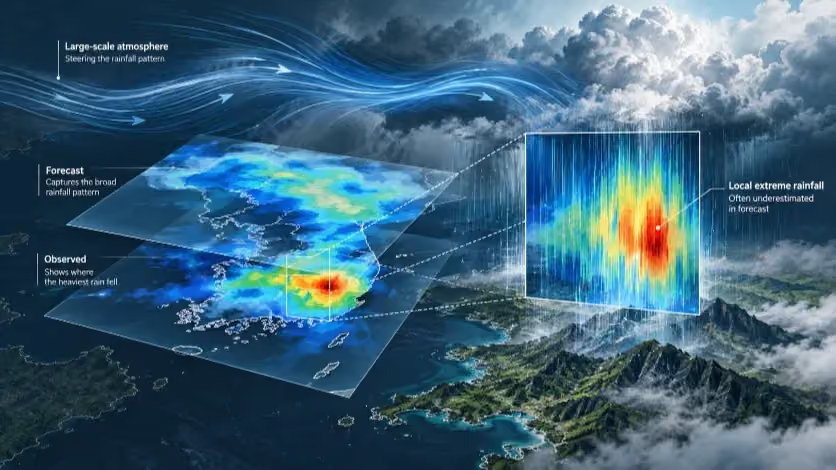 NewsOct 19, 2026
What an Accurate Rainfall Forecast Can Still Miss
AI weather forecasts can capture where rain will fall while underestimating i...
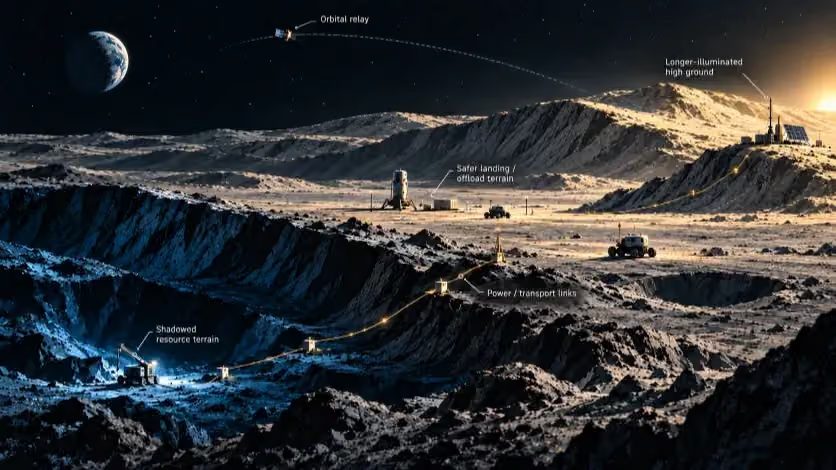 NewsOct 7, 2026
The Moon’s Industrial Future Begins With What Missions No Longer Need to Carry
Water, sunlight, safe landing terrain, communications and power do not natura...
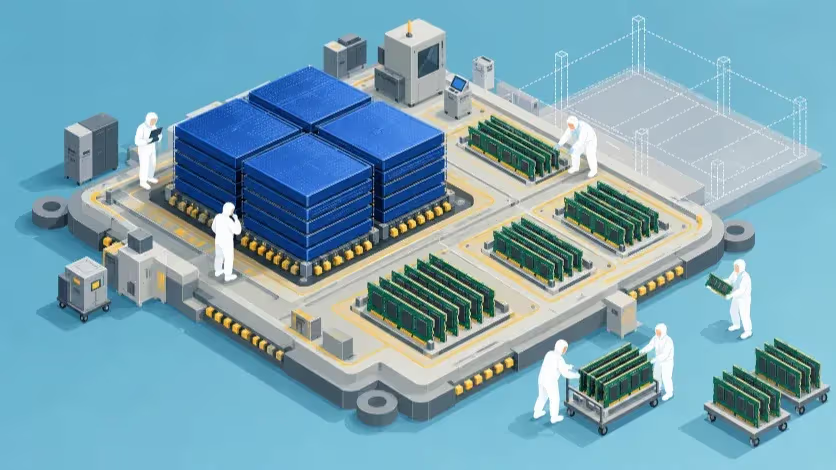 NewsOct 2, 2026
AI Is Reallocating the World’s Memory Factories
AI demand is forcing memory makers to decide how scarce DRAM capacity is divi...
More from the author
More from this byline
Stay with the same line of reporting through more work from this byline.
- NewsOct 19, 2026
What an Accurate Rainfall Forecast Can Still Miss
- NewsOct 2, 2026
AI Is Reallocating the World’s Memory Factories
Reader Signal
Community readWhat did this report leave you with?
Choose the signal that best reflects your reading. Select it again to remove it.
One response per article
No response selected
A moderated conversation about the reporting.
One-level replies and newsroom moderation keep the conversation anchored to this article.
Discussion Status
Open
Please sign in to join the discussion.
Newsletter
Weekly reporting and context from Busan and Korea.