US Courts' Conflicting Mifepristone Rulings Reflect Ongoing Abortion Law Struggle in South Korea
The Biden administration has requested clarification from a judge regarding how the federal government should comply with two conflicting court orders on the abortion pill mifepristone. The rulings, issued on Friday by judges in Amarillo, Texas, and Spokane, Washington, have created legal uncertainty over the drug's status. Mifepristone is used in over half of all abortions nationwide and is also employed in managing miscarriages. Meanwhile, legal abortion in South Korea remains a controversial


The Biden administration has requested clarification from a judge regarding how the federal government should comply with two conflicting court orders on the abortion pill mifepristone. The rulings, issued on Friday by judges in Amarillo, Texas, and Spokane, Washington, have created legal uncertainty over the drug's status. Mifepristone is used in over half of all abortions nationwide and is also employed in managing miscarriages.
Meanwhile, legal abortion in South Korea remains a controversial and complicated issue, despite a landmark ruling by the Constitutional Court in 2019 that decriminalized the procedure. The court ruled that banning abortion in the early stages of pregnancy violated the right to self-determination, but lawmakers have yet to agree on a legal definition for the "early stages of pregnancy." As a result, women seeking to terminate their pregnancies must navigate a fine line between what is considered legal and illegal. Although only around 3,000 "legal" surgical abortions are performed in the country each year, the total number is believed to be significantly higher.
Abortion was officially decriminalized in South Korea in 2021 following the Constitutional Court's ruling in 2019 that declared making abortion a criminal offense was unconstitutional. The court ordered the legislature to revise the laws by the end of 2020, but the National Assembly failed to take action. Consequently, the anti-abortion law was nullified at the beginning of 2021, making abortion no longer a crime in the country. However, confusion persists regarding how, when, or where abortions can be obtained, and the government must do more to provide clarity and support for those in need of the procedure.
Back in the United States, the legal turmoil created by the rival decisions on mifepristone may require resolution by the Supreme Court, which eliminated the constitutional right to abortion 10 months ago. Kacsmaryk's ruling marks the first time a court has invalidated an FDA drug approval, and if it takes effect, selling mifepristone would become a criminal offense nationwide.
The administration has chosen to work through the appeals process for now, rather than ignoring the ruling, as some prominent Democrats and at least one Republican have suggested. The Justice Department filed a 49-page emergency motion on Monday, asking the 5th U.S. Circuit Court of Appeals to keep Kacsmaryk's ruling on hold, arguing that it would cause irreparable harm to patients, healthcare systems, and businesses if allowed to take effect.
Continue this reporting
Reporting on the same issue
Related coverage selected from the article's desk, topics and newsroom relationships.
 NewsOct 4, 2026
Zelensky, South Korea and the Limits of Wartime Pressure
South Korea says Kyiv broke a confidentiality understanding when Zelensky rev...
 NewsSep 1, 2026
What Lee Jae Myung Thinks a Minister Can Fix
President Lee Jae Myung says reform should be judged by results rather than c...
 NewsAug 21, 2026
The Korean Peninsula Trump Is Returning To
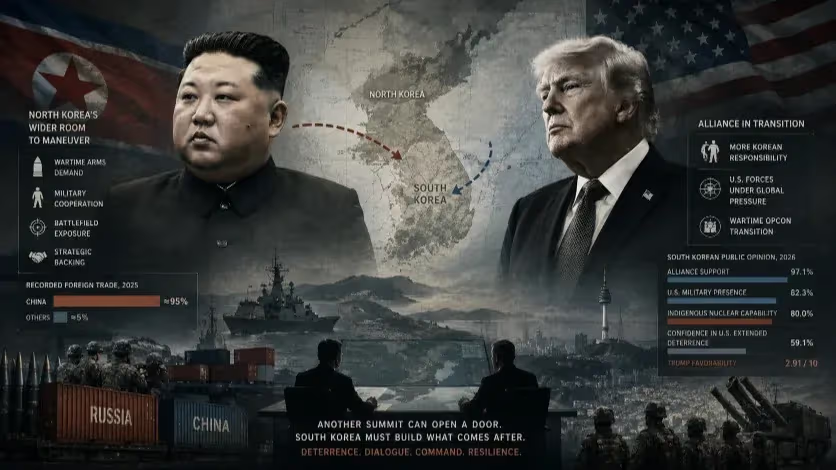
Another Trump-Kim summit would unfold on a peninsula where North Korea is har...
More from the author
More from this byline
Stay with the same line of reporting through more work from this byline.
 NewsOct 9, 2026
Why “Busan Is Good” Falls Short as a City Brand
 NewsSep 18, 2026
The Other AI Race Is for the Freedom to Change Course
Reader Signal
Community readWhat did this report leave you with?
Choose the signal that best reflects your reading. Select it again to remove it.
One response per article
No response selected
A moderated conversation about the reporting.
One-level replies and newsroom moderation keep the conversation anchored to this article.
Discussion Status
Open
Please sign in to join the discussion.
Newsletter
Weekly reporting and context from Busan and Korea.