When Growth Runs Out of People
South Korea's semiconductor boom is masking a deeper shift. As its workforce shrinks, future growth will depend on productivity, capital, technology and whether cities such as Busan can generate more value with fewer people.

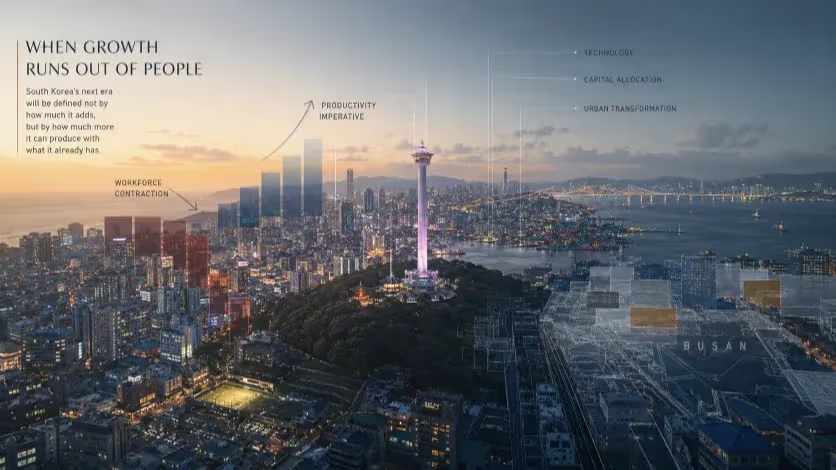
South Korea built prosperity by adding workers, capital and cities. As its workforce contracts, the harder task is making the economy it already has produce more.
A semiconductor boom is lifting growth even as Korea's working-age population falls, exposing a deeper challenge that reaches from company finance and artificial intelligence to housing, regional inequality and the fiscal choices confronting Busan.
South Korea entered the second half of 2026 with an economy performing far better than the country's demographic outlook might suggest. Strong demand for advanced semiconductors used in artificial-intelligence infrastructure has supported exports and investment, improving incomes as domestic consumption recovers, and in July the Bank of Korea said growth was likely to exceed considerably the 2.6 percent forecast it had issued less than two months earlier. The strength of the cycle demonstrates that demographic contraction does not impose a mechanical ceiling on economic growth, since an economy can lose working-age people while expanding rapidly when productivity, investment and external demand move strongly enough in its favor.
The demographic arithmetic underneath that expansion is nevertheless becoming more restrictive. The 2025 census counted 51.82 million people, almost unchanged from a year earlier, but the apparent stability concealed a decline of 393,000 in the population aged 15 to 64, which fell to 35.87 million, while the number of people aged 65 or older increased by 601,000 to 10.72 million and reached 20.7 percent of the population. Foreign residents increased by 66,000 to 2.11 million and helped keep the national total broadly stable, making the headline population increasingly less informative than the changing composition of the people available to work and support the economy.
Korea's latest official long-term projection gives the change much greater scale, although any forecast extending half a century necessarily depends on uncertain assumptions about fertility, mortality and migration. The central projection expects the working-age population to decline by 3.32 million between 2022 and 2032 and eventually fall from 36.74 million in 2022 to 16.58 million in 2072, when people aged 65 or older could account for 47.7 percent of the population; recent improvements in births or migration may alter the precise path, but the 2025 census has so far confirmed the nearer-term direction on which the forecast rests.
For much of Korea's modern economic history, policymakers and companies faced nearly the opposite problem. Industrialization shifted workers from agriculture into manufacturing and urban services as educational attainment rose, capital accumulated and cities expanded around new employment, while household formation supported construction and consumer demand and infrastructure lowered the cost of organizing an increasingly complex export economy. Population growth did not create the Korean development model, whose success depended heavily on education, capital deepening, technological absorption and global integration, but an expanding labor supply allowed those forces to reinforce one another in ways that a contracting workforce can no longer be expected to reproduce. The OECD's 2026 survey consequently places weaker productivity growth, population aging and widening regional disparities among the central constraints on Korea's next stage of development.
Korea now enters demographic maturity with much of the physical economy that earlier development policy sought to create already in place, including dense housing, industrial land, transportation networks, universities, hospitals and globally competitive manufacturing capacity. The constraint is increasingly found in the ability of stronger businesses to obtain the workers and finance required to expand, in the diffusion of productivity beyond frontier manufacturers, in the retention of higher-value economic functions outside the capital region and in the capacity of mature cities to decide which inherited assets still justify their continuing cost. Demographic contraction raises the price of mistakes in each of those areas because additional workers, households and taxpayers can no longer be assumed to arrive fast enough to make weak uses of existing resources less consequential.
The Old Arithmetic Stops Working
Population has never been an adequate measure of economic capacity because production depends more directly on how many people work, the hours they supply, the capital available to them and the value created from those inputs. Higher participation among women, longer working lives, immigration and labor-saving technology can therefore offset part of the numerical decline in the working-age population, leaving considerable room between demographic contraction and falling living standards; the room narrows, however, when the underlying population from which additional workers must be drawn is itself shrinking and aging. Korea's labor market remains resilient in 2026, with unemployment still low by OECD standards, which reinforces the point that the immediate issue is adaptation to a tightening long-term constraint rather than a claim that the country has already run out of labor.
The timing also separates Korea's demographic problem into two horizons that are often treated as though they were the same. Family policy, fertility and immigration can influence the population of future decades, but children born during the current improvement in births will not enter the conventional working-age population until the 2040s, leaving the economy of the 2030s largely dependent on people who are already alive. The nearer challenge is therefore to keep experienced workers productive for longer, reduce losses of human capital when careers are interrupted, integrate migrants into jobs with scope for advancement and enable employers facing tighter recruitment to reorganize production rather than merely preserve labor-intensive practices.
The effect on public finance develops more slowly because physical and social systems do not contract in proportion to the population supporting them. Transportation networks, utilities, hospitals and public facilities remain costly after the populations they were built to serve have begun to decline, while aging increases demand for health, care and income support, leaving a productive economy better able to finance those obligations through higher wages, profits and taxable income than one in which output per worker remains weak. The OECD's latest assessment therefore treats aging, regional convergence, productivity and fiscal sustainability as interconnected questions rather than separate policy problems.
The change in Korea's growth arithmetic is consequently less deterministic than population projections can make it appear, because similar demographic paths can produce very different living standards depending on where people work, which companies acquire capital and whether technology raises actual output. A shrinking labor pool increases the cost of leaving workers in businesses that create little value, constraining companies capable of expansion or maintaining assets whose returns have faded, which shifts the economic question from how many resources Korea can continue to add toward how effectively the resources already present can move between uses.
Where Productivity Comes From
Productivity is often described as an attribute of individual employees or machines, rising when workers gain skills or factories install better equipment, although economies also become more productive when stronger firms hire more people, obtain more capital and take market share from weaker competitors. Aggregate productivity can improve even when the efficiency of many individual companies changes slowly, provided workers and finance reach the businesses capable of generating more value, which makes the ability of successful firms to grow increasingly important when the supply of new labor is declining.
Recent Bank of Korea research indicates that this mechanism has weakened substantially. Using firm-level data covering roughly three decades, the central bank found that inefficiency in the distribution of production factors had widened significantly and had deteriorated more rapidly in services than in manufacturing, with much of the increase arising among highly productive firms that possessed too few resources, particularly capital; the problem was especially visible among service companies and startups, while low-productivity businesses holding more resources than their performance would appear to justify did not materially retreat.
The consequences extend beyond financing because a productive business that remains small also remains limited in the number of employees it can hire, the suppliers it can support and the competitive pressure it can impose on incumbents. Korea can therefore contain large numbers of entrepreneurs and viable small firms while remaining comparatively weak at converting successful businesses into organizations capable of financing intangible investment, entering foreign markets, recruiting specialist employees and spreading the fixed cost of technology across a larger revenue base. Faster demographic expansion once made such inefficiencies easier to absorb because more workers and customers could support both stronger and weaker companies, whereas a shrinking workforce increases the economic return to allowing better businesses to expand.
The service sector places this problem near the center of the country's future growth because it contains most Korean employment while producing substantially less per worker than manufacturing. The Bank of Korea's 2025 assessment found that private services accounted for 65 percent of employment and 44 percent of nominal GDP in 2024, yet labor productivity had remained at roughly 40 percent of manufacturing productivity for about two decades; the aggregate comparison hides enormous differences among software, finance, logistics, medicine, restaurants and care services, but it identifies the part of the economy in which even modest productivity improvements would reach a much larger share of workers than further gains confined to advanced manufacturing.
The internal structure of services helps explain why improvement has been difficult. The same central-bank study found that private-service investment fell from 26 percent in 2000 to 18 percent in 2022, that nearly 98 percent of sales at knowledge-intensive service firms in 2021 remained tied to domestic demand and that only 2.2 percent of those companies had experience in overseas markets, while 60 percent of the self-employed in 2024 were concentrated in lower-value-added services and 73 percent of businesses in those activities consisted of a single person. These are different problems with a common consequence: businesses that might scale beyond Korea's shrinking domestic market often do not, while large portions of neighborhood services remain organized around very small firms whose revenues are closely tied to the number of customers living nearby.
The distinction becomes particularly consequential outside the Seoul metropolitan area because businesses capable of selling beyond the local market can generate income without requiring the local population to grow. Logistics, engineering, software, medical services and specialized professional firms can bring outside revenue into a shrinking region, whereas many restaurants, retailers and personal services primarily compete for spending already circulating among local households; higher-value employers can then attract skilled workers and specialized suppliers, strengthening the same labor market from which further companies can draw. Regional population loss can therefore follow differences in economic opportunity as much as it causes them, which is why simply moving residents back toward a weaker region does not by itself recreate the productivity that originally attracted them elsewhere.
Financial institutions sit inside the same process because tangible collateral is easier to value than the uncertain future earnings of companies built around software, intellectual property, specialized employees or data. Korea does not suffer from a simple shortage of credit, and property finance itself can support productive construction and entrepreneurship, but the Bank of Korea's firm-level evidence suggests that the distribution of capital remains problematic when productive young firms operate with too little while weaker companies continue to retain resources. A shrinking economy therefore needs financial markets that become better at financing credible future cash flows while allowing workers leaving weaker businesses to move without bearing prohibitive losses in income, housing security or accumulated skills.
An Economy Built to Expand
The movement of workers and companies cannot be separated from an urban economy constructed when physical expansion and development were closely aligned. Industrial land accommodated factories, apartments housed urbanizing workers, roads and rail enlarged labor markets and rising property values supported household balance sheets and collateral-based finance, giving Korea a long period in which the addition of physical capital frequently expanded productive capacity at the same time. The mature economy inherits those assets after the demographic assumptions surrounding them have begun to change.
Housing illustrates why the transition cannot be reduced to a simple claim that a shrinking population should build less. Korea had 20.18 million homes in the 2025 census, 1.6 percent more than a year earlier, while one-person households rose to 8.24 million and 36.6 percent of ordinary households and average household size declined to 2.16 people; at the same time, 56 percent of the housing stock was at least 20 years old and 30.6 percent was at least 30 years old. Population decline can therefore coexist for years with demand created by smaller households, replacement of deteriorating buildings and shifts toward locations offering better housing or employment access, which makes the economic distinction between replacement and expansion more useful than a simple comparison between population and construction.
The longer spatial record nevertheless shows why additional construction deserves closer scrutiny as demographic growth fades. An OECD study published in 2025, using internationally comparable satellite observations through 2020, found that Korea's built-up surface expanded by 23.5 percent between 2010 and 2020, more than twice the increase recorded in countries with similar population growth, while built-up land continued to increase in areas already losing residents. The finding does not establish that particular roads, industrial estates or housing developments were unnecessary, but it does show that Korea continued to add territory and infrastructure after population growth ceased to provide a uniform explanation for that expansion.
The consequences differ sharply according to location and use because a thousand dwellings built near an established employment and transit center can replace deteriorating housing while using infrastructure already in place, whereas the same number built at the metropolitan fringe can require new roads, utilities, schools and transit while drawing residents from neighborhoods whose existing networks remain costly to maintain. Redevelopment of obsolete industrial land can similarly increase the return on infrastructure already embedded in the city, while outward development can increase the stock of capital that a smaller future population must finance, leaving construction spending with very different long-run effects even when it adds the same amount to current output.
Housing also influences the movement of labor through household balance sheets because a better job elsewhere can require a family to sell or rent its largest asset, purchase housing in a more expensive labor market and absorb transaction and commuting costs. The resulting problem is geographically uneven, with high housing costs capable of obstructing movement toward some of the country's most productive employment centers while shrinking regions carry aging or underused property whose economic value can fall much faster than the roads, utilities and public facilities surrounding it disappear. OECD analysis of Korea's regional disparities and shrinking areas increasingly treats housing, land use and infrastructure as part of the labor-market and productivity problem rather than a separate property-market question.
Financial policy has begun to acknowledge the same tension more explicitly. In April 2026, the Financial Services Commission set a target of limiting household-debt growth to 1.5 percent for the year and adopted a medium-term objective of lowering the household-debt-to-GDP ratio to 80 percent by 2030, describing the strategy as part of a broader effort to reduce excessive concentration of finance in real estate and create more room for productive finance. The policy does not imply that mortgages or property lending are inherently unproductive, since housing, business premises and industrial construction remain necessary, but it reflects the increasing importance of ensuring that a mature economy can finance intangible and innovative investment as readily as assets supported by familiar physical collateral.
The standard for new capital therefore changes as Korea becomes older and more fully built, because the relevant question is increasingly whether an additional asset improves the productivity of the city and economy already surrounding it. Housing that improves access to employment, rail that enlarges an effective labor market, laboratories that attract commercial research and redevelopment that removes obsolete capital can remain valuable without population growth, whereas assets that principally redistribute households or land values may leave a larger stock to support without creating a comparable increase in income.
The Technology Test
Artificial intelligence appears unusually well suited to a country facing demographic contraction because it can reduce the labor required to complete many tasks, although Korea's early experience shows that time saved by technology and productivity gained by an economy are different quantities. A Bank of Korea study released in June 2026 found that generative-AI use reduced working time by an average of 3.8 percent, or approximately 1.5 hours a week, and estimated a potential productivity gain of about 1 percent if all of the saved time were redirected toward productive activity, yet the researchers found essentially no relationship between the amount of time saved and realized increases in output across the broader sample.
The missing link is organization because a company receives little additional economic value when employees complete the same quantity of work more quickly and the released time is absorbed without changing production. Firms capable of removing unnecessary stages of work, redistributing responsibilities between software and employees, improving access to usable data and assigning workers toward more valuable tasks can turn AI into a change in their cost structure, whereas companies that merely add a new interface to existing processes may achieve visible efficiency without a corresponding increase in what they produce. The Bank of Korea's result therefore mirrors the broader pattern running through Korea's physical and corporate economy, in which possession of a new asset matters less than the way existing resources are reorganized around it.
Korea's company structure makes diffusion especially important because most workers are employed outside the large firms best positioned to finance those complementary investments. OECD research published in 2025 found that 31 percent of Korean SMEs reported adopting AI under its survey definition, compared with 51 percent in Germany, while SMEs account for more than 80 percent of Korean employment, leaving a substantial part of the productivity return dependent on whether smaller businesses can obtain the expertise, training and organizational capacity needed to use the technology effectively.
The risk is that AI could widen rather than narrow the gap between Korea's technological frontier and the economy in which most people work. Semiconductor companies can benefit directly from global spending on AI infrastructure and combine advanced computing with proprietary data, engineers and large capital budgets, while a smaller manufacturer, logistics company or hospital may recognize the value of the same technology without possessing clean data, integration staff or the managerial capacity to redesign its operations. National exports can therefore strengthen even if productivity diffusion through domestic services and SMEs remains much weaker, which helps explain why the current semiconductor boom and the country's structural productivity problem can coexist.
Artificial intelligence consequently changes the economics of labor scarcity without removing scarcity itself, because the technology can reduce the need for labor in particular tasks while increasing the importance of skills, management and complementary capital. Korea's advantage in the global AI supply chain may raise national income, but the longer demographic payoff will depend on whether companies employing the majority of workers can turn faster tasks into greater output and whether regions outside the capital area can capture more of the wages, intellectual property and specialist business activity surrounding technological adoption.
Busan, After Expansion
Busan makes these questions unusually tangible because demographic contraction, aging infrastructure and a changing industrial geography are already unfolding inside the same metropolitan economy. The 2025 census counted 3.235 million people in the city, 114,000 fewer than in 2020 and 22,000 fewer than a year earlier, yet the number of households increased from 1.420 million to 1.495 million over those five years while the housing stock rose from 1.276 million to 1.362 million. During 2025 alone, however, households increased by only 0.2 percent while housing grew by 0.9 percent, suggesting that the multiplication of smaller households that had long softened the housing consequences of population decline was becoming a weaker offset even before household numbers began falling across the city as a whole.
The city's housing stock makes the resulting problem more complicated than a conventional story of overbuilding. Of Busan's 1.362 million homes in 2025, 833,000, or 61.2 percent, were at least 20 years old and 474,000, or 34.8 percent, were at least 30 years old, leaving substantial legitimate demand for renovation and replacement as the population contracts. New construction can therefore remove obsolete housing or improve access to new employment, while construction in another location can add infrastructure that the city must support even after residents have left older districts, making the relationship among households, location and the productivity of urban capital more informative than the number of homes alone.
Citywide averages also conceal demographic conditions that increasingly resemble different stages of urban development. Gangseo reached about 150,000 residents in 2025 after growing 3.2 percent in a single year, while Yeongdo fell to roughly 104,000 after a 2.4 percent decline and Jung District to about 39,000 after a 2.6 percent decline; the contrast in age structure is still sharper, with an aging index of 79.5 older residents for every 100 children in Gangseo and 990.1 in Jung. The two districts sit within one municipal government while occupying almost opposite ends of the country's demographic distribution, which makes a single metropolitan population trend a poor description of the pressures facing particular neighborhoods.
Gangseo's growth also demonstrates why the movement of residents cannot be treated as a map of the movement of the economy. The Busan Economic Promotion Agency currently records 108,258 jobs across the city's designated industrial complexes, of which a large majority is located in the western industrial belt; Noksan alone employs 28,854 people, while other major complexes in the Gangseo area add substantial manufacturing and logistics employment. Western Busan is therefore more than a residential destination for households moving out of older neighborhoods, because it has become a major place of production toward which workers travel from across the metropolitan area.
Those employment numbers still cannot answer the harder question of how much activity is genuinely additional to Busan as a whole, because a factory transferred from another part of the city can increase Gangseo's production without increasing metropolitan output by the same amount. New exporters, outside investment and logistics capacity that captures business previously handled elsewhere represent a stronger economic gain, which means that industrial-estate employment establishes Gangseo as a genuine production pole without proving that every increment of development has enlarged the regional economy. The distinction is important because regional policy becomes more credible when it measures jobs, wages, exports and firm growth rather than treating the relocation of residents or businesses as equivalent to the creation of new value.
Eastern Busan shows a different form of concentration. The industrial-estate registry records 3,076 companies and 32,135 jobs across the eastern belt encompassing Gijang, Haeundae and Geumjeong, while Centum City alone contains 2,271 companies and 13,325 workers, giving Busan a substantial concentration of activity that is less dependent on large manufacturing sites than the western industrial districts. The economic importance of such centers ultimately depends on whether firms located there can sell services beyond the local market, become larger and retain specialized functions that might otherwise migrate toward Seoul, since company counts and office development alone say little about the value captured by the region.
The current national expansion reinforces the need for that distinction because strong Korean growth is reaching regions with different intensity. Experimental regional accounts for the first quarter of 2026 show real GRDP rising 3.8 percent nationwide and 4.8 percent in Seoul, compared with 1.5 percent in Busan, where services grew 3.0 percent while mining and manufacturing contracted 1.9 percent and construction declined 0.3 percent; one provisional quarter cannot establish a permanent regional hierarchy, but it provides a timely illustration of how a semiconductor-led national boom can coexist with a substantially weaker acceleration in a regional economy whose industrial mix and concentration of high-value corporate functions differ from those of the capital and semiconductor belt.
Busan is therefore changing along several maps at once, with households favoring some newer districts, manufacturing and logistics heavily concentrated in the west, knowledge-oriented services clustered around selected eastern centers and parts of the historic city retaining economic functions even as their residential populations contract. The resulting city cannot be understood adequately as a simple migration from old Busan to new Busan because people, workplaces, production and land values need not move together, leaving residential growth capable of occurring without comparable gains in metropolitan output and residential decline capable of occurring without the immediate disappearance of every commercial or employment function.
The physical city adjusts more slowly than these flows because roads, transit, water systems and public facilities serving older districts remain costly while growing areas generate new demands, and aging housing requires renovation or replacement at the same time that development proceeds elsewhere. Busan can therefore spend for years on the geography inherited from its demographic peak and the geography gradually replacing it, which raises the return required from new development because projects that mostly shift households and land values can leave the city supporting more capital without generating enough additional income to make that burden easier to carry.
The city's medium-term fiscal projections make this distinction more consequential without supporting a narrative of imminent financial crisis. Busan's 2026–2030 fiscal plan expects revenue raised from its own sources to increase by an average of 1.5 percent a year while transfers rise by 3.9 percent, and its 2026 fiscal disclosure places the fiscal independence ratio at 37.3 percent and the fiscal autonomy ratio at 50.46 percent; transfers are an ordinary and necessary part of intergovernmental finance, but slower growth in locally generated revenue makes the strength of the underlying economy more important when the city chooses among maintaining inherited infrastructure, supporting industrial change and financing new urban investment.
The evidence does not show that Busan is approaching insolvency, nor does the published medium-term expenditure classification justify attributing its spending path mechanically to aging or welfare. A more durable constraint emerges from the relationship between the revenue the local economy generates and the obligations attached to a large mature city, because investments that produce little additional metropolitan income carry a larger opportunity cost when the working population and locally generated tax base become harder to expand. The fiscal question is consequently inseparable from the economic one: which existing assets remain worth maintaining, which can be repurposed and which new investments are capable of creating enough future income to justify the capital committed to them.
Busan retains advantages that prevent demographic contraction from being treated as a predetermined path toward impoverishment, including a major port, extensive manufacturing and logistics capacity, connections to the southeastern industrial corridor and concentrations of services capable of earning income from outside the city. Those assets also raise the standard by which development should be judged, because port volumes reveal little about how much maritime finance, software or professional income remains locally, business counts do not show whether productive companies become larger and housing completions cannot establish whether workers have gained better access to valuable employment.
Busan once faced an urban-development problem in which factories brought workers, workers required housing, a larger city justified additional infrastructure and an expanding economic base helped finance the capital accumulated around it, whereas demographic maturity has separated processes that previously moved in the same direction. The city can now gain households in one district while losing population overall, add industrial employment without retaining every high-value function surrounding production and build new urban capital while substantial older capital remains in service elsewhere, leaving future prosperity increasingly dependent on whether the income created by its strongest firms and locations grows fast enough to support a metropolitan system whose physical scale will contract much more slowly than its population.
Growth Without Expansion
Korea's earlier development was unusually easy to see because factories spread along industrial corridors, apartment skylines rose, transportation connected new districts and employment expanded alongside them, allowing greater physical scale to serve for long periods as a reasonably good proxy for economic progress. A mature economy will produce more of its gains in less visible ways, as workers move toward companies capable of paying more and investing more, obsolete urban assets acquire new uses, technology allows scarce skills to serve larger markets and existing infrastructure supports more productive activity without requiring the city around it to keep expanding.
Such a transition does not require Korea to turn against manufacturing, construction or property investment, because an aging economy still needs factories, laboratories, efficient housing, transportation and digital infrastructure suited to technologies that did not exist when much of its current capital was built. It does require greater discrimination among forms of growth, since a company that expands exports, a home that improves access to employment or infrastructure that lowers the cost of production generates a different long-run return from an asset whose principal effect is to redistribute activity already present, while artificial intelligence adds another reminder that possessing more capital and producing more from capital are not the same achievement.
The semiconductor boom of 2026 may keep this transition from appearing urgent in the national growth rate, but its strength clarifies rather than weakens the underlying argument because Korea can prosper with fewer workers if the people, companies and capital that remain become more productive and move toward activities capable of generating higher income. The country spent several decades becoming exceptionally good at mobilizing new workers, finance and land for expansion; as the supply of people ceases to grow at anything resembling its earlier pace, the more demanding test will be whether Korea can become equally proficient at moving what it already has toward uses that create more.
Continue this reporting
Reporting on the same issue
Related coverage selected from the article's desk, topics and newsroom relationships.
 NewsSep 24, 2026
Taiwan’s AI Boom Is Surging, but Wealth Follows a Different Map
Taiwan’s semiconductor boom is lifting output and incomes at extraordinary sp...
 NewsSep 10, 2026
Busan Records 1.3 Percent Unemployment as Male and Female Employment Diverge
Busan’s 1.3 percent unemployment rate reflects real job growth, but not a bro...
 NewsSep 4, 2026
Korea Moves Deeper Into the Global Market for Long-Term Capital
Japanese yields are rising, Korean bonds are entering the WGBI and American p...
More from the author
More from this byline
Stay with the same line of reporting through more work from this byline.
 NewsOct 14, 2026
What Became of Busan’s University Streets?
 NewsSep 28, 2026
Why Some Commercial Space in Busan Is Hard to Reuse
Reader Signal
Community readWhat did this report leave you with?
Choose the signal that best reflects your reading. Select it again to remove it.
One response per article
No response selected
A moderated conversation about the reporting.
One-level replies and newsroom moderation keep the conversation anchored to this article.
Discussion Status
Open
Please sign in to join the discussion.
Newsletter
Weekly reporting and context from Busan and Korea.