Why Some Commercial Space in Busan Is Hard to Reuse
Two empty commercial spaces exposed to the same broader economy can have very different prospects for reuse. In Busan, the difference can lie in tenant fit, conversion costs and whether the property can be changed for the next viable use.

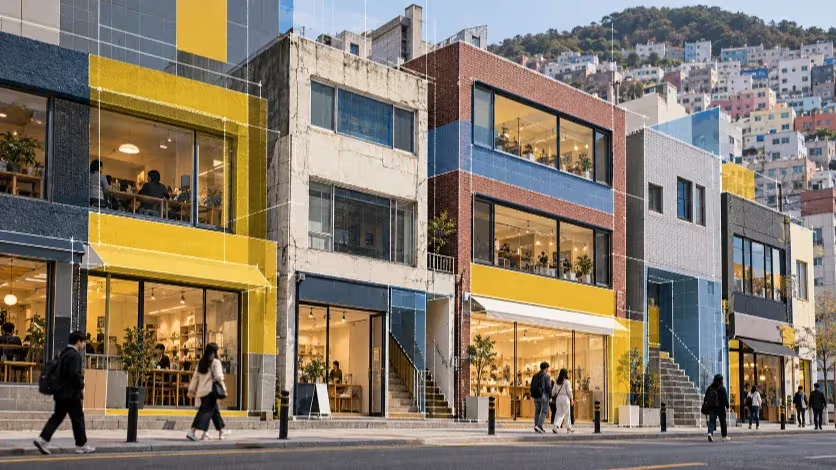
Demand and rent help explain why a unit goes vacant. Returning it to use can also require a workable tenant fit, affordable conversion costs and enough control over the property to make changes.
Years after the initial pandemic shock, Busan’s commercial-property market has experienced repeated tenant turnover, rent changes and shifts in consumer demand. Businesses have closed and opened, tenants have relocated, and consumers have redistributed spending across places, categories and online channels. Yet vacancy has not simply receded as the shock moved further into the past. Nationwide, the vacancy rate for general commercial properties reached 13.36 percent in the second quarter of 2026, up from 11.96 percent in the first quarter of 2021 and marking a seventh consecutive quarterly increase since the third quarter of 2024.
That statistic does not mean that 13.36 percent of individual shops are empty. Korea Real Estate Board vacancy rates measure vacant floor area relative to leasable floor area in sampled properties, so they describe unused commercial space rather than a count of storefronts. The more difficult question begins after the empty space has been measured. Two vacancies can look identical in a citywide statistic while representing very different economic conditions and very different prospects for returning to use.
Busan has no shortage of familiar explanations for commercial weakness. Population decline can reduce local demand, higher operating costs can squeeze businesses, online commerce can redirect purchases away from physical locations, and new development can deliver space faster than tenants absorb it. None of those forces disappears from the analysis. They explain important parts of why businesses close, why particular trade areas weaken and why some commercial space becomes vacant in the first place.
Vacancy persistence asks something narrower. Why does one empty unit find another tenant after an ordinary leasing interval while another remains unused through successive changes in rents, businesses and consumer behavior? The difference may still be demand: some locations simply do not have enough viable businesses seeking space. But once vacancies exposed to similar broader conditions begin to follow different paths, the characteristics of the property left behind become part of the economic question.
Recent data make it difficult to reduce Busan’s commercial economy to a single downward line. Service-sector production rose 2.2 percent in 2025 from a year earlier, while the regional retail sales index increased 1.9 percent. In the fourth quarter, service-sector production remained 2.6 percent above its year-earlier level even as retail sales declined 0.3 percent. These are not direct measures of demand for leased commercial floor area—services encompass activities with very different property requirements, and additional retail spending does not translate mechanically into additional occupied space—but they describe an economy whose parts were moving differently at the same time.
Commercial-property outcomes were uneven as well. In the fourth quarter of 2025, vacancy stood at 15.4 percent in Busan’s mid-sized and large commercial-property category, compared with 7.5 percent for small commercial properties and 8.8 percent for collective commercial properties. Because the categories represent different sampled populations, those figures cannot be turned into a claim that an individual large building was roughly twice as likely to be vacant as a small one. Their value is more limited: unused space was not distributed evenly across the market, while category-level rent indices were declining without an immediate restoration of occupancy.
Lower rents can still clear some vacancies, and weak demand can leave other properties with no realistic tenant at almost any workable price. The data do not overturn either proposition. They leave room for another one: price and aggregate demand do not tell a prospective tenant whether a particular floor, unit or building can support the business it wants to operate. Commercial property becomes concrete at precisely the point where citywide indicators become abstract.
From the District to the Building
A tenant does not lease Busan’s vacancy rate. It chooses a particular premises, with a particular entrance, floor plate, frontage, vertical access and relationship to the street. Two buildings can draw from much of the same neighborhood economy while offering very different operating conditions to the businesses considering them. Moving from the district to the property exposes differences that an aggregate vacancy number necessarily conceals.
A 2026 study of the commercial area between Pusan National University and Pusan National University Station offers an unusually close view of those differences. Researchers examined 97 commercial buildings facing roads at least 6 meters wide, combining field surveys and building-register records with GIS-based walking distances and measurements derived from frontal photographs. The study considered building scale, floor of vacancy, transit access and several façade characteristics. Smaller buildings and lower-floor vacancies were more strongly associated with higher vacancy rates, while the lower-floor sign-area ratio showed the most consistent association with lower vacancy and lower variation; transit distance had limited explanatory power within the study area.
Those findings do not establish that installing more signage will cause a vacant property to lease, and a university district cannot stand in for Busan as a whole. The value of the study lies in the narrower comparison it makes possible. Buildings within a relatively constrained commercial environment still produced different vacancy patterns, meaning that broad location did not finish the explanation. Scale, floor and the physical interface between the premises and the street remained visible after much of the surrounding trade-area context was shared.
The significance of those characteristics changes with the business considering the space. A ground-floor shop dependent on passing pedestrian traffic will value immediate frontage differently from a clinic, fitness facility or another destination business whose customers arrive with a prior intention to visit. Upper-floor space is not inherently uneconomic, just as ground-floor visibility cannot rescue a business model that lacks customers. Physical attributes acquire their economic value through the kind of tenant trying to use them.
That relationship begins to separate one vacancy from another. A ground-floor unit with direct frontage, usable utilities and a layout compatible with several business categories may require little more than a normal leasing process to return to occupancy. An upper-floor premises whose plausible next use needs substantial ventilation, electrical work or internal reconfiguration can remain technically usable while requiring far more money and time before a business can operate there. Both contribute vacant floor area to the same statistical measure, but they are not the same re-leasing problem.
What It Costs to Make Empty Space Usable
Commercial space is not economically available simply because a business likes the neighborhood and can afford the quoted rent. The premises must also work for what the business intends to do inside it. A restaurant may require exhaust and ventilation that the previous tenant never needed; a clinic can require a different internal layout and building services; a larger destination tenant may need contiguous floor area that exists only if several units can be combined. The decision to lease is consequently made against the cost of creating an operating business, not rent in isolation.
Some transitions demand little. Paint, fixtures, signage and ordinary equipment may fit within a routine tenant build-out, allowing one business to replace another without substantially changing the property. Other changes reach farther into the asset: walls may need to move, plumbing or electrical capacity may have to be extended, HVAC or ventilation may need upgrading, and circulation can become part of the problem if customers or staff cannot use the premises efficiently. A space can be perfectly serviceable as real estate and still be an uneconomic fit for the businesses currently seeking space.
The threshold varies with the tenant. A high-volume destination business can justify an investment that would overwhelm a small neighborhood operator, while a business whose customers deliberately travel to it can accept a location inside a building that would be unattractive to a retailer dependent on passing traffic. The effective tenant pool for any unit is therefore narrower than the total number of businesses interested in its district. It consists of businesses that want the location, can use the configuration and can earn enough from the premises to justify whatever changes are required.
Rent negotiations take place inside that larger calculation. A lower asking rent, a concession or a tenant improvement allowance can shift costs and make some deals workable, but a lower monthly payment does not create street frontage, join separated spaces or remove the disruption of a major build-out. An owner may choose to invest in reconfiguration when the expected future income makes the capital expenditure worthwhile. When the prospective tenant pool is uncertain, committing that capital before the new use has proved itself becomes a different economic gamble.
Persistent vacancy can emerge without either side simply refusing to adjust. A landlord can reduce the economic terms while the remaining obstacle lies in the premises; a tenant can accept the trade area while rejecting the conversion cost; an owner can see a technically possible renovation without seeing a return large enough to justify it. Another property may face a more fundamental problem and lack sufficient demand even after reasonable rent and physical adjustments. Keeping those possibilities separate prevents property adaptability from becoming a substitute for every other explanation of vacancy.
The distinction also explains why duration contains information that the headline vacancy rate does not. Routine turnover can be resolved through ordinary search and negotiation. A property that first has to find a different tenant category, finance a substantial build-out or change its physical configuration is moving through a longer process before another lease can even become economically plausible. What appears statistically as continued vacancy may, underneath, be a much more complicated attempt to make existing supply usable by new demand.
When Reuse Requires Control
Even a viable physical conversion requires someone able to authorize it. An owner controlling an entire property can consider combining units, changing circulation, reallocating common space or repositioning several floors around a different tenant mix. Where contractual rights or control are dispersed, many of the same physical possibilities can exist while becoming far harder to execute. Commercial adaptability can therefore have an institutional dimension as well as a physical one.
The former Fiesta complex in Seomyeon provides an unusually large example. The project contained 1,194 commercial units, with presale contracts signed for 494, and roughly 340 purchasers became involved in disputes over compensation and contractual positions. Although the building was completed, it remained largely unusable for roughly 12 years while claims and contractual relationships surrounding the project were resolved. The eventual settlement of those relationships allowed the property to be sold under unified control before its subsequent repositioning.
Fiesta cannot be reduced to a simple proposition that fragmented ownership causes vacancy. The project combined a developer failure, legal and contractual disputes and an exceptionally large building that never entered normal operation, circumstances far removed from an ordinary vacant commercial unit. Yet the scale of the problem makes one feature unusually visible: redesigning a building as a whole is difficult when the authority to treat it as one asset does not yet exist. Circulation, parking, common facilities and the distribution of tenants across floors cannot always be reorganized through a series of independent lease negotiations.
Once unified control had been established, the repositioning reached beyond changing the names on storefronts. The project involved changes to circulation, equipment, parking and the operating concept of the building itself. The later redevelopment does not prove that consolidation produces commercial success, but it demonstrates the range of actions that becomes possible when decisions can be coordinated across the property rather than confined to individual contractual positions. In that sense, control affects the menu of adjustments available to an asset.
The implication is broader than Fiesta but narrower than a citywide causal claim. Some commercial properties can be physically altered yet remain slow to change because the parties with rights over the asset cannot readily agree on, finance or authorize the necessary work. Others may have unified control but still fail because demand or project economics do not support the investment. Reuse depends on both the range of changes a property permits and the practical ability to carry them out.
Age Does Not Decide What Comes Next
By this point, the argument could easily collapse into another simple diagnosis: the problem is an aging commercial building stock built for an earlier economy. Some properties undoubtedly fit that description. Older mechanical systems can raise renovation costs, obsolete layouts can narrow the tenant pool, and ownership arrangements accumulated over decades may make coordinated change more difficult. But building age alone does not reveal how many economically plausible uses a property still possesses.
Jeonpo offers a useful countercase because much of its newer commercial identity emerged through an older, fine-grained urban fabric rather than after wholesale replacement. Tool shops, workshops and older commercial premises did not all disappear before cafés, food businesses, studios and other customer-facing uses began occupying the same streets. The shift depended on location, changing consumer preferences, entrepreneurial activity and the cumulative effect of new businesses giving visitors more reasons to enter the area. Some existing premises could participate because a different operator could use them without first remaking an entire large property.
That history should not be romanticized into a theory that small old buildings naturally regenerate. Plenty of older space can be difficult or uneconomic to reuse, and Jeonpo’s evolution depended on a particular mixture of demand, geography and business formation. Its relevance here is that age did not predetermine the outcome. Existing premises retained value when a new use could work with, rather than completely overcome, what the property already offered.
Nampo shows the same principle at a different scale. Four floors totaling about 2,970 square meters remained unused for more than five years before being absorbed in 2026 by a large destination retail use. The long vacancy might have looked like evidence that the space had lost its economic usefulness, yet the building did not become physically younger before it was occupied again. A tenant eventually appeared whose format, scale and expected customer base could make those floors viable.
The example does not mean that waiting long enough will rescue commercial space. Another vacant property can remain unusable because the next tenant would face excessive conversion costs, the trade area is too weak, or no emerging business model requires what the property can offer. Nampo demonstrates something more limited: vacancy duration alone cannot distinguish a permanently obsolete asset from a property waiting for a tenant whose economics fit its particular scale and configuration.
Myeongji approaches the same question from the other direction. Its newer commercial stock has experienced incomplete absorption and vacancy while functioning destination and service businesses operate in the surrounding new-town economy. New construction can reduce genuine sources of friction through modern elevators, mechanical systems, electrical capacity and parking, yet it does not eliminate the problem of matching individual units with viable tenants.
Development fixes many characteristics of commercial space before the future tenant market is fully known. Unit sizes, subdivision, frontage, vertical circulation and the total amount of commercial floor area are created around expectations about what businesses will eventually arrive. If the tenant economy develops differently, a recently completed property can begin its life with spaces better suited to some uses than others. Newness reduces some adjustment costs; it does not guarantee that the commercial format delivered is the format the market ultimately needs.
Jeonpo, Nampo and Myeongji are not a ranking of successful and unsuccessful districts. Taken together, they make age a less useful dividing line than it first appears. An older property can retain several economically plausible next uses, while a newer property can offer a narrower tenant fit than its physical condition suggests. The more important question is how many viable paths an existing premises has from its current use—or vacancy—to whatever the local economy demands next.
What Vacancy Actually Tells Us
Vacancy is among the clearest conditions a commercial-property market can measure and one of the least complete diagnoses it can provide. An aggregate rate tells a city how much leasable floor area is unused and whether that share is changing. It does not identify the adjustment process behind each empty square meter. Routine turnover, a rent reset, weakening demand, an unsuitable configuration, a coordination problem and structurally surplus space can all enter the same statistic.
Time begins to separate those conditions without resolving them automatically. A unit waiting briefly for a conventional replacement tenant is moving through a different process from a property that must first find another business category, finance substantial improvements or reorganize control before a viable lease can emerge. Longer vacancy is not proof of physical mismatch or structural decline. It is a reason to ask how far the property must travel before another use becomes economically possible.
Busan’s existing commercial stock contains many of those states simultaneously. Some space will return through routine leasing because demand remains sufficient and the premises already work for another business. Other units can clear after a rent reset or moderate build-out, while more difficult properties may need a different tenant category or broader repositioning. Some space may ultimately be surplus because no realistic combination of rent, investment and reconfiguration produces a viable next use.
Those outcomes are unfolding inside buildings accumulated over decades. Commercial properties preserve decisions made under earlier assumptions about consumer habits, business formats, development economics and ownership structures. Demand can change within months, a business category can expand or contract over a few years, and an individual tenant can disappear almost overnight; the building that housed it may remain for generations. The local economy and the physical stock through which it operates consequently move on different clocks.
That difference in speed is where vacancy persistence acquires its deeper meaning. Rent can change before a floor can be reconfigured, and a new category of tenant can appear before an owner knows whether the investment needed to accommodate it will earn an adequate return. Contractual rights can outlast the business model that produced them, while an old property can unexpectedly become useful again when a new kind of demand arrives. Commercial adjustment is not a single event in which price moves and space immediately finds its next occupant.
Demand, location and price still set the boundaries of what is economically possible. A flexible property in a market with no viable businesses can remain empty indefinitely, while a strongly demanded location can overcome physical disadvantages that would be prohibitive elsewhere. Property characteristics matter inside those market conditions because they affect how much time, capital and coordination stand between emerging demand and actual occupancy. They help determine whether a vacancy is easily recycled or becomes a longer-lived feature of the city.
A vacancy rate can tell Busan how much commercial floor area is unused today. It cannot tell the city how much of that space is one lease negotiation away from occupancy, how much requires substantial investment before another business can operate there, or how much no longer has a viable economic use. Those questions begin only after vacancy has been measured. Much of Busan’s commercial stock was designed around business formats and patterns of demand that have since changed; its continuing economic value depends partly on whether those properties can accommodate uses their original developers never anticipated.
Continue this reporting
Reporting on the same issue
Related coverage selected from the article's desk, topics and newsroom relationships.
 NewsOct 16, 2026
What Is Still Worth Going to See?
Busan’s biennale faces questions of artistic judgment and institutional care....
 NewsOct 14, 2026
What Became of Busan’s University Streets?
From 2015 to 2023, registered businesses grew near Pusan National University...
 NewsOct 12, 2026
Bukangi, the Shark That Stayed in Busan’s North Port
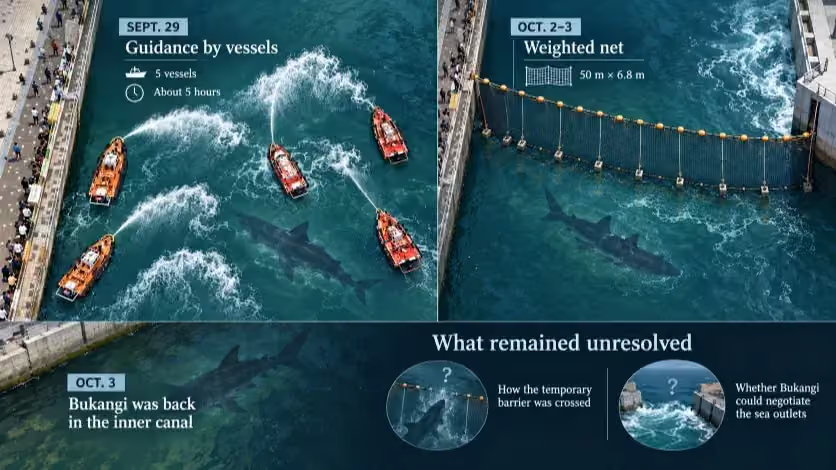
A rescue net guided Bukangi toward the sea, but the dusky shark returned to B...
More from the author
More from this byline
Stay with the same line of reporting through more work from this byline.
- NewsOct 14, 2026
What Became of Busan’s University Streets?
 NewsSep 22, 2026
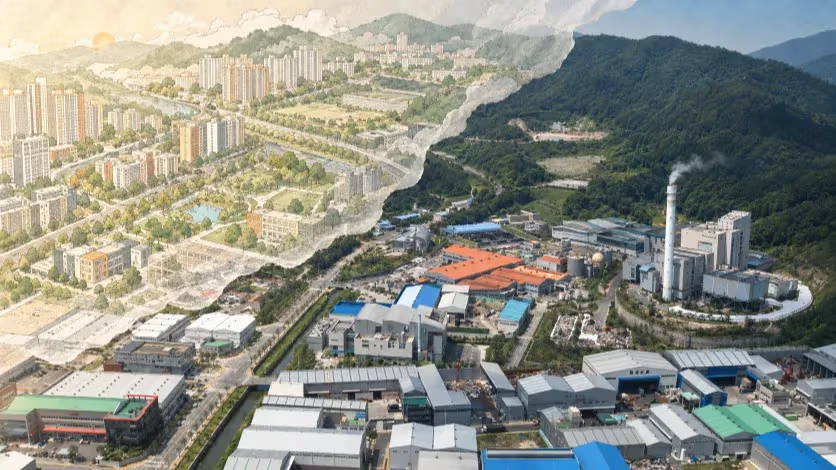
Busan Is Growing Westward as Its Waste Infrastructure Stays Put
Reader Signal
Community readWhat did this report leave you with?
Choose the signal that best reflects your reading. Select it again to remove it.
One response per article
No response selected
A moderated conversation about the reporting.
One-level replies and newsroom moderation keep the conversation anchored to this article.
Discussion Status
Open
Please sign in to join the discussion.
Newsletter
Weekly reporting and context from Busan and Korea.