The Capital Behind South Korea’s Hot Pot and Buffet Boom
South Korea’s large-format restaurants are scaling into a difficult market, revealing how franchising can accelerate expansion while placing the physical investment behind each new dining room on very different balance sheets.

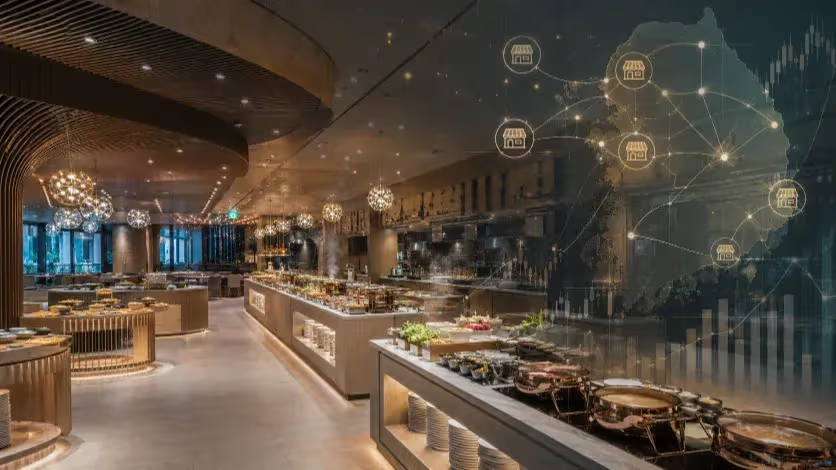
Across South Korea, large hot-pot and buffet chains are scaling even as restaurant margins tighten. Their expansion reveals a franchise model capable of mobilizing outside capital quickly while leaving much of the physical investment—and the consequences of a failed location—closer to the individual operator.
In January 2026, the Korean buffet chain QooQoo announced a new Gold-format restaurant in Bucheon with 414 seats spread across roughly 380 pyeong, giving the dining room a footprint large enough to function as a conspicuous piece of commercial real estate rather than simply another tenant occupying part of a building. Ashley Queens, one of the country’s largest buffet operators, moved in a similar direction several months later when it reopened its Grand NC Songpa location after expanding the restaurant from about 200 pyeong to 340. Although the companies differ in ownership and operating model, the physical scale of those stores captures an important feature of the latest phase of Korean dining, in which some of the industry’s most visible growth is taking place in rooms designed to serve hundreds of customers rather than in the small storefronts long associated with the country’s self-employed economy.
A restaurant of that size cannot be understood through the popularity of its menu alone, because long before customers encounter a buffet counter or a pot of broth, the business has already absorbed a succession of commitments involving the lease, construction, refrigeration, kitchen equipment, electrical capacity, ventilation, furniture and enough working capital to support an operation whose economics depend heavily on volume. When the restaurant belongs to a chain, much of the concept may have been designed before the local operator enters the picture: headquarters establishes the menu architecture, develops purchasing relationships, standardizes equipment and portions, organizes marketing and supplies a recognizable name, while the money required to translate those reusable assets into another physical restaurant may ultimately come from a different balance sheet.
That division has become more consequential as the broader economics of running a restaurant in Korea have grown less forgiving. Average food-service sales have risen over the past several years, yet operating expenses have risen faster, ingredients consume a larger share of revenue, and the pace of top-line growth has slowed sharply just as self-employed borrowers have become more heavily indebted. Franchise systems have nevertheless continued to proliferate, and investment has continued to move toward formats capable of converting standardized purchasing, preparation and service into high throughput, producing a market in which expansion and financial strain coexist rather than appearing as mutually exclusive conditions.
Large hot-pot and buffet chains are especially revealing in this environment because the features consumers value are closely connected to the way the restaurants are organized. One price covers a broad range of choices, families with different preferences can eat in the same place, and selecting or cooking part of the meal can be experienced as participation rather than diminished service, while the operator can arrange much of the same experience around purchasing, preparation and replenishment routines that are easier to reproduce across many locations. What appears abundant and highly customizable from the dining table can therefore be supported by an operating structure whose commercial advantage lies precisely in limiting unnecessary variation behind the scenes.
The appeal of such formats helps explain why they have become more visible at a time when many smaller restaurants are struggling to protect their margins, but their expansion also directs attention toward a more difficult issue than whether consumers currently like hot pot or buffets. Building an organization capable of reproducing a successful restaurant quickly does not ensure that every physical restaurant created through that organization will generate the return originally expected from the money committed to its lease, kitchen and interior over the full life of the investment.
When Thin Margins Reward Scale
The latest government survey of Korea’s food-service industry describes a sector that has grown substantially in nominal terms without becoming correspondingly more profitable. Average annual sales per establishment reached 255.26 million won in 2024, 41.4 percent above their 2020 level, while operating expenses increased by 46.7 percent over the same period, bringing the average operating margin down from 12.1 percent to 8.7 percent. Ingredients came to account for 40.7 percent of costs, up from 36.3 percent four years earlier, and after several years of much faster nominal expansion, average sales grew only 1.4 percent between 2023 and 2024, leaving restaurants with less room to absorb a cost base that had already moved sharply upward.
Those pressures do not fall equally across the industry, and the difference helps explain why standardized systems continue to attract operators. Franchise-affiliated food-service businesses averaged roughly 330 million won in annual sales, compared with about 230 million won among non-franchised establishments, with the gap between the two groups widening over the previous five years. Store size, location, cuisine, starting capital and the kinds of entrepreneurs who enter franchise systems all complicate the comparison, so the figures cannot establish that affiliation itself produces the difference, but they do show why an established chain can remain commercially attractive even in a difficult market: franchise restaurants operate at a materially larger revenue scale on average, and many of the capabilities associated with that scale become more valuable as margins narrow.
Research based on Korean Economic Census data points in the same direction while also showing where the advantage can begin to weaken. A 2025 study of local food-service markets found that greater franchise penetration was associated with significant gains in labor productivity, particularly in less-developed commercial districts, although the additional productivity benefit diminished as franchise presence became more intensive. The finding suggests that standardized purchasing, management and operating practices can raise efficiency where such capabilities are scarce, while also implying that an additional franchise outlet contributes progressively less organizational novelty once a market has already absorbed many of the same practices.
The registered stock of food-service franchise brands nevertheless continues to expand much faster than the physical restaurant network. The Fair Trade Commission counted 10,886 brands in 2025, 10.3 percent more than a year earlier, while the number of franchised food-service outlets rose only 1.5 percent to 183,714, meaning that the stock of brands grew at nearly seven times the rate of the stores through which those brands ultimately have to earn revenue. Opening and closure rates also moved closer together, with the food-service franchise opening rate falling from 21.5 percent to 18.2 percent while the closure rate rose from 14.9 percent to 15.8 percent.
None of those figures demonstrates that Korea has reached a uniform point of franchise saturation, since newly registered brands can remain small, replace older systems or disappear before building meaningful networks, while vigorous entry can also improve productivity by forcing weaker operators to adapt or leave. What the data show more clearly is that the incentives favoring shared infrastructure have become stronger at a time when the costs of remaining small are harder to absorb, because a modest procurement saving matters more when ingredients consume more than two-fifths of the cost base, standardized preparation matters more when experienced labor is difficult to recruit, and technology that would be expensive for one restaurant to develop becomes easier to justify when its cost can be spread across many locations.
Independent restaurants retain advantages that large organizations cannot manufacture easily, particularly local knowledge, flexibility and the ability to differentiate themselves from standardized competitors, but those strengths do not give them the purchasing volume of a national chain or allow them to amortize menu development, marketing and operating technology across a hundred dining rooms. The same increase in food or labor costs can consequently produce very different results depending on how the restaurant is organized, which helps explain why aggressive chain expansion can coexist with broader industry stress without requiring either side of the picture to be dismissed as anomalous.
Some of the current movement toward scale may therefore be occurring precisely because the restaurant business has become harder, as tighter margins make the efficiencies associated with purchasing power, standardized routines and shared infrastructure increasingly difficult to ignore.
Why Hot Pot Fits the Moment
The wider industry is already reorganizing restaurant work in ways that favor formats built around repeatable processes. Kiosks, table-ordering systems and other forms of unmanned ordering were used by 13 percent of establishments in 2025, up from 4.5 percent in 2021, while the share of preprocessed ingredients rose from 23 percent to 29.3 percent over the same period. These shifts suggest that tasks once performed repeatedly inside thousands of individual restaurants are increasingly being transferred either to technology or to suppliers operating farther upstream in the production process, allowing each store to begin service with a larger portion of the work already standardized.
Hot pot and buffet dining extend that reorganization into the architecture of the meal itself. A conventional full-service restaurant generates a sequence of individualized work each time a table orders, requiring preferences to be communicated, dishes to be prepared and timed, plates to be delivered and additional rounds to be managed as the meal progresses, whereas a buffet compresses much of that interaction into a fixed admission decision supported by continuous replenishment. Hot pot preserves the communal experience of table dining while allowing customers to select ingredients and complete much of the final cooking themselves, reducing the degree to which every portion consumed must be finished as a separate kitchen transaction.
Employees remain essential to these restaurants, which still require substantial preparation, cleaning, replenishment, food-safety management and customer assistance, while their large size can create labor demands that smaller establishments do not face. What changes is the amount of variation employees must manage for each additional diner, because more of the work can be organized around batches, standardized ingredients and predictable flows rather than the simultaneous completion of hundreds of individually specified dishes. That distinction matters particularly for chains, since a preparation method, ingredient specification or service routine developed at one level of the organization can be reproduced across dozens of locations without being reinvented at every address.
For consumers, the format also addresses a problem created by rising restaurant prices: uncertainty over the final bill. Fixed-price dining packages different preferences into a known transaction, allowing a family or group to combine meat, vegetables, cooked dishes and dessert without repeatedly adding new items to the check, so the attraction commonly described as value for money encompasses more than the possibility of eating a large quantity. Consumers are also purchasing a degree of price certainty and coordination, both of which become more valuable when ordinary à la carte dining grows more expensive.
The operator approaches the same fixed price from the opposite direction, managing foods with very different cost structures inside one overall admission charge. Every dish does not need to produce an identical margin because profitability depends on the consumption pattern of the dining room as a whole, allowing high-cost and low-cost items to coexist as long as purchasing, replenishment, portioning and waste remain consistent with what customers consume on average. As the number of locations grows, centralized sourcing and operating data become more useful because the company has more observations from which to estimate how diners move through meat, vegetables, prepared dishes, beverages and desserts.
Shopping malls, outlets and other large retail properties provide a natural physical setting for these formats because each side supplies something the other needs. A restaurant capable of seating several hundred people can occupy floor space that many conventional operators could not absorb, while the retail complex provides parking, shelter from weather and a concentrated flow of families already engaged in discretionary spending. Large restaurants can in turn function as destinations that help landlords generate traffic rather than simply fill space, which helps explain why the revival of buffets is closely connected to the economics of modern retail property as well as to changes in food-service operations.
Hot pot adds another advantage by making standardization compatible with a perception of personalization. Ingredients remain visible, diners determine their own combinations and cooking times, and part of the production process becomes part of the experience, allowing work shifted toward the table to feel like participation rather than a withdrawal of service. The format can therefore simplify certain aspects of production without requiring the consumer to experience the meal as rigid or uniform.
None of these advantages makes large-format dining inexpensive to operate, since high-volume restaurants require substantial premises, refrigeration, kitchen capacity and energy use, while unlimited-service formats must control waste and remain exposed to ingredient inflation within a fixed-price structure. Standardization can make those costs easier to organize and forecast, but it cannot remove them, which means that a dining room designed around hundreds of customers can become an expensive asset when traffic falls materially below the level assumed when the lease was signed.
The economic advantages of scale and the financial exposure created by scale are therefore produced by the same physical restaurant, and franchising determines how much of the money required to create that restaurant remains on the corporate balance sheet and how much is supplied elsewhere.
Capital-Light Networks, Capital-Heavy Stores
When Jollibee Foods Corporation announced its planned acquisition of Shabu All Day in February 2026, the Philippine restaurant group described the Korean chain in terms more familiar to an investment committee than to a dining review, citing approximately $285 million in annual systemwide sales, revenue of about $2.4 million per store, a two-to-three-year payback period, roughly 40 percent return on invested capital and high double-digit EBITDA and EBIT margins. Jollibee characterized the company as a capital-efficient, highly franchised business model capable of further growth, then completed the acquisition on April 16 after receiving Korean regulatory approval and subsequently described Shabu All Day as a network of approximately 170 restaurants nationwide, with about 60 tables per location on average.
Those figures require careful interpretation because they formed part of the buyer’s investment thesis rather than an independently audited description of the returns earned by every franchisee. Jollibee’s public announcement does not specify whether the stated payback period and return on invested capital correspond precisely to the total money committed by an individual franchise operator or reflect a broader unit-economics methodology, so treating them as a guaranteed franchisee return would go beyond what the company actually disclosed. Their significance lies instead in the way the buyer understood the network itself: as an organization capable of reproducing restaurant economics without requiring the parent company to finance every physical location directly.
A franchisor can develop the brand, sourcing system, recipes, training, marketing and operating procedures while relying on individual operators to provide much of the money that turns those reusable assets into leases, kitchens and dining rooms. If the same company wanted to open one hundred directly owned stores, deposits, construction, equipment, staffing and early operating losses would all compete for a finite amount of corporate capital, forcing management to weigh each proposed restaurant against other uses of the company’s money. A highly franchised network can loosen that constraint by drawing on one operator’s savings and borrowing for one location and another operator’s resources for the next, allowing physical expansion to proceed across many independently financed projects.
The physical cost of the restaurant does not diminish simply because the network has found a more efficient way to finance it, since the lease remains attached to one address, electrical and ventilation work remain embedded in one building, and a kitchen designed for a particular operating format may be worth considerably less to the next tenant than it was to the investor who paid to install it. Deposits may eventually be returned and movable equipment can be sold, but large portions of restaurant spending become difficult to recover once concrete, ductwork, wiring and interior finishes have turned them into part of a specific location.
The assets retained by headquarters follow a different economic logic because trademarks, supplier relationships, recipes, operating data, training systems and consumer recognition can continue supporting the rest of the network after an individual location has disappeared. A franchisee and the company controlling the brand therefore participate in the same restaurant business while holding assets with very different degrees of portability, with one investor concentrating a substantial amount of money in a particular address and the other retaining resources whose usefulness extends across many locations.
Jollibee’s purchase made that contrast unusually visible because the company paid roughly $87 million, or around 127 billion won, for exposure to the economics of an entire chain rather than to one dining room. The entrepreneur financing a single franchise location makes a much narrower investment, placing savings, borrowed money and expected years of labor behind one catchment area, one rent structure and one estimate of how much traffic a particular store will continue to attract.
The arrangement can generate value for all sides when the restaurant performs as expected, since franchisees gain access to an established menu, supplier relationships, marketing and operating knowledge that would be costly to reproduce independently, while headquarters extends the brand without paying the full physical cost of every store. Suppliers gain volume, landlords obtain tenants capable of filling large spaces, and consumers receive a product whose price and experience are comparatively predictable. When a location underperforms, however, the reusable assets of the network and the physical assets embedded in the restaurant do not lose value at the same rate, leaving the local investor exposed to the lease, site-specific construction, secondhand equipment and any debt that remains from opening the store even as the broader brand continues operating elsewhere.
The network can therefore remain comparatively light in physical capital precisely because a substantial share of the capital required to create each restaurant has been placed somewhere else, inside the balance sheets of the operators who finance the physical expansion.
Who Pays for the Next Store
A franchisee is consequently more than an operator purchasing permission to use someone else’s brand, because every new restaurant requires another lease to be signed, another interior to be built, another kitchen to be installed and another pool of working capital to be committed. In a highly franchised chain, individual operators are also among the principal sources through which the network finances its physical growth, combining personal savings with business borrowing, household credit or other forms of financing that allow a concept designed centrally to appear in another local market.
Korea’s credit structure makes that role especially consequential. The Bank of Korea estimated that borrowers holding individual business loans carried 1,095.5 trillion won in combined business and household debt at the end of the first quarter of 2026, up from 399.8 trillion won in early 2015, with 745.5 trillion won of the latest total consisting of individual business loans and another 350 trillion won of household borrowing held by the same group. Those figures cover the self-employed economy as a whole rather than the restaurant or franchise sector specifically, but their composition matters because the central bank combines business and household borrowing precisely to reflect the degree to which commercial activity and personal finance overlap for self-employed borrowers.
An entrepreneur unable to finance a several-hundred-million-won restaurant entirely with cash may still proceed if credit is available, which means that borrowing does not reduce the economic cost of the kitchen, interior or lease so much as move part of that cost into future trading periods. The restaurant can open sooner because construction is paid for today, while tomorrow’s cash flow is already partly committed to principal and interest, making the accuracy of the operator’s original assumptions about sales and margins increasingly important once borrowed money has been converted into a physical store.
Credit can therefore influence how rapidly restaurant supply responds to an attractive concept by widening the pool of prospective operators capable of financing an opening, while at the same time reducing the amount by which revenue can fall before fixed financial obligations become difficult to service. Two restaurants selling identical food under the same brand can face very different levels of financial pressure if one was funded largely with equity and the other with substantial debt, even though the customer sees no difference between them.
The connection between franchise expansion and credit became unusually visible in 2026 through government scrutiny of Myeongryundang, the company associated with the Myeongryun Jinsa Galbi franchise. Korean competition and financial authorities reported that the company had provided approximately 89.9 billion won to 14 lending companies established by its controlling shareholder and that those lenders supplied money to franchisees, including financing for interior work, at annual interest rates of 12 to 18 percent. The Fair Trade Commission later opened a separate deliberative proceeding over allegations that Myeongryundang had improperly supported those related lending businesses, with the commission examiner calculating a financial benefit to the lenders arising from the funding arrangement; because the proceeding remains separate from a final commission determination, the legal question must remain distinct from the economic structure disclosed through the investigation.
That structure is significant because it shows how the institutions surrounding a franchise can extend beyond the familiar relationship between headquarters and operator. In a simple model, the franchisor supplies the brand and operating system, a lender supplies credit, a landlord supplies the premises and the franchisee combines money with labor, whereas closer links between the franchise ecosystem and the financing used to construct stores can give the broader business network a greater influence over whether prospective operators obtain the funds required to build another location.
Such financing can support viable businesses that otherwise might never open, but it can also accelerate the creation of restaurant capacity because access to money removes one of the practical constraints on how quickly a successful concept can be reproduced. The loan that makes an additional restaurant possible consequently performs two functions at once, expanding the supply of stores today while laying claim to a portion of their future cash flow, which leaves leveraged operators more exposed when actual sales diverge from the assumptions made at entry.
The Economics of Leaving
Franchise marketing naturally concentrates attention on entry, when prospective operators are comparing startup costs, recent store sales and expected recovery periods, yet the same investment looks different once revenue begins to weaken because operating expenses and financial commitments adjust at very different speeds. Ingredient orders can be reduced and staffing schedules changed relatively quickly, while the lease, the money already embedded in the kitchen and interior, and the debt raised to finance construction continue to reflect expectations formed when the restaurant was expected to trade for years.
A June 2026 survey by the Ministry of SMEs and Startups provides a rare view of how prolonged that adjustment can become. Among 1,500 recently closed small-business owners who had participated in specified government support programs, 70.9 percent identified deteriorating profitability or weak sales as the main reason for shutting down, while nearly two-thirds waited until sales had fallen at least 40 percent from normal levels before deciding to close. At the time that decision was made, 68.5 percent still carried debt averaging 85.31 million won, and another 7.7 months passed on average before their business registrations were formally terminated.
The survey does not represent every Korean business closure and cannot be used as a direct estimate of the experience of a large hot-pot franchise, but it reveals how long a business can continue consuming money and attention after its owner has already concluded that remaining open no longer makes economic sense. Loan repayment was the most frequently reported difficulty during closure, while recovering deposits or goodwill payments was another major problem, and respondents reported an average 12.86 million won in direct closing costs that included demolition and restoration, remaining inventory, severance obligations, unpaid rent, taxes and contractual charges.
For a large restaurant, the eventual loss therefore cannot be inferred simply from the amount invested at opening, because some assets remain recoverable while others lose value quickly once operations end. Deposits may return to the owner, refrigerators and furniture can be sold, and kitchen equipment may find another buyer, whereas plumbing, electrical upgrades, exhaust systems and interior construction often derive much of their value from the restaurant continuing to occupy the premises for which they were designed. Equipment sold under time pressure may also realize substantially less than its purchase price, leaving the operator to reconcile what can be recovered with the obligations that remain after the business has stopped producing revenue.
Debt makes that reconciliation more severe because its contractual life does not depend on the useful life of the restaurant. A location can stop serving customers soon after the final decision is made, while principal and interest continue according to agreements written when years of future cash flow were still expected, so the economic end of the restaurant and the financial end of the investment need not occur at the same time.
The broader financial strain surrounding accommodation and food services is visible in Bank of Korea data, which placed the self-employed closure rate in the sector at 18.2 percent at the end of 2024 and the delinquency rate on individual business loans at 2.57 percent by the first quarter of 2026. The latter figure refers specifically to business loans rather than household borrowing held by the same people, an important distinction when tracing how commercial distress can migrate into personal finances, but the Ministry survey suggests that the consequences frequently continue after the business registration has disappeared.
Among respondents who had closed, 40.5 percent cited insufficient living expenses as a major subsequent difficulty and 22.1 percent said debt interfered with their next economic activity, while one-third were drawing on existing assets for living expenses and almost one-quarter relied principally on relatives or acquaintances. These figures should not be converted into a national estimate of what happens after every restaurant failure, yet they show why closure statistics alone cannot capture the full economic adjustment, since a storefront can disappear while the household that financed the business continues to absorb the consequences for years.
An unsuccessful restaurant also does not automatically imply wrongdoing by a franchisor, because weak demand, poor management, local competition or an inaccurate rent assumption can produce ordinary investment losses even when every participant complied with the law. Misleading disclosure, unsupported charges or unlawful contractual practices belong to a different legal category, and keeping those questions separate is essential because the structural issue exists even without misconduct: a franchise network can legitimately distribute large amounts of location-specific investment among individual operators while retaining much of its reusable brand and operating knowledge at headquarters.
A company-owned buffet and a franchised one may therefore appear almost identical to the customer while allocating the consequences of failure very differently, since a corporate parent can absorb one unsuccessful location within a diversified portfolio and shareholder base, whereas an individual investor operating one or two restaurants may have tied a far greater proportion of personal wealth and borrowing capacity to the same physical dining room.
When Success Changes the Market
The most difficult risk to identify often emerges from strong early performance because a successful restaurant does more than generate revenue; it also produces evidence that can persuade other entrepreneurs, lenders and landlords that the concept deserves additional locations. Early stores may benefit from novelty, a wide catchment area and limited direct competition, making their sales particularly persuasive, yet every new opening changes the conditions under which the next operator will trade.
Empirical research in Korea shows that this dynamic can occur inside a single franchise network. A study using transaction data from 49 bakery-franchise locations in Seoul’s Gangnam district found that the opening of another outlet of the same brand nearby reduced sales at incumbent stores, with statistically significant cannibalization around high-traffic subway areas. The authors’ estimates come from one category and one geographical market and cannot be transferred directly to hot-pot restaurants or buffets, but the mechanism remains relevant because it demonstrates that growth in network sales and the economics of an individual store do not necessarily move in the same direction.
Headquarters can rationally approve another location when additional royalties, purchasing volume, market presence or system sales outweigh spending diverted from existing stores, while an operator whose investment is concentrated in one dining room experiences the same shift through a much narrower portfolio. A reduction in that store’s revenue directly lowers the cash available to recover money committed to the lease, fit-out and equipment, which means that a restaurant can remain profitable in accounting terms while becoming a materially worse investment than the one originally presented to the operator.
If a store expected to recover its opening cost within three years instead requires five or six because competition divides demand, the restaurant may remain busy enough to avoid closure while producing a return far below the one that justified the investment. This is why the most consequential form of deterioration in a large-format chain need not resemble the spectacular collapse of a short-lived food fad; weaker unit economics can develop gradually while stores continue operating and the network continues expanding.
The available evidence does not establish that Korea’s current large-format dining market has already crossed a clear line into overexpansion. Jollibee acquired Shabu All Day on the expectation that the chain retained room for further growth, while QooQoo and Ashley continue committing money to larger formats, and none of those decisions should be treated either as proof of future success or as evidence that a bubble already exists. The more defensible concern is that information about a successful concept can become less representative as the concept itself changes the competitive environment.
Store economics observed when a chain has fifty restaurants may describe a very different market from the one confronting an operator who enters after the network has reached one hundred and fifty, particularly if competing brands are simultaneously pursuing the same family-dining expenditure. Additional locations can enlarge the overall category, take customers from weaker restaurants, divide spending among outlets of the same brand or produce some combination of all three, meaning that early-store performance becomes progressively less reliable as a simple forecast for later entrants.
Saturation is therefore better understood through returns than through restaurant counts alone, because dense dining districts can benefit from clustering and additional population, tourism or dining frequency can support more restaurants for long periods. The economically relevant threshold is reached when another location can no longer generate a return commensurate with the money required to build it without diverting enough spending from existing businesses to weaken their economics, a condition that may arise long before the market looks visibly empty or distressed.
Competition also extends beyond restaurants carrying the same menu label. A family deciding where to spend its weekend dinner budget may choose among hot pot, barbecue, sushi buffets, family restaurants, hotel dining and other group-oriented venues, allowing several categories to add physical capacity against essentially the same pool of household expenditure even when no single cuisine appears obviously overcrowded.
Because the decisions are decentralized, no participant needs to behave irrationally for the cumulative result eventually to become excessive. Consumers reward an appealing format, early stores generate persuasive numbers, prospective franchisees see an established operating model, lenders observe recent cash flow, landlords welcome tenants capable of filling large spaces and competing companies respond to the same visible demand, so each decision can remain commercially sensible when considered in isolation even as their combined effect creates more restaurant space than future consumer spending can support at the returns that initially attracted the investment.
The Balance Sheet Beneath the Meal
Korea’s franchise disclosure regime is beginning to recognize that entry data describe only part of the investment cycle. Changes approved in 2026 will broaden the information available to prospective franchisees, including measures intended to make longer-term store survival and the financial implications of early contract termination more visible, with the core revised disclosure framework scheduled to take effect on January 1, 2028. The direction of the reform matters because startup cost and average sales cannot fully describe an investment whose eventual value also depends on how long comparable stores remain open and what can be recovered if they do not.
No disclosure system can remove commercial uncertainty, since historical survival rates cannot capture every difference in rent, leverage, location, management or competition, and regulators cannot determine in advance how many restaurants a neighborhood will support several years later. Better information can nevertheless improve the quality of the investment decision by placing the possibility of exit alongside average sales and startup costs before the lease has been signed and the money has become difficult to recover.
Large hot-pot chains and buffets are expanding because they address genuine economic pressures inside the restaurant industry. Their operating models can centralize purchasing, spread technology and accumulated knowledge across many locations, reorganize some forms of restaurant labor and offer consumers a combination of variety and predictable pricing, while Korean research suggests that franchising can improve labor productivity particularly where organized business capabilities are otherwise limited, even though those gains diminish as franchise penetration becomes more intensive.
The same organizational structure determines how the expansion is financed, because a chain capable of drawing repeatedly on outside entrepreneurial capital can build physical capacity far faster than a company required to finance every new kitchen and dining room itself, while the operator gains entry into a business whose sourcing, menu and operating routines have already been developed. As long as the restaurant produces the revenue anticipated at entry, the arrangement can create value across the system, but the durability of that value depends increasingly on whether the next location can reproduce the economics of those that came before it after accounting for the competitive changes created by the network’s own growth.
Every new store alters the geography of the chain, the alternatives available to customers and the amount of money competing for the same household dining expenditure, which means that an organization exceptionally good at reproducing successful restaurants also needs sufficiently accurate information to recognize when reproduction begins to weaken the economics that made the format successful. That task becomes especially difficult when financing is widely dispersed, because each operator, lender and landlord evaluates one investment while the relevant market is being changed by many similar decisions occurring elsewhere.
The dining room conceals most of this from the customer, whose experience begins only after the lease has been negotiated, the kitchen financed, the equipment installed and the operating system prepared. A brand may extend across hundreds of locations, but the investor behind any one of those locations still depends on enough people choosing one particular address often enough to support the money embedded there, while debt attached to the opening can remain long after the novelty that initially attracted consumers has faded.
Korea’s new dining rooms are therefore testing something larger than the durability of a preference for hot pot or buffets, because they reveal whether an industry that has become increasingly sophisticated at identifying successful operating formats and mobilizing money to reproduce them can become equally sophisticated at recognizing the limits of that success before the investment becomes difficult to reverse. Once the lease has been signed, the equipment installed and borrowed money converted into a restaurant, an error about the size of the market is no longer simply a mistaken forecast about what people want to eat; it has become a difference between the value investors expected to create and the value that can still be recovered, and that difference must eventually settle somewhere on a balance sheet.
Continue this reporting
Reporting on the same issue
Related coverage selected from the article's desk, topics and newsroom relationships.
 NewsSep 21, 2026
Europe’s Electrical-Steel Safeguard Now Reaches Inside the Transformer
A new EU safeguard follows electrical steel into certain finished transformer...
 NewsSep 14, 2026
Foreign Tourist Spending Is Reshaping Busan’s Nampo District
Foreign spending is making long-empty commercial space valuable again in Namp...
 NewsSep 11, 2026
Busan-Jinhae’s New Industrial Strategy Meets a Jobs Divide
As BJFEZ prepares to add AI, data and advanced energy to its industrial prior...
More from the author
More from this byline
Stay with the same line of reporting through more work from this byline.
 NewsOct 14, 2026
What Became of Busan’s University Streets?
 NewsSep 28, 2026
Why Some Commercial Space in Busan Is Hard to Reuse
Reader Signal
Community readWhat did this report leave you with?
Choose the signal that best reflects your reading. Select it again to remove it.
One response per article
No response selected
A moderated conversation about the reporting.
One-level replies and newsroom moderation keep the conversation anchored to this article.
Discussion Status
Open
Please sign in to join the discussion.
Newsletter
Weekly reporting and context from Busan and Korea.