How Busan’s Cafe Boom Reached Saturation
Busan proved that people would travel for a new kind of cafe. As the market contracts and sales concentrate among fewer operators, the harder test is whether destination cafes can survive after the view, the building and the bakery are no longer new.

Busan’s cafe count nearly tripled in a decade before falling from its 2023 peak. Spending continued to rise even as closures overtook openings, exposing a widening divide between businesses that attract customers once and those able to bring them back.
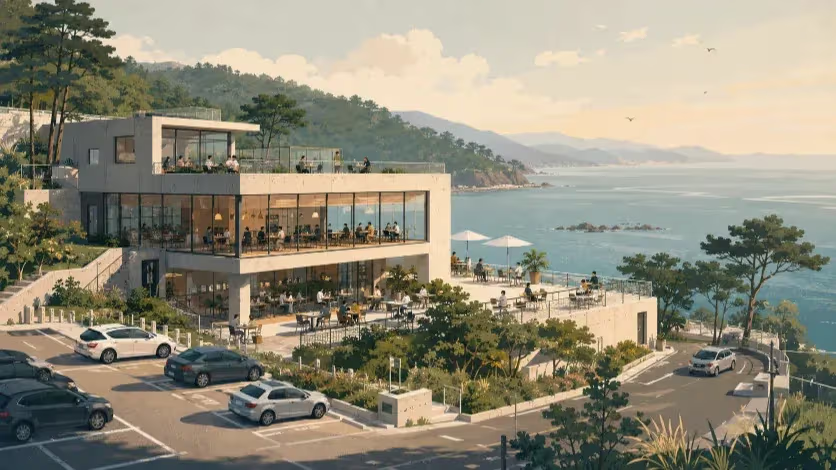
Busan’s largest cafes were built for the day everyone arrived. Their car parks anticipated weekend traffic, their glass walls faced the sea or the Nakdong River, and their bakery counters stretched across rooms large enough to absorb a queue. Several floors of seating allowed a coffee shop to function as a family outing, a date, a coastal drive and a destination for photographs, asking customers to buy more than a drink and give part of a day to the building.
When the format was still unusual, architecture carried much of the commercial burden. A panoramic window, a rooftop and a broad display of bread offered an experience that a compact urban cafe could not easily reproduce, while the journey, parking and premium bill belonged to leisure rather than routine consumption. Coffee was one part of a purchase that included scenery, space and the satisfaction of arriving somewhere unfamiliar.
The calculation changes when the customer considers returning. The view has been seen, the photographs have been taken and the route is no longer a discovery, yet the same travel time, parking problem and group payment remain. A neighbourhood roastery may offer a more distinctive cup closer to home, a takeaway chain can deliver weekday convenience within minutes, and another destination cafe may have opened with a different garden or a fresher position along the coast.
Busan’s public data cannot identify whether a transaction came from a first-time visitor or a regular customer. They do show that the city’s long expansion has ended. The number of active businesses in the official cafe category rose from 3,071 in 2015 to 9,424 in 2023 before falling to 9,182 in 2024. During 2024, 1,375 businesses opened and 1,470 closed, while the opening rate fell to 15 percent, its lowest level in the decade covered by the analysis.
The official category combines coffee shops with other non-alcoholic beverage businesses under Korea’s industrial classification, making it somewhat broader than the everyday meaning of a cafe. The establishment count also covers businesses that were active during the year rather than the number of storefronts operating on one fixed date. The decline in active businesses and the difference between annual openings and closures are therefore related indicators rather than two versions of the same calculation.
Customers had not stopped spending. Domestic card payments in Busan’s cafe category reached ₩375.35 billion in 2025, 16.7 percent above the 2023 level, while foreign card spending increased 73 percent to ₩5.87 billion. People in their forties and older accounted for 68.6 percent of domestic spending, complicating the youth-centred imagery through which cafe culture is often presented. The spending figures cover a later period than the 2024 business data, but they show that substantial demand remained after the number of active businesses had passed its peak.
Gijang, where ocean-view venues helped popularise the destination model, offers an early indication of how the expansion is changing. Among coffee shops licensed under a food-service category commonly used for cafes and other non-alcoholic food businesses, the number of premises measuring at least 100 square metres rose from 80 in 2020 to 94 in 2022 before falling to 82 in 2025. Fourteen such businesses were newly registered in 2022, none in 2024 and two in 2025. Large cafes operating under other licences fall outside the count, although registrations within the category still show a pronounced slowdown.
The divide running through Busan’s cafe economy is no longer simply large against small or independent against franchise. It lies between businesses that can attract a customer once and those able to earn the next visit. The city expanded by continually producing new places to see. It has now entered a harder phase in which novelty, scale and consumer spending no longer guarantee that the operator behind the counter will survive.
The Boom Has Stopped Expanding
For most of the past decade, Busan’s cafe market moved in one direction. More businesses appeared, more neighbourhoods acquired their own cafe clusters, and stretches of coast, riverfront and former industrial land became places where customers could remain for an afternoon rather than stop briefly for a drink. By 2024, the number of businesses in the official category was 199 percent higher than in 2015, leaving Busan with more than any of Korea’s other metropolitan cities outside Seoul.
The first annual decline arrived after the market had become enormous. Closures did not reach a record in 2024—the previous year had recorded more—but they remained historically high and exceeded openings as new entry continued to weaken. The opening rate had fallen from 24.8 percent in 2015 to 15 percent in 2024, suggesting that the reversal came from a combination of sustained exits and fewer new operators entering the market.
The sales data explain why the shift cannot be reduced to a disappearance of demand. Average annual sales reached ₩150.9 million in 2024, the highest among the metropolitan cities outside Seoul, but the median was only ₩63 million. Individually owned businesses recorded average sales of ₩104.3 million and a median of ₩58 million, while corporate businesses accounted for 9.7 percent of active enterprises and earned far larger revenues. A relatively small group of companies therefore pulled the citywide average well above the amount reported by the business in the middle of the market.
Revenue is not income. Rent, wages, ingredients, electricity, card fees, financing and unsold food still have to be paid, and the official figures do not reveal how much remained after those costs. Even without estimating profit, the distance between average and median sales changes the picture. A market can produce high aggregate spending and impressive flagship venues while leaving many ordinary operators with little protection against a weak season, a rent increase or another competitor opening nearby.
The concentration is visible in the districts most closely associated with destination and waterfront cafes. Average sales reached ₩213 million in Haeundae, ₩202 million in Gangseo and ₩181.5 million in Gijang. Median sales were much lower—₩84 million in Haeundae, ₩78 million in Gangseo and ₩65 million in Gijang—showing how strongly a smaller number of high-revenue businesses lifted the district averages.
Survival rates varied just as sharply. Among businesses founded three years earlier, 43.7 percent were still active at the end of 2024. Yeongdo recorded a rate of 65.1 percent, while Suyeong and Busanjin stood at 36.4 and 36.7 percent respectively. Rent, store size, ownership and franchise status vary across those districts, leaving the source of the differences unresolved, but the figures make one point clear: a famous cafe area can remain busy while individual businesses turn over rapidly.
Jeonpo illustrates the contradiction. Customers can return to the district several times without returning to the same cafe, treating the neighbourhood as the destination and each business as one stop in a continuing search for something new. Frequent openings preserve the area’s appeal from the visitor’s perspective, while the operator who paid for an interior and signed a lease faces a shorter period in which to recover the investment.
Expansion was also moving west. Gangseo’s cafe count increased from 56 in 2015 to 490 in 2024, a rise of 775 percent, while Gijang grew from 162 to 596. The numbers do not show that Gangseo has displaced the eastern coast, but they demonstrate that large-format development and high cafe sales are no longer confined to Gijang and Haeundae.
Busan had not stopped buying coffee. It had entered a more selective market in which strong spending could coexist with fewer active businesses, falling entry and a large gap between the most successful operators and the business at the centre of the distribution.
One City, Several Coffee Economies
A citywide total obscures what different cafes ask customers to purchase. A large bakery cafe on the Gijang coast, a garden compound beside the Nakdong River, a vertical waterfront venue in Gwangalli and a takeaway counter outside Seomyeon Station may occupy similar statistical categories, yet their customers arrive for different reasons and surrender very different amounts of time.
The destination market is the most visible because it occupies the largest buildings and produces the images most likely to circulate. Gijang, Songjeong and Cheongsapo developed an eastern coastal form centred on ocean views and car travel. Yeongdo, Songdo and Dadaepo created versions embedded in port, cliff and beach landscapes closer to the established city, while Gangseo added riverfront land, broad gardens and sites connected to the residential expansion of Myeongji and the road network leading toward Gimhae and Changwon.
A study of 296 consumers who had recently visited what the researchers called “hedonic cafes” found that travel distance, generation, ordering method and time spent at the cafe were associated with the choice between the coastal areas of Gijang and Yeongdo and the urban cafe district of Jeonpo. Customers travelling farther and planning to remain were more likely to choose the coastal areas, supporting the view that the destination cafe sells a journey and a period of occupation as much as a beverage.
Gijang and Gangseo should not be treated as identical markets. Gijang’s earlier venues sold the feeling of leaving the dense city for an open coastline, where a large standalone building and an ocean view still possessed scarcity. Gangseo’s later growth draws on riverfront sites, family travel and a nearby population expanding across western Busan. Both depend heavily on cars and group visits, but the sources of demand and the opportunities for routine use are different.
Urban waterfront cafes face another equation. Haeundae, Gwangalli and Millak provide tourists, residents and evening pedestrians without requiring every customer to organise a separate drive, although they also impose costly space, congestion and intense competition. Scarce land often pushes a large urban cafe through several floors rather than across a broad site, leaving only part of the seating with the unobstructed view that carries much of the promotional appeal.
A destination venue must persuade people to travel specifically to it, which can make a crowded Saturday look more decisive than it is. A queue may fill the car park and every floor, while the same building carries labour, maintenance, cooling and financing through a quiet weekday. Capacity creates the revenue potential visible during peak hours and the unused space that appears when ordinary demand returns.
Away from the coast and river, low-price chains expanded by making a much smaller claim on the customer’s day. Stores around subway exits, universities, offices, hospitals, academies and apartment districts inserted coffee into routes that already existed. The customer does not need to evaluate the architecture or decide whether the trip is worth making; the transaction can be completed in minutes and repeated several times a week.
A cafe in Gijang may ask a family to surrender half a day. A takeaway counter outside a subway station asks for three minutes. The first can collect more from a single group but must continually find people willing to make the journey, while the second earns less from each cup and can become part of a routine.
Convenience has its own form of saturation. A destination cafe may compete across a thirty-minute driving radius, while a takeaway business can lose customers to another counter on the opposite side of a crossing. Where prices and menus differ only slightly, the direction of the morning commute, the position of an exit or the length of a queue can determine which franchisee receives the sale.
Premium chains occupy the space between destination and takeaway markets by combining familiar drinks with seating, digital rewards and locations already used for work, shopping or meetings. Their repeat business does not require the customer to return to one address. Loyalty can accumulate across a network, allowing the brand to retain the customer even as the branch changes.
Independent roasters, dessert specialists and neighbourhood cafes make repetition more personal. Customers may return for a particular coffee, a recognisable product, a familiar owner, a quiet table or the convenience of walking from home. These businesses rarely produce the opening spectacle of a large coastal venue, but they can build value through familiarity rather than continually replacing it with novelty.
The same consumer can participate in every part of the market. A commuter may buy inexpensive coffee near work, meet a client in a premium chain, return to a neighbourhood cafe on Saturday and drive to a new coastal venue on Sunday. Price does not permanently divide customers into separate groups; the occasion determines how much money, time and travel they are prepared to give.
Saturation begins when the number of businesses competing for each occasion grows faster than the occasions themselves. A new cafe no longer has to create fresh demand. It can take the customer’s next visit from the business that opened before it.
The Business of the First Visit
A destination cafe begins selling before its doors open. Construction photographs appear online, terraces and windows emerge in short videos, and local recommendation accounts identify the building as the next place worth driving to. By opening day, weeks or months of curiosity may be released within a few weekends, making the first queue a measure of accumulated attention as well as ordinary demand.
The crowd proves that the building has been noticed and that customers are willing to travel. It says less about what happens after the venue becomes familiar. A busy opening month can contain people who have been waiting for the same first experience, leaving the operator with a stream of new visitors that resembles stable demand until the backlog of curiosity begins to clear.
The first visit also changes how price is judged. A drink at a coastal or riverside cafe is rarely compared only with coffee near home. The customer is purchasing the route, the view, the architecture, the seat and a place where a family or group can remain for part of an afternoon. An expensive menu can still feel acceptable because the payment is classified as the cost of an outing.
A later visit invites a narrower calculation. The same bill must compete with a specialist cafe closer to home, a meal, another family activity or a destination whose view has not yet been seen. The first trip turns inconvenience into part of the experience. The second returns it to traffic, parking and the total on the receipt.
Research based on the Busan Tourism Organization’s 2022 cafe-use survey offers a local view of the distinction. Among Busan residents, atmosphere and interior, price, accessibility and service were significant factors in stated revisit intention. Among non-residents, coffee quality, atmosphere, accessibility, side-menu quality and service were significant, while the exterior view appeared as a factor in recommendation rather than revisit intention. The survey measured intentions rather than observed repeat transactions, but it suggests that a view worth recommending and a cafe worth revisiting are not necessarily the same commercial achievement.
A visitor can enjoy a cafe, post photographs and recommend it to someone else without feeling any urgency to return. The experience may have delivered exactly what was expected from it, leaving no failure to complain about and no unfinished reason to repeat it.
Large destination cafes are particularly exposed because much of their value can be consumed quickly. The exterior, staircase, window, rooftop, garden and bakery display become legible during the first walk through the building. A neighbourhood cafe can deepen its value through repeated conversations and familiarity, whereas a destination venue often reveals its most distinctive assets at once.
Early operators benefited from scarcity. A wide ocean view or a purpose-built cafe remained memorable because few businesses offered the same combination of scale, scenery and leisure. As the model spread, its elements became a shared architectural language: floor-to-ceiling glass, stepped seating, landscaped outdoor space, rooftop terraces, extensive parking and a long bakery counter.
The buildings remained different, but customers learned how to read the experience before entering. A new operator no longer had to persuade Busan residents that a cafe could justify a drive; earlier venues had already established that habit. The next opening needed to promise a fresher view, a larger garden or a more striking interior, allowing the category to remain popular while individual businesses rotated through the customer’s attention.
The bakery became central to the model because it solved several commercial problems at once. Bread raised the value of a group order, gave children and non-coffee drinkers more choices, extended the visit toward a meal and filled a large interior with colour and smell. The counter created a second visual attraction after the exterior and the view had been photographed.
Once the bakery became standard, abundance offered less distinction. Similar croissants, cakes, salt bread and oversized pastries appeared across venues claiming different identities, pushing operators to widen displays while searching for a product customers would remember by name.
The final bill can shape the next decision more strongly than any individual price. Drinks and pastries are selected one at a time, while the total appears only after a family or group has assembled a tray. During the first visit, that amount can be understood as the cost of a leisure activity. When the customer considers returning, the full payment is easier to remember than the architecture that once helped justify it.
Abundance also creates costs behind the display. A wide range requires production labour, equipment, storage and decisions about uncertain daily demand, while the difference between a clear weekend and a quiet weekday can leave a business with food that cannot be sold later. Busan’s public data do not quantify bakery waste or connect it to closure, but the operating risk grows as food becomes a larger part of the destination-cafe proposition.
Social media accelerates discovery without distinguishing loyalty from turnover. An unfamiliar building produces material worth sharing; the same staircase or window offers less novelty on a later visit. A large number of posts can show that customers are arriving for the first time, but only transaction or visitation data can reveal whether those customers are becoming regulars.
Operators can reduce their dependence on the first visit by creating value that travels beyond the building. Roasted beans, packaged products, wholesale supply, online retail, signature bakery goods, events and seasonal programmes allow a relationship to continue without requiring the customer to reproduce the original outing.
The opening rush gives an operator revenue and time. It can also conceal whether the business is building repeat demand or merely receiving a sequence of customers who have not yet visited.
What Happens After the Buzz
Once the flow of first-time visitors slows, the problem moves from consumer choice to the assets and obligations left behind. A small leased shop may disappear quickly when sales no longer cover rent and wages, while a purpose-built destination venue can remain open after its strongest trading period because the operator has more capital, owns the property or cannot easily find another use for a building organised around multiple floors, a bakery kitchen and extensive parking.
A study of 9,362 cafes opened in Busan between 1972 and 2022 found that half had failed within five years. Survival differed significantly among Jeonpo, Oncheoncheon and Yeongdo, with Yeongdo showing a lower closure risk than the other two areas. The result provides a citywide benchmark across different cafe formats; it does not establish a five-year lifespan for large coastal or riverside venues.
Large cafes may remain open for reasons that do not appear in a business licence. More capital can provide time to adjust, and ownership of the land or building can reduce the immediate pressure of a commercial lease. The same assets can make departure harder because closing the cafe does not remove the debt, sell the property or convert a highly specialised space into another productive use.
Years of operation can therefore reflect commercial strength, financial endurance or the cost of leaving. A venue may reduce staffing, limit the use of upper floors, postpone refurbishment or depend increasingly on weekends while continuing to appear as an active cafe on public maps.
The lifespan of a destination cafe contains at least three separate periods. The operator’s life ends when the registered business closes or changes hands. The brand may continue through another branch, a successor operator or products sold elsewhere. The property can remain a cafe after both the original business and its name have disappeared. One address may therefore contain several business cycles without losing its basic commercial use.
A large property in Gijang’s Ilgwang area shows how those timelines can become entangled. The site was offered through public sale at ₩59.5 billion in late 2025. A representative attributed the closure to personal circumstances while acknowledging that daily sales, once above ₩10 million, had fallen to around ₩5 million or ₩6 million. Another large ocean-view cafe in the district reported that annual sales had declined by roughly 8 percent. These accounts do not prove that saturation caused either outcome, but they show how weakening trade, private decisions and the value of coastal property can converge.
The same report cited operators who believed that curiosity-driven visits were producing fewer returns, yet Busan still lacks the data needed to determine whether large cafes share a common sales curve or closure point. Establishing one would require licensing dates, floor area, monthly revenue or visitation, changes of brand, property transfers and successor businesses at the same address.
Scale can give an operator more time to adapt. It can also postpone the moment when weakening performance becomes visible, because closing a very large cafe may be more difficult than keeping it open.
What Busan Chose to Subsidise
Busan formalised its ambition to become a global coffee city while the retail market was approaching its numerical peak. The first coffee-industry development plan, covering 2024 through 2026, announced approximately ₩34 billion across four strategies, fourteen strategic tasks and thirty individual projects. The programme combined an administrative support system, infrastructure, business and workforce development, and global branding. The headline figure described the planned scale of a multi-year programme rather than money already spent.
Coffee is a broader industry than the businesses serving drinks across the city. Importers, roasters, equipment manufacturers, logistics companies, training providers, festivals and businesses processing spent grounds can create jobs and value even when the number of retail outlets has stopped growing. Those activities deserve to be measured according to their own objectives.
The condition of the retail market nevertheless changes what the city must ask. Busan no longer lacks cafes, and the latest figures show declining entry, closures exceeding openings, low survival and a wide distance between average and median sales. A policy designed during the growth years now operates in a market where another event, training course or opening cannot automatically be counted as evidence of a healthier industry.
Questions about outcomes have already surfaced inside the city council. During budget review, councillors asked for clearer year-by-year evidence from consulting, marketing and technology-support programmes and questioned whether the city had demonstrated broader industrial results. Neither the criticism nor the absence of a consolidated public scorecard proves that the programmes failed, but both show that the distance between announced activity and measurable outcomes has become part of the policy debate.
Busan is preparing a second plan for 2027 through 2029. A council committee initially removed the proposed research budget, but ₩80 million was restored in the final 2026 budget. The city later signed a ₩72 million research contract, with the work scheduled for completion in January 2027. The public project description calls for analysis of domestic and international trends, a survey of Busan’s coffee industry and proposals for creating added value and employment across the industry’s value chain.
The published summary does not indicate whether the research will examine store size, median retail sales, repeat demand, brand replacement at the same address or the survival of purpose-built destination cafes. Some of those questions may appear in the detailed work, but the value of the second plan will ultimately depend on whether it measures the market Busan now has rather than the expansion that came before it.
Festivals and branding can draw visitors, establish a shared identity and create markets for local roasters or equipment companies. Retail health requires different evidence: median sales, survival by business type and size, employee retention, weekday use and revenue earned beyond the physical shop. Destination venues add questions about property ownership, seasonal traffic and what happens to a highly specialised building after the original operator leaves.
Busan can promote coffee culture without treating every opening as evidence of industrial health. The city may gain recognition, attract tourists and support businesses higher in the value chain while individual operators continue to bear rent, debt, payroll and the risk of unsold food.
The second plan is already being prepared. Its value will depend on whether it measures a retail sector marked by contraction, uneven survival and concentrated sales, and whether it can distinguish events held from businesses made more durable.
Another Grand Opening
Another large cafe will open somewhere in Busan, and people will probably come. The building may face the sea, the Nakdong River or a newly developed part of the western city, advertising a rooftop, a garden, a bakery and enough parking for a family outing. Photographs will circulate before the first weekend is over, and the queue may appear to confirm that the city still has room for one more destination.
Busan does not need to regret the boom. Large cafes opened stretches of coast and riverfront to new forms of leisure, gave local brands and architects a public stage, and made coffee a visible part of the city’s economy. The mistake would be to assume that each new building represents new demand when many venues are competing for the same household’s next weekend and the same limited capacity for surprise.
The next grand opening may fill every floor. The more revealing moment will come after the photographs have been posted, the bakery display has become familiar and another new cafe has appeared a few kilometres away. By then, the view will still be there. The question is whether the customer will be.
Continue this reporting
Reporting on the same issue
Related coverage selected from the article's desk, topics and newsroom relationships.
 NewsSep 21, 2026
Europe’s Electrical-Steel Safeguard Now Reaches Inside the Transformer
A new EU safeguard follows electrical steel into certain finished transformer...
 NewsSep 14, 2026
Foreign Tourist Spending Is Reshaping Busan’s Nampo District
Foreign spending is making long-empty commercial space valuable again in Namp...
 NewsSep 11, 2026
Busan-Jinhae’s New Industrial Strategy Meets a Jobs Divide
As BJFEZ prepares to add AI, data and advanced energy to its industrial prior...
More from the author
More from this byline
Stay with the same line of reporting through more work from this byline.
 NewsOct 6, 2026
Busan’s Water System Is Entering a Harder Era of Renewal

Reader Signal
Community readWhat did this report leave you with?
Choose the signal that best reflects your reading. Select it again to remove it.
One response per article
No response selected
A moderated conversation about the reporting.
One-level replies and newsroom moderation keep the conversation anchored to this article.
Discussion Status
Open
Please sign in to join the discussion.
Newsletter
Weekly reporting and context from Busan and Korea.