Futronic’s Automotive Base Anchors Blackstone’s Robotics Bet
Blackstone is entering Futronic through an established automotive business rather than a pre-revenue robotics venture. The investment case now turns on whether the company can convert its engineering into commercial robot orders and where the resulting production will be located.

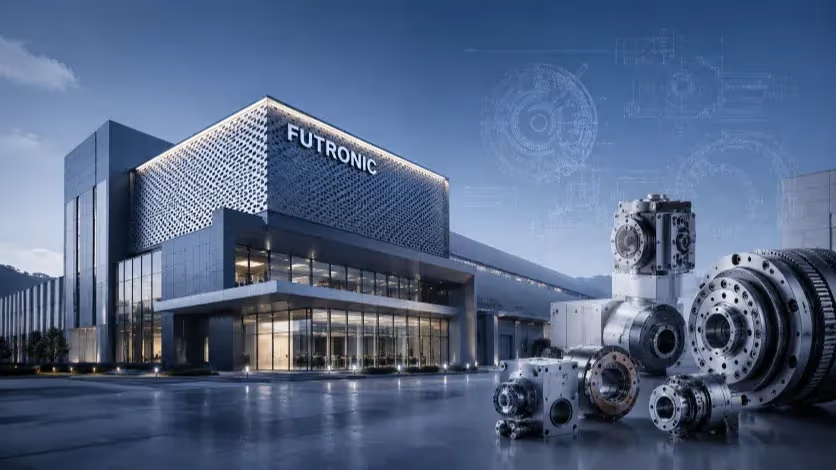
The Busan manufacturer brings a profitable automotive actuator business to the deal. The commercial robotics orders, capital structure and production footprint behind its reported 1 trillion-won valuation remain less visible.
A four-wheel-drive vehicle depends on a compact actuator to change how power reaches the road. Futronic’s transfer-case unit moves the drivetrain between two- and four-wheel-drive modes, detects whether the mechanism has engaged and, in versions equipped with a brake, holds the selected position while the vehicle is moving. The Busan manufacturer says the product is designed for temperatures between minus 40 and 150 degrees Celsius, with automotive functional-safety and water-resistance requirements built into the system.
That component provides a clearer starting point for understanding Futronic than the robotics label now attached to the company. Its published catalogue remains centred on vehicles, extending from steering and differential-control actuators to parking systems, electric oil pumps and devices that connect or disconnect power inside electrified drivetrains. Futronic also describes in-house work in motor and gear design, embedded controllers, structural and thermal analysis, safety compliance, reliability testing and production monitoring.
Blackstone opened a much larger industrial proposition on July 20, when affiliated private-equity funds signed a definitive agreement to make what the firm called a “significant investment” in Futronic. Founder Jin-ho Ko will remain chairman and chief executive, while Blackstone plans to support the company’s international growth and expansion into additional markets. Its announcement described Futronic as participating in early-stage engineering with customers developing humanoids and general-purpose robots, although it identified no customer, robot platform or component under development.
Reuters reported that the transaction values Futronic at about 1 trillion won, equivalent to approximately $676 million, citing a person familiar with the deal. Neither the investment amount nor the ownership percentage appears in Blackstone’s announcement, leaving the reported valuation separate from the cash that may enter Futronic or the amount that may be paid to existing shareholders.
The company’s automotive operation explains why Blackstone is entering Futronic. Its engineering and manufacturing record also gives the investor a plausible route into robotics, where electric motors, gearing, sensors and controllers must work together inside increasingly compact systems. The unanswered part of the transaction concerns how far Futronic has advanced along that route, how much capital it will receive to continue the work and where any resulting production will be placed.
The Automotive Business Behind the Valuation
Futronic operates where electronic control increasingly replaces or supplements mechanical links inside a vehicle. Its steering actuator can combine an electric motor, controller and internally developed software for electric power-steering and steer-by-wire systems. Transfer-case and power-disconnect units use position sensing and electronic commands to redirect power through the drivetrain, while electric oil pumps integrate motors and control systems for lubrication and thermal management.
The company’s technology page presents a broader engineering organisation behind those products. Futronic says it uses electromagnetic, structural, thermal and gear-stress analysis during design, alongside PCB development and functional-safety tools. Its production systems incorporate process failure analysis, automated error prevention, equipment monitoring, statistical quality control and traceability, capabilities that matter when a component must behave consistently across large manufacturing volumes. These descriptions originate with the company and do not constitute an independent technical assessment, but they indicate that Futronic’s role extends beyond assembling products to a completed customer design.
Smotronic’s first-quarter regulatory filing supplies the clearest public financial profile. In its description of the listed company’s largest shareholder, the filing records Futronic’s most recent fiscal-period revenue at 175.56 billion won and operating profit at 41.89 billion won, implying an operating margin of approximately 23.9 per cent. It also lists net income of 25.85 billion won, assets of 251.88 billion won, liabilities of 66.70 billion won and equity of 185.17 billion won.
Those figures give Blackstone an established automotive earnings base rather than a company whose valuation depends entirely on an untested robotics product. They reveal less about the durability and concentration of that business because the filing does not divide Futronic’s sales and profit among steering, transfer-case systems, pumps and other products, nor does it identify the contribution of major customers or individual vehicle programmes. A margin approaching 24 per cent may reflect specialised designs, efficient manufacturing, favourable supply contracts or a concentration in a smaller number of profitable programmes; the published accounts do not allow those explanations to be separated.
A simple comparison places Reuters’ reported 1 trillion-won valuation at roughly 5.7 times the revenue and 23.9 times the operating profit listed in the filing. The figures illustrate the size of the expectations surrounding the transaction, although they should not be treated as formal acquisition multiples: Blackstone has not said whether the reported number represents equity value, enterprise value or a valuation calculated after new capital is issued.
Futronic’s automotive income can account for a substantial part of the investment rationale without explaining all of the reported valuation. Blackstone’s own announcement reaches beyond the products currently listed for sale and presents robotics as one of the markets through which the company can expand. The credibility of that expansion rests partly on capabilities Futronic already possesses, but its commercial value will depend on performance requirements and purchasing decisions that differ from those of an automotive actuator programme.
What Futronic Still Has to Prove in Robotics
Automotive actuators and robot joints share a common electromechanical architecture. Futronic already integrates motors, gearing, sensors, control electronics and software in systems that must withstand temperature changes, vibration, contamination and repeated operation. Automotive supply also demands traceable manufacturing and predictable unit quality, giving an experienced supplier a stronger starting position than a robotics developer trying to move directly from a laboratory prototype into volume production.
Humanoid applications place those capabilities inside a different operating environment. A vehicle actuator generally completes a limited movement under loads established by the drivetrain or steering design, whereas a humanoid knee, hip or shoulder may reverse direction repeatedly, support changing body weight, absorb impact and respond safely to contact with people or objects. The finished joint must balance torque against weight, speed and power consumption while controlling backlash, mechanical resistance and heat through a sustained duty cycle.
A Korean patent application filed by Futronic in February 2024 gives one public indication of its work beyond the existing automotive catalogue. The application describes a planetary reducer built around multiple planetary gears and two ring gears, with one disclosed configuration reducing output speed to one-276th of the input. Futronic is listed as the applicant and Ko as the inventor, and a related international application was filed through the Patent Cooperation Treaty five days after the Korean filing.
The filing shows Futronic working on transmission architecture as well as the motors and controllers described in its existing products. It does not identify the reducer as a humanoid component or publish the module-level measurements needed to assess a commercial robot joint, including weight, efficiency, backlash, thermal performance, force control and service life. The document therefore supports an engineering direction without establishing that a complete actuator has passed customer validation or reached production.
Blackstone’s phrase “early-stage engineering” places Futronic somewhere between internal product research and a commercial supply programme. At that stage, a customer may be discussing performance requirements, testing a motor, evaluating a gearbox design or requesting a prototype built around a particular joint. The work acquires a different commercial significance when the customer completes validation, nominates the supplier, authorises production tooling and issues an order.
Blackstone and Futronic have disclosed none of those later markers. Their public materials identify no robot manufacturer, platform, joint type, order volume, production date or robotics revenue, while Futronic’s own product catalogue continues to present automotive applications. Confidentiality could prevent the disclosure of customer programmes, and Blackstone may have reviewed information during due diligence that remains unavailable to outside readers, but the published record cannot be used to determine how close any project is to generating repeat sales.
Hyundai Mobis provides a useful benchmark for disclosure rather than a direct comparison of technical ability. The company has publicly named Boston Dynamics, identified Atlas as the target platform and said it plans to supply actuators when the humanoid enters mass production. Hyundai Mobis operates within the same corporate group as Boston Dynamics and has access to resources far beyond those of an independent supplier, yet its announcement illustrates the commercial information that becomes visible when a programme has a defined customer, product and intended supply stage.
Futronic’s public case currently ends earlier in that sequence. Its automotive record and gearbox development provide a credible foundation for robot-actuator engineering, while the evidence needed to connect that foundation to an order book remains undisclosed. A customer commitment would carry more analytical weight than another estimate of the global humanoid market because it would establish what Futronic is supplying, which performance requirements it has passed and what production capacity the programme requires.
The Capital and Assets Around the Deal
The amount of capital available for that work cannot be inferred from the reported valuation alone. Blackstone has not disclosed the percentage of Futronic it will acquire, whether the investment consists primarily of newly issued shares or shares sold by existing owners, or how the company’s board and voting control will be structured after closing. Ko’s continued role confirms management continuity, although it does not resolve the future ownership balance.
Futronic’s current ownership is partly visible through Smotronic’s filing. As of March 31, Autronic held 60.05 per cent of Futronic and Ko held a direct 15.26 per cent interest. The same filing identifies Autronic as a precision automotive-parts company controlled by Ko and related shareholders, placing the founder at the centre of the group’s operating and ownership structure before Blackstone’s entry.
The group’s relationship with Smotronic has also changed rapidly. Futronic became the listed company’s largest shareholder in July 2025, when its holding rose to 7,136,807 shares, or 18.27 per cent. The filing described the purpose as management participation and recorded 28.15 billion won of Futronic’s own funds, with no borrowing, as the acquisition funding. By March 2026, Futronic’s stake had increased to 11,182,338 shares, equivalent to 28.91 per cent of Smotronic.
A corrected large-shareholding report subsequently separated Futronic’s corporate position from shares purchased personally by Ko. Futronic continued to hold 28.91 per cent, while Ko held 370,000 shares, or 0.95 per cent, producing a combined reported interest of 29.86 per cent. The correction matters because the corporate block and the founder’s personal shares are legally distinct assets.
Smotronic announced on July 20 that Futronic had agreed to transfer its 11,182,338-share corporate holding to Autronic for approximately 28.24 billion won, or 2,525 won per share. Once completed, Autronic is expected to hold 11,597,743 shares, equivalent to 29.99 per cent of Smotronic, while Ko’s separately reported personal stake falls outside the block being transferred. The closing remains subject to contractual conditions, according to the disclosure reported by South Korean financial media.
The transaction changes the form and location of an asset around the time Blackstone is preparing to enter Futronic. A listed shareholding that Futronic built during the previous year is scheduled to move to its controlling shareholder, leaving Futronic with the agreed sale proceeds if the transfer closes. Available disclosures do not establish that Blackstone requested the arrangement or explain whether the reported 1 trillion-won valuation was calculated with the Smotronic shares, the expected cash proceeds or neither included.
The distinction between newly issued and existing Futronic shares carries more direct industrial significance. Proceeds from new shares would remain in the company and could support engineering, testing, factory equipment or acquisitions, whereas payments for shares already held by Autronic, Ko or other owners would go mainly to the sellers. The Blackstone agreement may include both forms, but the division and the amount of new cash available to Futronic have not been disclosed.
A high valuation can therefore coexist with a much smaller increase in the operating company’s resources. The robotics plan will be shaped by the cash left inside Futronic after the ownership transaction, the treatment of the Smotronic proceeds and any financing attached to the deal have been accounted for. The next question is where the company will deploy those resources.
Where Futronic’s Next Investment Will Land
Futronic already operates across several markets. Its website lists the headquarters and Korean factory in Busan’s Seokdae district, a US operation at 2899 Business Park in Buda, Texas, a customer-service office in Troy, Michigan, and a European branch in Munich. Blackstone similarly described Korea and the United States as Futronic’s primary operating locations.
Buda’s municipal records place measurable conditions around the American project. A City Council resolution adopted in June 2024 approved incentives of up to $600,000 in exchange for Futronic USA investing at least $11 million in land and capital for opening and operating a local facility and creating and maintaining up to 130 full-time jobs over ten years. Payments were structured at $3,000 for each qualifying job, subject to the overall cap.
The resolution establishes contractual targets rather than completed results, and later public materials do not provide a single reconciled account of the project’s scale. Buda EDC’s fiscal 2026 budget set aside $300,000 for Futronic USA contractual payouts, while the development agency’s current advanced-manufacturing page advertises more than $17 million in capital investment and more than 350 jobs. Earlier Buda EDC publicity also referred to a possible $28 million project with 350 positions, and the city’s 2025–2030 strategic plan retained a task described only as “Futronic Business Investment: Next Step.”
Those figures may describe different stages: the minimum investment and job conditions attached to the 2024 incentive agreement, a broader company plan or subsequent expansion expectations. The available documents do not reconcile them or state how much capital has been spent, how many qualifying employees have been hired or how much incentive has been paid. They also describe Futronic primarily as an automotive or electric-vehicle parts manufacturer and provide no evidence that the Buda operation has been assigned a robot-actuator programme.
Busan remains the location of Futronic’s headquarters, its established Korean factory and the engineering organisation behind its existing product line. Blackstone’s announcement did not include a post-transaction capital budget for Seokdae, a dedicated robotics line, a hiring target or a plan dividing future development and production between Korea and Texas. The absence of such a plan does not indicate that production will leave Busan; it means the regional effect of the investment cannot yet be measured from the reported valuation.
Futronic could ultimately use both operations. Engineers in Busan could design and validate a product that is manufactured partly in Texas for North American customers, Korean suppliers could produce components for assembly closer to the buyer, or separate product lines could be allocated to each site. The public record offers no basis for choosing among those possibilities.
What can be measured later is more concrete. New machinery at the Busan plant, recruitment of robotics engineers, qualification work performed with a named customer and production orders assigned to Korean suppliers would show that the transaction is expanding the city’s industrial base. Capital spending, payroll and supplier contracts in Texas would demonstrate the corresponding share of the programme being built in the United States.
Blackstone’s agreement has changed the market description of Futronic, placing a Busan automotive supplier within the investment story surrounding humanoids and general robotics. The reported valuation records the expectations attached to that story, while the decisive evidence will arrive through a narrower set of disclosures: the money that enters Futronic, the customer that approves its first commercial robot component and the factories and engineering teams chosen to deliver it.
For Busan, the transaction will become an industrial event when it appears in equipment orders, engineering employment and contracts awarded through the local manufacturing base.
Continue this reporting
Reporting on the same issue
Related coverage selected from the article's desk, topics and newsroom relationships.
 NewsOct 21, 2026
What a Small Mackerel Is Worth
Busan’s catch is dominated by small mackerel even as some buyers need larger...
 NewsSep 21, 2026
Europe’s Electrical-Steel Safeguard Now Reaches Inside the Transformer
A new EU safeguard follows electrical steel into certain finished transformer...
 NewsSep 14, 2026
Foreign Tourist Spending Is Reshaping Busan’s Nampo District
Foreign spending is making long-empty commercial space valuable again in Namp...
More from the author
More from this byline
Stay with the same line of reporting through more work from this byline.
 NewsOct 22, 2026
Busan Port’s LNG and Methanol Plan: Who Pays to Keep Fuel Ready?
 NewsOct 12, 2026
Bukangi, the Shark That Stayed in Busan’s North Port
Reader Signal
Community readWhat did this report leave you with?
Choose the signal that best reflects your reading. Select it again to remove it.
One response per article
No response selected
A moderated conversation about the reporting.
One-level replies and newsroom moderation keep the conversation anchored to this article.
Discussion Status
Open
Please sign in to join the discussion.
Newsletter
Weekly reporting and context from Busan and Korea.