Europe’s Electrical-Steel Safeguard Now Reaches Inside the Transformer
A new EU safeguard follows electrical steel into certain finished transformers. China drove most of the import surge, but the downstream rule raises a new customs question for high-voltage equipment now being built in Busan for Europe.

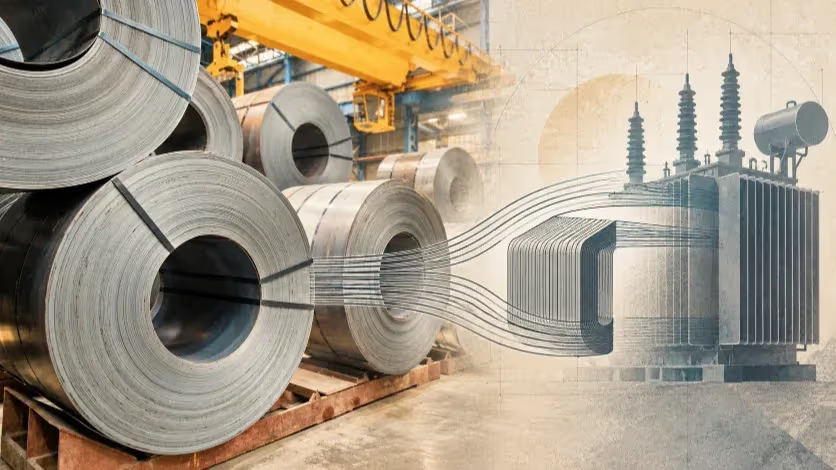
China accounted for 53 percent of the EU imports covered by a new electrical-steel safeguard by 2025. But Brussels has written the measure to follow protected steel cores into certain finished transformers, creating a new customs question for an LS ELECTRIC plant in Busan that is beginning to supply Europe’s high-voltage market.
From September 25, certain transformers declared for release for free circulation in the European Union will carry a customs obligation that cannot be seen from the outside. For the covered categories, an economic operator must declare the weight, in tonnes, of the steel core installed inside the machine, and that embedded core is subject to a provisional safeguard duty of €1,140 per tonne. Grain-oriented electrical steel and standalone cores enter a broader system of quotas and price thresholds, but a covered core already incorporated into a transformer receives no quota of its own. A component sealed deep inside a piece of grid equipment has become visible again when the finished machine enters European commerce.
The timing adds another dimension to the measure. Large power transformers are already among the grid components taking longest to procure: an International Energy Agency survey found that global lead times can reach four years, roughly twice as long as in 2021, while transformer prices had risen by about 75 percent since 2019. Europe is therefore trying to preserve industrial capacity in a material needed to make transformers while utilities are competing for more of the finished equipment. Protecting the input and securing the machine are becoming parts of the same supply-chain problem.
The material at the center of the safeguard is grain-oriented electrical steel, or GOES, a specialized steel designed to carry magnetic flux efficiently inside transformers. Manufacturers slit the steel into laminations, stack or wind those laminations into a core, and install the core inside the transformer. By the time the machine is complete, the steel has become part of a far more valuable product, but the Commission concluded that its physical and technical characteristics remain identifiable. That finding allowed Brussels to treat incorporation into a transformer as another stage of processing rather than the point at which the protected material disappears.
Brussels Extended the Safeguard to Cores Inside Finished Transformers
A measure confined to GOES, laminations and standalone cores would leave a route around the policy. During the investigation, interested parties argued that producers outside Europe could process the covered products into cores, install them in transformers and export the finished equipment instead, replacing a decline in protected steel imports with greater downstream imports. The Commission accepted the concern and said the inclusion of cores already installed in transformers was necessary to preserve the effectiveness of the measure. The safeguard therefore crosses the point at which the imported steel becomes part of a different commercial product.
European transformer manufacturers had reasons to resist tighter controls upstream. Industry groups representing equipment manufacturers, renewable-power companies, grid operators and technology suppliers warned that higher GOES costs could hurt a sector already under pressure to supply the equipment required for electrification and grid expansion. Their concern exposes a conflict that cannot be reduced to European producers competing with foreign suppliers. The domestic electrical-steel industry Brussels wants to preserve supplies another European industry whose capacity is also strategically important.
The Commission’s provisional findings acknowledge that tension. They put GOES at an average of 10 to 30 percent of the cost of a transformer and say European manufacturers still need imports, particularly for some higher-quality grades. Brussels therefore chose tariff-rate quotas combined with price thresholds rather than closing the market, arguing that any additional cost to transformer producers should generally remain a small fraction of the cost of the GOES itself. The policy is designed to give European steel producers room to invest while keeping specialized material available to downstream manufacturers.
Extending the safeguard to imported transformers addresses the opposite side of the same problem. A European transformer manufacturer facing a higher effective price for protected electrical steel could otherwise compete against a producer outside the EU that buys the material elsewhere, installs it in a transformer and enters Europe without an equivalent constraint. Applying the measure to the embedded core narrows that asymmetry while also blocking a processing route around the upstream safeguard. The rule consequently protects the steel industry partly by reaching into the product made by its customers.
Europe is trying to preserve domestic electrical-steel capacity, maintain access to grades its transformer industry needs and secure enough finished equipment to expand the grid. Quotas, price thresholds and separate treatment of embedded cores address different tensions inside that objective. In this case, the protected input remains relevant through successive stages of manufacturing rather than disappearing from trade policy when its tariff identity changes. The approach is unusual, but its significance depends on understanding the trade flows that prompted it.
Those flows were far from evenly distributed. Imports expanded rapidly between 2021 and 2025, but China, Japan, Türkiye and South Korea did not move together. The geography of the import surge was considerably more concentrated than the manufacturing geography the downstream provision can now reach.
How the safeguard travels downstream
The safeguard follows the steel into the transformer
A covered electrical-steel core can remain inside the measure after manufacturing has turned the input into part of a finished transformer.
China’s Share Rose to 53% as Korea’s Fell to 4%
Imports of GOES and steel laminations and cores covered by the investigation rose from 135,140 tonnes in 2021 to 297,079 tonnes in 2025, an increase of about 120 percent. European demand was also rising, but consumption growth alone did not account for the shift: apparent EU consumption increased by roughly one-third while production by Union manufacturers declined from 336,555 tonnes to 306,539 tonnes. Imports rose from the equivalent of 34 percent of consumption to 57 percent. EU producers’ market share moved in the opposite direction, falling from 66 percent to 43 percent.
China accounted for about 20 percent of the covered imports in 2021 and 53 percent by 2025. Japan’s share fell from 25 percent to 20 percent, Türkiye’s from 16 percent to 13 percent and South Korea’s from 9 percent to 4 percent. The Commission regarded the Chinese increase as disproportionately large when designing the provisional quotas and did not allow the most recent surge to become the basis for future access. More than half of the relevant imports were coming from China by 2025, but the percentages conceal a different pattern among the other suppliers.
EU imports covered by the investigation
Imports doubled. China and Korea took very different paths.
The total market expanded sharply from 2021 to 2025. China gained both share and implied volume, while Korea lost share in a much larger import market.
Share and implied volume both surged.
Share fell sharply; implied volume stayed broadly flat.
A rough calculation using the Commission’s rounded country shares and reported total import volumes illustrates the difference. Chinese shipments would have increased from roughly 27,000 tonnes in 2021 to more than 157,000 tonnes in 2025, while Korean shipments would have remained near 12,000 tonnes in both years. The calculation is approximate rather than a substitute for country-level customs data, but it changes the meaning of Korea’s falling share. Korea’s percentage of EU imports more than halved while its estimated physical volume remained broadly stable because the market around it expanded so quickly.
The Commission nevertheless places Korea inside a wider supply problem. It estimated about 600,000 tonnes of excess GOES capacity in China in 2024 and another 242,000 tonnes across India, Japan and South Korea combined, compared with EU consumption of 366,850 tonnes that year. The second figure cannot be divided into a Korean number from the information Brussels published. It shows instead why the Commission describes the surge as part of a global imbalance in which large amounts of production capacity can seek new destinations when access to existing markets tightens.
Trade barriers elsewhere can redirect those flows. The Commission cited restrictions in the United States and Chinese anti-dumping measures affecting Japanese and Korean GOES as factors capable of shifting exports toward alternative markets. Production capacity does not disappear when one destination becomes harder to enter; its route can change. The safeguard is therefore responding to two forms of movement at once: electrical steel can move farther down the manufacturing chain, and trade can move geographically when another market closes.
The countries inside those flows are not economically interchangeable. The Commission describes Japanese and Korean supplies as important sources of higher-quality GOES and notes that some of those products already enter Europe at prices around or above the thresholds used in earlier anti-dumping measures. European transformer manufacturers have also argued that some high-performance grades are not sufficiently available from domestic mills. Restricting imports while preserving access to those grades is one reason the new measure distinguishes by quality and historical trade patterns rather than simply imposing the same flat barrier on every tonne.
South Korea received a country-specific GOES quota of 4,789.93 tonnes for the provisional period. The number is less important than the structure around it: Brussels sought to preserve established supply relationships without allowing China’s unusually rapid recent expansion to reset the market. Korea was not a major driver of the change in EU import share, but it remains part of the global GOES production system the safeguard is meant to manage.
Korea also occupies a second position farther down the chain. It manufactures the finished transformers into which GOES can be incorporated and has been expanding exports of large grid equipment as shortages create openings in overseas markets. A trade rule written in response to upstream import patterns dominated elsewhere can therefore become relevant to a Korean manufacturer for a different reason: the rule continues following the material after another company has turned it into a machine.
LS ELECTRIC’s Busan Plant Is Entering Europe’s High-Voltage Market
LS ELECTRIC completed a second ultra-high-voltage transformer production facility at its Gangseo-gu plant in late 2025 after investing about KRW 100.8 billion. The company said the expansion would raise annual ultra-high-voltage transformer production capacity at the Busan site from roughly KRW 200 billion to KRW 600 billion. Its current transformer catalogue describes a power-transformer line reaching up to 550kV and 800MVA and states that grain-oriented silicon steel is used in core construction. Busan is therefore both a production location for large transformers and a point farther down the same material chain now covered by the European safeguard.
Europe has begun to enter that production geography directly. Korean news reports say LS ELECTRIC signed a roughly KRW 62 billion contract in early 2026 to supply 400kV-class ultra-high-voltage transformers to German energy company RWE, with deliveries through 2027, and that the equipment will be produced at the Busan plant. The order represents LS ELECTRIC’s push into a European market where long equipment lead times are opening opportunities for additional suppliers. It also creates a real commercial route on which the new EU measure becomes relevant to ask about rather than merely hypothetical.
Busan to the EU customs boundary
The commercial route is real. The shipment-level exposure is not yet public.
LS ELECTRIC is expanding high-voltage transformer production in Busan and has a reported German order. Whether individual units fall within the safeguard depends on facts that are not disclosed in the public record reviewed for this article.
PUBLIC RECORD ESTABLISHES
SHIPMENT-LEVEL FACTS STILL NEEDED
Public information reviewed for this article does not establish those shipment-level variables for the RWE order, so it does not support a reliable tariff estimate.
The public evidence stops short of showing that the RWE units themselves are covered. A 400kV rating describes voltage class, not the CN classification used at EU customs, and the safeguard lists transformer categories according to characteristics that include dielectric type and power-handling capacity. LS ELECTRIC’s general catalogue shows that its power-transformer range includes oil-insulated machines with capacities far above the thresholds found in some covered classifications, but a product catalogue is not a specification sheet for the RWE contract. The individual units’ MVA ratings and customs codes have not been identified in the public material reviewed for this article.
That boundary also prevents a reliable estimate of the tariff bill. Public reports provide the overall contract value and voltage class but not the weight of the covered steel cores inside each transformer, the specific GOES grades, the material’s origin or the date each machine will be declared for free circulation. The €1,140 charge applies to each tonne of covered core incorporated in a qualifying transformer, not to the total weight or value of the equipment. Substituting an assumed core weight would convert the most important unknown in the regulation into a false precision.
A customs charge, if one applies, would not automatically equal a loss for LS ELECTRIC either. Under the EU’s Union Customs Code, the customs debt arises when the declaration for release for free circulation is accepted, and the declarant is the debtor; in an indirect representation arrangement, the party on whose behalf the declaration is made is also a debtor. The commercial incidence can still be different from the legal customs liability. Delivery terms, tariff clauses, pricing arrangements and negotiations between supplier and buyer can determine where an additional cost ultimately settles.
The new information requirement is less ambiguous. For a transformer that does fall within the covered classifications, the economic operator must declare the weight of the core in tonnes. Manufacturers already know core weight as part of engineering, procurement and production, so Brussels is not asking them to discover a new property of the machine. It has made an internal manufacturing attribute relevant to the customs treatment of the finished product.
That distinction may prove more important than the headline duty for some high-value transformers. European importers could ask suppliers for additional supporting records; engineering and bill-of-material data could have to connect more directly with customs documentation; a charge could alter pricing in one contract while remaining too small to change another. No public evidence yet shows which of those effects, if any, applies to LS ELECTRIC’s RWE order. The answer depends on shipment-level classification, core weight and contract terms rather than on the existence of the safeguard alone.
The immediate Busan connection is therefore more precise than a claim of regional economic damage. LS ELECTRIC is increasing transformer production in the city, its products use GOES cores, and a reported 400kV order from Germany is to be manufactured there. At the same time, Europe has created a system under which the core inside some imported transformers remains subject to a steel safeguard after the machine is complete. The open question lies at the point where those two verified facts meet.
Actual shipments will supply the evidence needed to close that gap. A covered Busan-built transformer entering the EU would have a customs classification, a declared core weight, an identified debtor and a contract that determines how any added cost is distributed. Those transaction-level facts will distinguish a material commercial constraint from a narrower documentation requirement.
The confirmed change does not require a prediction about which outcome will prevail. A trade measure created to address an upstream electrical-steel problem now has the legal capacity to follow that material into certain finished transformers, even when the manufacturer sits outside the geography that drove most of the original import surge. For a Busan plant beginning to supply Europe’s high-voltage market, the question is no longer whether the steel disappears once the transformer is assembled, but what happens when a European customs regime continues to see it.
Continue this reporting
Reporting on the same issue
Related coverage selected from the article's desk, topics and newsroom relationships.
 NewsSep 14, 2026
Foreign Tourist Spending Is Reshaping Busan’s Nampo District
Foreign spending is making long-empty commercial space valuable again in Namp...
 NewsSep 11, 2026
Busan-Jinhae’s New Industrial Strategy Meets a Jobs Divide
As BJFEZ prepares to add AI, data and advanced energy to its industrial prior...
 NewsSep 9, 2026
Busan’s Ageing Economy Is Not One Market
As one in four Busan residents reaches 65 or older, ageing is reshaping care,...
More from the author
More from this byline
Stay with the same line of reporting through more work from this byline.
 NewsOct 4, 2026
Zelensky, South Korea and the Limits of Wartime Pressure
Reader Signal
Community readWhat did this report leave you with?
Choose the signal that best reflects your reading. Select it again to remove it.
One response per article
No response selected
A moderated conversation about the reporting.
One-level replies and newsroom moderation keep the conversation anchored to this article.
Discussion Status
Open
Please sign in to join the discussion.
Newsletter
Weekly reporting and context from Busan and Korea.