Busan’s 122 University Projects Face Their First Funding Test
Busan funded 122 university projects in the first year of RISE. With Pukyong National University receiving the only top rating, the next budget will show whether evaluation can change how the money is distributed.


Pukyong National University won the city’s only top rating after the first year of regional university reform. As RISE becomes ANCHOR, Busan must decide whether that assessment will change the distribution of 134.1 billion won across a system that counts both 2,125 continuing company partners and 3,633 university-level relationships.
Pukyong National University emerged from Busan’s first annual review of regional university funding with the city’s only S rating and a commitment of additional support for the program’s second year. The result introduced the first visible hierarchy into a system that had distributed 134.1 billion won across 122 projects involving 21 universities since May 2025, when Busan’s immediate task was to establish a new regional funding structure and bring most of its higher-education sector into it.
Pukyong did not operate the program’s largest company network. The Busan Anchor Center’s current table assigns 108 participating companies to Pukyong, compared with 560 at Busan Health University, 401 at Dongseo University and 391 at Dong-A University. Evaluators nevertheless placed Pukyong first after crediting its blue-food and energy technology strategies, company-linked curricula, joint research, matching investment and management of the first-year budget.
The contrast indicates that the partner total alone did not determine the ranking. A university can build hundreds of relationships through student placements, events, advisory groups and institutional agreements, while a smaller group of companies can become more deeply involved through research funding, curriculum design, technology development or hiring. Busan’s second funding round will reveal how far the assessment system is prepared to convert those differences into larger increases for some projects and reductions for others.
The timing has given Pukyong’s rating significance beyond the university itself. The Ministry of Education has restructured the Regional Innovation System and Education program, known as RISE, into a regional talent-development system called ANCHOR, promising closer attention to student outcomes and more aggressive performance-based allocation. The ministry plans to distribute about 400 billion won differentially among regional governments and has said its review will examine whether local authorities divided their budgets too broadly among universities.
Busan’s first annual review must therefore do more than produce a ranking. It will become meaningful when the assessment changes what universities receive, which projects expand and whether activities approved during the launch year continue under the same form. That task has arrived as the institute overseeing the program faces separate questions about failures in its own internal controls, adding an administrative test to an already difficult funding decision.
A Broad First Year
RISE transferred much of the planning authority for several national university-support programs to metropolitan and provincial governments, which were expected to align higher education with local industries, employment and demographic needs. Busan entered the system with national research universities, private teaching institutions, vocational colleges and smaller campuses facing declining domestic enrollment. The city built its first-year portfolio across four large areas covering talent development, industry, social programs and university reform rather than concentrating the entire budget in a narrow group of research institutions.
That breadth produced 122 projects at 21 universities and a first-year investment of 134.1 billion won. The work ranged from maritime engineering, energy and advanced manufacturing to employment preparation, international-student support, continuing education and programs for local communities. Busan described the initial eight months as a period of structural change connecting education, industry and settlement, while the first-year figures demonstrated the speed with which universities could organize programs and draw outside institutions into the new framework.
At a February 2026 performance forum, the city said talent-development programs had reached about 25,000 people and that universities had established a standing cooperation system with 2,125 regional companies. Busan also cited increased international enrollment and several companies that won CES innovation awards as evidence that the program was beginning to affect campuses and businesses. The numbers measured the reach of the launch year, although the activities beneath them differed greatly in duration, cost and distance from an eventual job or commercial product.
Pukyong represented one of the portfolio’s more concentrated industrial models. The university organized much of its strategy around blue-food technology, energy technology and marine-related education, linking those fields to field campuses, joint research, contract or customized courses, capstone projects and company matching funds. Its research-talent project received an S rating, while several industrial, community and company-support components received A ratings, showing that evaluators considered separate parts of the university’s portfolio rather than treating every activity as equally strong.
Korea Maritime & Ocean University developed another industry-centered structure. Its RISE organization commissioned 36 joint technology-development projects with about 1.4 billion won, involving 36 companies or institutions, 36 faculty project leaders and roughly 200 professors, researchers and students. The projects were selected after an industry-demand survey and focused on maritime mobility, marine materials and components, and the wider maritime value chain.
The maritime projects began with a relatively clear chain of activity. A company or institution identified a technical need, a faculty-led team conducted research, and the work was intended to move toward industrial application or technology transfer. Commercial adoption was never guaranteed, but the projects began with defined research obligations and named industrial participants rather than a general promise that university-industry cooperation would eventually emerge.
Other parts of the portfolio worked through education and exposure rather than technical development. Pusan National University selected 50 students for a two-day finance camp that combined visits to major financial institutions in Busan with occupational briefings and mock interviews. The program gave students direct contact with employers concentrated in the city’s financial district, while any effect on applications, internships or hiring would necessarily emerge later than the camp itself.
Dongseo University used RISE funding for a two-day entrepreneurship camp attended by 54 international students. Working in 10 teams, the participants developed business models, studied market validation and presented investor-style pitches in English with instructors from the startup sector. The camp offered a practical introduction to entrepreneurship in Korea, but it occupied the opening stage of a much longer path toward incubation, business registration, investment or employment.
Pusan National University’s regional startup package offers an example of a program that extended beyond a single event. The university said the initiative expanded from 38 Busan teams to 50 teams drawn from universities across Busan, Ulsan and South Gyeongsang Province, then moved participants through seven stages that included practical education, networking, business-model development, technical validation, investor pitching and global exposure. The expansion shows how RISE funding can add scale and a longer progression to work that universities or local agencies had already begun.
Research projects, employment camps and startup education can all serve regional policy, but they operate on different clocks. A university can complete a camp and count its participants within the same budget year, while technology adoption, company formation and employment may take several years and may fail despite competent work. Busan’s annual review therefore has to compare immediate activity with slower results without allowing the easiest number to collect to become the strongest evidence of success.
What the Company Numbers Measure
Busan’s two main company figures describe different layers of the program. The city’s February performance report referred to 2,125 companies in a standing cooperation system involving technology development, joint research and other activity. The Anchor Center’s current table lists 3,633 participating companies across 20 university operators and describes the total as covering various forms of cooperation under 2025 projects.
The two figures do not necessarily conflict because their scopes are different. The smaller number was presented as a continuing regional cooperation system, while the larger figure adds the partner totals reported by individual universities. A company working with several campuses can create several university relationships while remaining one company, and a broad university table can include relationships that would not meet a narrower definition centered on sustained research or technology cooperation.
A separate participant register shows how widely the system used the language of company participation. Entries include manufacturers and technology firms, but also government offices, public agencies, universities, industry associations, welfare organizations and nonprofit groups. Pukyong’s entries, for example, include Busan’s fisheries division, the Korea Maritime Institute, a regional food and drug office and a Busan Technopark research center alongside seafood processors, hospitals and engineering companies.
Those organizations can make substantial contributions. A public hospital can supervise clinical training, a research institute can share equipment and expertise, and a government department can identify a problem that a university is equipped to address. Their participation represents a different economic commitment, however, from that of a private company financing research, purchasing a technology or hiring graduates.
The university totals also reflect different institutional missions. Busan Health University’s 560 partners may include a large network of hospitals, clinics, welfare providers and workplaces used for occupational training, while Pukyong’s 108 relationships can include a smaller concentration of research-intensive partners. Korea Maritime & Ocean University reports 144 participating companies in the same table, although its 36 joint technology projects involved a narrower set of organizations tied to research budgets, faculty leaders and defined technical assignments.
A raw partner total cannot therefore function as an industrial ranking. A hospital that accepts students for supervised practice contributes a meaningful educational service, while a manufacturer that provides cash and engineers for a technical project contributes another kind of value. An organization attending a seminar or signing an alliance agreement may still extend the university’s network, but it does not create the same obligations as a paid internship, research contract or technology purchase.
Pukyong’s S rating provides the clearest evidence that the company count was not decisive on its own. The top-ranked university reported fewer partners than most of the institutions in the Anchor Center table, while its evaluation highlighted matching funds, company-linked education and joint research. The assessment appears to have rewarded the structure and intensity of at least some relationships alongside their number, even though the final institutional grade also reflected management, target achievement and regional contribution.
Vocational and teaching-focused universities do not need to reproduce Pukyong’s research model to demonstrate comparable value. A health college can show that employers repeatedly supervise students and hire graduates, while a university working with international students can connect language, visa and career services to sustained employment. The common question is what the partner contributed and what changed for the students, researchers or organizations involved.
The second-year allocation will show whether those differences are consistently reflected across the system. A university may continue to report hundreds of relationships, but the weight assigned to company funding, paid training, technology adoption and hiring will determine whether the partner network becomes an economic measure or remains primarily a measure of institutional reach.
From Participation to Work
The figure of 25,000 people reached through talent-development programs contains the same mixture as the company total. Participants entered short courses, industry projects, shared curricula, employment programs and other activities grouped under a common talent label. Each form of participation can be useful, but the distance between attendance and employment varies sharply.
Pusan National University’s finance camp illustrates the beginning of one route. Over two days, 50 students moved among financial institutions in Busan, received information about occupations and practiced interviews for jobs concentrated in the city’s financial district. The program’s regional value will depend on whether that exposure connects to later applications, internships and employment rather than remaining a stand-alone career event.
Dongseo’s international entrepreneurship camp began from a different barrier. Foreign students may have technical knowledge or business ideas but little familiarity with Korean regulation, investment networks and workplace practices. English-language instruction and practical pitching can lower that initial barrier, while regional settlement requires the participants to move toward a viable company, an eligible occupation or another form of stable legal employment.
Maritime education presents a geographical complication that reaches beyond any individual campus. Korea Maritime & Ocean University has sought industry demand across Busan, Ulsan and South Gyeongsang Province because the region’s shipbuilding, port, logistics and equipment industries operate across administrative borders. A graduate trained in Busan may take an appropriate job in Geoje or Ulsan, producing a successful industry match while no longer contributing to Busan’s resident population.
The national government’s new regional framework recognizes that economic geography. ANCHOR includes 120 billion won for shared university structures and 80 billion won for industry-linked “growth engine” projects organized around the government’s five-pole, three-special-region strategy. The plan encourages universities to share curricula, infrastructure and research capacity across provincial borders rather than duplicating complete systems within each city.
The wider geography can strengthen southeastern industries, but it produces different results for regional employment and municipal retention. A student who studies in Busan and works in Geoje remains in the southeastern labor market but may leave the city, while a graduate living in Busan may work for a company whose major production facilities are elsewhere. ANCHOR’s settlement objective will have to account for those outcomes separately instead of treating every job in the wider region as evidence that Busan retained a young resident.
Universities cannot control the full path from education to settlement. Employers decide how many positions to create and what wages to offer, immigration rules affect international graduates, and students may choose stronger career opportunities elsewhere. The design of a funded program can still begin with demonstrated employer demand, sustained workplace experience or a technical problem that a company has committed resources to solve.
The annual evaluation will gain credibility when later stages carry more weight than initial participation. A short program linked to a paid internship or a continuing curriculum belongs to a stronger pathway than an event repeated each year without progression. A research project moving toward testing and adoption may deserve additional time, while a program that produces the same attendance figure without deepening its connection to employment or industry presents a weaker claim on the next allocation.
What the First Rating Rewarded
Pukyong’s S rating offers the first concrete indication of the behavior Busan’s system has chosen to reward. The evaluation covered target achievement, implementation, performance management and contribution to regional innovation, and the university attributed its result to a strategy linking established research strengths with regional industries and company demand. Pukyong also said the rating would bring additional funding for its second-year work in research-talent development, business support, commercialization and international research cooperation.
The result does not establish a single model for all participating universities. Busan classifies institutions as research-oriented, education-oriented, or vocational and lifelong-education providers because patents, clinical placements, teaching reform and community programs do not generate comparable outputs. A health college should not lose simply because its strongest relationship is a supervised placement rather than a research license.
Different results can also exist within the same university. Pukyong’s research-talent project received the highest rating, while several other components received A ratings, indicating that the evaluator did not treat the university’s portfolio as a single undifferentiated block. Project-level differences will become more important if funding changes are intended to refine individual activities rather than merely rank whole institutions.
The launch-year allocation depended largely on plans because the regional system was new. Universities submitted strategies, responded to evaluation and began work under a structure that had no local performance history. The first annual review added evidence from implementation, spending, company participation and progress toward targets, giving Busan a basis for decisions that did not exist when the initial portfolio was assembled.
The central government is applying similar pressure to regional authorities. Its ANCHOR review emphasizes horizontal cooperation, strategic investment and performance feedback, and the 400 billion won incentive pool is intended to produce meaningful differences among regional allocations. The ministry has explicitly said it will examine budget sharing and whether the interests of students and regional talent were sufficiently considered.
That national incentive moves money first among regions, not among individual Busan universities. A strong national assessment could increase the city’s total allocation without determining how much reaches Pukyong, Busan Health University or any specific project. Busan still has to decide whether to spread a gain broadly, distribute a reduction evenly or move resources toward programs that performed more strongly within their institutional category.
Pukyong’s additional funding shows that some differentiation has begun. A deeper change will appear when a weaker project receives less, is combined with another university’s work or does not return in the next portfolio. Ending or reducing a project would not mean that every part of the first-year investment was wasted; it would mean that implementation produced enough evidence to alter the judgment Busan made at the launch.
The Next Funding Round Arrives After an Audit
Busan’s Audit Committee released a separate review of BISTEP—the Busan Institute of Science & Technology and Higher Education Promotion—on July 31. The audit covered work conducted since February 2023 and produced 16 corrective demands, including two orders for rectification, eight warnings and six formal notifications. The city also called for personnel action involving 25 executives or employees.
Several findings involved BISTEP’s affiliated Busan RISE Innovation Institute. According to the audit details reported by the Kookje Shinmun, only three of 167 local business trips had been processed through the normal electronic approval system, while 164 lacked the required advance travel order or subsequent report. Twenty-eight entries listed a destination without a sufficiently specific official purpose or supporting documents, and the audit also found an unauthorized arrangement that allowed the institute’s director to approve personal leave and travel.
Recruitment exposed a separate weakness in numerical checking. Scores of 77 and 90 assigned to two applicants were reversed when entered into a final compilation sheet, and some quantitative screening criteria lacked sufficiently objective scoring standards. The transposition did not change the successful applicant, according to the audit account, but it passed through the organization’s review process without correction.
The findings concern internal administration rather than the integrity of the 122 university projects. They do not establish that university performance figures were fabricated, that evaluators used incorrect scores or that Pukyong’s rating should be challenged. The audit nevertheless arrived before the program’s most contentious phase, when the administrator must support decisions that give one university more money and may reduce funding elsewhere.
The next round will require the institute to compare universities with different missions, reconcile large performance submissions and defend the numerical and procedural basis of funding changes. Independent approval, traceable documentation and secondary checks are routine administrative controls, but their importance rises when an error can affect a major public allocation rather than an internal worksheet. Universities that lose money are likely to examine the evaluator’s procedures as closely as the evaluator examines theirs.
BISTEP’s organization chart continues to list the Busan RISE Innovation Institute as an affiliated body, while the program’s public portal now operates under the Busan Anchor Center brand. The policy name may have changed, but the first-year projects, records and institutional relationships continue into the new system. The audit therefore belongs to the second-year story even though it did not reach a conclusion about the quality of the university assessment itself.
ANCHOR’s First Budget Test
The Ministry of Education’s decision to restructure RISE rather than abandon it gives Busan a second stage rather than a fresh start. ANCHOR retains local control over university support but directs more attention toward students, larger economic regions and performance-based reallocation. The government’s 400 billion won incentive pool, 120 billion won shared-university initiative and 80 billion won growth-engine program place substantial resources behind that shift.
Busan has already completed the organizational work of building a citywide coalition. Universities have project teams, partner networks, new courses and equipment plans, while companies and public institutions have joined alliances covering the four major areas of the regional strategy. The next question is whether cooperation changes what individual campuses do or simply adds another administrative layer above existing programs.
Overlap is unavoidable in fields such as artificial intelligence, biohealth, tourism, entrepreneurship and international-student employment because the same technology or student group can serve several industries. Duplication becomes consequential when campuses buy similar equipment, approach the same employers or repeat comparable programs without a clear division of work. A funding system shaped by evaluation would preserve distinct occupational or industrial roles while combining functions that can be shared across institutions.
Company participation will provide an early indication of the direction Busan takes. The 3,633-partner table demonstrates the reach of the university network, while the 2,125-company figure describes a narrower standing cooperation system, and Pukyong’s top rating shows that the largest partner count was not the decisive factor. The next allocations will reveal whether matching investment, paid training, joint research, technology adoption and hiring consistently outweigh the addition of another organization to a university list.
Student results will take longer, but program design can change before the final employment figures arrive. A finance camp connected to later internships, or a startup program that moves teams through technical validation and investor pitching, creates a stronger sequence than an event that begins and ends with attendance. A maritime research project with company resources and a defined technical problem can be judged by its movement toward testing or adoption, even before a commercial product reaches the market.
Those decisions will generate resistance because RISE funding now supports staff, courses, facilities and institutional strategies across much of Busan’s university sector. A reduction can be presented as damage to a campus or district even when the city is attempting to move money toward a stronger use. Regional control places funding decisions closer to the students and industries the program is intended to serve, but it also places them closer to the university leaders and local constituencies that will contest a loss.
The first annual review has identified a winner and attached additional support to that judgment. The next budget will show whether the assessment has enough force to change the wider system by expanding programs with demonstrated demand, consolidating work that overlaps and ending activities that do not earn another allocation. Busan’s first year established the coalition; ANCHOR’s first meaningful result will be the explanation for why money moved inside it.
Continue this reporting
Reporting on the same issue
Related coverage selected from the article's desk, topics and newsroom relationships.
 NewsOct 16, 2026
What Is Still Worth Going to See?
Busan’s biennale faces questions of artistic judgment and institutional care....
 NewsOct 14, 2026
What Became of Busan’s University Streets?
From 2015 to 2023, registered businesses grew near Pusan National University...
 NewsOct 12, 2026
Bukangi, the Shark That Stayed in Busan’s North Port
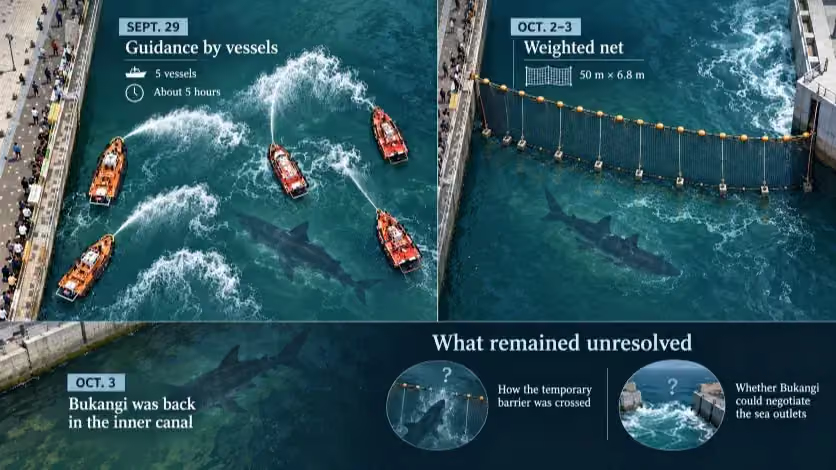
A rescue net guided Bukangi toward the sea, but the dusky shark returned to B...
More from the author
More from this byline
Stay with the same line of reporting through more work from this byline.
- NewsOct 14, 2026
What Became of Busan’s University Streets?
 NewsSep 28, 2026
Why Some Commercial Space in Busan Is Hard to Reuse
Reader Signal
Community readWhat did this report leave you with?
Choose the signal that best reflects your reading. Select it again to remove it.
One response per article
No response selected
A moderated conversation about the reporting.
One-level replies and newsroom moderation keep the conversation anchored to this article.
Discussion Status
Open
Please sign in to join the discussion.
Newsletter
Weekly reporting and context from Busan and Korea.