Busan Biennale 2026: What ‘Dissident Chorus’ Reveals After 45 Years
Busan Biennale 2026 opens with ‘Dissident Chorus,’ 46 artists and teams from 22 countries, and a deeper question shaped by 45 years of tension between local agency and international circulation.
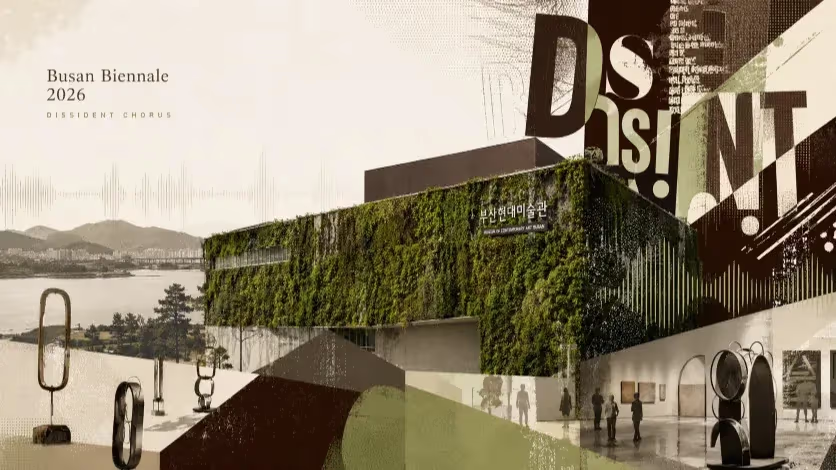
Dissident Chorus opens with 46 artists and teams from 22 countries, using sound, memory and collective experience to connect political histories across three Busan venues. The biennale’s own past provides a harder measure of the exhibition: whether the city changes the art and ideas arriving through an increasingly global cultural system.
Busan Biennale opened its 2026 edition Saturday across the Busan Museum of Contemporary Art, Space OneZ and the former Busan Nam High School, beginning a 65-day exhibition organized around sound, bodily memory and forms of dissent. Co-artistic directors Amal Khalaf and Evelyn Simons have brought together 46 artists or teams from 22 countries, representing 49 individual participants. Their curatorial premise begins with vibration moving through water, air and bodies, then extends into protest, ritual, migration, ecology, nightlife and collective performance. Official texts describe sound as a medium capable of carrying memory beyond authorized archives and of creating relations before experience is organized into formal language.
The new exhibition arrives with an unusually long institutional record behind it. Busan Biennale traces its origins to the Busan Youth Biennale of 1981, followed by the Sea Art Festival in 1987 and an outdoor sculpture symposium that began in 1991. Those artist-led and locally developed programs were consolidated into the Pusan International Contemporary Art Festival, or PICAF, which held its first integrated edition in 1998. The organization approved the name Busan Biennale in January 2001, and the first exhibition under that title followed in 2002. Busan’s own historical record describes the predecessor events as initiatives that had grown through the city’s art community before their incorporation into a larger international festival.
The transition changed more than the scale of the event. Artists working in Busan had originally created the platform from within the same cultural environment in which it operated, so the relationship between exhibition and city was embedded in the organization itself. Internationalization introduced artistic directors, artists and intellectual frameworks formed across a much wider range of places, while Busan increasingly entered through commissioned research, local partnerships, historic buildings and the selection of particular episodes from the city’s past. The broader institution gained international reach at the same time that decisions over how Busan would be represented acquired greater curatorial weight.
Busan Biennale was already discussing one consequence of that shift by 2008. The theme Expenditure drew from Georges Bataille’s critique of accumulation and productive rationality, yet operating committee chairman Lee Doo-shik publicly cautioned against allowing the concept to function as a category into which individual artworks would simply be placed. He described conceptual categorization as a concern among biennial planners internationally and said Expenditure was intended as an attitude toward the works rather than their prescribed subject. Only a few years after consolidating the international format, Busan was acknowledging how a large curatorial concept could acquire more coherence than the heterogeneous practices assembled beneath it.
Roger M. Buergel shifted the institutional response toward participation in 2012. Preparing Garden of Learning, he began from his acknowledged lack of familiarity with Korean affairs and established a Learning Council of about 80 people from different backgrounds, including artists, to help conceive and make the exhibition. Smaller councils worked directly with artists and the artistic director over the months leading to the opening and were later invited to serve as educators. Contemporary documentation also records Buergel’s decision to move away from what he considered the oppressive festival atmosphere of large exhibitions and toward the slower character of a museum collection.
Professional hierarchies remained in place: Buergel was still artistic director, the invited artists retained control over their practices, and the biennale controlled the institutional resources. The timing of participation nevertheless changed the position of people in Busan. Residents entered while production and exhibition decisions were still being made, giving local knowledge an opportunity to affect the project before the public encountered a completed curatorial structure. The arrangement offered an institutional version of a relationship that had existed more directly in 1981, when artistic initiative had arisen from people already working within the city.
The 2016 edition moved a related concern into art history. Hybridizing Earth, Discussing Multitude divided its program between avant-garde practices that had developed in Korea, China and Japan from the 1960s through the 1980s and a second project devoted explicitly to the international biennial system that expanded after the 1990s. Organizers described the latter as a re-examination of the role and nature of global biennials as sites for generating contemporary-art discourse. Busan was therefore using the international exhibition format to compare locally generated artistic movements with the transnational system in which the biennale itself had become established.
Those three editions left no permanent institutional formula. Later artistic directors pursued their own approaches, and Busan Biennale retained the discontinuity that gives biennials much of their capacity for reinvention. The earlier experiments nevertheless established a record of questions concerning thematic authority, local knowledge and the effects of international circulation, and the editions immediately preceding Dissident Chorus made those questions increasingly concrete.
Recent editions set the terms for 2026
Divided We Stand in 2018 began with the division of the Korean peninsula and the Cold War order that sustained it, then widened the exhibition across other geopolitical conditions and more abstract forms of separation. Artistic director Cristina Ricupero, curator Jörg Heiser and guest curator Gahee Park brought together 65 artists from 34 countries. Reviewing the exhibition for Frieze, Andrew Maerkle described a relatively compact show moving through a “dizzying array” of locales and contexts and found that it became unfocused in places as it travelled from the Korean peninsula toward increasingly abstract ideas of division.
The comparative reach reflected the international origins of Korea’s own division, yet every expansion of the term increased the burden placed on interpretation. Territorial partition, ideological conflict and other forms of social division could enter one field while remaining products of very different institutions and histories. The exhibition demonstrated the intellectual possibilities of an international biennial and exposed the difficulty of retaining precise historical distinctions when a political concept becomes capable of travelling across a large number of circumstances.
Jacob Fabricius chose literature as the organizing structure in 2020. Words at an Exhibition brought together 67 artists, including 46 producing new commissions, around ten stories and five poems commissioned for the biennale. A Korean-English reader containing the literary works ran to more than 450 pages, while visitors encountered shortened synopses and wall texts in the galleries. ArtAsiaPacific found substantial strength in individual works but argued that the literary context necessary to reconstruct many of the relationships among them remained difficult for ordinary visitors to access.
Busan consequently acquired direct experience of a gap that can develop between an intellectually elaborate exhibition structure and the encounter available in the galleries. Fabricius had created a rich system connecting literature, site and visual art, but the written material carried so much of the connection that visitors were often asked to recover relationships through explanation. That precedent is relevant to Dissident Chorus, where sound replaces literature as the dominant connective language and works formed under widely different historical conditions again enter a shared interpretive system.
We, on the Rising Wave in 2022 produced one of the biennale’s clearest recent examples of a different relationship with place. Frieze called the edition “refreshingly local,” highlighting the extent to which regional and international artists worked with the history and material environment of the port city. Phyllida Barlow incorporated a concrete-dipped fishing net taken from a Busan vessel into Untitled: Bluecatcher, and Mounira Al Solh collaborated with the local feminist bookstore Hantya to translate and distribute her publication NOA. Mire Lee installed Landscape with Many Holes: Skins of Yeongdo Sea in a defunct shipbuilding factory in Yeongdo.
Typhoon Hinnamnor then intervened in the exhibition without artistic or curatorial planning. Winds of about 40 meters per second damaged Lee’s installation, enlarging holes in its surface and leaving the structure slightly tilted. The work remained in its altered condition, and Frieze described it as having been reconfigured by local conditions. Busan’s relevance in that instance had moved beyond representation because the physical environment of the host city had entered the material history of the artwork itself.
The 2024 edition, Seeing in the Dark, brought another institutional issue into view. Artistic directors Vera Mey and Philippe Pirotte assembled practices concerned with solidarity, anticolonial histories and knowledge formed outside dominant Western institutions. Mark Rappolt wrote in ArtReview that the exhibition escaped much of the cliché surrounding such themes because it gave substantial space to individual bodies of work, including Taring Padi’s material produced in solidarity with peasant movements and Subversive Film’s archive of liberation cinema.
Terence Trouillot reached a different observation in Frieze. Taring Padi and Subversive Film had both been present at Documenta 15, where intense public controversy affected the reception of their work. In Busan, Trouillot found Taring Padi’s installation “oddly subdued” and described Subversive Film’s archival project as having lost some of the political urgency he expected from its earlier context. The difference showed how political material changes when it moves from active controversy into a cultural institution designed to provide duration, interpretation and proximity to other histories.
By the opening of the 2026 edition, Busan Biennale had therefore accumulated recent experience with four issues that are central to Dissident Chorus: a political concept whose reach can exceed its precision, a sophisticated connective structure requiring extensive mediation, local conditions capable of altering artistic production, and political material whose affective force changes as it enters institutional display. Khalaf and Simons approach those issues through sound and embodiment, concentrating on the means through which people gather, remember and communicate before political experience becomes a formal statement.
Why sound, and why Busan
Khalaf and Simons have described protest and nightlife as two important sonic environments behind the exhibition. In an interview published by Frieze before the opening, Khalaf spoke of gathering through voice and bodies as a response to an era of algorithmic visual saturation and political language that can be appropriated by power. Simons connected their research directly to Busan and Korea, citing the Bu-Ma Democratic Uprising, recent protests and an archive of Korean protest songs assembled by Kim Young-Goo. Their research led them toward sound as a political and bodily practice rather than simply another artistic medium.
The biennale’s official language develops the idea from vibration itself. Sound moves through water, air and bodies, crossing physical limits and carrying memory without relying on formal archives. The foreword describes bodies as living archives for experiences excluded from official records and presents the exhibition as a chorus in which conflict, division and resistance remain present without being reduced to a single harmony. The organizers have distributed that proposition across three venues described as a score in three movements.
The Busan Museum of Contemporary Art sits on Eulsukdo near the Nakdong estuary and carries much of the exhibition’s ecological and migratory material. Space OneZ occupies a former maritime warehouse in Yeongdo and is framed through histories of port labor, maritime movement and colonial inequality. The former Busan Nam High School, vacated in early 2026, provides classrooms and corridors for projects involving pedagogy, oral history, censored material and knowledge outside official curricula.
The arrangement draws together approaches Busan Biennale has tested separately over the past decade and a half. Collaborative practice recalls the institutional experimentation of 2012; a broad political field extends questions visible in 2018; sound performs connective work analogous to the literary structure of 2020; site-oriented commissions continue the material engagement of 2022; and unofficial archives and marginalized histories extend concerns prominent in 2024. The published documentation also makes it possible to identify where Busan affects the production of individual works and where the relationship depends more heavily on the conceptual architecture of the exhibition.
Where Busan changes the work
Eunji Cho’s Sonic Octopus, Ecological AI brings research into the distributed nervous system of the octopus into contact with Dadaepo Hurisori, the traditional fishing songs associated with collective labor on Busan’s western coast. The commissioned performance involves the Dadaepo Hurisori Preservation Association alongside local art spaces, performers and community participants. The local tradition enters with its own knowledge of coordinated work, breathing, rhythm and transmission, placing Cho’s interest in decentralized intelligence against a social practice developed long before the biennale commissioned the project.
Aliaskar Abarkas used participant production for Spell. Before the opening, people gathered at the former Busan Nam High School for a multi-day workshop to help produce a large-scale site-specific commission, which was then scheduled for an opening-day activation with daegeum player and researcher Hyelim Kim. Abarkas retains the position of commissioned artist, while the labor performed in Busan becomes part of the material history of the installation before it reaches exhibition form.
Moe Satt’s Body, Face and Fingers was developed through workshops with dancers in Busan and organizes 108 combinations of facial and hand gestures across photography, sculpture and live performance. The public performance is scheduled for November 1, placing any assessment of the event itself beyond an opening-day analysis. The production record nevertheless establishes local bodies, different gender identities and intergenerational participation as material within a practice already concerned with gesture as a form of communication.
Jota Mombaça’s newly commissioned drowning is not a poem, but it's not not a poem either gives the sea a much more literal role. Mombaça recorded underwater sound with a hydrophone while sailing off the Busan coast and used the recordings as the starting point for workshops with the Yeongdo-gu Women’s Choir and Poema Artcenter. Members responded vocally to the marine recordings, while seawater-dyed textiles entered the installation at Space OneZ. Busan’s coast appears here as recorded acoustic material, physical substance and a basis for collaboration before the sea acquires any wider symbolic meaning.
Joar Songcuya arrives with maritime labor already embedded in his artistic practice. His years as a seafarer inform work concerned with machinery, ports, people and the lived geography of the sea. For the newly commissioned Birdsongs, Songcuya carried out field research in Busan on migratory birds travelling between the Philippines and Korea, migratory fish and what the official artwork description calls invisible labor. The work layers movement in the sky, at the water’s surface and underwater, placing an existing artistic knowledge of seafaring against a particular port ecology.
These commissions use Busan in substantially different ways, yet each places local conditions inside production while decisions remain open. Cho works through inherited cultural knowledge; Abarkas incorporates participant labor; Moe Satt develops the work through dancers in the city; Mombaça begins with actual Busan waters and local voices; Songcuya reorganizes a maritime practice through field research. Their common significance lies in the consequences of the encounter, since Busan contributes expertise, bodies, material or environmental conditions that shape what is being made.
The maritime emphasis also places Dissident Chorus inside a wider development in contemporary exhibition-making. Over the past decade, oceans have become prominent frameworks for addressing colonialism, migration, climate crisis, diaspora and relations among human and nonhuman life. Busan has unusually strong material reasons to participate in that discourse because shipping, shipbuilding, fisheries and logistics have shaped its economy and urban geography. The same strength makes a generic language of fluidity, movement and border-crossing insufficient to establish local specificity on its own.
Ports demonstrate how unevenly maritime movement is organized. Commercial cargo, migrant workers, fishing communities, naval vessels, seafarers and marine species occupy shared waters under different legal, economic and biological conditions. Mombaça’s underwater recordings and Songcuya’s attention to labor give the 2026 exhibition identifiable materials and working histories through which the oceanic vocabulary acquires a more specific Busan context.
Space OneZ places a similar question inside a building. The organizing committee describes the old maritime warehouse through cargo, labor and the wider history of Yeongdo, extending the narrative into colonial hierarchies, entertainment districts and the confinement of women before journeys across the Pacific. Yeongdo’s broader industrial and colonial histories support serious inquiry into those conditions, while the biography of a single warehouse remains narrower than the historical geography surrounding it. An analytical reading therefore has to preserve the distinction between evidence attached directly to a site and the wider district histories that the site is being used to introduce.
The former Busan Nam High School raises a related issue. Organizers connect its empty classrooms with Korea’s demographic crisis and use the building for work concerned with unofficial learning, oral histories and “dissidence as pedagogy.” The school also belongs to a more specific history involving relocation and changes in educational geography, which complicates any reading of vacancy as a direct symbol of demographic decline. The venue carries greater analytical value when its actual institutional history places limits on the metaphor applied to it rather than disappearing beneath a general narrative of emptiness.
Both sites illustrate the degree of authority curating exercises over urban history. Buildings provide physical evidence and historical traces, while organizers decide which periods, conflicts and social relations will become most visible to the audience. The stronger site relationships in Dissident Chorus emerge where documented conditions complicate the exhibition’s language and require historical distinctions to remain present.
How far “dissent” can travel
Alison Nguyen’s Ellipse and Perforation, Ellipse V01 enter the biennale with music and political history already tightly connected. Nguyen works with nhạc vàng, or “yellow music,” including Vietnamese bolero that was banned after the American War in Vietnam for its sentimentality and romantic lyricism but survived through diasporic cassette tapes and transnational cabarets. Lyrics taken from censorship documents appear on aluminum plaques, while bolero periodically moves through the ten-channel video installation. Censorship, unofficial circulation and memory are therefore embedded in the work before it encounters the biennale’s language of dissent.
Zahra Malkani’s The Wanderers Taught Me Longing, the Mystics Taught Me Lament provides another direct relationship between sound and political experience. A 20-minute video is accompanied by a swing made from Karachi shipyard scrap and combines lullabies, laments and devotional music with voices remembering people who have disappeared or been killed. The official description links the work to Malkani’s research on the Indus Delta, ecological devastation and traditions of resistance and explicitly identifies sound as both archive and an ongoing practice of political dissent.
Placing Nguyen and Malkani in the same exhibition creates a comparison without requiring the political histories of Vietnam and Pakistan to become interchangeable. Their proximity exposes different mechanisms through which music and remembered voices survive censorship, disappearance, displacement and ecological violence. The political structures inside each work remain clear enough to establish why the histories differ even as sound provides a basis for comparison.
Suki Seokyeong Kang and Lala Rukh produce a relationship that depends more visibly on curatorial arrangement. Kang translated Jeongganbo, the grid-based notation system of Korean court music, into painting, sculpture and installation and used the constrained dimensions of traditional dance and weaving to examine the relation between structure and bodily movement. Her presentation in Busan gathers several series into a sculptural landscape that organizers describe as a choreographed chorus of individual forms.
Rukh approached musical structure through Hindustani classical music. Rupak translates a seven-beat rhythmic cycle into a visual sequence, while Hieroglyphics V brings together calligraphic marks and musical rhythm and River in an Oceanextends notation toward tidal movement. The biennale’s own artwork text explicitly places Rukh in dialogue with Kang’s Jeongganbo-based practice and describes the pairing as part of a “dissident chorus.” The relationship is produced by the exhibition, while the distinct musical and cultural systems behind both bodies of work remain available to the viewer.
Luiz Roque’s newly commissioned Sex in Space sits farther from the politically explicit histories visible in Nguyen and Malkani. Two unidentified beings encounter each other inside a spacecraft and communicate through sound and movement, moving from conflict toward cooperation after another threat appears. The installation draws on Casa Bola, a spherical São Paulo house built in 1979, and asks viewers to imagine relations beyond conventional language. Its fit with the exhibition is clear at the level of communication and social difference, while the term dissent has to encompass a broader field of alternative bodily and social relations.
Political power has long been analyzed through sexuality, bodies, knowledge and everyday social organization as well as through governments and formal institutions, so the broader curatorial range has a substantial intellectual basis. Across Dissident Chorus, however, prohibited music, mourning, ecological resistance, ritual, migration, queer embodiment, club culture and speculative communication all enter the same conceptual space. The breadth gives the exhibition an unusually wide comparative range and increases the amount of interpretation required to preserve the differences among the histories being compared.
Busan has encountered that pressure before. “Division” travelled widely across the 2018 exhibition, and the literary structure of 2020 demonstrated how an intelligent connective system could require substantial mediation before visitors could recover the relationships among works. Khalaf and Simons address the risk by explicitly rejecting a harmonious chorus and emphasizing dissonance, yet the published artwork descriptions still show different distances from the exhibition’s central term. Nguyen and Malkani arrive with political and sonic histories already intertwined; Kang and Rukh acquire a productive relation through pairing; Roque requires a wider political interpretation of difference and communication.
The variation is analytically more useful than deciding which artworks qualify for inclusion. International exhibitions produce part of their value by creating relationships among practices that had no previous reason to be considered together. Busan’s recent history indicates that the quality of those comparisons depends on the amount of historical specificity that remains after the common vocabulary has done its connective work.
Participation, access and curatorial authority
The 2012 Learning Council provides an unusually demanding precedent for participation because residents entered while an entire edition was still being conceived. In 2026, participation is distributed across separate commissions and programs. Cho works with a preservation association and local cultural organizations, Abarkas brings people into fabrication, Moe Satt develops work with Busan dancers, and Ultra-red uses collective listening to gather activists, artists and community members around port redevelopment and gentrification.
Those relationships distribute authority differently. A preservation association carries knowledge accumulated independently of the biennale; a workshop participant can change the physical production of a commission while the artistic direction remains with the commissioned artist; a dancer contributes embodied knowledge; an activist entering a temporary listening session contributes political experience while the institution retains control over the broader exhibition. The variety makes the exact position of participants more informative than the general label of community engagement.
The organizers’ description of a chorus without a conductor therefore functions most clearly as an ethical model for coexistence. Khalaf and Simons selected the artists, established the conceptual framework and assigned functions to the three principal venues, while individual artists and collaborators hold different degrees of authority within projects. Curatorial authorship remains visible even as the exhibition attempts to preserve disagreement rather than direct every voice toward a single conclusion.
Public access adds a practical dimension to collective experience. The three principal venues are split between Eulsukdo and Yeongdo, and the organizing committee operates a free shuttle with three daily departures from the Museum of Contemporary Art and two each from Space OneZ and the former Busan Nam High School. The museum lists accessible toilets, an elevator, a nursing room, a children’s area and lockers; the former school lists an elevator and toilets, while Space OneZ lists toilets. Such details do not determine the accessibility of the biennale on their own, but they establish the material conditions through which a dispersed exhibition centered on gathering and listening reaches its audience.
The exhibition will also move beyond Busan almost immediately. During Frieze Seoul week, Busan Biennale × Frieze Film Seoul will present moving-image works by nine participating artists at SongEun on September 1 and September 3–5. Organizers call the project a “Seoul-based extension” of the biennale’s curatorial concerns, carrying film, sound, performance, ritual, choreography, club culture, collective memory and embodied resistance into another institutional setting.
The move separates two layers of the exhibition. Sound, performance and the thematic language of resistance can travel readily to Seoul, while Dadaepo Hurisori, the physical history of Space OneZ, the former school and the production relations tied to Busan remain geographically fixed. International circulation is part of the value of a biennale, and the Seoul program gives participating artists access to another audience during one of Korea’s most internationally visible art weeks. It also exposes which parts of Dissident Chorus depend on a globally mobile curatorial vocabulary and which depend on conditions that cannot be transferred with the works.
The international network around the exhibition
Busan city officials have separately tried to direct part of the international art network associated with Frieze Seoul toward Busan. During deliberations over the 2026 municipal budget, the Busan Metropolitan Council scrutinized a proposed Frieze Week in Busan initiative involving conferences, gallery tours, networking, VIP events and visits by international collectors and curators. City officials argued that the network could introduce Busan artists and galleries to overseas professionals, while council members questioned whether 250 million won in proposed public funding should support an initiative associated with a powerful private art-fair brand.
The same council debate examined the biennale’s own spending. One member noted that the 2026 Busan Biennale budget had risen by 160 million won compared with the 2024 edition and said roughly 140 million won of the increase was associated with publicity. The council committee later cut 150 million won from the proposed Frieze Week in Busanallocation. The debate centered on two different definitions of cultural infrastructure: direct support for local galleries, artists and institutions, and access to international curators, collectors and professional networks that could create opportunities beyond the city.
Those approaches address different needs. Studios, galleries, independent organizations and local audiences determine whether artistic production can be sustained in Busan, while external networks affect exhibitions, acquisitions, critical attention and professional relationships available to artists working there. International visibility can have material consequences, but periodic attention from visiting professionals offers limited value if the institutions sustaining work between major events remain weak.
The political vocabulary of Dissident Chorus makes the relationship with those networks especially visible. Many participating practices draw their significance from forms of memory and association that developed outside dominant commercial or state institutions: songs circulating after censorship, political movements maintaining their own archives, rituals carrying knowledge outside official records. Once those practices enter an international biennale, museums, foundations, publications, galleries and art fairs become part of the infrastructure through which they reach new audiences.
The official Dissident Chorus light stick compresses that movement into a single object. The organizing committee describes it as emerging at the intersection of contemporary Korean protest culture and pop culture, acknowledging the movement of light sticks from organized fandom into political demonstrations. The acrylic lettering glows in 15 colors, and the object is sold as official merchandise at the biennale.
Its history cannot be reduced to resistance being converted into a commodity. Fandom developed a technology and social practice of collective affiliation; political crowds repurposed it as a tool of public visibility; the biennale now incorporates the resulting hybrid into its institutional identity and retail program. Political artworks undergo related transformations when they move from movements and communities into museums, international exhibitions and art-market weeks, where wider circulation alters the setting in which their histories are encountered.
Busan Biennale has spent enough time inside the international exhibition system to identify the ambivalence itself. The 2016 edition directly examined the global proliferation of biennials, while the foreword to the 2026 edition argues that contemporary biennials increasingly repeat similar discourses and exhibition forms. Executive Committee Chairman Lee Jun places greater emphasis on the way global issues are reread through the history and life of the host city.
That institutional statement provides a demanding standard for Dissident Chorus. Shared concepts are unavoidable in an international art world whose artists, curators and exhibitions move across borders. The distinctive issue in Busan concerns the degree to which those concepts are altered through contact with specific histories, materials and people rather than simply applied to them.
Forty-five years of previous exhibitions have raised the threshold for making that claim. The Learning Council demonstrated that residents could enter before an exhibition had been fully formed. The 2022 edition showed that local materials, organizations and even weather could affect artistic production directly. Published documentation from 2026 records similar processes in commissions involving Dadaepo Hurisori, participant fabrication, Busan dancers, underwater recordings made off the coast and research into maritime labor and ecology.
The same historical record makes the limitations of broad thematic language easier to recognize. Busan has already seen a political category expand until significant interpretive work was required to preserve differences among the histories gathered beneath it, and it has produced an exhibition whose intellectual connections depended heavily on a textual apparatus inaccessible during an ordinary visit. Dissident Chorus enters those precedents with a more explicit commitment to disagreement and dissonance, while its central concept still stretches from censorship and political disappearance to ecological knowledge, sexuality, ritual, nightlife and speculative communication.
An opening-day analysis cannot determine how the full exhibition will operate over the next 65 days. Performances scheduled for later dates, public workshops and the changing use of the venues will add evidence unavailable on August 29. The published commissions, official artwork descriptions, institutional records and criticism of earlier editions already allow a different judgment: where the 2026 curatorial argument is anchored in material and historical relationships, and where the internationally familiar language of contemporary art performs more of the connection.
The artists who organized the Busan Youth Biennale in 1981 created a platform from within their own artistic environment and extended it outward. The institution presenting Dissident Chorus in 2026 now operates in both directions, bringing practices from across the world into Busan and carrying part of its program into networks concentrated elsewhere. Internationalization has made the reach of that circulation easy to measure. Busan Biennale’s longer history sets a more exacting standard in the opposite direction: how much the city changes the art, the institution and the terms through which those international encounters are understood.
Continue this reporting
Reporting on the same issue
Related coverage selected from the article's desk, topics and newsroom relationships.
 NewsOct 16, 2026
What Is Still Worth Going to See?
Busan’s biennale faces questions of artistic judgment and institutional care....
 NewsOct 14, 2026
What Became of Busan’s University Streets?
From 2015 to 2023, registered businesses grew near Pusan National University...
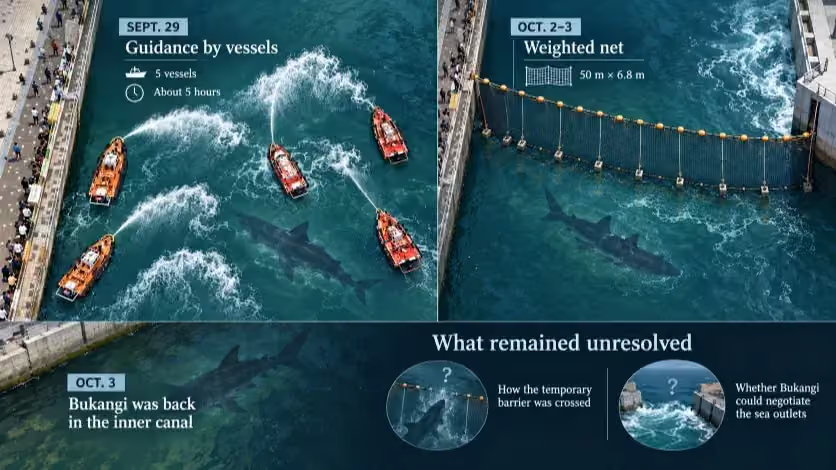 NewsOct 12, 2026
Bukangi, the Shark That Stayed in Busan’s North Port
A rescue net guided Bukangi toward the sea, but the dusky shark returned to B...
More from the author
More from this byline
Stay with the same line of reporting through more work from this byline.
- NewsOct 16, 2026
What Is Still Worth Going to See?
 NewsAug 24, 2026
Busan Is Building Policy Around a Running Boom
Reader Signal
Community readWhat did this report leave you with?
Choose the signal that best reflects your reading. Select it again to remove it.
One response per article
No response selected
A moderated conversation about the reporting.
One-level replies and newsroom moderation keep the conversation anchored to this article.
Discussion Status
Open
Please sign in to join the discussion.
Newsletter
Weekly reporting and context from Busan and Korea.