Western Busan Requires Industry, Not Disney
Dadaepo’s decline is rooted in the deterioration of fisheries, cold-chain logistics, and small maritime manufacturers. A theme park cannot replace the industrial ecosystem required to retain youth and stabilize neighborhoods.

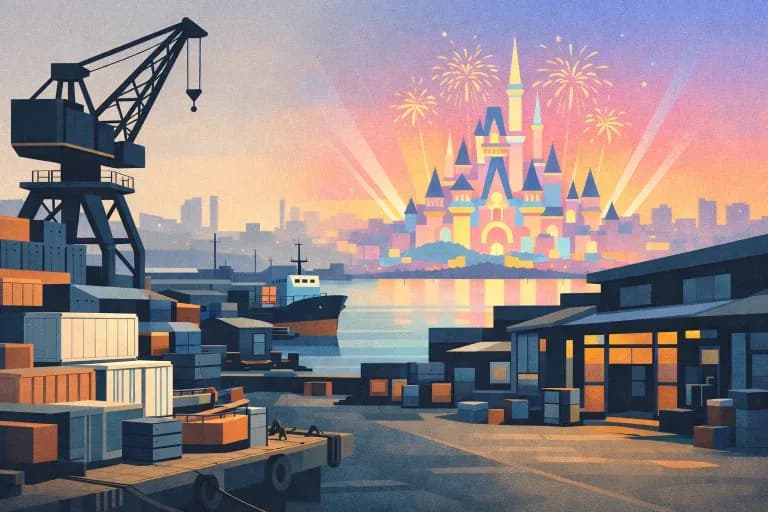
Western Busan’s decline did not begin with tourism failure. It began when maritime industries aged without modernization and younger households exited the district. Elections have treated the area as a branding surface rather than an industrial economy. The Disney proposal introduced during the pre-nomination phase of the June local elections reflects that tendency. No theme park can resolve the industrial, demographic, and employment problems driving the region’s contraction.
Political season in Busan has revived an old habit of promising spectacular urban transformations for the city’s neglected western shore. The latest proposal circulating ahead of the June local elections is the construction of a Disney theme park in Dadaepo, a waterfront district located at the southern edge of Saha-gu. Dadaepo once hosted the logistics and port-related industries that supported the city’s maritime economy. Today it faces rapid population decline, retail collapse, rising vacancy, and an accelerating transition toward an elderly demographic structure. Busan’s municipal data shows Saha-gu losing nearly 40,000 residents over the past decade, while small commercial strips near Dadaepo Beach and the adjacent industrial zones registered significant business closures and rent deflation not seen in the city’s eastern districts.
The promise of a global entertainment complex attracts attention because it appears to offer a shortcut to economic revival. Disney carries international brand equity, and its presence is commonly associated with mass tourism, high occupancy rates in surrounding hotels, and the creation of thousands of service jobs. Supporters in local politics describe the proposal as a “breakthrough strategy,” and campaign materials argue that Dadaepo’s shoreline and planned transport improvements, including the new Gadeok airport, provide the “geography for transformation.” In the narrative adopted by candidates, Disney functions as the catalyst that would convert a declining industrial periphery into an international destination.
Underlying conditions in western Busan conflict with that assumption. Dadaepo has limited hotel inventory, a shallow night-time economy, and no tourism corridors connecting it to existing visitor magnets such as Haeundae, Gwangalli, Seomyeon, or the port-side commercial districts in Nampo. Internal city tourism data indicates that visitors follow an eastward coastal axis shaped around hospitality supply, cultural infrastructure, and shopping districts, rather than moving across older industrial zones along the western coastline. The city’s tourism flows also show a strong bias toward short daytime trips rather than overnight stays, and the majority of domestic visitors rely on private vehicles rather than transit, reducing the likelihood of multi-node itineraries extending to Dadaepo.
Dadaepo’s economic structure further complicates the proposal. The district’s inland zones host clusters of fisheries, cold-chain logistics, metal fabrication, and machinery workshops connected loosely to the Jangnim and Sinpyeong industrial complexes. These facilities form part of a maritime production ecosystem whose employer base is aging and whose capital stock requires modernization rather than displacement. The concentration of small and medium manufacturers in the area differentiates western Busan from its eastern counterpart, where the economy has shifted decisively toward residential real estate, private consumption, and leisure services. Any intervention that treats Dadaepo as a tabula rasa for tourism overlooks the ongoing role of maritime industries and the dependence of those sectors on waterfront access.
The gap between the symbolic promise of Disney and the spatial and industrial reality of western Busan raises a larger question facing the city: whether high-profile consumer attractions can serve as engines of urban recovery for districts built on production rather than consumption. The Dadaepo proposal exposes the tension between election-cycle image politics and the long-term requirements of industrial modernization, demographic stabilization, and neighborhood-level economic revitalization. The proposal’s visibility stems not from feasibility but from the absence of credible policy alternatives for a region that has been left behind in the city’s shift toward east-side real estate and tourism development.
Symbolic Politics in an Election Cycle
The proposal to invite Disney to Dadaepo belongs to a long lineage of large-scale development pledges used in Korean municipal elections to signal ambition rather than execution. In Busan, the promise echoes earlier attempts to rebrand declining districts through spectacular projects: the failed Universal Studios plan in Songdo, unrealized resort proposals along the western coast, and periodic bids to secure global events as shortcuts toward metropolitan status. Each initiative functioned as a symbolic upgrade without resolving structural weaknesses in industry, demographics, or local economic ecosystems.
Campaign materials for the Disney proposal rely on a narrative that treats global entertainment infrastructure as a turnkey solution for local stagnation. The argument assumes that a theme park would draw international visitors, fill hotels, create service jobs, and reverse years of urban decline through consumption-led revival. The concept is attractive in electoral settings because it projects confidence without contesting the underlying sources of stagnation: shrinking working-age populations, limited youth retention, weak entrepreneurial activity, and the erosion of neighborhood retail.
Korean local elections reward proposals that emphasize brand power. Disney ranks near the top of global consumer brands, and its cultural weight simplifies the work of political persuasion. The brand suggests tangible stakes—families, recreation, fantasy—while bypassing debates about industrial modernization, fiscal prioritization, or workforce development. Public opinion surveys in Korea indicate strong responsiveness to lifestyle and consumption infrastructure, especially in cities competing with Seoul for visibility. Political strategists in Busan have repeatedly leaned on international brands or mega-events to substitute for long-term economic strategy.
The political utility of the Disney proposal becomes clearer when comparing western and eastern Busan. The eastern districts—Haeundae, Suyeong, and parts of Nam-gu—achieved higher real estate valuations and steady residential migration by emphasizing waterfront condominiums, hospitality, and leisure. The western districts did not follow the same trajectory, largely because industrial facilities, fisheries, and aging port infrastructure constrained the construction of consumption-oriented districts. The electoral temptation to replicate the eastern model through a single prestige asset is strong, even though the spatial, demographic, and industrial conditions differ fundamentally.
The proposal’s momentum owes more to the absence of credible policy alternatives than to feasibility. Western Busan lacks a shared plan for integrating industrial modernization with neighborhood-level redevelopment. No candidate has presented a strategy for the cold-chain logistics sector, for upgrading waterfront manufacturing clusters, or for converting maritime know-how into new commercial and technological platforms. In that policy vacuum, Disney functions as a narrative placeholder that shifts attention away from complex industrial realities and toward emotionally legible development imagery.
International examples show similar dynamics. Shanghai introduced Disney as an emblem of global status, not as an employment or industrial policy tool. Paris leveraged Disney for metropolitan branding and rail ridership, not for local neighborhood revitalization. Orlando’s political establishment treated tourism as a civic identity rather than an industrial strategy. In all cases, the political value of Disney preceded its economic function, and none of the projects operated as mechanisms for restructuring declining industrial districts.
In Busan’s election cycle, Disney’s symbolic power operates the same way. The proposal signals ambition without demanding specificity. It flatters regional identity by placing western Busan on an imagined global map. It resolves the discomfort of speaking directly about industrial decay, demographic contraction, and the hollowing of local commerce. It converts difficult policy into an image that can be consumed quickly on television or campaign posters. The gap between the promise and the implementable policy remains unexamined because elections reward spectacle over structure.
The Industrial and Urban Mismatch
The spatial structure of western Busan contradicts the commercial logic required for a global theme park. International parks are built to maximize the capture of overnight tourists through proximity to hotel clusters, dining corridors, event venues, and shopping districts. Dadaepo lacks every component of that ecosystem. The district has almost no hotel supply, weak food and beverage density, no recognizable night economy, and no tourism corridors linking it to the city’s most visited zones. Busan’s municipal tourism data shows that more than 70 percent of domestic visitors concentrate in the eastern districts and in downtown Namcheon–Seomyeon nodes, with itineraries rarely extending into Saha-gu. The city’s most profitable hospitality clusters are located more than 25 kilometers from Dadaepo, separated by industrial belts and disconnected transit patterns.
Transit reinforces the separation. Busan’s east-west tourism axis relies on subway lines, coastal boulevards, and walkable commercial streets that allow tourists to move between Haeundae, Gwangalli, and Centum City without friction. Western districts lack equivalent connective infrastructure. The subway terminates before reaching key industrial clusters, and coastal roads that might serve as scenic corridors are interrupted by port facilities, fisheries, and logistics yards. The absence of multi-destination flows prevents western districts from functioning as nodes within integrated tourism circuits. Theme parks depend on such circuits to distribute visitors into hotels, retail venues, and other attractions. Dadaepo currently operates as a terminal point rather than a node within a network, and terminals do not support multi-day tourist stays.
Industrial composition compounds the spatial mismatch. The districts inland from Dadaepo house workshops, repair shops, cold-chain facilities, fisheries, and small-scale fabrication clusters tied to the port economy. Many of these firms rely on waterfront access for operational reasons, including the receipt of seafood, access to materials, proximity to shipyards, and truck-based logistics. External observers frequently misclassify the area as a declining periphery suited for waterfront redevelopment, yet the region functions as an industrial zone requiring modernization rather than displacement. Theme park development would provide no functional link to fisheries, logistics, or ship repair, and would impose noise, zoning, and land price pressures that accelerate the displacement of industries that still generate employment.
Demographics further weaken the feasibility of consumption-led revival. Saha-gu’s age structure has shifted rapidly toward older cohorts over the past decade, and household income data indicates weaker purchasing power than in eastern districts. The majority of outbound migration consists of working-age residents and younger households moving toward districts with more employment and educational opportunities. A theme park requires a surrounding consumer base with disposable income, family-oriented spending patterns, and a broader hospitality sector. The demographic profile near Dadaepo resembles industrial suburbs undergoing population thinning rather than entertainment precincts accumulating affluent middle-class families.
The real estate structure of western Busan prevents the emergence of the hotel market required for Disney’s operational model. The city’s hospitality sector is drawn to districts with cultural density, business travel demand, nightlife, convention facilities, or upscale retail. Dadaepo has no assets in those categories. Without hotels, there is no overnight tourism; without overnight tourism, there is no multi-day spending; without multi-day spending, a theme park fails to generate revenue synergies beyond ticket sales. International operators compensate for such gaps by internalizing hotels within the park perimeter, but internalization eliminates local spillover, and western Busan depends on spillover to offset decades of industrial stagnation.
Theme parks demand metropolitan-scale visitor flows. Busan’s existing visitor flows remain regional and domestic, and most visits last a single day. The city loses international tourism share to Seoul and Jeju, and its non-Korean visitor base skews heavily toward short-term itineraries that prioritize shopping and coastal leisure. A global theme park requires an international airport hub, a large hotel ecosystem, and a stable pipeline of inbound package tourism. Dadaepo sits outside every element of that pipeline. The new airport planned for Gadeok-do may strengthen Busan’s aviation capacity, but such infrastructure upgrades do not convert industrial districts into consumption clusters without broader economic ecosystems.
International case studies underline the structural mismatch. Disney parks in Tokyo, Shanghai, Paris, and Orlando did not anchor industrial redevelopment; they attached themselves to metropolitan engines that had already built spatial, demographic, and consumption infrastructures. Industrial districts do not transform into tourism destinations through brand introduction. Those transformations require multi-decade urban investments, cultural production, and demographic renewal, none of which can be substituted by a single entertainment complex.
The Enclosure Risks of Consumption Economies
Operators of global theme parks absorb economic activity rather than distribute it. The standard model internalizes hotels, restaurants, retail, and entertainment inside the park perimeter to maximize spending capture and reduce dependence on external ecosystems. Analysts at the Themed Entertainment Association and Oxford Economics estimated that internalized spending accounts for 60–80 percent of visitor expenditure in major international parks. Internalization creates a closed-loop economy that rewards the operator but generates minimal spillover for adjacent districts.
Closed-loop economies carry a second-order consequence for urban peripheries. Disney parks in Orlando, Paris, Hong Kong, and Shanghai produced surrounding zones that failed to develop alongside the parks and, in several cases, experienced deterioration. Orlando’s tourism belt illustrates the enclosure problem most clearly. Hotels and retail outside the park perimeter shifted toward low-cost accommodation and short-cycle consumption to service a workforce that earns significantly less than the regional median. Property markets deteriorated in districts that lacked the brand premium of the park interior. Analysts at the University of Central Florida described the surrounding municipalities as “Disney-dependent suburban slums,” a term referring to the concentration of low-wage labor and under-maintained hospitality properties around a globally profitable attraction.
Paris provides a different variant of the enclosure problem. Disneyland Paris reinforced metropolitan tourism flows into central Paris rather than into the towns surrounding Marne-la-Vallée. The rail link made the park an extension of Parisian consumption rather than a catalyst for suburban regeneration. Housing markets in the adjacent communes stagnated, and mixed-use districts failed to develop despite the presence of one of Europe’s largest tourism engines. The French case shows that even strong transport infrastructure cannot guarantee local spillover when the consumption logic directs visitors toward a metropolitan core.
Shanghai demonstrates the geopolitical dimension of enclosure. The Pudong district already contained the city’s international airport, business districts, and hotel clusters before the park opened. Disney became another node within an existing consumption ecosystem rather than a driver of local restructuring. The surrounding precincts did not receive significant retail uplift, and industrial upgrading in the area proceeded independently of the park. The Shanghai case indicates that theme parks integrate effectively only when metropolitan consumption ecosystems are already mature.
The enclosure effect becomes more severe when applied to industrial districts. Dadaepo depends on small manufacturers, cold-chain facilities, and fisheries that require working waterfront access. Industrial land near ports typically faces strong pressures during redevelopment cycles, and theme park proposals amplify those pressures without offering replacement industries or compatible employment. Displacement of maritime production would remove one of the few export-oriented sectors in western Busan. The region’s industrial belt is already under strain from aging workforces, outdated facilities, and weak capital accumulation. Industrial displacement without industrial upgrading accelerates urban decline.
Demographic conditions magnify the risk of low-wage service economies. Service sectors associated with theme parks generate jobs, but most positions fall below the regional median in wage level and career progression. Labor economists studying Orlando and Anaheim found high rates of wage stagnation among park-dependent workers and weak pathways into middle-income employment. Saha-gu’s existing demographic profile skews older and poorer than the eastern districts of Busan, and outbound migration of younger households continues. A low-wage service shock would trap the district in a labor structure unsuited for long-term regional competitiveness.
Retail market dynamics also trend negatively for industrial peripheries exposed to enclosed consumption assets. Retail geographers studying U.S. theme park zones observed that independent cafes, restaurants, and small retailers failed to survive in the shadow of internalized theme park hospitality. Local retail depends on discretionary income, foot traffic, and repeat visitors. Parks produce neither. Visitors consume internally for efficiency, and the workforce does not possess the disposable income to support neighborhood retail. The result resembles the commercial collapse already visible in parts of Dadaepo and along industrial corridors in Saha-gu.
Hotel economics illustrate the final component of the risk. Theme parks require hotel supply, but hotel investors require urban amenities, business travel demand, cultural density, and night economy. Those conditions do not exist in western Busan. When hotel ecosystems are absent externally, operators normalize internal accommodations. Internal accommodations maximize revenue capture for the operator but eliminate spillover for adjacent districts. The Paris, Hong Kong, and Shanghai parks follow that logic. Internal accommodation models leave surrounding districts with none of the gains associated with hospitality and all of the economic distortions associated with land speculation and labor influx.
The worst-case scenario for Dadaepo follows a pattern already documented internationally: the park succeeds, the operator captures the gains, and the neighboring districts absorb the costs. Maritime industries would face land price pressure without receiving replacement infrastructure or workforce programs. Small manufacturers and fisheries would face zoning conflicts. Retail would not recover. Demographic thinning would continue. Hotels would be internalized. Service wages would stagnate. Public finances would be strained by infrastructure obligations to support an asset that does not regenerate the local economy.
Urban decline does not always follow abandonment. Decline can occur through redevelopment strategies that weaken industrial capacity, remove employment diversity, and substitute consumption for production. Western Busan’s industrial corridors require modernization and reinvestment rather than conversion into consumption enclaves. The gap between what the Disney model supplies and what the region requires is structural rather than ideological.
Western Busan Requires Industry, Not Disney
Western Busan’s decline stems from industrial erosion, demographic thinning, and the collapse of neighborhood commerce. The districts surrounding Dadaepo lost younger residents and small manufacturers as maritime production aged without reinvestment. Retail followed the population out, and the municipal economy shifted toward consumption districts in the east. Real estate appreciation in Haeundae, Suyeong, and Centum City produced a narrow form of urban prosperity while the western coastline absorbed industrial stagnation. The imbalance accelerated youth outmigration toward Seoul and the capital region, weakening the productive base that once sustained the city.
No global theme park addresses the causes of that decline. Disneyland does not modernize cold-chain logistics, fisheries, or machine workshops. It does not generate technical employment, vocational training pathways, or innovation ecosystems. The park model internalizes hotels, restaurants, and retail, and converts surrounding districts into low-wage service belts rather than productive neighborhoods. The metropolitan cases in Orlando, Paris, Shanghai, and Hong Kong show that revenue accrues to the operator while adjacent municipalities absorb the labor and land costs. Western Busan must retain maritime production to maintain employment, youth, and households. Entertainment cannot perform that function.
Political actors introduced Disney because elections reward imagery and penalize complexity. The industrial question in western Busan requires long-term investment in production, not symbolic consumption assets. Younger households do not remain in cities because of theme parks; they remain for jobs and wages. Industrial modernization holds residents. Consumption parks move revenue inward and workers outward. The mismatch between Dadaepo’s needs and Disney’s model is structural, not ideological.
Democratic preliminary contender Lee Jae-sung used Disney to secure recognition in a region without a clear development narrative. The proposal answered the communications problem created by the incumbent administration rather than the economic problems created by industrial decline. Mayor Park Heong-joon prioritized attractiveness, real estate, and events in the city’s eastern districts, but did not halt industrial deterioration in Saha, Sasang, and Gangseo. Balanced development did not materialize in policy or budget. The balance remained rhetorical.
Western Busan cannot negotiate its future through symbolic politics. The district requires investment mechanisms for maritime industries, vocational pipelines for technical labor, and modernization programs for fisheries, workshops, and cold-chain production. Without industrial reconstruction and demographic stabilization, no entertainment infrastructure—Disney or otherwise—can reverse decline. Elections that elevate theme parks over industrial strategy accelerate the loss of youth and the loss of planning capacity.
Cities survive when they produce. Western Busan requires production, not fantasy; industry, not branding; and policy, not spectacle.
The Weekly Breeze
Keep pace with Busan's deep narratives.
Delivered every Monday morning.