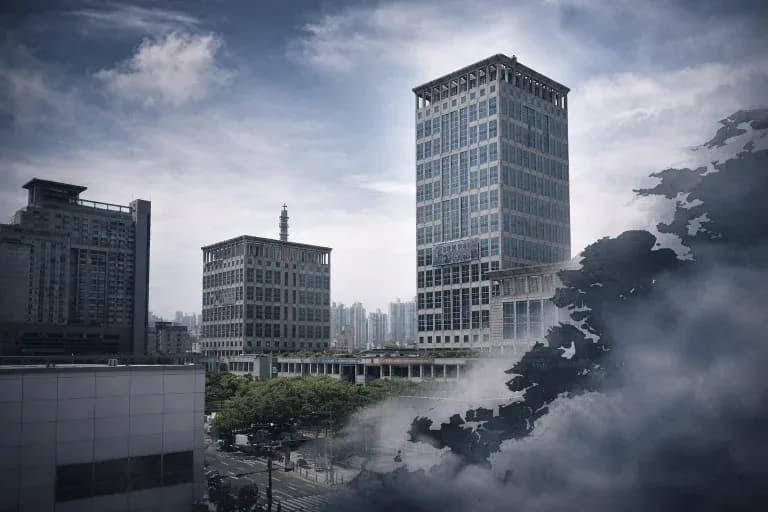
Can Busan–Gyeongnam Command an Economy, Not Just a Map?
For two decades Busan tried to swap factories for festivals, betting on film, cruises and MICE to replace heavy industry. The city gained visitors and visibility but not headquarters, research jobs or reasons for young people to stay. It became more famous, but less viable.


The question is not whether Busan and Gyeongnam should merge, but what the merged city-region would command. Ports, factories and energy already exist; a production thesis does not. Integration without function becomes geography without power.
Busan entered the twenty–first century believing it could trade factories for festivals. Film, cruise terminals and MICE facilities became the city’s calling card, promising a pivot from smokestack industries to branding, tourism and culture. The strategy delivered footfall and global recognition, yet failed to anchor capital, headquarters, research jobs or a future for young residents. The city’s economic profile grew more visible but less viable.
The demographic ledger is unambiguous. Busan peaked at nearly 3.9 million residents in 1995; by 2024 the figure had fallen to roughly 3.25 million, marking one of the sharpest long-term declines among Korea’s metropolitan regions. In a symbolic reversal, Gyeongnam—once overshadowed by Busan’s industrial and commercial weight—now surpasses it in population. Statistical agencies classify Busan as Korea’s first “extinction-risk” mega-city, a label previously reserved for shrinking counties and remote municipalities.
Youth flight explains much of the decline. Between 2015 and 2024, the Busan–Ulsan–Gyeongnam bloc lost more than half a million residents aged 19 to 39, with most departures bound for the Seoul capital region. The trend reflects wages and career ladders rather than lifestyle preference. Busan’s average monthly wage sits well below both the national mean and Seoul’s metropolitan levels; for young workers the gap widens further. A city marketed for culture and leisure increasingly functions as a low-wage service economy—one that attracts tourists for a weekend and dispatches graduates for a lifetime.
The industrial consequences are quiet but severe. Fragmented spatial planning in the 1970s and 1980s diverted heavy industry toward Ulsan, Changwon and Pohang, leaving Busan with ports, logistics and commerce but without the manufacturing core that sustained Germany’s Hamburg or Japan’s Kansai. When global trade shifted and domestic industrial chains reorganized, Busan lacked both production clusters and high-value command functions. Tourism filled the vacuum rhetorically, not structurally.
Beneath the branding lies a strategic vacuum. A city that loses its young, its headquarters and its industrial narrative eventually loses its negotiating power. Administrative consolidation debates between Busan and Gyeongnam now unfold against this backdrop, yet the discussion centers on municipal boundaries and political choreography rather than economic role or industrial logic. The stakes are demographic and existential, not administrative.
Factories Left First, Command Functions Vanished
Busan did not merely lose factories; it lost the command functions that anchor modern industrial cities. When Korea’s heavy-industrial strategy matured in the 1970s and 1980s, the most decisive splits were spatial. Petrochemicals and shipyards consolidated in Ulsan, steelmaking in Pohang, machine tools and precision engineering in Changwon. Busan was reduced to logistics and consumer markets, vital for throughput yet peripheral to design, R&D and finance—the stages that generate headquarters and high wages.
Manufacturing matters less for its assembly lines than for its control rooms. Cities retain talent not by hosting factories but by hosting the command layer around them: engineering decisions, supplier coordination, export risk assessment, financing, compliance, and procurement. Hamburg and Rotterdam kept their industrial role not through smokestacks but through maritime insurance, shipping finance, carbon trading and industrial services. Osaka’s Kansai belt evolved from machine tools to robotics and biomedical clusters by preserving its design and supplier networks. Busan lost the layer that ties production to power.
Tourism and MICE offered a narrative substitute but never a structural one. Festivals can pull visitors; they do not pull headquarters. Cruise terminals fill hotels; they do not fill research labs. A city becomes vibrant when it prices time, not when it prices sightseeing. Busan priced weekends and forfeited weekdays.
Labor statistics trace the consequences. Youth outmigration accelerated after 2010 as wage differentials widened between Busan and the capital region. Between 2015 and 2024, the Busan–Ulsan–Gyeongnam bloc shed more than half a million residents aged 19 to 39. Cities do not lose a generation accidentally; they lose it because the labor market cannot produce trajectories. Tourism generates density without mobility—employment without advancement.
Demography only stated what economics had already implied. Busan peaked at nearly 3.9 million residents in 1995; by 2024 its population had contracted to roughly 3.25 million, while Gyeongnam surpassed it. Statistical agencies now place Busan among Korea’s first metropolitan “extinction-risk” zones, an astonishing designation for what once functioned as the country’s second industrial hub.
The critical misstep was mistaking logistics for strategy. Ports do not generate prosperity automatically; they require manufacturing, finance, and energy systems to convert throughput into value. Busan’s port became a commodity rather than a platform. Once the command layer dissolved, the city could not rewire itself. Industrial cities rarely die from factory closures alone; they die when the factories’ cognitive infrastructure leaves with them.
Branding Without Strategy
City officials and consultancy reports speak in nouns: innovation, clusters, ecosystems, hubs, platforms and globalization. None of these words describe who pays, who builds, who supplies, who governs or who hires. Policy language in Busan replaced verbs with slogans and substituted value chains with branding. The region’s industrial problem was structural, yet the proposed solutions were lexical.
Digital transformation became a placeholder for industrial policy. “AI manufacturing” appeared in reports without specifying whether it meant predictive maintenance, digital twins, supply-chain integration or reshoring of design work. Without clarifying the layer in which AI would operate—plant-floor automation, engineering optimization, or procurement intelligence—the term functioned as a costume for indecision. Technology cannot substitute for strategy when the command layer is gone; it merely decorates the void.
Tourism and MICE followed a similar logic. The industrial literature distinguishes between cities that host visitors and cities that host decisions. Busan chose the former. A visitor economy yields transient demand and low switching costs, attractive to firms seeking occupancy rates but irrelevant to firms considering headquarters. Festivals invite spectators, not engineers. Cruise terminals generate traffic, not trajectories.
The city’s reports exhibit another pathology: abstraction without mechanism. A typical page lists the need for innovation, collaboration, resilience and high-value-added industries, yet omits the input-output structures that make those words real. Clusters require shared suppliers; headquarters require capital and legal counsel; design requires proximity to failure; manufacturing requires cheap time and expensive precision. None of these appear in municipal strategy documents because each implies trade-offs and power—concepts policy language avoids.
Administrative integration debates between Busan and Gyeongnam inherited the same vocabulary. The discourse emphasized governance, symbols and fiscal efficiency, not industrial roles or market coordination. A merged city without a production thesis is only a bigger jurisdiction with the same uncertainty. The essential question—what problem does integration solve in the value chain—remained unasked. Ports cannot justify integration alone; logistics must pair with manufacturing, finance and energy to produce durable economic identities. That calculus never surfaced in the public debate.
The buzzword economy has costs. Over time, policy becomes indistinguishable from marketing, citizens become consumers of civic experiences, and firms with actual production needs treat the region as a transient commodity. In the absence of mechanism design, tourism becomes a default because it evidences activity without requiring strategy. Yet cities are not brands; they are machines of coordination. Branding can attract attention, but only industry can retain people.
Integration Requires a Production Thesis
Ports do not create prosperity by moving containers; they create prosperity by coordinating value. The decisive question for Busan–Gyeongnam is not whether two municipalities should merge, but whether the region can reassemble a production thesis—an integrated logic that links manufacturing, logistics, energy and finance into a coherent urban function. Without such a thesis, administrative consolidation is cosmetic.
Manufacturing can no longer be evaluated through output or employment alone. Its strategic relevance derives from its adjacency to data, energy and financial markets. Modern factories generate telemetry and failure data; logistics corridors generate risk and timing information; energy systems generate price and carbon exposure; export contracts generate financing and insurance demands. These elements form a value-information circuit, and the cities that dominate it—Rotterdam, Hamburg, Antwerp, Osaka—do so by owning the circuits, not the warehouses.
Busan and Gyeongnam possess the fragments of such a system. Busan controls Korea’s most critical port infrastructure; Changwon remains the country’s deepest reservoir of defense, machinery and mobility suppliers; Ulsan and the East Sea corridors maintain petrochemical and offshore energy assets; Gyeongnam hosts the territorial depth manufacturing clusters require but Busan lacks. The spatial split that once weakened the region now provides an opportunity: production in Gyeongnam, export in Busan, energy upstream in Ulsan, and financial intermediation in Busan’s nascent district. If coordinated, these form a city-region capable of commanding the industrial chain rather than servicing it.
The financial layer is decisive. Ports generate risk; risk demands pricing; pricing demands finance. Rotterdam built its maritime finance desks and carbon markets not out of ideology but necessity: ships move commodities, commodities carry emissions, emissions require contracts. Busan’s attempts at a financial hub failed because they cloned metropolitan finance rather than building real-economy finance—shipping credit, export insurance, structured trade finance, energy hedging and carbon settlement. These are the instruments that tie ports to balance sheets and transform logistics into a headquarters function. A merged Busan–Gyeongnam cannot afford to repeat Seoul’s script; it must write Rotterdam’s.
Energy provides a second anchor. The East Sea offshore basin, hydrogen and ammonia pilots in Ulsan, and petrochemical complexes form a data-rich ecosystem of price signals, emissions and compliance burdens. Energy assets are rarely municipal; they are metropolitan. Their optimization depends on scale, transmission and planning. A fragmented governance environment treats them as nuisances; a city-region treats them as exportable expertise.
The last component is data. Manufacturing telemetry, port schedules, carbon declarations, customs records, bunker fuel pricing and offshore energy outputs constitute an underutilized industrial dataset. If standardized, anonymized and opened to developers and insurers, this dataset can produce software and analytics companies the way Hamburg’s maritime cluster produced maritime services and Rotterdam produced carbon traders. This is not “AI manufacturing”; it is industrial software and compliance technology—domains where Asia lacks concentration outside Tokyo.
Taken together, the industrial case for integration is strong: Gyeongnam supplies production and suppliers; Busan supplies ports and finance; Ulsan supplies energy and emissions; the region jointly supplies data. The missing ingredient is coherence. A metropolitan merger without a production thesis risks producing the worst of both worlds: larger bureaucracies managing a city without a function. A merger built on industrial logic would produce the inverse: a city-region with fewer factories than before, but more power over those that remain.
The Future Depends on Headquarters, Not Hype
Future scenarios for Busan–Gyeongnam hinge on a question that rarely appears in municipal strategy documents: where will the headquarters sit, and what will they do? Cities do not compete for tourists; they compete for command functions—procurement, legal, financing, carbon compliance, risk modeling and design. These are the functions that determine whether young engineers and analysts settle or leave, and whether firms treat a place as a site of transactions or a site of decisions.
A credible future for the region begins with reassembling the industrial command layer around four concrete markets: supply chains, emissions, energy and insurance. Each already exists in rudimentary form. Shipping schedules and customs filings constitute a real-time logistics signal; refinery outputs and offshore projects create price and emissions risk; petrochemicals and machinery supply chains generate failure data; export contracts require credit and hedging. None of these markets require speculation about “AI” or “innovation”; they require institutions capable of pricing risk.
The most promising path for a Busan–Gyeongnam city-region is not a factory boom but the emergence of real-economy finance and compliance technology—the connective tissue between ports, production and energy. Rotterdam did not become a hub by attracting unicorns; it became a hub by monetizing carbon and risk. Hamburg did not scale by advertising “innovation”; it scaled by consolidating maritime insurance, classification societies and industrial services. These cities export decisions, not souvenirs.
Industrial software presents a second axis. Machinery clusters in Changwon and energy complexes in Ulsan generate telemetry that manufacturers have never fully exploited: vibration signatures, fuel curves, downtime, corrosion, emissions and defect profiles. If standardized and commercialized, those datasets enable predictive maintenance marketplaces, regulatory reporting services and equipment financing models. These are not “smart” factories; they are financialized factories, where data informs warranties, leases and insurance. The region already owns the hardware; the missing layer is the software and the balance sheets.
The demographic return emerges from this structure. Young professionals do not remain in cities because they are fun; they remain because the labor market compounds skills. Skill compounding requires laddered professions—junior analysts become compliance officers, then structurers, then partners; design engineers become systems engineers, then product owners, then CTOs. Tourism cannot produce ladders; logistics cannot produce ladders without finance; manufacturing cannot produce ladders without software. A city-region that coordinates all three acquires a future.
Strategically, the Busan–Gyeongnam merger only makes sense if it produces a city capable of commanding industrial data, emissions and credit. Administrative consolidation without headquarters consolidation is inert. The city-region will either become a platform for real-economy capital or a service provider for cities that are. The map of Northeast Asia is unforgiving: Tokyo controls corporate governance, Singapore controls shipping finance, Shanghai controls industrial scale. A fragmented southeastern Korea cannot challenge any of them; a consolidated one could at least enter the conversation.
If the future proceeds under a tourism or lifestyle thesis, Busan will continue losing residents and Gyeongnam will continue exporting engineers. If it proceeds under a production thesis that integrates ports, factories and finance, the region can generate the only metric that matters for declining cities: reasons to stay.
Integration as a Question of Function, Not Identity
The argument for a Busan–Gyeongnam merger succeeds or fails on a single criterion: whether the region can regain command over the industrial chains that define Northeast Asia. Municipal borders, cultural identities and administrative efficiencies are secondary variables. Cities are not judged by how they brand themselves, but by what they command.
The industrial evidence is blunt. The region already possesses production in Gyeongnam, ports in Busan, energy upstream in Ulsan and data embedded across all three. What it lacks is a jurisdiction capable of integrating these assets into markets—credit, insurance, compliance and software. Without that integration, each asset remains a commodity sold to other command centers: Tokyo prices the risk, Singapore structures the finance, Seoul hires the analysts. Busan and Gyeongnam perform the labor and surrender the margin.
The demographic stakes are equally unforgiving. No metropolitan economy retains young talent through sentiment or scenery; it retains talent through compounding professions and headquarters functions. A city that cannot promote analysts into decision-makers exports them. A region that cannot offer command roles becomes a staging ground for departures. Branding cannot reverse that logic.
If integration proceeds without a production thesis, the merger will yield scale without power. It will enlarge bureaucracies, harmonize signage, and streamline procedures while leaving the labor market unchanged. The region will continue losing its young, headquarters will continue locating elsewhere, and ports will continue clearing cargo priced by other cities. This is the low-equilibrium future.
If integration is anchored in industrial logic—ports, manufacturing, energy and finance coordinated through data—then the region acquires a function that no other Korean metropolitan area can credibly claim. Seoul dominates consumption and capital; Daegu and Daejeon claim manufacturing; Jeju claims tourism. Only a consolidated southeastern corridor can claim control of supply chains, emissions and export risk. That control produces headquarters, and headquarters produce residents.
The decision is therefore not administrative but strategic. The question is not whether Busan and Gyeongnam should merge, but whether they can construct a city-region that commands something essential to the economy of its century. The alternative is not stasis; it is silent decline. Declining cities do not collapse suddenly; they fade through outmigration and external pricing. The window for reassembly remains open, but not indefinitely.
In metropolitan competition, identity follows function, not the reverse. Busan and Gyeongnam will be known tomorrow for what they decide to command today.
The Weekly Breeze
Keep pace with Busan's deep narratives.
Delivered every Monday morning.