Busan and Gyeongnam Challenge Seoul’s Fast-Track Integration Plan
As Seoul pushes fast-track consolidation with financial incentives, Busan and Gyeongnam insist on referendums and statutory guarantees, exposing a deeper conflict over power, timing, and political risk.

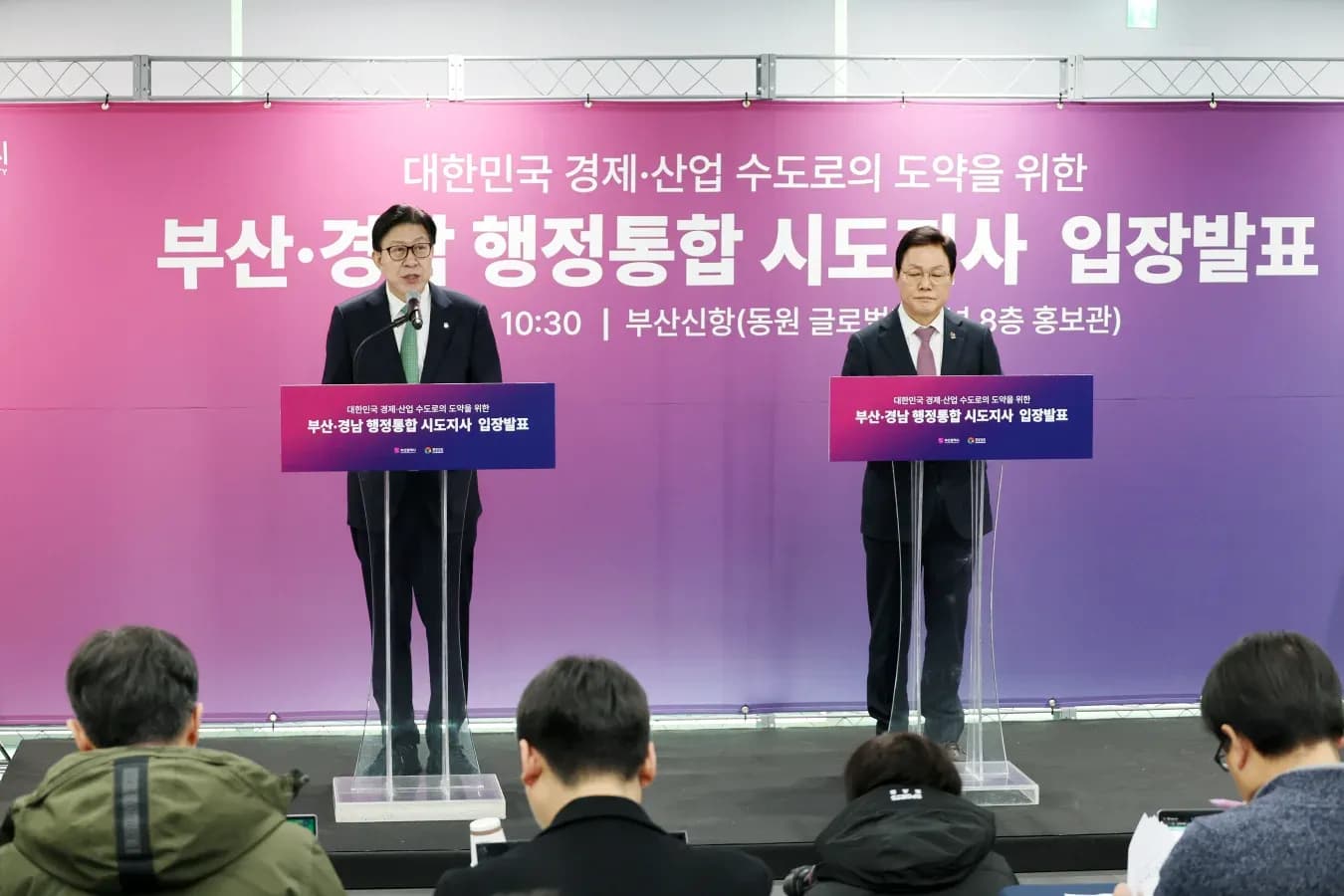
South Korea’s push to consolidate regional governments has entered a more confrontational phase. What had been framed by the central government as a fast-moving administrative reform, backed by generous fiscal incentives, is now facing organized resistance from local authorities demanding structural guarantees.
The government’s proposal, unveiled in mid-January, offers up to 20 trillion won ($15 billion) over four years to regions that agree to merge, along with promises of administrative status comparable to Seoul and preferential treatment in public investment and institutional relocation. Several regional blocs have responded positively, treating the initiative as a rare opportunity to expand scale amid demographic and economic decline.
Busan Metropolitan City and South Gyeongsang Province (Gyeongnam) have taken a different position. Rather than rejecting integration outright, the two governments have questioned the premise on which it is being advanced. Temporary financial incentives, local officials argue, cannot substitute for permanent fiscal authority or legally guaranteed autonomy. A phased roadmap toward integration by 2028 has been presented, built around a resident referendum and the enactment of a special law — conditions that shift the debate from administrative efficiency to the distribution of power.
The divergence has exposed a central tension in South Korea’s decentralization agenda. Expansion of administrative size has been prioritized, while the transfer of authority remains conditional. As integration efforts accelerate nationwide, the dispute emerging from the southeast raises a narrower but more consequential question: whether consolidation under the current framework produces stronger local governments, or merely larger ones.
Speed by Design
The central government’s administrative integration initiative was structured to advance ahead of institutional debate. Financial incentives were positioned not as a supplement to decentralization, but as its primary trigger. Constitutional revision, tax reallocation, and statutory guarantees were deferred, while immediate fiscal rewards were placed at the center of the proposal.
In mid-January, the government committed up to 5 trillion won per year for four years to regions that completed administrative consolidation within a designated time frame. Eligibility was tied to formal merger decisions rather than to the scope of authority transferred afterward. Additional benefits — including priority placement in public institution relocation plans and expanded discretion over internal organization — were outlined through executive guidelines, not legislation, allowing rapid rollout without parliamentary approval.
The sequencing altered the incentives facing local governments. With regional elections approaching, integration shifted from a long-term governance question to a near-term political calculation. Early movers stood to secure preferential access to limited national resources, while delayed decisions risked exclusion once funding ceilings were reached. The design favored speed over negotiation, encouraging alignment with the central framework before unresolved questions of fiscal autonomy and legal authority could be addressed.
Under the current framework, however, most of the authority offered to integrated regions remains conditional. Financial support is explicitly time-limited. Organizational autonomy is subject to ministerial guidelines. Core fiscal instruments — including tax rates, revenue-sharing formulas, and borrowing authority — continue to be governed by existing national statutes. Even the promise of “Seoul-level” status lacks statutory definition, leaving its scope dependent on future executive interpretation.
Administrative consolidation under such conditions expands territorial scale without fundamentally altering the balance of power between central and local governments. Larger jurisdictions inherit broader responsibilities, yet remain reliant on transfers controlled in Seoul. The incentive structure rewards speed of agreement rather than clarity of institutional design, favoring mergers that can be announced quickly over those that require complex legislative negotiation.
Other regions have accepted the trade-off. Gwangju and South Jeolla have prioritized early integration, focusing on economic scale and access to national investment. Daejeon and South Chungcheong have pursued a more cautious course, emphasizing institutional planning while remaining within the government’s framework. Participation has varied in pace, but the underlying logic has remained consistent: consolidation first, authority later.
Busan and South Gyeongsang’s objections emerged from this structural gap. Opposition did not center on the size of the incentives or the symbolism of status elevation. The critique targeted the sequencing itself. Without legally guaranteed fiscal authority, integration risks producing regional governments that are administratively larger but politically unchanged. Speed, in this view, becomes a substitute for reform rather than a path toward it.
Referendum First
Busan Metropolitan City and South Gyeongsang Province approached administrative integration from the opposite direction. Rather than accepting consolidation first and negotiating authority later, the two governments placed legal and political preconditions at the front of the process.
The roadmap unveiled on January 28 set out a three-stage sequence. A resident referendum was scheduled for 2026, followed by the enactment of a special law in 2027 defining the powers and fiscal framework of the integrated government. Only after those steps would voters elect a unified regional leader in 2028. Integration, under this design, would occur only after popular consent and statutory guarantees were secured.
The emphasis on a referendum marked a deliberate departure from the government’s fast-track model. Local officials framed the vote as indispensable, not symbolic. Public approval was presented as a mechanism to bind future administrations and limit the scope for post-merger retrenchment. The approach also shifted political risk. Failure would occur early, before institutional commitments were made, rather than after administrative consolidation had already taken place.
At the center of the proposal lay a demand for fiscal restructuring. Busan and South Gyeongsang called for a revision of the national–local tax revenue ratio to at least 60:40, arguing that integration without stable revenue would increase dependency rather than autonomy. Based on 2024 accounting standards, the two governments estimated that such a change would secure more than 7.7 trillion won annually in recurring local revenue, exceeding the value of the government’s time-limited incentive package within a single budget cycle.
The special law envisioned by the two governments was not framed as a procedural instrument authorizing merger. The demand extended to codifying fiscal authority, clarifying the scope of delegated central functions, and insulating core powers from executive discretion. References to “Seoul-level” status were recast as a question of legal equivalence rather than administrative symbolism. Authority, under this framework, would derive from statute rather than policy guidance.
The proposal, however, stopped short of operational detail. No draft legislation was released. Specific tax instruments subject to reallocation were not identified. The political pathway for securing parliamentary approval remained undefined. The absence of such detail preserved negotiating space, but also limited immediate scrutiny of feasibility.
A public finance expert noted that revising the national–local tax ratio would require “a chain of legislative changes, not a single political decision,” adding that “without specifying which taxes are reassigned or how revenue gaps are absorbed, such demands remain aspirational rather than operational.”
The contrast with other regions was stark. While several regional governments calculated that early consolidation maximized access to central resources, Busan and South Gyeongsang treated delay as leverage. The strategy relied on the assumption that integration at this scale could not proceed without their participation, allowing sequencing to become a bargaining tool rather than a procedural constraint.
Whether the approach represents institutional caution or strategic positioning remains unresolved. What is clear is that the dispute has reframed administrative integration as a question of order: whether authority follows consolidation, or consolidation follows authority. The answer will determine not only the outcome in the southeast, but the shape of regional governance reform nationwide.
Political leverage without a blueprint
The confrontation between Seoul and the Busan–Gyeongnam bloc has added a political dimension to what was initially framed as an administrative reform. By challenging the sequencing of integration, the two governments shifted the terrain of debate. The move altered negotiating dynamics, but it also exposed the limits of opposition built on conditions rather than proposals.
Public statements emphasized principles — fiscal autonomy, statutory guarantees, and democratic consent — while leaving implementation unresolved. Calls to revise the national–local tax revenue ratio to 60:40 were presented as prerequisites, not as legislative plans. References to a special law outlined desired outcomes, but stopped short of specifying institutional design. The absence of draft provisions, transition mechanisms, or fiscal offsets left critical questions unanswered.
The ambiguity has strategic value. By withholding detail, local leaders preserved flexibility and avoided early confrontation in the National Assembly. The approach allowed resistance without full commitment, positioning integration as negotiable rather than inevitable. Political capital was accumulated by defining red lines rather than by advancing a complete alternative framework.
The same ambiguity, however, complicates claims of policy leadership. Without a concrete blueprint, demands for authority risk being interpreted as leverage-seeking rather than governance planning. Integration remains contingent on conditions whose feasibility has not been tested against constitutional constraints, budgetary trade-offs, or parliamentary arithmetic. The distinction between structural caution and political positioning becomes difficult to sustain as timelines advance.
Elsewhere, regional governments have made different calculations. Some accepted temporary dependency in exchange for immediate scale and access to national resources. Others opted for institutional clarity within the government’s framework, even at the cost of reduced bargaining power. The southeastern bloc chose to delay, wagering that its economic weight and strategic importance would force accommodation. The outcome of that wager remains uncertain.
The dispute has revealed a deeper fault line in South Korea’s decentralization effort. Central authorities have treated integration as a managerial exercise, relying on incentives and executive discretion. Local governments have responded by demanding authority without fully articulating how such authority would be exercised. The gap between redistribution of power and redistribution of responsibility has yet to be bridged.
“What we are seeing fits a familiar pattern of procedural deferral,” said a political scientist specializing in Korean governance. “Actors acknowledge the need for reform, but shift decisive choices into process — referendums, special laws, future negotiations — especially when electoral risk is high.”
As negotiations continue, the debate is likely to hinge less on whether integration proceeds, and more on who defines its terms. Political leverage can delay consolidation and reshape bargaining positions. Sustainable decentralization, however, requires institutional design that survives beyond negotiation cycles. Without that transition, resistance risks becoming posture rather than policy.
Delay by design, and the cost of waiting
Administrative integration between Busan and Gyeongnam remains at a political stage rather than a policy one. No merger decision has been taken. No referendum date has been fixed. No legislative draft defining fiscal authority or administrative powers has been released. What exists is a framework of conditions, not a sequence of execution.
The central government has moved quickly to frame consolidation as an urgent reform, but the authority it offers remains provisional. Financial incentives expire. Organizational autonomy depends on ministerial discretion. Core fiscal powers remain anchored in national statutes. Acceleration has applied to announcements, not to redistribution of control.
Local governments in the southeast have responded through a form of procedural deferral, placing referendums and special legislation ahead of consolidation. The sequencing shifts decisive moments beyond the electoral calendar, reducing immediate political exposure while increasing negotiating leverage. The approach also reflects familiar patterns of blame avoidance, redistributing responsibility through process rather than commitment.
The strategy leaves key questions unresolved. Calls for fiscal decentralization and statutory guarantees have not been accompanied by legislative drafts or transition plans, creating space for strategic ambiguity. Leverage is preserved, but feasibility remains untested.
“From a regional decline perspective, time is the scarcest resource,” said a researcher who studies local governance and depopulation. “Processes that delay institutional decisions can be democratically justified, but they also carry opportunity costs that accumulate quickly in shrinking regions.”
The result is not deadlock, but suspension. Both sides acknowledge the need for reform. Both have adopted sequencing that postpones irreversible decisions. In the meantime, population loss, fiscal contraction, and administrative erosion continue independently of political timelines.
For regions facing accelerated decline, time is not neutral. The unresolved question is not whether integration occurs, but whether institutional design arrives before delay hardens into structural constraint.
The Weekly Breeze
Keep pace with Busan's deep narratives.
Delivered every Monday morning.