The Strike That Changed the Rules
In June 2025, the United States and Israel launched coordinated airstrikes against Iran’s nuclear infrastructure—justified as preemptive defense, executed without UN sanction.

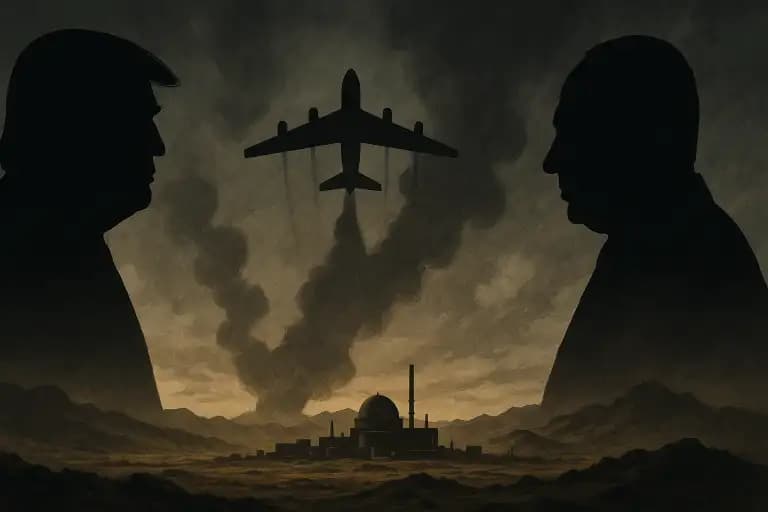
In an age where the language of emergency increasingly governs more than the emergencies themselves, the line between defense and theater grows thin. On June 22, 2025, the United States launched coordinated airstrikes deep into Iranian territory—targeting nuclear enrichment sites, suspected weapons facilities, and the infrastructure of a regime long portrayed as a global menace. The strikes were framed as a preemptive act of deterrence, a necessary blow to halt a looming nuclear threat. But as smoke rose over Natanz and Fordow, the real question wasn’t whether Iran posed a threat. It was why, at that moment, the crisis was declared—and by whom.
For a second time in just weeks, a powerful democracy resorted to high-stakes military force under the banner of existential defense. First came Israel’s dramatic air campaign—Operation Rising Lion—authorized by Prime Minister Benjamin Netanyahu amid domestic collapse. Then came the United States, under Donald Trump, invoking the specter of proliferation to justify a strike whose timing felt more tied to politics than to geopolitics. The official rationale was security. The underlying logic was something else: power under pressure does not always seek consensus—it seeks control.
This is not merely a story of missile strikes and military escalation. It is a study in how modern democracies confront crisis not as an interruption of normal politics, but increasingly as its operating mode. When national emergency becomes the stage on which legitimacy is reclaimed, the most dangerous weapons may not be the ones dropped from the sky—but the narratives constructed below them.
The Strike and Its Staging
In the early morning hours of June 22, 2025, American B-2 bombers slipped across the horizon, invisible to radar and unaccompanied by fanfare. Their payload—twelve bunker-busting GBU-57 munitions—was destined for some of the most fortified nuclear installations on Earth. Deep below the Iranian desert, the uranium enrichment facilities of Natanz and Fordow absorbed the impact. By sunrise, satellite imagery confirmed what the Pentagon had only hinted at: the United States had joined Israel in executing the most audacious coordinated strike on Iranian soil in a generation.
Official statements were swift and severe. The White House described the operation as “limited, targeted, and essential.” It was, according to President Trump, a necessary intervention “to prevent a catastrophic arms race.” Pentagon officials pointed to classified intelligence that placed Iran weeks away from acquiring weapons-grade uranium—a claim met with polite skepticism even among U.S. allies. Within hours, the Israeli government offered praise. European leaders called for restraint. Iran, unsurprisingly, called it war.
Yet beneath the statements and press briefings, a more complex theater was unfolding. This was not merely military action—it was political choreography. In Israel, Prime Minister Netanyahu had faced weeks of coalition collapse, legal peril, and civil unrest. His decision to launch a unilateral strike on June 13, known internally as Operation Rising Lion, was both a return to the Begin Doctrine and a calculated moment of spectacle. His American counterpart, navigating legal threats of his own and an uncertain electoral path, joined the campaign not simply as a global sheriff—but as a political actor in search of narrative control.
If war is the continuation of politics by other means, this was crisis governance reimagined as military demonstration. The timing, the symbolism, the scale—all suggested a mission designed not just to deter Iran, but to reclaim authority at home.
Iran Is Not Iraq: Misreading the Adversary
For decades, Western military doctrine has operated on the assumption that precision force applied at the right moment can bend adversaries toward compliance—or collapse. In Iraq, that assumption led to regime change and, ultimately, the rise of insurgency. In Libya, it unraveled a dictatorship only to unleash anarchy. In both cases, the target was a brittle regime—centralized, personalized, and vulnerable to shock.
Iran is different.
It is not a failed state masquerading as a threat, but a state forged through revolution, isolation, and strategic patience. With nearly 90 million people, a deep bureaucratic infrastructure, and a hybrid theocratic-republican system, Iran is not merely a regional actor—it is a long-game strategist. Its nuclear program, decades in the making, has survived sabotage, sanctions, assassinations, and cyberattacks. Its internal political structure, while opaque, is surprisingly stable. Power is not concentrated in a single figure but distributed across clerical institutions, military elites, and civilian ministries, all ultimately answerable to the Supreme Leader—a position that itself is institutionalized through the Assembly of Experts.
Moreover, Iran’s regional influence is not projection—it is entanglement. From Hezbollah in Lebanon to Shia militias in Iraq and the Houthis in Yemen, Iran has cultivated a network of asymmetric deterrents that give it reach without overextension. In this ecosystem, retaliation does not need to be immediate to be effective—it simply needs to be credible.
And it is.
The 2025 strikes may have damaged enrichment facilities and killed key personnel, but they have not altered the fundamental reality: Iran has survived worse. Economic sanctions, cyberwarfare, and covert assassinations have all failed to compel surrender. If anything, they have hardened the national security consensus. The lesson Iran has drawn from Libya and Ukraine is clear—those who relinquish nuclear ambitions invite regime change. Those who resist may pay a price, but they survive.
In this light, the U.S. strike, however tactically effective, may serve not as a deterrent, but as validation. The one thing that now seems certain is that Iran has fewer reasons than ever to trust nonproliferation guarantees—and more incentive than ever to finish what it started.
The Law of Power, and the Power to Break Law
In the official telling, the U.S. and Israeli strikes on Iranian territory were acts of self-defense—preemptive measures taken to neutralize an imminent nuclear threat. But in the realm of international law, preemption is a slippery doctrine, and imminence is a dangerous word. Under the UN Charter, the use of force is permitted only in response to an armed attack (Article 51), or with the explicit authorization of the Security Council. Neither condition was met.
Iran, while provocative, had not launched an attack. No missile had been fired. No strike had been attempted. The United States acted not in retaliation, but in anticipation. And that anticipation, legally speaking, remains unproven.
The International Atomic Energy Agency (IAEA), the global body tasked with nuclear monitoring, was notably cautious in its assessments. While it acknowledged Iran's continued enrichment of uranium, it found no evidence of weaponization, no radiation leakage from the targeted sites, and no confirmed breach of the Non-Proliferation Treaty (NPT). If a line had been crossed, it had not yet been documented.
This puts the United States—and by extension Israel—in precarious legal terrain. A strike without a documented threat violates not only the UN Charter, but the normative principles that have governed nuclear nonproliferation since the Cold War. It signals to the international community that force, not diplomacy, is once again the preferred method of enforcement. Worse, it hands the narrative advantage to Tehran, allowing Iranian officials to recast themselves not as aggressors, but as victims of illegal war.
The law, of course, has always been political. Great powers bend it, reinterpret it, or ignore it when convenient. But the erosion of legal norms is not without consequence. It weakens the credibility of the very institutions meant to prevent escalation. It signals to other aspiring nuclear states that treaties are fragile and that the only real guarantee of sovereignty may be the weapon itself.
This is the paradox of preemption: it may succeed tactically, but it often fails normatively. By striking first, the U.S. and Israel may have set back Iran’s program—but they also set fire to the rules designed to prevent a world where such strikes are routine.
From Tehran to the Global Order
In the hours and days following the strike, the world braced not only for missiles, but for meaning. Iran, true to its vow, launched a volley of short-range attacks on Israeli targets via its regional proxies—rockets in southern Lebanon, drones from Iraq, cyber intrusions aimed at U.S. infrastructure. These were the expected consequences. But the deeper aftershocks, the more enduring kind, are still rippling quietly through the geopolitical system.
The first and most obvious result is regional: the unraveling of what remained of the nuclear containment regime. For years, the West had wagered that Iran could be deterred or delayed through a mix of sanctions, diplomacy, and covert action. That framework is now shattered. Having absorbed a direct attack on its sovereign territory—despite remaining inside the legal bounds of the Nuclear Non-Proliferation Treaty—Iran now faces no incentive to show restraint. On the contrary, it now has an internal mandate to go further, faster. For hardliners in Tehran, the strike was not a warning. It was a permission slip.
This shift does not stop at Iran’s borders. In Riyadh and Ankara, the lessons of the past are being re-learned: that security cannot rely on treaties alone. Saudi Arabia has already signaled its willingness to pursue nuclear enrichment “for peaceful purposes”—a phrase that now carries more strategic ambiguity than ever. Turkey, long hedging, may accelerate its covert research. The specter of a regional arms race, once theoretical, now stands at the threshold of policy.
But the strike’s most subtle—and perhaps most corrosive—effect is reputational. For much of the postwar era, the United States positioned itself as the guarantor of a rules-based international order. That role relied not only on strength, but on the perception of restraint. The 2025 strike has put that perception in jeopardy. To much of the Global South, it confirmed a growing suspicion: that international law applies differently depending on who breaks it. That some states are punished for even seeking enrichment, while others bomb enrichment facilities with impunity.
Russia and China, unsurprisingly, capitalized on the moment. Moscow denounced the strike as “an act of imperial aggression,” while Beijing issued a veiled condemnation framed as a defense of “global stability and multipolarity.” But their rebuke was not just rhetorical—it was strategic. In Iran’s sense of siege, they saw an opportunity to deepen partnerships, expand influence, and redraw the alliances of the post-American order.
Thus, what began as a targeted strike may evolve into a pivot point. A blow intended to stop one nuclear program may have instead opened the door to many. And a demonstration of Western resolve may, in hindsight, be remembered as the moment its moral authority truly fractured.
The Strike That Changed the Rules
Democracies do not collapse in thunderclaps. They erode by habit—by the normalization of the extraordinary, and the quiet disappearance of limits.
The June 2025 strikes on Iran may be remembered for their coordination and technical precision. But their deeper impact lies not in the payload, but in the precedent. For the first time in decades, a sovereign nuclear state—without formal declaration of war—was attacked under the logic of preemption, not proof.
What was struck was not merely a site, but a structure: the normative framework of global non-proliferation, the credibility of international law, and the political architecture of restraint. In bypassing UN authorization, sidelining the IAEA’s verification mechanisms, and acting absent immediate provocation, the United States and Israel did not just violate rules—they rewrote them.
Iran, for its part, has been forced into a new strategic phase. Under siege, yet undeterred, it now finds the logic of nuclear deterrence more attractive than ever. The very weapon the strikes aimed to prevent may now become the outcome they guarantee. In Tehran, hardliners have gained ground. Moderates have lost face. The language of retaliation is no longer rhetorical—it is structural.
But the geopolitical reverberations do not stop at Iran’s borders. Across the region, states watch as norms dissolve. The message received is not just that might makes right, but that law can be optional, and sovereignty, conditional. In this new climate, arms races accelerate, diplomacy decays, and exceptionalism becomes routine.
Carl Schmitt warned that sovereignty rests in the power to decide the exception. The 2025 strikes embodied that claim. But if every crisis becomes an exception, and every exception becomes a precedent, then the world edges closer to a system not of rules, but of permissions—granted by power, revoked by force.
And so the question returns—not to who attacked, but to what was attacked: not just a reactor, but a regime of restraint. Not just Iran’s capacity for enrichment, but the international community’s capacity for judgment.
In the end, the missile was not only a message to Tehran. It was a message to every state still bound by law, asking: When power claims urgency, who will insist on legitimacy?
The Weekly Breeze
Keep pace with Busan's deep narratives.
Delivered every Monday morning.