How Modern Leaders Are Turning Crisis Into Power
From airstrikes to martial law, modern leaders are increasingly turning to national crises—real or manufactured—to consolidate power.

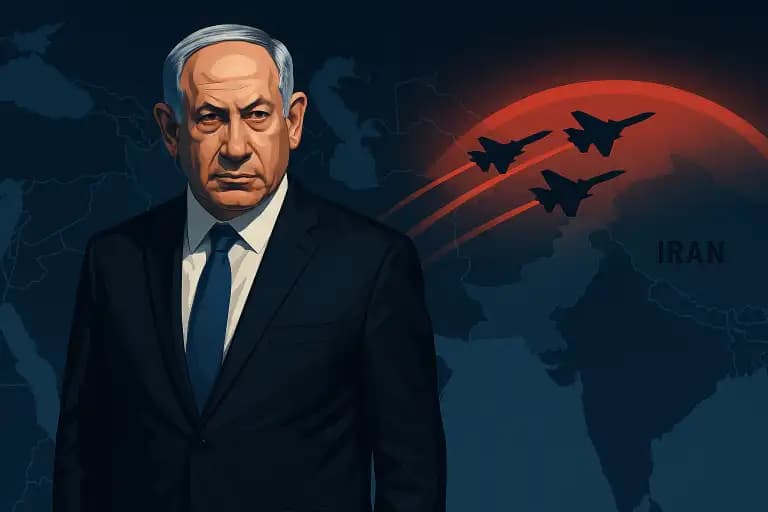
In an age when democracies are tested less by revolution than by rhetoric, the most dangerous threat is not a tyrant outside the gates—but a leader inside them who learns to call crisis by name, and then governs by it.
In the space of weeks, two of the world’s most scrutinized democracies—Israel and the United States—have veered into moments of extraordinary confrontation. In one, Prime Minister Benjamin Netanyahu ordered sweeping airstrikes on Iran, citing existential threats while battling deep political fragility at home. In the other, Donald Trump, poised for a return to the presidency, dispatched military units to American cities amid a sweeping immigration crackdown and swelling protest.
Though separated by continents and ideologies, both leaders responded not merely to external pressures, but to internal vulnerabilities. Faced with eroding public confidence, legal entanglements, or coalition instability, each reached for the language of emergency—and the instruments of force.
The result: blurred lines between governance and spectacle, defense and opportunism. As political crises are reframed as national ones, and executive power expands under the cover of urgency, a deeper question emerges: When is a crisis real, and when is it manufactured? And who pays the price when democracies are ruled not by consensus, but by command?
When Crisis Becomes Governance
There is a long and uneasy history of political leaders invoking crisis not merely to protect their nations, but to fortify their own positions. Power, when threatened by protest, prosecution, or parliamentary gridlock, often finds refuge in the language of national emergency. The tools vary—missile strikes, military deployments, sweeping legal decrees—but the logic is strikingly consistent. Fear concentrates authority. Urgency dissolves opposition. And in that moment, executive power expands, often beyond its rightful bounds.
The political science behind this is well established, even if the behavior it describes remains troubling. Decades ago, theorists observed that embattled leaders—particularly those facing domestic dissent or waning popularity—sometimes manufacture external threats to shift the public gaze. What has come to be known as diversionary conflict theory is not just a matter of military strategy; it is political theater with real consequences. External confrontation becomes a surrogate for internal legitimacy. A sudden crisis silences critics, postpones reckoning, and restores the optics of control.
Closely tied to this is the phenomenon known as the rally-around-the-flag effect, in which national crises temporarily boost public support for incumbents. Though typically associated with war, the same psychological mechanism is observed during immigration surges, terrorist attacks, or even pandemics. In the shadow of fear, the public often suspends its skepticism. The media narrows its focus. Institutions defer. What begins as emergency response easily becomes a normalized state of exception.
But while the short-term gains are seductive, the long-term risks to democracy are profound. The German legal theorist Carl Schmitt—writing in the wake of the Weimar Republic—famously asserted that the sovereign is “he who decides on the exception.” In other words, the true power lies not in routine governance, but in the ability to suspend it. For liberal democracies, that claim remains an existential warning. Emergencies may be inevitable. But when they become the method, rather than the moment, democracy begins to erode from the inside.
This tension between security and liberty, between urgency and consent, will recur throughout the cases ahead. For while airstrikes, troop deployments, and legal overreach may be presented as matters of national survival, they are just as often stories of political survival—executed not in response to genuine collapse, but to forestall electoral or institutional reckoning.
Netanyahu and the Calculus of War
In the early hours of June 13, 2025, Israeli warplanes launched one of the most extensive military operations in the country’s recent history. Dubbed Operation Rising Lion, the strikes reached deep into Iranian territory, targeting nuclear research facilities, ballistic missile infrastructure, and senior military figures, including several high-ranking officers within the Islamic Revolutionary Guard Corps. The Israeli government justified the attack as a preemptive act of national self-defense—an existential response to Iran's expanding nuclear capability. But the timing, intensity, and political context surrounding the strike raised a different, more complex question: was this war initiated to defend the state, or to save a prime minister?
Benjamin Netanyahu, Israel’s longest-serving and most polarizing leader, was facing one of the most precarious political landscapes of his career. His fragile coalition—held together by ultra-Orthodox and far-right factions—was unraveling over disputes on military conscription and judicial reform. Protests against his government had once again flooded Tel Aviv, reigniting a civil divide that had been simmering since the previous year’s controversial judicial overhaul. Polls showed his popularity falling. A vote of no confidence had been narrowly avoided. His personal legal battles loomed large in the public imagination.
Then came the jets.
From a strategic perspective, the operation was bold but familiar. Israel has long maintained the doctrine of Begin Doctrine—a commitment to preemptively strike any regional actor seeking nuclear weapons. But the 2025 strike differed in scope and effect. The elimination of key Iranian military figures in one night, the targeting of civilian-adjacent infrastructure, and the risk of dragging the entire region into open conflict suggested a new threshold had been crossed—not just militarily, but politically.
Critics, including former Mossad officials and international legal scholars, questioned the intelligence justifying the strikes. Several reports indicated that Iran’s nuclear program, while active, had not reached weaponization thresholds. The operation, they argued, was not a necessary last resort, but a calibrated spectacle—designed as much for domestic consumption as for strategic deterrence.
Netanyahu’s rhetoric in the days following the strike did little to dispel that impression. He invoked biblical references, declared the operation a “divine mandate,” and warned of a “great civilizational battle.” The language was not merely martial—it was mythic, aimed at reanimating a vision of national unity under siege. Within Israel, public opinion temporarily surged in his favor. The headlines shifted. The protests quieted. Coalition partners, for the moment, fell back into line.
But the unity came with a cost. Iran’s retaliatory missile strikes killed civilians in southern Israel. Hezbollah and other proxy groups moved closer to engagement. The international community, including longtime allies like the United States and the EU, expressed muted concern. And behind the show of force, the original fractures—political, legal, and social—remained unresolved.
Whether the operation succeeds in degrading Iran’s nuclear capabilities is still uncertain. But what is clear is that Netanyahu, once again, turned to war at a moment when peace at home seemed politically untenable. And in doing so, he reminded the world of a truth often forgotten in moments of fire and fear: not all wars are born from necessity. Some are born from power.
Trump and the Domestic Theater of Crisis
By the summer of 2025, Donald J. Trump had returned not only to the center of American political life, but to its most combustible edges. Facing intensifying legal troubles, a fractured opposition, and a volatile electorate ahead of the November election, Trump escalated his rhetoric—and then his actions. What began as vows to restore “law and order” quickly turned into executive orders unleashing mass deportations, and, most dramatically, the deployment of National Guard and Marine units into major U.S. cities, including Los Angeles and Chicago.
Officially, the justification was security. Spikes in migrant crossings were framed as an "invasion," and urban unrest in sanctuary cities was portrayed as a breakdown of national sovereignty. But the scale and symbolism of the response suggested something deeper than border enforcement: it was a display of federal power, directed inward. Troops were not stationed at international boundaries—they were patrolling domestic streets.
Legal scholars immediately raised alarms. Civil liberties groups filed injunctions. Even some Pentagon officials expressed discomfort with the blurring of military and civilian lines. But the political choreography was already in motion. Trump staged press conferences flanked by uniformed generals, invoked the Insurrection Act without formal declaration, and called on governors to “stand aside or stand trial.” The deployment—though selectively enforced—was broadcast with deliberate theatricality. It was, above all, meant to be seen.
And it was familiar. Trump had long understood that spectacle, when coupled with threat, is a potent political weapon. During his first term, he flirted with martial imagery—from Lafayette Square to military parades—but in 2025, with institutions more divided and electoral stakes higher, the gestures turned operational. Cities became stages. Migrants became villains. And troops became props in a story about a nation under siege.
The political logic was not dissimilar to that of Netanyahu’s Iran strike. Both men turned to the tools of state power not only to confront external or societal threats, but to reassert personal legitimacy at home. And in both cases, the crises they claimed to manage were also the ones they helped narrate into being.
Unlike Israel, however, the United States retains a powerful legal tradition of limiting executive overreach. Federal courts began to push back. Public opinion fractured: Trump’s base applauded the show of force, but moderate and independent voters recoiled. Civil-military experts warned of long-term erosion in the apolitical tradition of U.S. armed forces. And for many watching abroad, the scenes of soldiers in American cities served less as reassurance than as warning.
In the end, the deployments did little to meaningfully curb immigration or restore urban calm. But like many crisis-driven political actions, the utility was not in the outcome—it was in the optics. Trump had once again placed himself at the center of a national storm, cast as the last defender of a country he insisted was under attack.
And in doing so, he reaffirmed a dangerous precedent: that in moments of political vulnerability, the machinery of democracy can be repurposed—not to defend the state, but to dramatize it.
The Architecture of Crisis Politics
By this point, a pattern begins to emerge—not just across nations, but across philosophies of power. Netanyahu launched missiles over sovereign borders. Trump sent soldiers into domestic streets. Both leaders claimed necessity. Both insisted the state was under siege. But in each case, the crisis was not simply confronted—it was curated.
This is the architecture of crisis politics: a structure in which fear becomes fuel, emergency becomes method, and the extraordinary becomes routine. Its blueprints are not hard to trace. Power concentrates at the executive. Oversight weakens. Institutions defer. The citizenry, anxious or exhausted, either rallies or withdraws.
In political theory, these moments represent a dangerous inversion of democratic logic. Rather than drawing strength from deliberation, governments move by decree. Rather than empowering institutions to distribute responsibility, they centralize it in the name of security. The ancient tradeoff between liberty and order—always delicate—tilts decisively toward the latter.
Historically, this playbook is not new. From the Roman Republic’s dictatorship in wartime, to Weimar Germany’s use of Article 48, to modern states invoking anti-terror legislation, the cycle of emergency governance has been a recurring temptation. But in today’s media-saturated age, the crisis is no longer just invoked—it is performed. Leaders don’t merely respond to threat; they stage it. The language of survival becomes part of a larger spectacle in which the leader is both savior and sword.
And yet, the true crisis may be less about missiles or troops, and more about erosion: the erosion of guardrails, of proportionality, of public trust. Political emergencies, especially those repeated without resolution, have a corrosive effect. They desensitize a nation. They shift the baseline of what is considered acceptable in civic life. What once required consensus comes to require only command.
This is not to suggest that all uses of emergency power are illegitimate. Democracies must, at times, act quickly to defend themselves. But there is a difference between acting in defense of a nation and acting in defense of one’s political survival. And when that line blurs—when crisis becomes choreography—what is left behind is not just broken norms, but a redefinition of power itself.
Three Paths Through the Storm
When former South Korean President Yoon Suk-yeol declared martial law in late 2024—citing an unspecified internal threat and ordering military forces to surround the National Assembly—the alarm bells rang fast and loud. Yet what followed was not a collapse of democracy, but a stress test it ultimately passed. Within hours, opposition lawmakers, legal scholars, and civil society condemned the move. Within days, the legislature had voted to impeach. By April 2025, South Korea’s Constitutional Court—citing clear violations of civilian control and constitutional order—unanimously upheld his removal from office. It was a moment of constitutional clarity: power had overreached, and the republic pushed back.
By contrast, in the United States, the storm never fully passed. Trump’s reassertion of executive might—military deployments, emergency decrees, punitive immigration crackdowns—was met with institutional resistance: court injunctions, journalistic scrutiny, street protests. Yet the long arc of democratic repair remains uncertain. Unlike in South Korea, no impeachment was delivered. No clear legal ruling has fully repudiated the executive actions. Much of the machinery used in 2025 remains intact, and the precedent set—military force within civilian jurisdictions, policy via proclamation—is now part of the American political repertoire.
In Israel, the calculus is more complex. Netanyahu’s military action may have scored tactical victories, but the domestic problems that preceded the strike—coalition instability, corruption trials, constitutional tensions—have not disappeared. On the contrary, they were temporarily muted by the fog of war, but not resolved. Israel’s institutions—particularly the judiciary—remain active, but polarized. The public, fatigued by both war and political scandal, risks retreating into resignation. What unfolds may not be authoritarianism in the classic sense, but something slower: a soft corrosion of civic vigilance and pluralistic discourse beneath the mantle of permanent crisis.
The contrast among these three democracies offers a rare political-philosophical lesson: crisis reveals not only the character of leaders, but the resilience of institutions. South Korea demonstrated that with strong legal mechanisms and active civil society, even dramatic overreach can be contained and reversed. The U.S. experience shows how such overreach, if left without definitive institutional judgment, can linger and evolve into new norms. Israel shows how the militarization of politics—even under democratic procedures—can gradually displace public discourse with perpetual securitization.
In each case, the temptation of crisis politics followed a familiar logic. What differed was the response. Who pushed back? How fast? Through what mechanisms? And with what clarity?
Political theorists like Judith Shklar remind us that the true test of liberalism is not its ideals, but its procedures under stress. Democracy is not defined by the absence of crisis, but by its capacity to absorb it without abandoning the rule of law. Carl Schmitt saw power in the ability to decide the exception. But in modern republics, the exception must itself be answerable—legally, ethically, and electorally.
South Korea’s response showed this principle in action. The U.S. response remains a question. Israel’s may depend on whether a society long defined by external enemies can recover its internal democratic balance before permanent exceptionalism becomes its default mode.
Democracy at the Edge of the Exception
Democracies do not collapse in a single moment—they erode by habit. In the end, it may not be the crisis that undoes them, but how quietly we accept its usefulness.
Democracy is not merely a system of elections; it is a system of limits. It draws its strength not from the volume of power it grants, but from the precision of the boundaries it imposes. When those limits are blurred—when executive authority invokes crisis to suspend process, when legality is used as a veil for coercion—democracy enters a new, and dangerous, phase: government by exception, normalized.
In each of the cases examined—Israel, the United States, and South Korea—leaders turned to extraordinary measures during moments of political vulnerability. But their destinations diverged. South Korea resisted. Its institutions moved quickly to interpret martial law as a constitutional breach, not a national necessity. The result was not collapse, but correction. The rule of law prevailed, not because it was inevitable, but because it was asserted.
The United States, by contrast, remains suspended between impulse and consequence. Donald Trump’s use of military force inside American cities, framed as a response to chaos and border invasion, was met with institutional friction—but not decisive repudiation. The laws were tested. Norms eroded. The precedent—executive power in the name of internal order—remains alive, waiting to be invoked again.
In Israel, the danger is subtler, but no less potent. Netanyahu’s wartime operation may have delivered military results, but domestically it functioned as an anesthetic—blunting public dissent, reuniting a fractured coalition, shielding political crises in the fog of national security. It is not the pace of authoritarianism that matters, but its persistence. When the state of emergency becomes habitual, the very idea of a “normal” democratic process begins to fade.
This pattern reveals a core truth of modern power: that authoritarianism rarely announces itself in marching boots or manifestos. It arrives through law, through security, through fear—cloaked in the credibility of necessity. Carl Schmitt saw the sovereign as the one who decides on the exception. But liberal democracy must insist on a deeper sovereignty: one that rests not on power to suspend law, but on commitment to its continuity.
Judith Shklar reminded us that liberalism’s true origin is fear—not of enemies, but of unchecked rule. When law is used not to constrain power but to protect it, the public ceases to be governed and begins to be managed. And as Hannah Arendt warned, authoritarianism does not erupt fully formed; it seeps in—normalized through habits of obedience, indifference, or convenience.
The lesson is not that democracies must avoid crisis. Crisis is inevitable. The lesson is that they must resist the temptation to use it as a shortcut for power. To protect democracy is not simply to vote—but to limit, to question, to withhold consent when power demands too much. In moments of panic, it is the pause—the institutional “no”—that distinguishes republics from regimes.
And so the final question is not whether emergencies will come. They will. The question is: when they do, will our democracies remember what they are for—and what they are not?
The Weekly Breeze
Keep pace with Busan's deep narratives.
Delivered every Monday morning.