The Philosophy and Architecture of Korea’s Borrowed Scenery
Korean chagyeong, the art of borrowing scenery, weaves distant mountains, rivers, and seasonal light into the living fabric of everyday space.
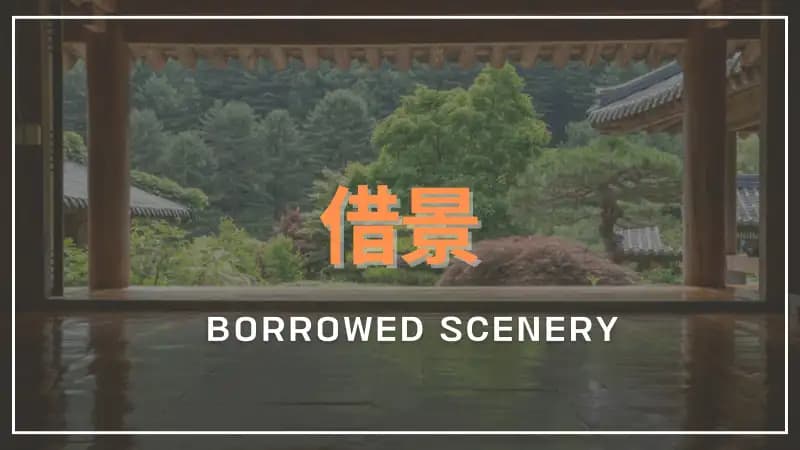
Late autumn settles quietly over the Secret Garden of Changdeokgung. Stepping barefoot onto the maru—the wooden floor polished by centuries of footsteps—you feel the grain’s warmth seep into your skin. Below, a pond holds the pale reflection of drifting clouds, while beyond the palace walls the ridgeline of Bukaksan Mountain fades into soft layers of blue. The mountain is not part of the palace grounds; no royal gardener planted its pines, no architect shaped its slopes. And yet, framed by the open expanse of a pavilion, it becomes inseparable from the garden’s composition.
This quiet collapse of boundaries is the essence of chagyeong (借景)—Korea’s interpretation of borrowed scenery, a design philosophy that treats the world beyond one’s walls as an extension of the space within. It is not merely an architectural device but a way of seeing: a recognition that harmony emerges not from mastering the landscape, but from allowing it to complete the place you inhabit.
Chagyeong is more than an aesthetic—it is an ethos. In an age of environmental crisis, designing with the borrowed horizon reminds us that we are part of a larger, enduring landscape. Every window can be a window to the infinite.
The Meaning and Origins of Borrowed Scenery
The idea that a garden should never be confined by its own walls first appeared in recorded form in 17th-century China, within Ji Cheng’s Yuanye (The Craft of Gardens). Writing for the literati elite, Ji devoted his final chapter to a principle that was less about construction than perception: a garden could reach beyond its physical limits, drawing distant mountains, neighboring groves, or even a passing cloud into its composition.
In its mature form, this principle operated on multiple planes of awareness. A far-off mountain crest might extend the mind’s horizon; the silhouette of a neighbor’s pine could become part of a courtyard’s geometry; the sky itself, shifting with clouds and light, might lend the structure its mood. Even the ground—its textures, its mirrored surfaces of water—could turn into part of the scene, anchoring the architecture in a dialogue with what lay beyond its threshold.
Such thinking made the garden porous, a place where the physical and the imagined coexisted. In China, it often resulted in orchestrated grandeur, where vistas were staged with theatrical precision. Japan, absorbing the idea through the lens of Zen, distilled it into meditative clarity: a single framed view, sparse yet infinite in suggestion. Korea’s chagyeong took yet another path—less a display, more a conversation—placing structures where the land itself seemed to invite them, allowing borrowed views to flow in naturally, like air through an open door.
The Korean Aesthetics of Chagyeong
In Korea, chagyeong—literally “borrowed view”—is not an ornamental flourish added after the walls are raised. It is the quiet architect, present from the moment a site is chosen. A hanok is not simply placed upon the land; it is oriented toward the life beyond its threshold. Rooflines dip low to grant the sky its due share of the view, while the open wooden veranda, the maru, becomes a lens through which the outside world enters daily life.
This architectural openness is rooted in the Confucian ethic of restraint and harmonious coexistence with nature. Rather than reshaping the land to fit an ideal, the builder reads the topography, aligning the home with the slope of a hill, the curve of a riverbank, or the seasonal arc of sunlight. A low wall may guide the gaze toward a distant ridge, while a sliding changhoji door frames the exact bend of a willow’s trunk. The intention is never to dominate the view but to hold it gently, letting it remain what it is.
The effect is both practical and poetic. A room opens to the cool breeze of summer, the warming light of winter, the fleeting fire of autumn maples. A pond mirrors the pale moon, doubling the sky. As seasons turn, so does the composition—spring’s mist softens a mountain’s line; winter snow sharpens it into black-and-white ink. In this way, chagyeong transforms architecture into a living conversation with its surroundings, one that shifts subtly with every day and every hour.
One Principle, Three Voices
Korea’s chagyeong developed alongside Confucian scholar culture, where study and contemplation demanded a physical connection to nature.
Across East Asia, the idea of borrowing scenery has traveled under different names—jiejing in China, shakkei in Japan, chagyeong in Korea—each emerging from the same impulse, yet shaped by distinct cultural sensibilities. The principle is simple enough: a space should reach beyond its own boundaries. But what each culture chooses to invite into that frame reveals far more than a design preference; it speaks to an entire worldview.
In China, where jiejing matured within the gardens of scholar-officials and imperial courts, nature often served as a stage for civilization. A distant mountain might be framed not for its own sake, but as a metaphor for stability and virtue, echoing the moral ideals of Confucian governance. The designer’s hand was evident—corridors curving to build suspense before revealing a peak, rockeries constructed to mirror hills beyond the wall. Nature was artfully arranged, its beauty enlisted in the service of cultural symbolism.
Japan’s shakkei, refined under the meditative gaze of Zen, took a different path. Here, the borrowed view was pared down to its essence, often just a single mountain ridge or a slice of sea glimpsed between pines. The frame was absolute, the viewpoint fixed. What mattered was not variety but the slow, contemplative act of looking—the recognition that impermanence and incompleteness were themselves forms of beauty.
Korea’s chagyeong occupies a quieter middle ground. Its roots in Neo-Confucian thought gave it a moral dimension, but its expression was grounded in daily life rather than ceremony or abstraction. A scholar’s pavilion might lean toward the morning mist over a river; a family courtyard might open to the layered hills beyond a village wall. The borrowed view was not staged for visitors or isolated for meditation—it was lived with, like a familiar neighbor seen each day across the fence. In this, chagyeong offers perhaps the most permeable boundary of the three: not a stage, not a frame, but a threshold that one can step across without noticing.
The Architecture of Seeing
Borrowed scenery is often described as a painter’s trick translated into the language of buildings and gardens, but in truth, it is an architecture of perception. It relies not on ornament, but on the way space is positioned, proportioned, and opened—how the eye is led and the body is placed. The result is a choreography of sightlines in which the distant and the immediate speak to each other.
In Korea, chagyeong finds its purest expression in the open maru—a raised wooden platform without glass or wall, where air and light pass freely. From this vantage, the world beyond is not an intrusion but a continuation: the ridgeline of a mountain folds into the roofline of the hanok, the shimmer of a stream slips under its eaves. The foreground is left loose and breathing—open yard, low wall, winding path—so that the transition between house and horizon feels almost imperceptible.
China’s jiejing, by contrast, prefers a more orchestrated approach. Garden paths bend with intention; moon gates and lattice windows become instruments that frame and reveal. Here, the borrowed view is part of a larger composition, a sequence in which the viewer is both participant and audience. Each step alters the alignment of rock, tree, and peak, as though one were walking through a living scroll.
Japan’s shakkei speaks with an economy of means. A low wall with a single opening may admit just the tip of a sacred mountain; a veranda may be positioned to hold only a sliver of sky between two pines. The foreground is pared back—raked gravel, moss, or a single tree—so that the eye meets no distraction before it meets the view. The effect is not to integrate the outside into daily life, but to isolate it for contemplation, as one might a poem on a scroll.
What unites these approaches is a recognition that scenery is never static. Light shifts, seasons turn, a cloud passes, a bird alights. The architecture of borrowed scenery does not seek to freeze these changes; it creates the conditions for them to be seen. In this way, every wall becomes a lens, every opening a kind of clock, marking not hours but the slow procession of the natural world.
A Window to the Infinite
It always begins quietly. You sit, and you look. Beyond the veranda, bamboo leans into the wind, whispering against the paper screens. Past the low wall, a hill rises—sometimes sharp as calligraphy against winter air, sometimes blurred by the haze of late summer. Slowly, you realize you have not been looking at the landscape so much as living with it.
This is the enduring promise of borrowed scenery. Whether called jiejing, shakkei, or chagyeong, it is less a design device than an ethic of dwelling—one that softens the boundary between shelter and world, between the human and the more-than-human. In Korean tradition, this invitation is woven into the fabric of daily life: the scholar’s desk angled toward the bend of a river, the family courtyard opening to the rhythm of the seasons, tea shared in the company of rustling leaves.
In the restless geometry of our vertical cities, this sensibility feels almost radical. We build higher, seal windows, privatize the view—believing that isolation equals progress. But the old masters understood that a view gains meaning when it is not owned, when it shifts with every cloud, every season, every mood of the day. They knew that to borrow a view is also to borrow time: to acknowledge that the horizon was here before us and will remain long after.
Perhaps the future of architecture will be measured not only in new materials or technological brilliance, but in our ability to recover this quiet intelligence. For in the end, the most valuable window is not simply an opening in a wall. It is an opening in the mind—a frame through which the infinite can step in, unannounced, and take a seat beside you.
The Weekly Breeze
Keep pace with Busan's deep narratives.
Delivered every Monday morning.