Words That Wound: The Violence of Hate Speech in Korea’s New Street Protests
The hate rallies in Seoul’s Myeongdong district do not resemble the candlelight vigils that defined Korean democracy. Instead, they echo repertoires seen in Japan and the US.

From Protest to Exclusion
The public realm exists only when we stand together with others.
In the heart of Seoul’s Myeongdong district, a familiar urban scene has taken on an unfamiliar form. Demonstrations—so often in South Korea a vehicle for civic demands and political accountability—have turned their attention to passing tourists. The chants no longer call for reform or resignation, but for removal: strangers are told they are unwelcome.
For a country long recognized for its disciplined and purposeful protest culture, the sight is dissonant. South Korean demonstrations have carried a certain reputation abroad: mass gatherings that confront authority without collapsing into violence, rallies that press for rights with a language of reform rather than exclusion. The new rallies in Myeongdong, directed not at institutions but at individuals, mark a rupture in that lineage.
This rupture is not simply a matter of style. It signals the arrival of a repertoire that is at once familiar elsewhere and alien here: the global vocabulary of far-right mobilization, imported through digital networks and adapted to local discontent. What emerges is not a protest in the traditional sense, but a performance of hostility—a spectacle that raises urgent philosophical questions about the boundaries of speech, the ethics of public space, and the fragility of democratic culture.
The Grammar of Civic Anger
Civil disobedience can steady a democracy when it defends constitutional essentials.
South Korea’s modern history is inseparable from the sound of its streets. In the 1980s, students filled campuses and downtown boulevards to challenge military rule. Workers gathered at shipyards and factories to demand dignity and safer conditions. Later came civic rallies for peace, for the environment, and for broader freedoms. Most memorably, in 2016, millions held candles aloft in central Seoul, week after week, until a president stepped down.
These moments share a defining quality: they were aimed at power. Protests here were not staged against passersby but against institutions—governments, corporations, entrenched elites. They carried grievances, but they also carried proposals: for democracy, for labor rights, for accountability. The legitimacy of these gatherings rested on that orientation toward reform.
Equally notable was their discipline. Even at their largest scale, South Korean protests earned recognition abroad as examples of collective action conducted without mass violence. They were assertive but rarely chaotic, confrontational but tethered to civic purpose. In this way, protest culture became part of the country’s democratic identity—proof that public anger could be expressed without dissolving into disorder.
It is precisely this history that makes the current rallies in Myeongdong so unsettling. Instead of addressing the structures of governance, they single out individuals who have no hand in shaping policy. Instead of reform, they call for exclusion. In doing so, they sever themselves from the tradition that once made South Korea’s protest culture both distinctive and admired.
When Critique Becomes Discrimination
Ethics begins at the face of the Other; effacing it abandons ethics.
That such rallies would emerge in 2025 is not without context. Anti-China sentiment has been present in South Korea for years, shaped by disputes over missile defense, economic retaliation, and pandemic-era tensions. Yet those sentiments, however sharp, had largely been directed at Beijing’s policies, not at the presence of ordinary Chinese people on Korean streets.
The return of mass tourism after years of border closures created a new stage. Myeongdong, long a symbol of commerce and hospitality, once again drew large groups of Chinese visitors. For merchants this signaled recovery; for the protestors, it offered visibility. By targeting tourists in a district synonymous with shopping and spectacle, organizers ensured that their message would carry not only through local media but also across countless phone cameras and online channels.
This choice of target and location points away from spontaneity. The chants, placards, and marching routes repeat with theatrical consistency, suggesting choreography rather than impulse. Even more striking is the demographic makeup. Among the participants are young men and women in their twenties—an age group rarely seen at conservative or far-right gatherings in South Korea. Their presence raises questions of motivation: whether this reflects a genuine shift in generational politics or a deliberate attempt by organizers to project a broader appeal.
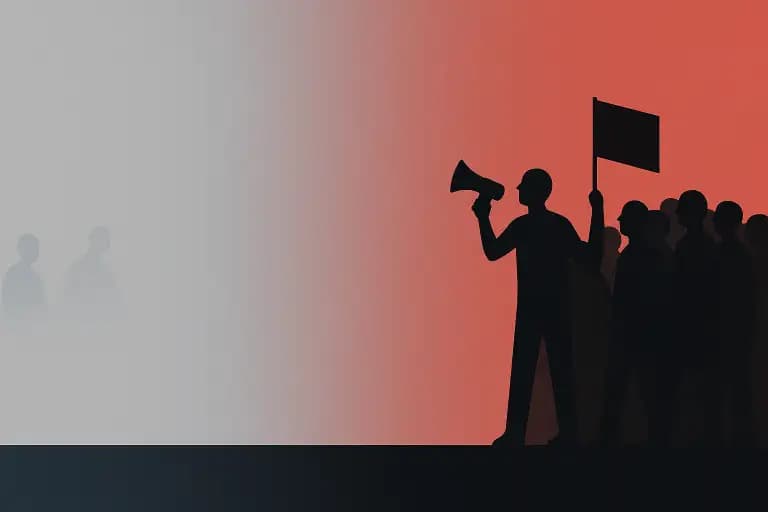
What emerges is less a groundswell of popular anger than a staged performance of antagonism. It borrows the aesthetics of protest—megaphones, banners, crowded sidewalks—while stripping away the substantive goals that once defined protest culture. Instead of seeking reform, it rehearses hostility. Instead of pressing demands, it draws boundaries. And in this dissonance lies the unease: a form of demonstration that looks familiar but carries a logic that is foreign to South Korea’s civic tradition.
The Stage of Hostility
Power circulates through discourse; it shapes what can be seen and said.
Violence does not always arrive with fists or weapons. It can be carried in words, repeated through chants, and amplified by the presence of a crowd. The rallies in Myeongdong make this plain. To tell strangers that they do not belong, in a public space where they have every right to stand, is not simply expression. It is an act of exclusion enacted through speech.
Philosophers have long warned of this boundary. John Stuart Mill allowed wide latitude for free expression but drew the line at speech that inflicts direct harm on others. By that measure, chants that target identifiable groups do not expand the marketplace of ideas; they close it down through intimidation.
Hannah Arendt described the public realm as a space where people appear to one another in equality. When speech drives some away, that realm is diminished. Jürgen Habermas, too, emphasized the role of rational discourse in sustaining a democratic public sphere. Hate speech functions in the opposite way: it is not an invitation to debate but a signal that debate is no longer possible.
Judith Butler has argued that certain utterances are performative—that they do not just describe but do. To say “leave” to a group of people in a public square is to perform the act of expulsion, even if no physical force is used. Emmanuel Levinas, writing on the ethics of the Other, would recognize in such speech a refusal to acknowledge the face of the stranger, a denial of their very humanity.
Seen through these lenses, the rallies in Myeongdong are not protests in any meaningful civic sense. They are rituals of exclusion, using language as a weapon to redraw the boundaries of who may stand within the city’s most visible spaces. Their violence is symbolic, but its effects are real: fear among those targeted, corrosion of the civic commons, and a narrowing of the democratic imagination.
Words That Wound
Speech does not merely describe; it acts—and sometimes it injures.
One of the most striking features of the Myeongdong rallies is the profile of those on the front lines. Unlike the conservative street gatherings of the past, which were dominated by older participants waving national flags, these demonstrations often feature younger faces—men and women in their twenties, dressed less like activists than like passersby who have been handed placards. Their presence lends the rallies an unusual texture, one that feels at odds with South Korea’s broader patterns of political mobilization.
This generational shift is not necessarily organic. The careful staging of chants, the repetition of slogans, and the circulation of images online suggest orchestration rather than spontaneous assembly. The rallies appear designed not only for those present but for the digital afterlife of video clips and photographs. In this sense, the protest functions less as a petition to authority than as a performance meant to be recorded, shared, and replicated.
The adoption of this performative style connects the rallies to a wider repertoire of far-right mobilization visible in Japan, the United States, and Europe, where spectacle itself has become a political tactic. What distinguishes the Myeongdong case is its transplantation into a society where protest has historically been associated with reformist purpose. Here, the spectacle displaces substance, and the performance of hostility substitutes for the pursuit of policy change.
The involvement of younger participants, especially in a context where their presence feels out of place, raises further questions. Are they drawn by conviction, by curiosity, or by recruitment through online networks? Whatever the answer, their visibility helps recast the rallies as something new: not simply an echo of older conservative activism, but an experiment in importing the aesthetics of global extremism into Seoul’s public squares.
The Erosion of Hospitality
Hospitality is genuine only when it is unconditional.
The protests in Myeongdong are not confined to rhetoric; they ripple outward into the city’s daily life. For local merchants, who depend on the steady flow of foreign shoppers, the gatherings are not symbolic but material. Chants that drive tourists away translate directly into lost revenue. Some shopkeepers have pleaded with authorities to restrict the rallies, not out of abstract principle but out of economic survival.
Tourists themselves encounter more than inconvenience. A district long marketed as a welcoming gateway now confronts them with hostility. Even if no physical confrontation occurs, the experience of being singled out as an unwanted presence can carry the weight of intimidation. In a country that has built its global image on hospitality and civility, the sight unsettles both visitors and residents.
There are cultural costs as well. South Korea’s protest tradition, once a point of pride, risks being overshadowed by images of hostility. The country’s international reputation as a model of peaceful civic action could be diluted if the most visible demonstrations are those of exclusion rather than reform. The risk is not only to tourism or commerce but to the symbolic capital that democratic cultures build and rely upon.
Perhaps most troubling is the prospect of normalization. When hate speech enters the public square without consequence, its presence can harden into precedent. What begins as a fringe performance may, through repetition, take on the appearance of ordinary dissent. The danger lies not only in the immediate disruption but in the erosion of boundaries that distinguish legitimate protest from targeted hostility.
The Dignity of Democracy on Trial
Liberty meets its limit where harm to others begins.
What is at stake in Myeongdong is more than the discomfort of a few weekends or the disruption of a shopping district. It is the integrity of a civic tradition that has long defined South Korea’s democratic life. For decades, protests here embodied the conviction that public anger could be directed at power without collapsing into hostility against people. The current rallies fracture that principle.
To mistake these gatherings for a continuation of protest culture is to miss their essential nature. They do not press for reform, nor do they seek accountability. They stage exclusion. Their target is not government but the stranger, not policy but identity. By importing the repertoires of far-right agitation from abroad, they risk transforming the square from a site of deliberation into a stage of hostility.
The challenge for democracy is not to silence dissent but to preserve the conditions in which dissent serves its purpose. When words are used to expel rather than to persuade, when the public square becomes unsafe for dialogue, the civic space that sustains democracy begins to contract.
South Korea’s protest culture has been admired precisely because it reconciled passion with restraint, anger with discipline. The events in Myeongdong test whether that balance can be maintained. They remind us that the dignity of democracy is not only measured by the right to speak, but by the responsibility to ensure that speech does not destroy the very public space that makes democracy possible.
The Weekly Breeze
Keep pace with Busan's deep narratives.
Delivered every Monday morning.