MASGA and the Rebuilding of American Shipyards
As U.S. shipbuilding falters under protectionist laws and naval strain, Korean capital fills the void. But with steel still behind a 50% wall, the alliance may be legal—but not yet equal.

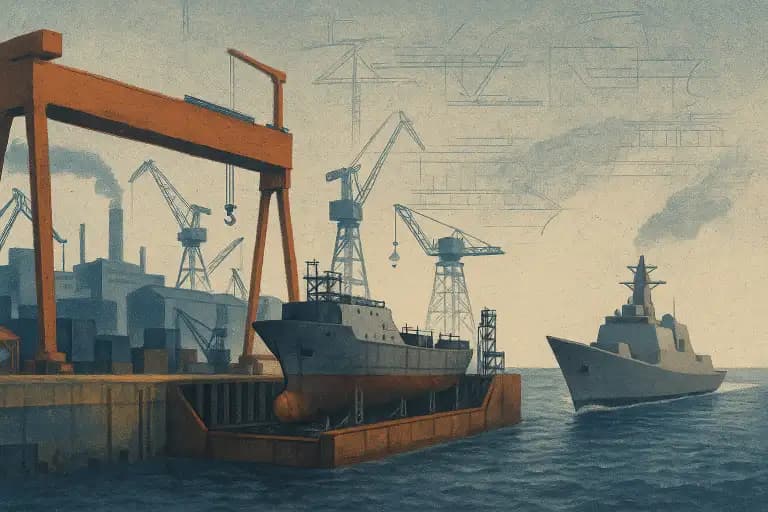
Mid-July, the U.S.–South Korea trade talks were unraveling. Washington had signaled sweeping tariff hikes—up to 25 percent—on Korean industrial exports by August. In Seoul, urgency turned tactical. Officials knew a defensive posture wouldn’t suffice. They needed something transformative.
What they proposed was not a tariff workaround, nor a quota deal. It was capital—$150 billion of it. And it came with a target: American shipbuilding.
The initiative, now termed MASGA, offered a reset. Not on goods, but on production itself. Korea would invest directly in U.S. maritime infrastructure, rebuild shipyards, and back the Navy’s faltering supply base. It was a departure from trade diplomacy as usual. It was also an entry into something else: alliance-driven reindustrialization.
What followed was swift. Hanwha took control of Philly Shipyard. HD Hyundai partnered with the Pentagon’s biggest naval contractor. Korean financing swept in behind blueprints and drydock upgrades.
This was no ordinary concession. The United States has long since abandoned commercial shipbuilding as a strategic priority. Naval yards are overloaded. Auxiliary vessels are aging. And China, with industrial statecraft at full throttle, now launches more hulls in a year than the U.S. does in five.
Washington needed capacity. Seoul offered scale. In return, Korea sought access—relief on duties, and a durable foothold in a market long shielded by legal walls. The deal was accepted. But behind it lie harder questions:
Can allied capital rebuild an industrial base left behind? Can foreign firms navigate laws designed to exclude them? And can American politics absorb foreign power—even allied—in its most strategic infrastructure?
The answers are still unfolding. But the terms have shifted. Shipbuilding is no longer just a trade issue. It’s a test of how alliances adapt when commerce, defense, and sovereignty converge.
The Mechanics of MASGA
The offer that turned the tide was not framed as relief. It came as a plan. Rather than ask for tariff leniency, Seoul offered to rebuild something Washington no longer believed could be restored. The figure—$150 billion—was less a price tag than a signal of seriousness. Not just a gesture, but an industrial proposition, aimed at reviving an entire sector that had long drifted into strategic irrelevance.
What Seoul put forward was a structured deployment of capital, routed through multiple channels. It would begin with investment in physical plant—yards, cranes, weld lines—followed by equipment modernization, and backed further by soft loans and credit instruments from Korean financial institutions. Officials in Seoul described it as a “tiered injection,” calibrated to match both commercial feasibility and political palatability. In Washington, aides took to calling it a form of reindustrialization by alliance.
At the center of the initiative stands a logic: that capacity, not policy, defines credibility in the Pacific. To that end, Korea’s leading shipbuilders—Hanwha, HD Hyundai, and Samsung Heavy—were positioned not simply as exporters, but as infrastructure actors within U.S. territory. Their role was not to compete with American yards, but to activate them.
Hanwha's acquisition of Philly Shipyard was not incidental. The yard is one of few in the United States that meets the Jones Act's strict criteria, and for years had limped along with niche orders and limited scope. Under Korean control, the facility is being retooled for deeper integration with both commercial and naval output. In parallel, HD Hyundai entered into cooperative arrangements with Huntington Ingalls, the Navy’s primary contractor. The language—modular coordination, shared design—was careful, but the intent was unmistakable: to build more vessels, faster, without breaching legal or political thresholds.
Even deeper moves are underway. Hanwha is seeking to increase its stake in Austal USA, a Gulf Coast yard with Navy contracts. That bid is under review by CFIUS, though early signals suggest alignment. As with other Korean acquisitions this year, the structure adheres to U.S. security expectations. Entities remain domestically incorporated. Management retains U.S. citizenship. Sensitive data flows are firewalled. The ships may follow Korean lines, but they will be cut and welded on U.S. soil.
For the Biden administration, the offer solved more than a trade standoff. It provided a way to reestablish control over naval production timelines without invoking new subsidy battles in Congress. U.S. yards had for years fallen behind—on capability, on delivery, on volume. Commercial demand for Jones Act-compliant ships had atrophied, and attempts to jumpstart the sector through domestic investment had stalled under political inertia. MASGA arrived as a workaround, but also as a model.
Still, the arrangement is delicate. The politics of foreign ownership remain fraught, particularly in sectors tied to national security. Union scrutiny is high. Congressional hearings on procurement have already flagged concerns over strategic autonomy. Yet the alternative—deeper industrial stagnation—was not one the White House was prepared to accept. Reframing access not as a concession, but as a contribution to allied readiness, allowed the administration to reposition the narrative.
The wager, ultimately, is structural. That Korean capital, operating under U.S. law and within U.S. constraints, can produce results that domestic capital would not. That speed, not sentiment, will define the next phase of American shipbuilding. And that when strategic capacity is lacking, partnership can function not as dependence—but as leverage.
Naval Frontline
The strain within the U.S. Navy is no longer a quiet concern. Deployment cycles are stretched. Carrier groups are rotating late. And the support fleet—those auxiliary ships that move fuel, ammunition, parts—grows older and less reliable by the year. Domestic shipyards, long undercapitalized and understaffed, cannot keep pace with the demands of modernization. The Navy’s stated target of reaching 355 ships by 2040 is no longer viewed as a plan. It is a hypothetical.
Korean shipbuilders were among the first to respond to that gap, not through rhetoric but through execution. In early 2024, the U.S. Navy awarded Hanwha Ocean a contract to refit the USNS Wally Schirra, a 40,000-ton dry cargo vessel assigned to Pacific duty. The decision followed a quiet certification process, in which Hanwha’s Geoje yard was cleared as compliant with U.S. military quality and security protocols. Two additional ships followed—the USNS Yukon and the Charles Drew. All three were completed ahead of schedule and below budget. For the first time, the U.S. military had sent maintenance work offshore to an allied yard. It had also, by most accounts, gotten what it paid for.
That success did not remain offshore. It was followed by a strategic pivot back to the U.S. mainland. Hanwha’s operations at Philly Shipyard began preparing bids for newbuild contracts, ranging from fleet support vessels to survey ships and potentially expeditionary transports. Pentagon officials have not formally defined the scope of work under consideration. But shipyard visits, procurement drafts, and internal timelines point toward a growing interest in alternatives. Not in ideology—but in capacity.
Parallel movements have followed. In April, HD Hyundai entered into a cooperative framework with Huntington Ingalls Industries, the Navy’s largest contractor. The language was careful, bordering on euphemistic—“modular collaboration,” “design support,” “capacity extension”—but the logic was clear. American yards alone cannot deliver to spec, to scale, and on time. The Navy is no longer waiting for capability to emerge organically. It is signaling, cautiously but clearly, that allied industrial participation is now on the table.
Within Congress, the implications are not universally embraced. Hearings on maritime readiness have begun shifting focus from budgets to production sources. Some lawmakers question the reliance on non-U.S. yards, even those run by treaty allies. Others frame the debate differently, asking whether excluding capable partners leaves the Navy vulnerable to failure-by-delay.
In official channels, defense leadership speaks in measured terms. But within operational commands, the tone has sharpened. At a naval symposium in Norfolk, one senior procurement officer put the matter plainly: “If we had three more yards that could deliver to spec, we wouldn’t be talking about this. But we don’t.”
What MASGA has created, in effect, is not a substitute for American yards, but a supplement—one that operates under U.S. law, employs U.S. labor, and builds to U.S. standards, while drawing on Korean industrial depth. It offers not just hulls, but a shift in tempo: from bottleneck to throughput.
Korean firms are not yet bidding on combatants. The Navy has not asked, and the Koreans have not proposed. But the line between support and combat production is thinner than it appears. Sealift platforms, cable tenders, survey hulls—these are the vessels that carry the fleet's sustainment and intelligence capacity. And in a conflict theater, their absence becomes vulnerability.
What is emerging is not just a logistics arrangement, but a new geometry of readiness. One in which alliance is measured not only in shared values or joint exercises, but in the steel that leaves the drydock—on time, on spec, and in service of something larger than commerce.
Legal Walls
For all its industrial ambition, MASGA moves within the rigid constraints of American law. The funding may cross borders, but the steel, the labor, and the ship itself cannot—at least not freely. Every piece of the project must thread through statutes designed not for efficiency, but for exclusion.
The Buy American Act, in effect since 1933, is not a suggestion. It is a mandate—one that has only grown stricter over time. For federal procurement, especially in defense, the law requires that a growing percentage of materials and components be domestically produced. The standard, once flexible, is now hardening. By 2026, ships must meet a 65 percent U.S.-content requirement. By 2033, that threshold rises to 100 percent. The intention is not subtle: to force industrial self-reliance, even when capacity lags.
Then there is the Jones Act, which predates it. Passed in 1920, its restrictions are even tighter. For any vessel moving goods between U.S. ports, the law requires that the ship be U.S.-built, U.S.-flagged, and U.S.-crewed. These conditions are not negotiable, and they are not symbolic. They form the spine of American maritime policy. And in political terms, they are sacrosanct.
Korean officials understood this from the outset. MASGA was structured not to challenge those laws, but to operate inside their lines. Hanwha’s acquisition of Philly Shipyard was a calculated move. The yard already met Jones Act criteria. Its output—though modest—qualified as American-built. Under Korean ownership, the legal identity remains unchanged. Vessels produced there will fly U.S. flags, employ U.S. workers, and, to the extent required, use U.S. steel.
But within that compliance lies complexity. Korean shipyards, particularly those with export-scale efficiency, rely on global supply chains. Engine modules, integrated control systems, propulsion shafts—these are sourced from networks that do not end at American borders. Under current law, their inclusion would violate Buy American thresholds unless special waivers are obtained. Such waivers are allowed, but only under strict conditions. The benchmark is cost: if the domestic equivalent is more than 25 percent more expensive, an exemption may apply. MASGA's engineering teams are now reworking specifications to fit those narrow gates.
Overlaying this is CFIUS—the Committee on Foreign Investment in the United States. It is not a court, but its powers are near-sovereign. Any acquisition or partnership that touches national security is within its reach. Shipyards, defense manufacturers, propulsion firms—they all qualify. Hanwha’s proposed expansion of its stake in Austal USA is under CFIUS review. So is its planned joint venture with a New Orleans-based propulsion company. Other approvals have already been granted this year, though with strict conditions: American managerial control, domestic data handling, firewalls around sensitive technologies.
The structure is legal. But it is not invisible. Critics point to precedent: Philly Shipyard, once under Norwegian control, operated without controversy for years. Yet Korea is not Norway. Its shipbuilders are state-backed, commercially aggressive, and globally dominant. The political optics are different. What was once benign foreign participation now reads—at least to some lawmakers—as strategic encroachment.
Still, no part of MASGA has been blocked. So far, the line has held: foreign ownership under American law, foreign capital under American command. Each contract signed under this framework becomes a test—not only of legality, but of political tolerance.
Because in American shipbuilding, legality is not always enough. The steel may comply. The jobs may remain. But the perception of control—of who owns, who decides, who builds—can redraw the line between partnership and resistance. And in this case, that line is written in statute.
The Politics of Steel
When the MASGA framework was announced, the administration presented it as a breakthrough in industrial diplomacy—a solution to bottlenecks, a gesture of alliance, a path to maritime revival without the need for new legislation. But on Capitol Hill, the reception was less uniform. While some lawmakers praised the deal as a lifeline for dormant shipyards, others saw something else entirely: a workaround. A cleverly constructed, foreign-funded method of skirting the deeper obligations of domestic reindustrialization.
Nowhere was that tension more apparent than in the treatment of steel. As the terms of MASGA came into public view, so too did its omissions. While the agreement loosened tariffs on Korean electronics, vehicles, and semiconductors, the steel clause—Section 232, enacted under the Trump administration—remained untouched. The rate, already elevated to 25 percent, had been raised to 50 percent just weeks before negotiations concluded. It stayed there. No exemptions, no quotas, no phase-outs.
To many in Seoul, the message was unmistakable: capital was welcome, but core inputs were not. Korean firms could buy American yards, hire American welders, modernize American docks—but if they wanted to use Korean plate steel, they would pay for the privilege. It was not protectionism concealed behind procedure. It was protectionism written plainly into law.
That structure has left MASGA ideologically divided. In its legal form, the initiative complies with U.S. procurement codes. In its political form, it flirts with contradiction. Korean companies are positioned as partners, but denied access to the very materials that give them global efficiency. Trade officials describe this as balance; critics describe it as double bind.
Union groups, for their part, are not neutral. Many welcomed Korean investment, particularly in regions where shipbuilding jobs have vanished. But they remain firmly opposed to any softening of domestic content rules. Their concern is straightforward: if foreign steel enters under the same framework that delivers foreign capital, the line separating alliance from outsourcing begins to blur.
Lawmakers, too, have begun to draw their own distinctions. Some support MASGA in principle, but now demand stricter clarity around sourcing language. Others call for exemptions—limited, conditional, but symbolic—that would allow allied material in strategic projects. Neither camp has prevailed. For now, the tariff wall holds. And every bolt, sheet, and weld not made on American ground is counted against MASGA’s political credit.
Externally, the pressure is growing. China continues to launch more naval hulls in three years than the United States builds in a decade. The production imbalance is no longer an abstract concern—it is embedded in Pentagon threat assessments and maritime strategy memos. If shipyard capacity is now a metric of military readiness, then exclusion of allied steel becomes more than economic friction. It becomes risk.
South Korean officials have begun shifting their own rhetoric. What once was framed as export competitiveness is now cast in terms of industrial security. MASGA is presented in Seoul not as a trade concession, but as a coordinated maritime posture. Yet the asymmetry remains. Capital flows freely. Material does not.
What this has produced is a deal suspended between legality and ideology. The framework holds. But it holds unevenly. Korean investment fills the gaps in American shipyard infrastructure, while Korean steel remains behind a tariff barrier twice the global average. The ship may be American-built. But the inputs, the decisions, the dependencies—they are now the terrain of contested policy.
In that tension lies the test. Whether MASGA can survive not only in courts and contracts, but in committee hearings, labor coalitions, and election cycles. Whether an alliance can function when one side funds the fix and the other guards the gate.
For now, the welders are working. The steel, however, waits.
What Comes Next
The signatures are dry. The capital is earmarked. Shipyards are under evaluation. Designs are passing through compliance filters. But the ships—those visible measures of industrial ambition—have yet to be ordered.
At Philly Shipyard, Hanwha’s newly held asset is preparing for scale. The yard is capable of building mid-sized hulls—training ships, tankers, auxiliary support vessels—but capacity alone doesn’t guarantee contracts. The Navy’s long-stated goal of reaching a 355-ship fleet remains in planning documents, yet its budget tells another story. Appropriations trail ambition. Legislators disagree on priorities. Commercial carriers, bound by Jones Act constraints and squeezed by freight volatility, remain hesitant to place orders. The equation does not yet balance.
South Korea understands this. The $150 billion figure announced under MASGA is not a lump sum. It is a ceiling—conditional, graduated, and mobilized only as projects move from proposal to procurement. State-backed credit is contingent on throughput. Loan guarantees depend on vessel orders. And every dollar of capital is subject not only to financial review but to political weather.
The risks are not hidden. A change in administration could alter procurement policy. A shift in congressional makeup might revive protectionist pressures. Tax incentives built into infrastructure alignment could expire. CFIUS approvals, once routine, could harden. And with each policy change, the space for allied capital inside U.S. defense-adjacent industry narrows.
Even now, the model survives less by legal certainty than by political will. MASGA exists because two governments, facing a breakdown in trade talks, chose structural investment over tariff escalation. It thrives only so long as that consensus holds. For some, that makes it fragile. For others, it makes it responsive. In either case, the structure will be tested with every new contract.
Internationally, the eyes are not just on the ships. Japan is assessing co-financed shipyard models of its own. Australia has begun exploring foreign joint ventures in undersea infrastructure. NATO allies are discussing pooled maritime procurement for auxiliary fleets. What MASGA represents to them is less a one-off and more a signal—that industrial capacity, once viewed as domestic terrain, may now be shared among allies when the strategic calculus demands it.
Still, there are limits. The steel clause remains in place. The Buy American thresholds continue to rise. The Jones Act remains inviolate. And the future of shipbuilding in the United States will depend not just on what Korean firms are willing to build—but on what American politics is willing to absorb.
The welders in Philadelphia are preparing. The drydocks are measured, surveyed, and slowly coming back online. But the hulls do not yet exist. They remain in renderings, in spreadsheets, in procurement forecasts.
What MASGA has created is not yet a fleet. It is a mechanism—a way of asking whether an ally’s capital can be trusted with another’s critical infrastructure. The next five years will define whether that answer lies in contracts or caution.
For now, the promise holds. It holds in steel, in trust, and in the unfinished shape of what comes next.
The Weekly Breeze
Keep pace with Busan's deep narratives.
Delivered every Monday morning.