Gadeokdo New Airport: The 84-Month Gamble Between Politics and the Seabed
Building a giant airport on the sea—politics may be a bigger challenge than the engineering. At the crossroads of past failures and successes, Gadeokdo’s fate is taking shape.


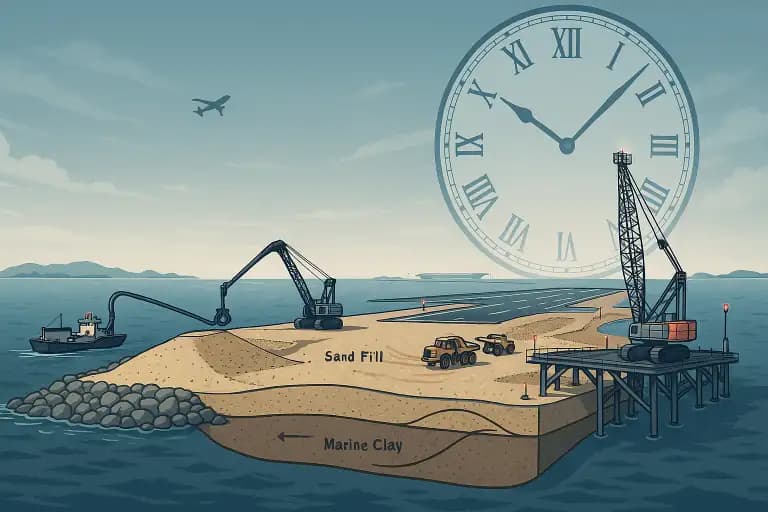
Gadeokdo New Airport, South Korea’s flagship regional infrastructure project, is entering a decisive and contentious phase. Conceived as a long-awaited solution to the air transport bottlenecks of the Busan–Gyeongnam region, the project carries both political urgency and complex engineering demands. The government has committed to an 84-month construction period to meet its promised opening in December 2029.
Yet the withdrawal of Hyundai Engineering & Construction — the former lead contractor — and POSCO E&C has thrown the project’s schedule and delivery model into question. Hyundai’s insistence on a 108-month timeline, citing the need for extended ground improvement on ultra-soft marine clay, collided directly with the Ministry of Land, Infrastructure and Transport’s fixed-term requirements. This clash highlights a deeper tension: the political calendar versus the ground’s physical timetable.
Experience from offshore airports in Hong Kong, Japan, and Korea suggests that shortening preloading and consolidation periods to fit an aggressive schedule can have costly long-term consequences — from accelerated settlement and runway deformation to chronic maintenance burdens. New consolidation simulations, using parameter ranges consistent with Gadeokdo’s expected subsoil conditions, indicate that achieving industry-standard consolidation levels within 84 months is statistically unlikely even with advanced vertical drain methods.
As the government prepares for a re-bid and considers possible changes to procurement strategy, the central question is no longer simply whether the airport can be built in 84 months, but whether it should be — and what trade-offs such a schedule entails for safety, cost, and long-term operational stability.
From Consortium Shake-Ups to Design Changes
The political will behind Gadeokdo New Airport has been unwavering. In 2023, the National Assembly passed a special law and the Ministry of Land, Infrastructure and Transport (MOLIT) unveiled a roadmap committing to the airport’s opening in December 2029. This deadline was not just an infrastructure target — it was a political promise, reiterated by the President himself as a matter of national credibility. The project’s procurement framework followed suit, with tender conditions explicitly fixed to an 84-month construction period.
Initially, the main civil works were to be delivered through a turnkey consortium led by Hyundai Engineering & Construction. This group also included POSCO E&C, Daewoo E&C, and a roster of mid-tier contractors and local firms. Hyundai, however, would soon become the focal point of a dispute that exposed the fault lines between political ambition and geotechnical reality.
During the basic design stage, Hyundai proposed a revised schedule of 108 months — an extension of two full years — citing the need for 17 months of additional ground improvement for ultra-soft marine clay stabilization, plus 7 months for breakwater construction ahead of reclamation. MOLIT rejected the extension, insisting that the contractor adapt the design to the original 84-month limit. When Hyundai refused, the legal framework governing single-source (negotiated) contracts left MOLIT with no option but to cancel the process entirely.
The fallout was swift. POSCO E&C, holding a 13.5 percent stake and initially expected to absorb part of Hyundai’s share, announced its withdrawal as well, citing a corporate policy shift away from new infrastructure projects. This left Daewoo E&C — with an 18 percent share — as the de facto anchor, and MOLIT scrambling to reconfigure the consortium.
A shortlist of potential replacements emerged: Lotte E&C, Hanwha Construction Division, HJ Heavy Industries, and others signaled interest, but none committed outright. Industry sources suggested that participation would hinge on relaxing the bid conditions — either by extending the schedule, adjusting cost parameters, or both. In parallel, MOLIT floated the possibility of segmenting the works into multiple tenders if a single turnkey arrangement proved unviable.
The design itself had already been altered once. Originally conceived as a full offshore reclamation platform, the layout was revised to a hybrid island–offshore configuration in order to avoid the deepest waters and thickest soft clay deposits. Officials framed the change as a strategic measure to shorten the construction timeline. Critics, however, noted that while the new footprint reduces certain geotechnical challenges, it introduces new interface risks where land and marine works meet — zones historically prone to differential settlement.
With re-bidding expected as early as late August, the project stands at a crossroads: maintain the aggressive schedule and risk further contractor attrition, or recalibrate timelines to align with the physical behavior of the seabed beneath Gadeokdo.
When Soil Physics Meets the Political Calendar
Beneath the waters off Gadeokdo lies the project’s most intractable adversary: ultra-soft marine clay. Borehole and geological surveys conducted in the surrounding Busan–Gyeongnam coastal zones indicate clay layers ranging from 10 to over 40 meters thick, with low permeability and a coefficient of consolidation (cv) typically between 2×10⁻⁸ and 1×10⁻⁷ m²/s. In engineering terms, this means the soil releases water and gains strength slowly — sometimes over decades.
For major offshore platforms, the industry standard is to preload the reclaimed ground — building up sand fill in excess of the final design height — and then wait. This preloading and waiting period allows pore water to escape, settlements to occur, and the ground to stabilize before permanent pavements and structures are placed. The benchmark consolidation targets, expressed as average degree of consolidation (U), are usually 90–95 percent for runways and taxiways, since any residual settlement can translate into bumps, slopes, and surface cracking under aircraft loads.
The problem with Gadeokdo’s 84-month schedule is that it compresses this slow, natural process. Our Monte Carlo simulation, using realistic ranges for layer thickness, cv, and vertical drain acceleration factors, found that even with advanced prefabricated vertical drains (PVD), the probability of achieving U≥0.95 within 84 months is only about 15 percent. Extending to 108 months raises that probability to 24 percent — still far from certain. Without PVD, the probability in either timeframe is effectively zero.
These findings align with Hyundai E&C’s assertion that an additional 17 months were required for adequate ground improvement, plus 7 months for pre-reclamation breakwater works. Reducing or eliminating this buffer period shifts the risk downstream: settlement will continue after the airport opens, forcing costly re-leveling and resurfacing operations and potentially causing operational disruptions.
The risks are not hypothetical. Japan’s Kansai International Airport — also built on soft marine clay — experienced settlement far faster than predicted, reaching nearly 8 meters within six years against a 50-year forecast of 11 meters. This required repeated structural adjustments and has left the airport with a permanent maintenance burden.
Even the design change to a hybrid island–offshore configuration, intended to sidestep the deepest and weakest zones, cannot eliminate the issue. Such layouts introduce transition interfaces where differential settlement between reclaimed and natural ground can be severe. Mitigating these effects demands additional design detailing and construction sequencing — and, critically, time.
In short, the seabed beneath Gadeokdo will not adjust to the political calendar. The preloading process, the consolidation of ultra-soft clay, and the physics of pore water dissipation operate on their own schedule. Any attempt to force them into an 84-month window is a calculated gamble — one whose odds, as the data shows, are not in the project’s favor.
Hong Kong, Kansai, and Incheon
When Hong Kong embarked on its Third Runway System at Chek Lap Kok, the engineers faced a familiar trinity of challenges: soft marine clay, strict environmental regulations, and the political imperative to deliver. Rather than lock the project into a single fixed schedule, the Airport Authority approached it as a dynamic problem. The site was divided into zones, each with distinct geotechnical and ecological constraints, and multiple ground improvement methods — from prefabricated vertical drains and sand drains to vacuum consolidation, sand compaction piles, and deep cement mixing — were tested in controlled pilot areas.
Environmental restrictions, such as work slowdowns during the breeding season of the endangered Chinese white dolphin, were built into the planning from the outset. Simulations modeled productivity at full, half, and quarter capacity, generating a matrix of cost, time, and risk scenarios. This transparent, data-rich approach allowed stakeholders to make deliberate trade-offs between speed, budget, and long-term stability, rather than letting a single deadline dictate all choices.
Japan’s Kansai International Airport offers a sharply different narrative. Completed in 1994 as the world’s first fully offshore airport, it was laid atop a deep, highly compressible alluvial clay deposit — not unlike sections of the Gadeokdo site. Even after years of preloading and extensive vertical drain installation, the settlement forecasts proved too conservative.
Ground that was expected to sink by eleven meters over fifty years subsided almost that much in only six. The airport remained operational, but only through constant re-leveling of pavements, adjustments to buried utilities, and a maintenance regime that continues to drain resources three decades on. Kansai stands as a reminder that in soft-ground reclamation, the limits of geotechnical prediction can become painfully visible once the facility is in service.
South Korea’s own Incheon International Airport, by contrast, avoided many of these pitfalls during its first phase by insisting on empirical verification before full-scale works. Trial sections of sand compaction piles, sand drains, and PVD were instrumented and monitored to capture actual consolidation rates under local conditions.
The data shaped a zone-specific improvement plan, deploying methods where they performed best rather than uniformly across the site. In some areas, 95% consolidation was achieved within six months of preloading — a pace made possible by favorable soil permeability and moderate clay thickness, but only because the design had been grounded in real measurements, not textbook assumptions.
Together, these three cases form a spectrum of outcomes for airports built on soft marine clay. Hong Kong shows the power of flexibility, adaptive method selection, and risk transparency. Kansai warns of the cost of optimism untempered by variability. Incheon demonstrates the value of pilot testing and design adaptation even under the banner of a national prestige project. Gadeokdo, with its mix of political urgency and challenging subsoil, stands closer to Kansai in risk profile — but still has the chance to follow Hong Kong’s and Incheon’s lead.
Doing so would mean relaxing the rigid 84-month completion target or embedding realistic productivity and environmental scenarios into the plan from day one, acknowledging that in offshore reclamation, the seabed’s timetable must be treated as a primary design constraint, not an afterthought.
Modeling the Seabed’s Patience
When we modeled Gadeokdo’s seabed using realistic geotechnical ranges drawn from coastal surveys and marine clay literature, the numbers told a story that felt uncomfortably close to Kansai’s early warning signs. We assumed clay layers between ten and forty-five meters thick, with consolidation coefficients typical of ultra-soft marine deposits. Even under optimistic drainage conditions, pore water moves slowly through such soils, and strength gain follows the physics of consolidation, not the pace of a political calendar.
To see how the government’s 84-month schedule stacked up against these constraints, we ran a Monte Carlo simulation, varying layer thickness, consolidation coefficient, and the efficiency of prefabricated vertical drains (PVD) — the very tools meant to speed up the process. Each trial calculated how long it would take for the reclaimed platform to reach industry-standard consolidation targets: ninety and ninety-five percent, levels widely considered the threshold for laying permanent runways without inviting uneven settlement.
The results were sobering. With PVD in place, only about one in six scenarios reached ninety-five percent consolidation within the 84-month window. Even stretching the timeframe to 108 months — Hyundai E&C’s proposed schedule — raised the odds only to roughly one in four. Without PVD, neither the shorter nor the longer schedule achieved meaningful probabilities of success; in most cases, the clay would still be consolidating long after the airport was open for business.
In practice, this means that an 84-month build, even under favorable assumptions, carries a strong likelihood of leaving significant residual settlement in the ground. That settlement does not politely wait for off-peak seasons; it continues silently, bending pavements, shifting drainage lines, and demanding resurfacing that interrupts operations. It is the kind of hidden cost Kansai has paid for decades — a maintenance debt built into the very foundation.
Hyundai’s insistence on an additional 24 months, including seventeen months of extra ground improvement and a seven-month head start on breakwater construction, now reads less like a negotiating position and more like a risk calculation. The simulation suggests they were not far off: adding time improves the odds, but only marginally, unless coupled with aggressive and zone-specific improvement methods and a willingness to adapt the schedule as monitoring data comes in.
This is the central tension: the seabed beneath Gadeokdo can be modeled, instrumented, and improved, but it cannot be bullied into compressing decades of settlement into seven years without consequence. Our analysis does not argue the airport cannot be built in 84 months; it argues that doing so would be a gamble, one where the house edge is set by nature, not by the Ministry’s tender documents.
The Four Fronts of Vulnerability
The timeline pressure facing Gadeokdo New Airport is not simply the product of an ambitious political promise; it is the outcome of structural forces that interact in ways that magnify risk. At the core lies the geotechnical reality of building on ultra-soft marine clay. Such soils are uneven, often more compressible in one location than in another just a few dozen meters away. This variability makes settlement predictions inherently uncertain, even before construction begins. Where one section may achieve adequate strength in a few years, another may lag far behind, undermining uniformity across a runway surface designed to millimeter tolerances.
Layered over this are the environmental constraints of the site. The waters around Gadeokdo are subject to strong currents, seasonal typhoons, and the seismic activity that ripples through the broader Korean peninsula. They are also home to sensitive marine habitats — including finless porpoises and seagrass beds — that can restrict when and how certain construction methods are deployed. Each delay imposed by weather or environmental regulation compresses the working calendar further, forcing contractors to either accelerate elsewhere or accept slippage. In an 84-month schedule, there is little slack to absorb such disruptions.
The procurement model compounds the difficulty. The insistence on a single turnkey contract with a fixed completion date transfers much of the risk to the contractors. In theory, this aligns incentives for efficiency. In practice, it discourages participation when the technical uncertainty is high, as evidenced by Hyundai E&C’s and POSCO E&C’s withdrawals. Contractors know that unforeseen settlement, cost overruns, and safety liabilities — now intensified under South Korea’s stricter workplace safety laws — can quickly erode margins and reputations. This is why some potential entrants have signaled interest only if the bid terms are relaxed.
Even if the airport is delivered on time, the operational dimension of risk remains. Residual settlement means ongoing re-leveling of pavements, interruptions to runway availability, and the possibility of structural distortion in critical facilities. These issues are not just technical headaches; they have economic and reputational costs that extend across the airport’s lifespan. Airlines measure reliability in on-time departures and landings; a runway out of service for repairs during peak season can ripple through schedules across the network.
In short, the tight schedule is not an isolated challenge but a multiplier of vulnerabilities across geotechnical, environmental, contractual, and operational domains. Compressing the build to 84 months demands that each of these variables behaves exactly as hoped. History — in Kansai, in Hong Kong, even in parts of Incheon — suggests that is an optimistic assumption.
Shaping a Smarter Timeline
The Gadeokdo project is at a point where engineering evidence and political commitments must be reconciled. That reconciliation will not come from a simple extension or contraction of the schedule, but from reshaping how the schedule itself is set, monitored, and adapted over time. The government’s 84-month target was conceived as a symbol of urgency, a visible sign to the region that the long-promised airport would finally materialize. But in infrastructure of this scale, symbols cannot override soil mechanics.
A first step is to acknowledge uncertainty as a design parameter, not a flaw. Projects like Hong Kong’s Third Runway System built contingency into their schedules by modeling multiple productivity scenarios and by preparing alternative ground improvement combinations for different zones. Gadeokdo could adopt a similar approach, allowing the schedule to flex in response to real-time settlement monitoring. Such flexibility does not mean abandoning the target date; it means defining it as a range — perhaps 96 to 108 months — with clear technical milestones for consolidation and structural stability.
Procurement reform would also help. A segmented or staged contracting approach, with the government retaining a stronger program management role, could spread risk more evenly and make participation attractive to major contractors. Under this model, marine works, reclamation, and superstructure could be bid separately, allowing specialized firms to contribute without taking on the full geotechnical risk.
From an engineering standpoint, early and extensive site-specific trials should be non-negotiable. Pilot sections can verify actual consolidation rates, allowing adjustments before full-scale fill placement. This was a decisive factor in Incheon’s success and would give Gadeokdo a grounded basis for selecting between PVD, SCP, vacuum consolidation, or deep mixing in each zone.
Finally, the conversation should expand beyond the opening day. Long-term performance criteria — limits on residual settlement, allowable surface gradients, maintenance frequency — should be written into the project’s key performance indicators alongside the completion date. If the schedule must be tightened, these criteria will at least ensure that shortcuts do not compromise the airport’s service life and safety.
The trade-off is clear: more time now for ground improvement reduces the likelihood of chronic maintenance later. The choice before policymakers is whether to deliver the ribbon-cutting on time but inherit decades of remedial work, or to align ambition with the ground’s timetable and build a facility that will perform reliably for generations.
The Calendar vs. the Clay
Gadeokdo New Airport has always been more than a construction project. It is a political commitment to the southeast, a signal of economic intent, and, for many in Busan and Gyeongnam, a long-delayed promise finally within reach. But beneath the speeches and ceremonial dates lies a stretch of seabed whose properties are indifferent to political urgency. Ultra-soft marine clay will consolidate in its own time, responding only to the laws of physics and the methods applied to it.
The government’s 84-month schedule is not impossible, but it is improbable without assuming that every variable — from weather to marine ecology, from contractor performance to soil permeability — behaves exactly as hoped. Our simulations, grounded in realistic geotechnical parameters, suggest that even with advanced vertical drains, the probability of meeting full consolidation targets within this window is low. The experience of Kansai warns that optimism at this stage can translate into decades of operational compromise.
The question, then, is not whether the airport can be opened in December 2029, but whether opening it then is worth the risk of inheriting a permanent maintenance burden. The trade-off is stark: a slightly longer build for a more stable and reliable asset, or a politically timely delivery at the cost of performance, safety, and long-term expense.
The choice belongs to policymakers, but the consequences will be shared by operators, airlines, passengers, and taxpayers alike. In infrastructure, as in engineering, the most durable achievements come when ambition is matched to reality. For Gadeokdo, that means listening not just to the demands of the calendar, but to the quiet, measured timetable of the clay beneath it.
The Weekly Breeze
Keep pace with Busan's deep narratives.
Delivered every Monday morning.