South Korea, U.S. Agree on 15% Tariffs and $350B Investment Deal
South Korea and the United States have introduced a 15% reciprocal tariff regime, replacing a planned 25% duty on Korean goods.

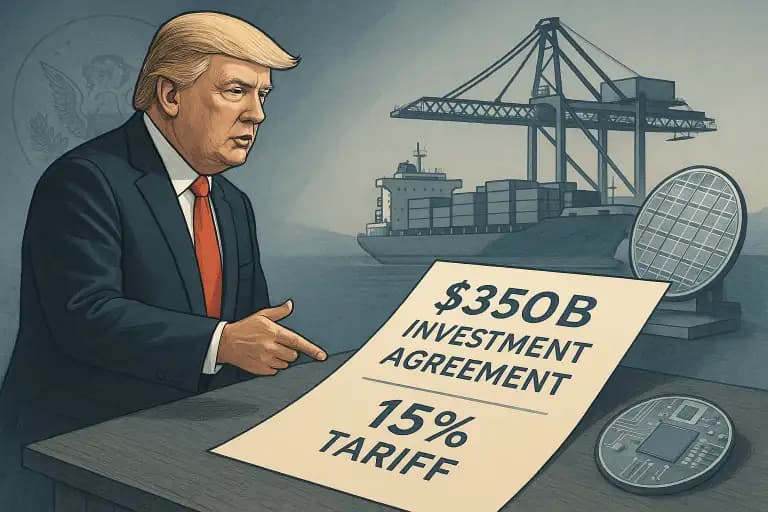
On July 31, 2025, the Republic of Korea and the United States reached a bilateral arrangement to replace a scheduled 25 percent U.S. tariff on Korean exports with a reciprocal 15 percent rate applied by both governments. The agreement includes a South Korean investment commitment of $350 billion, directed toward sectors identified by both sides as strategically significant.
This development constitutes a departure from the preferential tariff framework previously upheld under the Korea–U.S. Free Trade Agreement. The new structure imposes formal duties on a wide range of goods that had circulated without tariffs since 2012, including passenger vehicles, industrial machinery, and advanced components. No revisions to the underlying FTA have been announced; however, the implementation of uniform tariffs effectively suspends its central trade benefit.
The investment component is structured around a series of proposed funds. As of the agreement date, neither the legal framework nor the financial governance mechanisms of those funds have been disclosed. Korean authorities have stated that operational terms will be negotiated in subsequent phases. Statements from U.S. officials have emphasized capital inflow figures, while refraining from comment on profit allocation or project-level ownership.
The arrangement was concluded in the context of a broader U.S. effort to restructure major trade relationships through unilateral tariff actions and investment-linked concessions. For Korea, the agreement averted immediate trade disruption and postponed the entry into force of higher duties. The scope and enforceability of the agreement remain subject to future clarification.
Tariffs Imposed, Investment Promised
The bilateral understanding announced on July 31, 2025, introduces a new tariff structure and outlines a planned investment initiative. Both elements were presented during a joint briefing without the release of an accompanying legal text. The arrangement is described as being in effect but subject to further administrative coordination.
Under the terms disclosed, South Korea and the United States will each apply a 15 percent tariff on designated categories of goods. The tariff measure replaces a 25 percent rate previously scheduled for implementation by the U.S. government on August 1. Goods affected include automobiles, electronics, machinery, and certain intermediate components. No full schedule of tariff lines has been published.
The tariff applies to Korean exports to the United States that had been covered by zero-duty provisions under the Korea–U.S. Free Trade Agreement. These include passenger vehicles, which now fall under the 15 percent rate. U.S. exports to South Korea will receive the same treatment under the agreement’s reciprocal structure.
The investment component consists of a stated commitment by the South Korean side to mobilize $350 billion in funding toward industrial projects located in the United States. According to government briefings, $150 billion is earmarked for shipbuilding-related initiatives. The remaining $200 billion is intended for use in semiconductor fabrication, nuclear energy development, biotechnology, and battery manufacturing.
Details concerning the form of investment, fund governance, disbursement mechanisms, and legal entities involved have not been made public. South Korean officials stated that these matters are under review and will be addressed in forthcoming bilateral consultations. No reference has been made to sovereign guarantees, private sector contributions, or external financing structures.
Questions regarding the distribution of investment returns remain open. Reports referencing a 90 percent allocation of returns to U.S.-based entities have not been confirmed. Neither government has issued clarification on revenue-sharing models or ownership rights within the proposed project framework.
The agreement does not include provisions for enforcement, oversight, or dispute resolution. No supplementary memorandum, annex, or treaty schedule has been published at the time of writing. A follow-up meeting between the heads of state is scheduled within two weeks of the announcement.
How the Agreement Reshapes Korean Export Sectors
The tariff adjustment and investment arrangement announced on July 31, 2025, affects multiple industrial sectors with varying levels of exposure to U.S.-bound trade and outbound capital deployment. The sectors below have been identified in official statements or confirmed through tariff classifications and investment designations.
Automotive
Passenger vehicles manufactured in South Korea and exported to the United States are no longer exempt from import duties. These goods were previously covered by the Korea–U.S. Free Trade Agreement under a zero-tariff provision. The imposition of a 15 percent tariff introduces a new cost factor for this category. The Korean automotive sector includes production platforms operated by Hyundai Motor Company and Kia Corporation, both of which have existing assembly capacity in the United States. The extent to which the new tariff affects unit prices, export volumes, or plant utilization has not been disclosed.
Shipbuilding
A portion of the announced investment commitment, totaling $150 billion, is designated for projects in the shipbuilding sector. No breakdown of the allocation across civil, commercial, or defense-related ship construction has been provided. The shipbuilding component is expected to include infrastructure upgrades, supply chain cooperation, and technology-related initiatives. Project-level participation terms for Korean shipbuilders or their subsidiaries remain unspecified.
Semiconductors
Semiconductors are included in the $200 billion segment of the investment framework. Korean firms maintain fabrication, packaging, and foundry operations globally, with some presence in the United States. The structure of future capital deployment—whether through new facilities, equity joint ventures, or government-backed research partnerships—has not been outlined. No tariff increase for semiconductors was noted in the joint announcement, although tariff lines for related equipment and components remain under review.
Nuclear Energy
Nuclear energy is listed as one of the strategic areas for bilateral investment cooperation. Korean suppliers possess reactor design capabilities and have participated in overseas plant development projects. The investment arrangement does not specify whether capital will be directed to new builds, fuel cycle operations, or regulatory cooperation. No information has been provided on the role of U.S. federal agencies or public-private consortia in project administration.
Batteries and Biotech
Battery and biotechnology sectors are grouped within the remaining portion of the investment plan. Korean firms have operating assets in the United States in both sectors, including battery manufacturing plants and research centers. No project announcements or siting decisions were made public at the time of the agreement. Regulatory conditions, funding structures, and labor market provisions applicable to these sectors have not been disclosed.
How Other U.S. Trade Partners Are Negotiating Their Terms
The bilateral framework agreed between South Korea and the United States in late July 2025 forms part of a broader U.S. initiative to restructure trade relations with key partners. Similar negotiations are either underway or recently concluded with Japan, India, and the European Union. While each case involves tariff adjustments and capital commitments, the scope and legal clarity of these arrangements vary significantly by jurisdiction.
Japan
On July 29, 2025, the U.S. and Japan announced a provisional agreement aimed at averting previously threatened tariff hikes. Under the terms reported, a 15 percent tariff will apply to selected Japanese exports, notably in the automotive and industrial sectors. This represents a reduction from the initially proposed rates of up to 27.5 percent for vehicles and 25 percent for general goods.
The Japanese government has expressed a non-binding commitment to invest approximately $550 billion in U.S. infrastructure, energy, and industrial projects. However, no formal agreement has been published, and the framework remains unratified by the Japanese Diet. Media outlets in Japan have reported that the United States may retain up to 90 percent of the profits generated from the pledged investment, though no official confirmation of the distribution terms has been issued to date.
India
Negotiations between the United States and India failed to produce a bilateral trade agreement before the August 1 implementation deadline. In the absence of a formal deal, a 25 percent tariff on Indian exports to the U.S. has taken effect. India has not announced any reciprocal tariff measures and, as of July 31, has not submitted an alternative investment-based offset proposal.
Indian officials have criticized the tariffs as inconsistent with World Trade Organization rules. Nonetheless, no formal dispute proceedings have been initiated. The U.S. Trade Representative's office has confirmed that channels for further negotiation remain open.
European Union
Talks between the United States and the European Union have led to a partial framework under which a general 15 percent tariff now applies to most EU-origin industrial goods. This replaces earlier U.S. proposals for tariffs of up to 30 percent. Temporary exemptions have been granted for certain sectors, including pharmaceuticals, aerospace components, and select automotive parts.
The European Commission has expressed willingness to consider a capital deployment mechanism aligned with similar discussions involving Asian counterparts. However, no collective investment commitment has been disclosed, and the EU has not confirmed participation in any dedicated fund structure. As foreign investment remains under the competence of individual member states, coordination delays have impeded the pace of negotiation. No ratified agreement exists as of the latest reporting.
Unanswered Questions Surround Korea’s U.S. Investment Pledge
The investment component of the July 31 arrangement outlines a financial commitment by South Korea totaling $350 billion, to be allocated across shipbuilding, semiconductors, nuclear energy, biotechnology, and batteries. As of the date of announcement, no binding documents defining the legal structure, fund management protocols, or disbursement procedures have been released by either government.
South Korean officials have confirmed that the investment will be organized into sector-specific funding mechanisms. The division includes $150 billion for shipbuilding-related programs and $200 billion across the remaining sectors. No public information has been provided regarding the classification of the funds as public, private, or mixed capital. Likewise, the extent to which funds will be administered by Korean entities, U.S. agencies, or joint boards remains unconfirmed.
Statements from the South Korean Ministry of Economy and Finance indicate that consultations are ongoing with U.S. counterparts concerning project-level identification and governance. No schedule for the finalization of operational terms has been issued. As of August 1, 2025, no agreements have been registered under South Korea’s foreign investment disclosure system or listed in the U.S. Federal Register.
Unverified media reports citing a 90 percent profit allocation to U.S. beneficiaries have not been addressed in official releases. No revenue-sharing formulas, return conditions, or capital ownership rules have been published. The possibility of U.S. public agencies acting as anchor recipients or intermediaries for project revenue has not been confirmed or denied.
No enforcement clauses, exit conditions, or review procedures have been attached to the public description of the funds. It is unclear whether the arrangement will take the form of memoranda of understanding, sovereign investment contracts, or industry-specific joint ventures. The designation of dispute resolution mechanisms, including jurisdiction and governing law, is pending.
The implementation of reciprocal tariffs between South Korea and the United States alters the external trade environment in which Korean export sectors have operated since the entry into force of the Korea–U.S. Free Trade Agreement in 2012. The replacement of a zero-duty regime with a 15 percent bilateral tariff introduces a new cost layer across multiple product categories.
Automobiles, industrial machinery, and certain consumer electronics—categories previously exempt from U.S. tariffs—are now subject to duties. In response, South Korean ministries and trade agencies have indicated a review of existing export diversification measures. No official revision to the national export strategy has been released as of August 1, 2025.
The Ministry of Trade, Industry and Energy has identified Southeast Asia, India, and selected Middle Eastern economies as target markets for expanded trade activity. Negotiations on bilateral and regional trade frameworks with ASEAN member states, the Gulf Cooperation Council, and MERCOSUR are ongoing. No new agreements have been signed in direct relation to the tariff adjustment.
Trade promotion agencies have announced additional support measures for exporters entering non-U.S. markets, including credit insurance, logistical subsidies, and market-entry consulting. Budget allocations and implementation timetables have not been disclosed. Industrial associations have submitted policy proposals focused on digital trade, logistics infrastructure, and localized production in emerging markets.
Korean exporters with manufacturing presence in North America have not received formal guidance on realignment strategies. No provisions within the July 31 agreement address value chain relocation, regional rules of origin, or subsidy eligibility under U.S. law.
The structural implication of the tariff shift remains under administrative evaluation. No legislation or executive order has been introduced to redefine Korea’s preferential trade architecture. The National Assembly has not opened deliberations on amendments to existing FTA implementation laws. Inter-ministerial review is ongoing.
The Weekly Breeze
Keep pace with Busan's deep narratives.
Delivered every Monday morning.