The Threat of SLAPP Suits: South Korea and the Need for Stronger Anti-SLAPP Legislation
Free speech and the press have long been suppressed in South Korea by the government, particularly under the country's National Security Law. However, in recent years, the role of the country's Public Prosecutor's Office in limiting free speech has become a growing concern. The Public Prosecutor's Office has been accused of using its power to target journalists, activists, and ordinary citizens who speak out against the government or powerful corporations. One tactic used by the Public Prosecuto


Free speech and the press have long been suppressed in South Korea by the government, particularly under the country's National Security Law. However, in recent years, the role of the country's Public Prosecutor's Office in limiting free speech has become a growing concern. The Public Prosecutor's Office has been accused of using its power to target journalists, activists, and ordinary citizens who speak out against the government or powerful corporations. One tactic used by the Public Prosecutor's Office and powerful corporations to silence critics is Strategic Lawsuits Against Public Participation (SLAPP).
The Growing Threat of SLAPP Suits in South Korea and Beyond
SLAPP suits are frivolous legal proceedings aimed at entangling activists, journalists, and other public figures in endless legal battles, with the goal of silencing them. SLAPP suits are often used by wealthy and powerful entities to intimidate those speaking out against them. The assumption is that if they can tie someone up in court, they will silence themselves to avoid costly litigation. SLAPP suits are becoming increasingly common in South Korea, particularly in cases related to environmental activism, consumer rights, and social injustices. Activists, journalists, and whistleblowers who report on these issues are often threatened with defamation lawsuits or even criminal charges.
Examples of SLAPP Suits Around the World
SLAPP suits are not just a problem in South Korea, but are a growing threat to free speech and activism around the world. In the United States, for example, SLAPP lawsuits are often used by corporations to silence critics and deter whistleblowers. In Europe, SLAPPs have been used to target journalists and media organizations reporting on corruption and human rights abuses. One well-known example is the case of Azerbaijani journalist Khadija Ismayilova, who was targeted with multiple SLAPP suits after investigating government corruption in her country. Ismayilova faced up to 16 years in prison on trumped-up charges, which were widely viewed as retaliation for her work as a journalist.
Another example is the case of UK-based human rights organization Global Witness, which was sued for defamation by a mining company after it reported on alleged human rights abuses in the Democratic Republic of Congo. Global Witness was forced to retract its report and issue a public apology, which many viewed as a blow to freedom of the press and the public's right to know.
The Importance of Stronger Anti-SLAPP Legislation in South Korea
Given the growing threat of SLAPP suits to free speech and activism, it is crucial that countries like South Korea strengthen their anti-SLAPP legislation. In Korea, several lawmakers have proposed an anti-SLAPP law as a partial amendment to the Civil Procedure Act, but it has not yet been enforced. This could include measures such as expanding the scope of existing anti-SLAPP laws, creating new laws to protect free speech, and ensuring that defendants have access to legal resources and protections. By taking these steps, countries can send a clear message that SLAPPs will not be tolerated, and that free speech and activism are fundamental rights that must be protected.
However, South Korea's anti-SLAPP laws are still insufficient, leaving individuals and organizations vulnerable to SLAPP suits. The current law distinguishes between collecting and using personal information and providing it to a third party, leaving it open to interpretation as to whether the media report "used" the information or "provided" it. Furthermore, there is no protection for informants who provide information to the media. In order to protect free speech and activism in South Korea, there is a need for stronger anti-SLAPP legislation. The current lack of protection leaves individuals and organizations vulnerable to SLAPP suits, with no recourse to defend themselves or recover legal costs. This not only silences dissenting voices but also hinders the ability to hold those in power accountable.
Several countries have already taken steps to combat SLAPP suits by adopting anti-SLAPP legislation. For instance, in the United States, 33 states have anti-SLAPP laws in place, while Canada, Australia, and several European countries have similar legislation. These laws provide defendants with a way to quickly dismiss SLAPP lawsuits and recover legal costs.
There have been some efforts in South Korea to address the issue of SLAPP suits. Lawmakers proposed an anti-SLAPP law as a partial amendment to the Civil Procedure Act, which would allow individuals or groups to file a counterclaim against those who initiate SLAPP suits. However, the proposed law has not yet been enforced, and there is still a need for further legislative action to protect free speech and activism.
The use of SLAPP suits to silence and intimidate critics is a growing concern in South Korea and around the world, posing a serious threat to free speech, the press, and activism. Stronger anti-SLAPP legislation is crucial to protect individuals and organizations from being silenced and to uphold the fundamental right to free speech. Without these measures in place, those in power will continue to use SLAPP suits to suppress dissenting voices and undermine democracy. Therefore, South Korea and other countries must take swift action to protect free speech and activism by enacting strong anti-SLAPP laws.
Continue this reporting
Reporting on the same issue
Related coverage selected from the article's desk, topics and newsroom relationships.
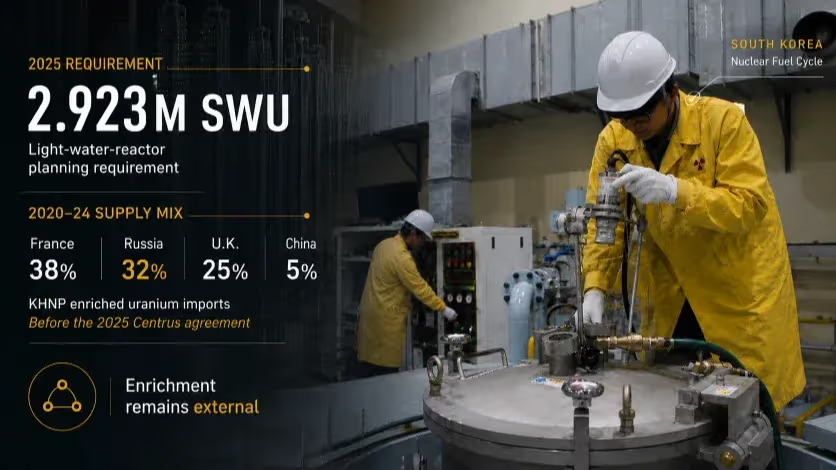 NewsAug 27, 2026
South Korea Has Outgrown Washington’s Nuclear Rules
The U.S. once constrained South Korea’s nuclear fuel cycle over real prolifer...
 NewsAug 7, 2026
North Port’s New Ministry and the Unfinished Work of Busan’s Old Downtown
Busan has secured a permanent center of national maritime administration at N...
 NewsJul 10, 2026
South Korea’s Smart Cities and the K-AI City Planning Challenge
South Korea has spent more than two decades building smart cities around digi...
More from the author
More from this byline
Stay with the same line of reporting through more work from this byline.
 NewsSep 5, 2026
How a Political Appointment Becomes a Judgment of Character
- NewsAug 27, 2026
South Korea Has Outgrown Washington’s Nuclear Rules
Editorial Record
Corrections, sourcing notes and newsroom disclosures remain part of the published record. View Newsroom Notes →
Reader Signal
Community readWhat did this report leave you with?
Choose the signal that best reflects your reading. Select it again to remove it.
One response per article
No response selected
A moderated conversation about the reporting.
One-level replies and newsroom moderation keep the conversation anchored to this article.
Discussion Status
Open
Please sign in to join the discussion.
Newsletter
Weekly reporting and context from Busan and Korea.