Why Nvidia Is Betting on South Korea’s Factories
Nvidia needs more than chips and data centres to make physical AI work. Korea’s factories offer the industrial data, machinery and engineering needed to close the gap between simulation and reality—but the long-term value will depend on who controls the models and software built there.

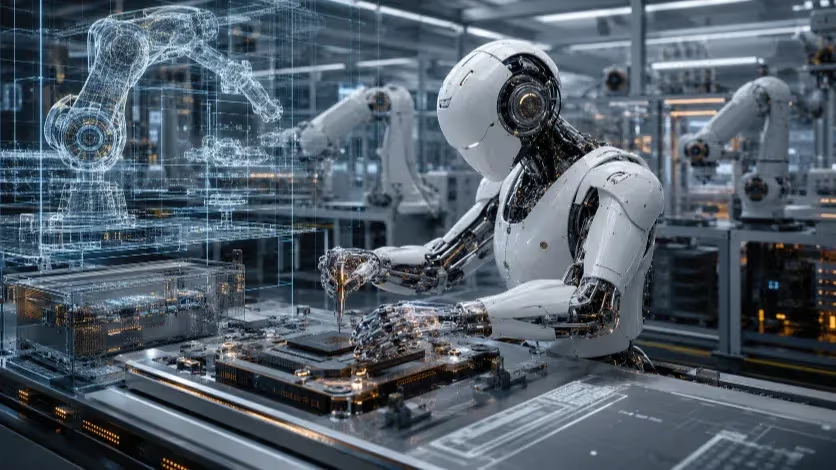
South Korea offers Nvidia advanced memory and a national test bed for physical AI. Its larger opportunity lies in controlling and exporting the models, software and operating systems developed inside those factories.
Jensen Huang arrived at South Korea’s San Francisco AI summit with an offer that reached beyond another sale of processors. Nvidia would establish an AI Frontier Lab in Korea, he said, and one of the company’s leading researchers would move from California. A separately announced $300 million joint laboratory with KAIST will develop agentic AI for Korean industries and language, with Nvidia providing an expected $50 million a year in computing resources during the initial five-year programme and supporting at least 10 KAIST researchers annually. Public announcements have not established whether the frontier lab and the KAIST laboratory will operate as the same organisation.
President Lee Jae Myung had brought Huang, OpenAI Chief Executive Sam Altman, Anthropic Chief Executive Dario Amodei and Broadcom Chief Executive Hock Tan together with the heads of Samsung Electronics, SK Group, Hyundai Motor and Naver. Seoul cast the gathering as the beginning of a deeper alliance between American AI companies and the Korean industrial system, with Korea serving as a production base, test bed and supply-chain partner for the next generation of computing.
Huang’s expanded research presence signals confidence in Korean engineering. It also follows Nvidia’s commercial interests. The company’s next growth market will require more than cloud providers filling data centres with accelerators. Physical AI—the use of models to perceive the real world and act through robots, vehicles and machinery—must be developed inside factories and transport systems, where software encounters worn equipment, sensor drift, friction and physical risk.
Korea offers those environments at unusual density. Samsung and SK hynix produce the high-bandwidth memory required by Nvidia’s systems. Samsung, SK, Hyundai Motor and Naver are also prospective buyers of the computing, networking and software platforms Nvidia wants to embed across industrial AI. Through a relatively small number of corporate relationships, Huang can reach semiconductor fabrication, telecommunications, cloud infrastructure, vehicle production, robotics and extensive manufacturing supply chains.
The exchange runs in both directions. Nvidia needs sophisticated memory, industrial customers and credible places to prove that its physical-AI stack works. Korean companies need advanced computing and mature development tools they cannot reproduce quickly enough on their own. Nvidia gains supply security, customers and reference sites. Korea gains a shorter route from research to deployment.
The summit’s headline figure made that exchange appear more settled than it is. The Korean government grouped the announcements under approximately $950 billion in AI and semiconductor cooperation. Around $750 billion was associated with SK Group’s relationships with global technology companies, including a partnership with Nvidia valued at more than $500 billion. Samsung and Broadcom said their collaboration could exceed $200 billion through 2030.
The total is not a single pool of committed investment. It combines projected memory supplies, computing infrastructure, foundry and packaging services, joint development and expected commercial activity over several years. SK and Nvidia signed letters of intent covering long-term memory cooperation and a phased AI-cloud buildout of up to two gigawatts. Nvidia says the first facility is due to begin operating in 2027. Samsung and Broadcom signed a memorandum of understanding spanning memory, sub-two-nanometre foundry production and advanced packaging.
San Francisco established the scale of corporate intent. It revealed much less about pricing, delivery schedules, capital risk, data rights or ownership of the systems that will be built. Those omissions matter because the lasting value of the agreements will be created above the hardware—in the models, simulations and industrial software developed inside Korean factories.
The Business Behind Huang’s Praise
Nvidia built its position around graphics processors and CUDA, the software environment through which developers use its hardware. It has since expanded into networking, data-centre architecture, simulation and robotics tools designed to remain present from model training to operation inside machines.
Physical AI widens the market beyond hyperscale computing. A robot handling an unfamiliar component, a vehicle reacting to road conditions or a production line adjusting to variations in materials requires virtual environments for training, software that links models with sensors and control systems, and reliable mechanisms for updating those models after deployment.
Nvidia supplies several layers of that infrastructure. Omniverse supports simulation and digital twins, while Isaac provides tools for robot development. Its broader AI-factory architecture combines accelerators, networking and software in facilities designed to train and operate AI systems.
The business becomes more durable as those layers connect. Hardware generates revenue when customers buy and replace it. A development environment that shapes university training, factory software and robotics workflows can sustain demand across successive generations of processors. Switching suppliers then requires companies to rewrite applications, rebuild data pipelines and retrain engineers.
SK Group’s partnership illustrates the full cycle. SK hynix supplies HBM for Nvidia systems, while SK Telecom plans to buy Nvidia infrastructure for an AI cloud with a long-term capacity of up to two gigawatts. The first facility is expected to use Nvidia’s Vera Rubin platform with SK hynix HBM4. The groups also plan to develop physical, agentic and enterprise AI services.
Money flows in both directions. SK sells memory into Nvidia’s global platform and buys Nvidia computing to construct domestic capacity. Adding both projected streams produces an immense headline, but it does not reveal Korea’s net economic benefit or which party bears more of the capital and demand risk. Minimum purchases, price-reset mechanisms and cancellation provisions remain undisclosed.
Samsung’s agreement with Broadcom gives Korea another route into AI infrastructure. Broadcom designs custom accelerators and networking silicon for major technology companies. Samsung’s proposed role covers memory, leading-edge foundry production and advanced packaging. Successful execution would place Samsung inside AI systems developed outside Nvidia’s GPU ecosystem and strengthen its attempt to win manufacturing work concentrated at TSMC.
Korea’s leverage therefore extends beyond one company’s demand for HBM. SK hynix can shape Nvidia’s roadmap through memory co-development. Samsung can combine memory, logic-chip production and packaging for custom accelerators. Korean firms occupy several stages where AI companies have encountered supply and manufacturing constraints.
Huang had already highlighted the country’s industrial value before the summit. During a June visit, he identified robotics as Korea’s next major growth sector and deepened discussions with companies across semiconductors, vehicles, cloud services and industrial machinery.
His praise can be sincere without being disinterested. Korean memory is central to Nvidia’s system performance, and Korean factories offer sites where its platform can prove itself beyond controlled demonstrations. A successful deployment would benefit local manufacturers while giving Nvidia a reference architecture for other industrial economies.
The research laboratories serve the same dual purpose. Engineers working alongside KAIST and Korean companies can adapt systems to Korean language, equipment and production processes. The partnerships may also deepen local research. Patent ownership, technical leadership and overseas licensing rights will reveal whether they create durable Korean capability or primarily localise Nvidia products.
Why Korea Is a Credible Test Bed
Korea’s appeal lies in the concentration of its assets. It produces advanced memory, operates highly automated factories and retains major domestic companies in semiconductors, vehicles, electronics, telecommunications and cloud services. The state also has extensive experience coordinating digital infrastructure and national technology programmes.
Korea rose to fourth in WIPO’s 2025 Global Innovation Index, its highest position. It ranked first in human capital and research and in business-performed R&D, while placing second in total R&D spending and researcher density. These figures show a high concentration of technical activity, although they do not place Korea ahead of the United States in frontier models or China in the absolute scale of AI research and patents.
The physical base is more distinctive. Korea operates 1,220 industrial robots for every 10,000 manufacturing workers, the highest density recorded by the International Federation of Robotics. The figure measures established automation, not leadership in intelligent or humanoid robots. It nevertheless gives Korea a dense layer of machines, sensors and production systems on which adaptive models can be tested.
Samsung’s corporate reorganisation shows physical AI moving beyond a research programme. In July, the company created a CEO-level Robotics eXperience division to oversee core technology, commercial strategy and overseas research. Samsung expects humanoid robots to enter manufacturing before expanding into retail and domestic applications.
Samsung is also expanding computing for semiconductor design and production. Hyundai Motor is connecting AI infrastructure with autonomous driving, robotics and smart factories. SK combines memory, telecommunications and cloud services, while Naver contributes Korean-language models and domestic cloud infrastructure. These groups give Korea access to both sides of physical AI: the systems that train models and the factories in which those models must operate.
Government capacity shortens the distance among them. Korea scored 0.89 out of 1.00 for government AI maturity in the OECD’s 2023 Digital Government Index, ranking first among the 33 countries assessed. Public agencies have used AI in areas including labour inspection, patent examination and flood prediction, although the OECD also identified weaknesses in procurement, transparency and accountability.
A university project can therefore move into a major factory, receive support from public computing infrastructure and spread through a supplier network without requiring a new organisation at every stage. Samsung, SK and Hyundai Motor can influence engineering requirements across thousands of smaller companies.
The United States has deeper capital markets, the leading model companies and dominant cloud platforms. China combines manufacturing scale with state coordination and a growing domestic hardware ecosystem. Japan remains strong in precision machinery, motors and reducers, while Europe has considerable advantages in industrial software and safety standards.
ETRI’s comparison of major AI-robotics economies places Korea in a promising but incomplete position. Its semiconductor, battery and manufacturing capabilities support vertical integration. Weaknesses remain in vision-language-action models, robotics software talent and precision drive components. Korea has one of the strongest industrial foundations from which to compete; it does not yet control every technology governing how intelligent machines perceive, decide and move.
The Hard Part Is Moving from Simulation to the Factory
A factory robot programmed to repeat one motion is fundamentally different from a machine expected to recognise a new object, interpret an instruction and select a safe action in real time.
Much of the current research centres on vision-language-action, or VLA, models. These systems seek to combine visual perception, natural-language instructions and physical actions within one architecture. Digital twins and synthetic data allow developers to expose robots to simulated conditions without placing expensive equipment or workers at risk.
Simulation solves only part of the problem. Lighting changes, surfaces wear, objects deform and sensors drift. A movement that succeeds virtually may fail when an actual machine encounters vibration, friction or a component positioned a few millimetres differently. Researchers describe this distance between simulated and physical performance as the sim-to-real gap.
KAIST mechanical engineer Kyoungchul Kong has argued that more detailed virtual environments alone will not close it. Real-world physical variables must also become predictable and stable. Professor Hyun Myung has emphasised a related need to integrate physical laws and hardware expertise into learning systems.
Korea’s factories can supply the conditions needed to reduce that gap. Semiconductor production provides one of the most demanding cases. A modern fab coordinates thousands of process steps under tightly controlled conditions, where small variations can lower the yield of an expensive wafer batch. Models combining equipment readings, inspection images and production histories could help engineers detect defects, anticipate failures and stabilise new processes.
Samsung and SK have announced large computing facilities intended to connect semiconductor research and production with accelerated computing. These projects are buildouts, not evidence that autonomous semiconductor manufacturing has already been achieved. Their significance lies in placing model development beside the equipment and engineering teams that generate the relevant data.
Automobiles offer a parallel route. Hyundai Motor can validate systems across virtual vehicle development, autonomous driving, robotics and factory simulation. A model may begin in a simulated production line, move into a Korean plant and later operate across Hyundai’s overseas factories, accumulating experience in several industrial settings.
Shipyards and ports provide another set of environments rooted in Korea’s economy. A shipyard changes from one project to the next, with workers, materials and heavy equipment moving across irregular sites. Ports must respond to vessel arrivals, container flows, weather and equipment availability. Digital twins and perception systems may improve safety and scheduling, although the summit did not announce specific projects in either sector.
Korean research is also addressing the learning bottleneck. A KAIST team developed Video-based Optimal Transport Preference, or VOTP, a method that lets AI infer human preferences from a small number of videos rather than thousands of individually rated examples. The paper was selected for an oral presentation at ICML 2026. The method remains research, but it shows that Korea’s contribution need not be limited to facilities and operating data.
Reliability creates another barrier. Consumer AI can give a wrong answer without causing physical damage. A machine handling heavy components or operating near workers must function inside a safety system that anticipates failure, restricts dangerous movement and records changes to the model.
ISO revised its core industrial-robot safety standards in 2025. ISO 10218-1 covers the safe design and risk reduction of industrial robots, while ISO 10218-2 governs the integration of robot applications and cells. Adaptive systems introduce further questions: whether a robot must be revalidated after a model update, how cyberattacks affect functional safety and when human control must override the model.
Korea’s extensive installed base gives it an opportunity to develop practical answers. Methods for testing adaptive machines across semiconductor, automotive and logistics environments could eventually become exportable standards alongside the machines and software themselves.
Who Will Own the Factory Layer?
The partnership between Nvidia and Korea is often described through accelerators, HBM, networking and data centres. The more consequential division of power lies between the general computing platform and the factory floor.
Operational datasets, digital twins, trained control policies, software interfaces and engineering knowledge form what may be described as the factory layer. This is where a general AI platform becomes a working industrial application.
Nvidia can provide processors, networking, simulation and robotics tools. It does not own the production histories of Korean semiconductor plants, the engineering logic of Hyundai’s vehicle programmes or the operating knowledge accumulated inside Korean shipyards. Much of that information remains embedded in equipment settings, maintenance records and the experience of engineers and workers.
Models trained on those environments may outlast the computing purchase that created them. Accelerators follow rapid replacement cycles. A production model refined across millions of events can embody knowledge that a competitor cannot acquire by buying the same hardware.
The public announcements provide little detail about how that value will be divided. A predictive-maintenance model trained on a Korean semiconductor line might remain under the manufacturer’s control. The same work could also improve a broader Nvidia platform later offered to competing chipmakers. The disclosed agreements do not explain who controls the trained models, derivative products or overseas sales.
Industrial data also passes through several organisations. A manufacturer may own the raw records, an integrator may prepare them, Nvidia may provide the training environment and a cloud operator may host the model. A university laboratory can add code and patents. Formal ownership may be divided while practical control remains with the company operating the dominant platform and customer channel.
Korean companies possess leverage because the data is scarce. Large public text collections can support language-model development. Accurate records from semiconductor equipment, battery production or industrial robots are far harder to obtain. Factory access is therefore a contribution to joint development, not simply a location for imported computing.
Commercial rights will show how the balance is resolved. Samsung, SK and Hyundai operate factories across Asia, Europe and the Americas. Systems developed in Korea can move through those networks and eventually reach outside customers. Korean control of the models and applications would turn overseas production sites into distribution channels for industrial AI.
Portability matters for the same reason. CUDA’s mature ecosystem makes Nvidia the rational choice for many immediate projects. A system built entirely around one environment may later prove expensive to move, even when another accelerator becomes attractive in cost, energy efficiency or security.
Complete self-sufficiency is unrealistic. Korea already depends on foreign suppliers for chip-design software and advanced manufacturing equipment. Controlled dependence offers a more practical objective: use the leading platform while preserving the ability to operate data, models and applications across more than one hardware or cloud environment.
Publicly funded projects can require portable data formats, technical documentation and interoperable interfaces. Manufacturers can negotiate rights to reuse trained models and simulations. Universities can build expertise across several architectures rather than becoming localisation centres for one vendor.
Korea can build on Nvidia’s computing stack. Its position will be determined by who controls the factory layer above it.
An AI-Native Economy Needs More Than Nvidia
Nvidia sits near the centre of Korea’s current buildout, but an AI-native economy cannot be measured by how thoroughly one foreign platform is adopted. It requires domestic companies that build software, operate infrastructure and offer credible alternatives in selected markets.
Samsung’s Broadcom agreement provides diversification in advanced silicon. Domestic accelerator companies offer another path, although none matches Nvidia’s breadth across training, networking, robotics and developer software.
Rebellions raised $400 million in March at a valuation of about $2.34 billion. The government-backed Korea National Growth Fund supplied 250 billion won under the “K-Nvidia” initiative, while the company plans to expand its Rebel100 data-centre platform and enter the United States. Commercial workloads and software adoption will matter more than the nationality of the design.
Domestic accelerators need not displace Nvidia across every workload. Inference, energy-efficient computing, secure public systems and specialised industrial applications may provide narrower markets in which Korean chips can mature. Without commercial workloads and developer tools, however, domestic designs will remain demonstrations rather than strategic alternatives.
Industrial software presents a similar problem. Samsung, SK and Hyundai may build sophisticated internal systems without creating a broad Korean software sector. Smaller robotics, simulation and factory-software companies need controlled access to testing environments and common interfaces that allow them to turn project work into repeatable products.
The gap is particularly important for smaller manufacturers. In one OECD survey, 31% of Korean SMEs reported using AI, compared with 51% in Germany. SMEs employ more than 80% of Korea’s workforce. A national programme confined to flagship plants would increase the productivity of the largest groups without transforming the wider economy.
Most factories do not need their own foundation model. They need reliable tools for visual inspection, predictive maintenance, energy management and production planning. Shared computing can lower costs, while regional universities and technology institutes can adapt common systems to different machines.
Pilot projects must also survive after subsidies end. An application requiring permanent customisation and expensive cloud use may succeed technically without becoming a viable product. Productivity, operating cost and continued use provide more meaningful measures than the number of projects carrying an AI label.
Government procurement can create an early domestic market, but it can also entrench one vendor or favour the largest contractors. Contracts for publicly supported systems should preserve access to data, documentation and audit records.
National coordination becomes valuable when it widens participation. It becomes restrictive when public infrastructure reinforces a permanent alliance between dominant domestic groups and a single foreign platform.
Speed Can Harden Into Dependence
Korea’s ability to coordinate large projects quickly may provide an early advantage. It can also embed technical and financial choices before their consequences are understood.
A platform adopted by major companies and reinforced through public funding can become a national standard without a formal decision. Universities teach its tools, suppliers build compatible software and public programmes adopt its interfaces. A later change of hardware then requires companies to rebuild applications, pipelines and skills.
Physical infrastructure creates a longer commitment. AI factories need electricity, substations, transmission lines, cooling and land. A processor may become obsolete within several years; grid infrastructure remains for decades.
Korea’s semiconductor expansion already faces constraints involving power, water and local acceptance. Reuters reported that four proposed fabs in the Honam region could require electricity equivalent to 70% to 80% of current consumption across Gwangju, North Jeolla and South Jeolla. The projects are separate from the summit agreements, but they illustrate the physical limits facing a country expanding chip production and AI computing simultaneously.
Public descriptions of the AI projects do not consistently distinguish maximum connection capacity, IT load, total facility demand and expected utilisation. The two-gigawatt headline therefore cannot be converted directly into annual electricity consumption.
The International Energy Agency expects global data-centre electricity demand to rise from about 485 terawatt-hours in 2025 to roughly 950 TWh in 2030. Grid construction generally moves more slowly than data-centre development, increasing the risk that electricity supply becomes the binding constraint.
Infrastructure plans need phased demand forecasts, grid-connection schedules and transparent cost allocation. Underused facilities or applications that generate little domestic value would burden the energy system without producing equivalent productivity.
Industrial concentration creates a parallel risk. Samsung, SK and Hyundai can absorb experimental costs and influence standards across their suppliers. Smaller companies may be required to follow those standards without receiving the computing, skills or financing needed to use them.
Fast deployment therefore requires reversibility. Independent reviews must be able to end projects that underperform, revise interfaces that restrict competition and redirect infrastructure when demand fails to materialise. Centralised programmes mobilise resources quickly; they can also make failure politically difficult to acknowledge.
Korea’s speed becomes a durable advantage only when systems remain portable, markets remain contestable and institutions retain the ability to change direction. Hardware and infrastructure cannot be allowed to advance far faster than domestic software ownership, safety practice and competition.
The Layer That Will Decide 2030
The decisive question for Korea is not how much AI infrastructure it can install by 2030. It is whether the leverage created by its factories survives after that infrastructure becomes ordinary.
Korea enters the current cycle with considerable industrial power, but much of it sits upstream. SK hynix and Samsung supply the memory and manufacturing capacity required by global AI systems. Korean conglomerates operate factories complex enough to expose physical AI to conditions that cannot be reproduced inside a data centre. The country can therefore influence how the next generation of industrial computing is built even though it does not control the dominant processors, cloud platforms or development environments.
That position contains a risk familiar from earlier technology cycles. A country can become indispensable to the production of a global system while capturing only a limited share of the value generated above it. Korea has already demonstrated that semiconductor manufacturing and component leadership do not automatically produce control over software platforms, customer relationships or recurring digital revenue. Physical AI could reproduce that division on a larger scale: Korean memory and factories underneath, American computing and software platforms above.
The factory layer is where that outcome can still be changed. Models trained on equipment failures, process variations and worker decisions are not interchangeable commodities. Neither are digital twins refined through years of production, robot-control policies validated near human workers or safety procedures developed through repeated deployment. These assets emerge from Korean industrial environments, but they will not necessarily remain under Korean control simply because the underlying data originated there.
Value will accumulate with the organisations that can separate that knowledge from a single factory and turn it into a system that travels. A model that improves yield inside one Samsung or SK facility creates an internal productivity gain. A model that can be adapted to another semiconductor line, licensed to overseas manufacturers and maintained through recurring software contracts creates an industry. The transition from the first outcome to the second is the real technological and commercial test.
Nvidia’s presence can accelerate that transition, because Korea does not need to spend years recreating every layer of advanced computing before beginning industrial deployment. The same acceleration can narrow Korea’s future choices when simulation assets, engineering workflows and trained models become inseparable from one vendor’s architecture. Dependence becomes strategically useful only when it buys time for Korean companies and research institutions to develop assets that remain valuable across hardware generations and, where necessary, across competing platforms.
The strongest Korean outcome would therefore look less like technological independence than a reversal of the current dependency. Nvidia would continue to supply much of the computing, while Korean companies controlled the systems that decide how factories use it. Domestic accelerators could serve selected workloads, but their larger importance would be to preserve bargaining power and technical alternatives. Korean software firms would earn recurring revenue from manufacturing systems developed first at home and later deployed through the overseas networks of Samsung, SK and Hyundai. Research partnerships would leave behind patents, engineering teams and commercial rights that outlasted the original collaboration.
A weaker outcome is equally plausible. Korea could remain essential to the AI supply chain through HBM, foundry services and advanced production while becoming one of the world’s largest markets for foreign computing platforms. Its leading factories would become more productive, but the software, licensing and customer relationships created from that experience would accumulate elsewhere. The country would occupy a central position in AI production without controlling the economic layer through which industrial knowledge is sold.
Installed accelerators cannot distinguish between those futures. Factory productivity alone cannot do so either. The evidence will appear in the ownership of trained models, the revenue of Korean industrial-software companies, the portability of publicly supported systems and the number of overseas factories operating technology developed and controlled in Korea.
Huang is betting on Korea because physical AI requires a manufacturing environment dense enough to convert general models into reliable machines. Korea’s corresponding wager is more demanding. It is using a foreign computing platform to shorten the path toward an industrial software economy that does not remain subordinate to that platform.
By 2030, Korea’s position will be visible in the layer between the processor and the factory floor. The country will have moved up the AI value chain when its industrial knowledge travels abroad as Korean-controlled systems, regardless of whose chips are running underneath.
Continue this reporting
Reporting on the same issue
Related coverage selected from the article's desk, topics and newsroom relationships.
 NewsOct 19, 2026
What an Accurate Rainfall Forecast Can Still Miss
AI weather forecasts can capture where rain will fall while underestimating i...
 NewsOct 7, 2026
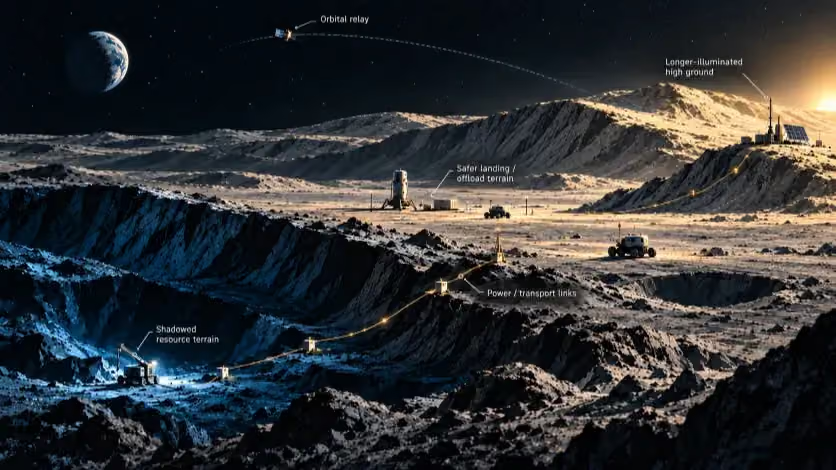
The Moon’s Industrial Future Begins With What Missions No Longer Need to Carry
Water, sunlight, safe landing terrain, communications and power do not natura...
 NewsOct 2, 2026
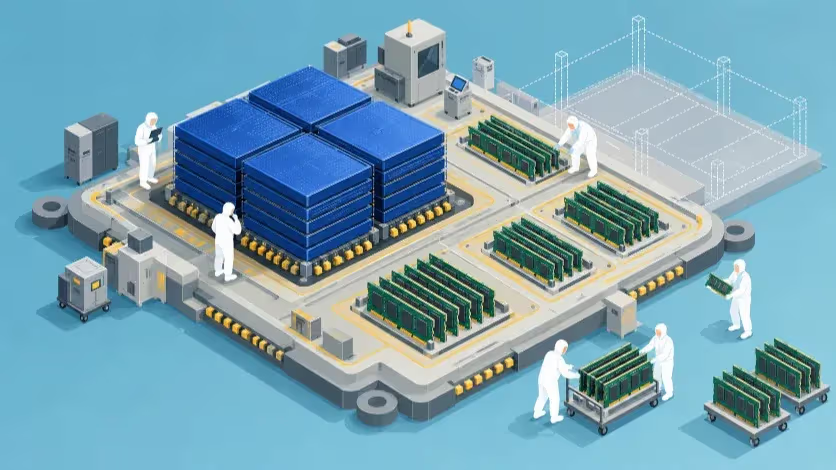
AI Is Reallocating the World’s Memory Factories
AI demand is forcing memory makers to decide how scarce DRAM capacity is divi...
More from the author
More from this byline
Stay with the same line of reporting through more work from this byline.
 NewsOct 21, 2026
What a Small Mackerel Is Worth
Reader Signal
Community readWhat did this report leave you with?
Choose the signal that best reflects your reading. Select it again to remove it.
One response per article
No response selected
A moderated conversation about the reporting.
One-level replies and newsroom moderation keep the conversation anchored to this article.
Discussion Status
Open
Please sign in to join the discussion.
Newsletter
Weekly reporting and context from Busan and Korea.