Beyond the Engineers: Including Philosophers and Sociologists in Discussions on AI Development
The development of Artificial Intelligence (AI) technology is advancing at an unprecedented rate, and many administrative agencies in South Korea are eagerly anticipating its arrival. However, it is important to not only admire the capabilities of these new technologies but also to consider their social impact. As AI becomes increasingly integrated into our daily lives, it is essential to have a discourse that goes beyond the traditional engineering and technical perspectives. One of the most s


The development of Artificial Intelligence (AI) technology is advancing at an unprecedented rate, and many administrative agencies in South Korea are eagerly anticipating its arrival. However, it is important to not only admire the capabilities of these new technologies but also to consider their social impact. As AI becomes increasingly integrated into our daily lives, it is essential to have a discourse that goes beyond the traditional engineering and technical perspectives.
One of the most significant advancements in AI technology is the development of large language models, such as Chat-GPT, which can generate text that is virtually indistinguishable from that written by humans. These models have the potential to revolutionize a wide range of industries, including finance, healthcare, and education, by providing personalized services and automating routine tasks. However, the rapid deployment of these models without sufficient consideration of their social implications can lead to unforeseen consequences.
For example, there are concerns about the potential for large language models to amplify biases and perpetuate discriminatory practices. AI systems are only as good as the data they are trained on, and if the data is biased or incomplete, the resulting models can be flawed. Additionally, there is a risk that these models can be used to manipulate public opinion or generate disinformation, creating a threat to the integrity of democratic processes.
To address these concerns, it is essential to engage in a broader ethical discourse that includes philosophers, humanities scholars, and sociologists, in addition to the technical experts. By bringing together diverse perspectives, we can develop a deeper understanding of the potential implications of these new technologies and work to mitigate their negative effects.
Furthermore, this ethical discourse should also consider the potential impact of AI on the workforce. While AI has the potential to automate routine tasks and increase efficiency, it also poses a threat to many jobs, particularly those that are repetitive or low-skilled. As a result, it is crucial to consider the potential social and economic impact of AI and to develop policies and programs that address these issues.
In conclusion, the development of AI technology is an exciting and promising advancement. However, it is important to consider the social implications of these new technologies and to engage in a broader ethical discourse that includes a variety of perspectives. By doing so, we can work towards a more equitable and sustainable future that benefits all members of society.
Continue this reporting
Reporting on the same issue
Related coverage selected from the article's desk, topics and newsroom relationships.
 NewsOct 4, 2026
Zelensky, South Korea and the Limits of Wartime Pressure
South Korea says Kyiv broke a confidentiality understanding when Zelensky rev...
 NewsSep 1, 2026
What Lee Jae Myung Thinks a Minister Can Fix
President Lee Jae Myung says reform should be judged by results rather than c...
 NewsAug 21, 2026
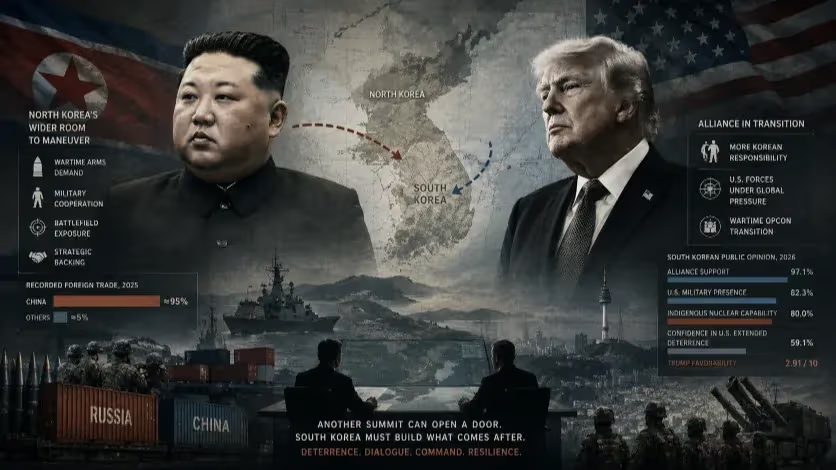
The Korean Peninsula Trump Is Returning To
Another Trump-Kim summit would unfold on a peninsula where North Korea is har...
More from the author
More from this byline
Stay with the same line of reporting through more work from this byline.
 NewsOct 9, 2026
Why “Busan Is Good” Falls Short as a City Brand
 NewsSep 18, 2026
The Other AI Race Is for the Freedom to Change Course
Reader Signal
Community readWhat did this report leave you with?
Choose the signal that best reflects your reading. Select it again to remove it.
One response per article
No response selected
A moderated conversation about the reporting.
One-level replies and newsroom moderation keep the conversation anchored to this article.
Discussion Status
Open
Please sign in to join the discussion.
Newsletter
Weekly reporting and context from Busan and Korea.