Gyeongnam’s Pine-Wilt Surge Is Forcing a Shift From Tree Removal to Forest Management
Gyeongnam’s pine-wilt outbreak has grown beyond a tree-removal problem. As reported occurrence passed 1.15 million, warmer transmission conditions, an extensive pine landscape and mass forest conversion began reshaping how southeastern Korea manages its forests.

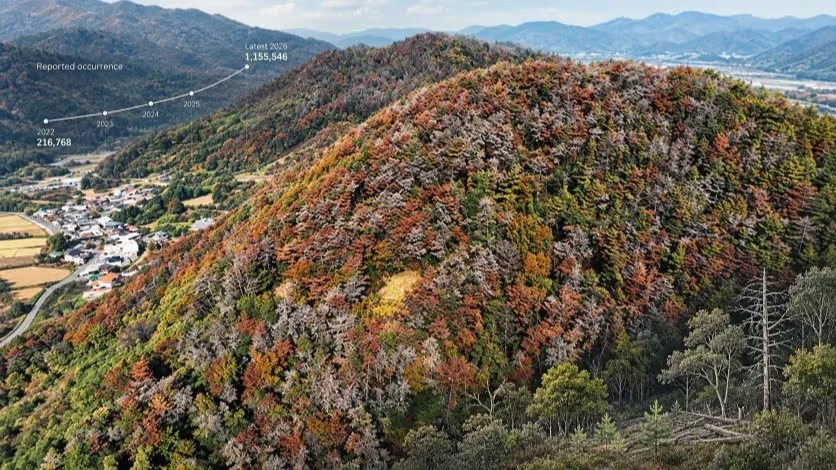
Reported occurrence in Gyeongnam rose above 1.15 million trees as control expanded, pushing foresters to decide not only where pine can still be protected but what kind of forest should replace the most heavily damaged stands.
Gyeongnam did not arrive at more than one million reported pine-wilt occurrences because forest control suddenly stopped. The province reported treatment of 755,743 damaged trees in its latest control series, up from 416,076 in the preceding one, while reported occurrence increased from 584,156 to 1,155,546. The rise had already been building for several years, from 216,768 damaged trees in the 2022 series to 416,980 in 2023 and 451,190 in 2024 before the numbers began climbing much more rapidly. By the time the latest survey period closed in May 2026, crews were processing hundreds of thousands more trees than they had a year earlier, but the amount of newly measured damage entering the system was increasing faster. Several seasons of transmission, delayed symptoms and accumulating infected material were beginning to overlap inside the same landscape.
The change is difficult to miss from the road. Hillsides across parts of the province now contain concentrations of fading red and brown crowns where mortality appeared much more scattered only a few seasons earlier, and heavily affected stands can make the outbreak look as though it swept through a mountain within a single summer. Pine wilt does not move on the same timetable as the landscape becomes visibly brown. Trees infected during one period of vector activity can remain inconspicuous before declining later, while adult longhorn beetles are already moving pine wood nematodes into other trees. What residents see across a valley is consequently the delayed surface of an outbreak that has been developing through more than one biological season.
Why the Surge Accelerated
South Korea recorded its hottest year on record in 2024 and its second-hottest in 2025, when unusually high temperatures persisted from early summer well into autumn. Those years overlap the period in which Gyeongnam's reported pine-wilt occurrence moved from roughly 451,000 trees to 584,000 and then beyond 1.15 million. Pine wilt does not increase according to a simple temperature formula, but it depends on Monochamus longhorn beetles whose development, emergence and seasonal activity respond strongly to temperature, while prolonged heat and dry conditions place additional physiological stress on their pine hosts. Korean field studies have found the emergence of Monochamus alternatus closely associated with average temperature, experiments on Monochamus saltuarius have recorded temperature-sensitive changes in maturation and reproduction, and national spatial research has linked temperature and precipitation with the distance pine wilt advances between years. Two exceptionally warm seasons therefore changed more than the condition of individual trees; they altered the biological setting in which vector, host and pathogen repeatedly encountered one another.
The Korea Forest Service has placed recent abnormal warmth and drought near the center of its explanation for the renewed expansion. Commissioner Park Eun-sik has described conditions in which vectors can emerge earlier and remain active later, while heat- and water-stressed pines become less capable of tolerating infection. Recent genetic work on Korean pine wood nematode isolates did not identify a geographic or host-linked genetic pattern corresponding to the recent expansion, and the researchers interpreted the resurgence as more consistent with ecological and environmental factors than with the appearance of a newly differentiated nematode population. Attention therefore returns to the environment surrounding a pathogen that has been present in South Korea for decades. A familiar disease can produce a different landscape outcome when the vector season lengthens, host trees are stressed and more infected material remains distributed through the surrounding forest.
South Korea's control system was changing during the same period. For years pine-wilt management attacked different stages of transmission at different times: infected and dying trees were primarily located and removed from autumn through the following spring, while insecticide treatment during the warmer months targeted adult vectors after they emerged from woody material. Manned aerial spraying had been contracting for years as local demand fell and was ended nationwide in 2023 amid concerns over the environmental effects of broad insecticide use. Drone treatment remained available over smaller and more selective areas, but the disappearance of manned aircraft removed the large-area method that had been used after adult beetles left the trees targeted by winter sanitation. By 2026 the Korea Forest Service had begun testing manned aerial treatment again in severely affected areas, and Park publicly acknowledged that the loss of that control layer had contributed to the conditions under which the disease expanded.
Winter sanitation and summer vector control act on different parts of the same cycle. Crews can find an infected pine, fell it and destroy the logs and branches in which beetles may be developing, but once adult vectors have emerged and begun feeding on healthy trees, cutting the original tree cannot retrieve insects already moving through the forest. Broad-area adult control had addressed that later phase; after it receded, more of the burden shifted toward detecting and completely treating infected material before emergence. Intensive sanitation can suppress small outbreaks with remarkable effectiveness when neighboring infections are found early enough and crews can work beyond the trees that have already turned brown. Its demands rise sharply after infections become widespread, because some infected pines remain outwardly healthy while the number of locations requiring survey and treatment continues to grow.
Pine wilt also transfers work from one season into the next. Korean researchers have found apparently healthy trees that were already infected and developed visible wilt later, while damaged and declining pine can support vector larvae before another generation emerges. A large infection cohort enlarges the following season's workload before its full size is visible: survey teams begin finding new symptomatic trees while contractors are still processing earlier sites, and another period of vector emergence approaches on a calendar that does not lengthen because more trees require treatment. Gyeongnam's latest count contains that accumulated history rather than only infections created during the months in which officials counted them. The province was removing one generation of visible damage while part of the next workload was still appearing around it.
Between the preceding and latest reporting series, Gyeongnam added 339,667 treated trees, an increase of about 81.6 percent. Reported occurrence increased by 571,390, or about 97.8 percent. The administrative periods differ enough that the two changes cannot be converted into an epidemiological efficacy rate, but they show how quickly the workload moved: more than 755,000 treated trees represented a major expansion of activity, while measured occurrence still moved farther ahead. Each larger infection cohort brought additional forest to survey, access routes to secure, contractors and equipment to deploy and woody material to process before the next vector season.
Municipal control systems entered that expansion with different levels of staffing, contractor capacity and field performance. The Korea Forest Service has acknowledged substantial variation among local governments, while a 2026 review of 26 national, regional and local pine-wilt strategies found cases in which early damage estimates proved too small for the budgets and treatment capacity prepared for the season. The review also found that priorities suited to a newly affected boundary could become inefficient when applied to a forest already carrying mass mortality. A county with several focal outbreaks can concentrate crews around each new cluster; a province containing severely damaged interiors, moving boundaries and high-value pine landscapes has to decide which objective receives attention first. By 2026, Gyeongnam's outbreak had reached the point where those allocation decisions were becoming as important as the total number of trees crews could remove.
The Forest Beneath the Epidemic
Gyeongnam contains an unusually large landscape of susceptible pine through which that increased transmission pressure can move. Provincial forestry officials told the Gyeongnam Provincial Council in 2026 that pure pine stands account for about 39 percent of the province's roughly 699,000 hectares of forest, compared with a national pure-pine share they placed at around 25 percent. Earlier testimony, using a broader definition that included mixed stands containing pine, put the proportion of Gyeongnam forest in which pine was present above 60 percent. The figures describe different categories, but both reveal a region in which pine repeatedly occurs across adjoining hillsides rather than surviving mainly in isolated stands. A beetle leaving an infected pine in such a landscape encounters a different sequence of potential hosts than it would in a forest where susceptible trees quickly become sparse.
Changnyeong makes that geography especially visible. The National Atlas of Korea identifies the county as having the country's highest proportion of Pinus densiflora, at 52.9 percent, and Changnyeong is now among Gyeongnam's most severely damaged pine-wilt jurisdictions. Heat, vector activity and the accumulated infection cycle explain why transmission intensified; the county's forest composition helps explain the scale of the consequence once it did. Across a pine-heavy landscape, new infections remain embedded within a larger network of potential hosts, allowing repeated transmission to accumulate across adjoining slopes rather than rapidly encountering areas where suitable hosts disappear.
The forest through which the disease is moving was not produced by a single national decision to plant Korean red pine after the Korean War. South Korea's restoration programs used black locust, pitch pine, alder, larch, Korean pine, cedar, hinoki cypress and other species, while the first national greening plan launched in 1973 sought to restore one million hectares of badly degraded mountains as quickly as possible. The program succeeded faster than expected, helping transform eroded and fuelwood-depleted slopes into one of the world's best-known examples of national forest recovery. Korean red pine later occupied extensive areas through surviving native stands, natural regeneration, secondary succession and continued management as well as planting. The historical achievement was restoring forest cover; half a century later, many of those forests are mature enough that the management problem has shifted from how quickly trees can return to how a densely forested landscape responds when drought, fire, insects and disease strike repeatedly.
Geumjeongsan in Busan shows how that transition changes the meaning of a pine forest. Researchers examining pine communities inside and outside Geumjeongsanseong found stands several decades old whose understory and diameter structure pointed toward gradual succession into forests containing more oak, hornbeam and other broadleaved species. Maintaining the recognizable pine landscape in culturally important areas would require continued management of competing vegetation rather than simply leaving the mountain untouched. Geumjeongsan, where South Korea first recorded pine wilt in 1988, therefore contains two overlapping reasons for intervention: managers have to suppress a disease capable of killing pine, while human preference can also hold parts of the mountain in a pine-dominated state that natural succession would gradually change.
Other forests do not follow the same trajectory. Recent Korean research after multiple-tree mortality found sites where red pine regenerated vigorously more than fifteen years after canopy loss, growing alongside oak rather than disappearing from the stand. Harsh exposure, poor soils and other local conditions can allow Pinus densiflora to remain dominant even after heavy mortality. Mixed forest offers no automatic escape either when enough susceptible pine remains connected through the stand. The useful distinction is not between pure forest and mixed forest as labels, but between landscapes in which susceptible hosts remain abundant and continuous and those in which a disturbance can be absorbed by other species and structures without reconstructing the same host network.
Miryang, Changnyeong and the other severely affected jurisdictions now have to translate those ecological differences into management decisions. A small new cluster near an outbreak boundary can justify expensive surveillance and aggressive removal because eliminating a limited number of infections may prevent another large forest from becoming persistently affected. A culturally important pine landscape can justify preventive injection, repeated vector control and rapid sanitation because preserving mature pine is itself the objective. Repeatedly devastated interiors face a different calculation: once enough of the former canopy has been lost, continuing to reconstruct the same pine landscape may offer less value than reducing host continuity and allowing or directing the site toward another forest. The outbreak is dividing what appears on a forest map as one pine resource into landscapes that no longer have the same desirable future.
When Control Becomes Forest Triage
A crew working near an advancing outbreak boundary and a crew clearing a heavily damaged interior may both record treated pine, but they are doing different work. Along the boundary, one symptomatic tree can lead surveyors to a small group of neighboring infections that still can be removed before the disease becomes established over a wider area. In an interior forest carrying thousands of damaged stems, each additional tree enters a much larger problem of sanitation, hazard removal and access, while new symptoms continue appearing around crews already at work. A protected pine landscape creates a third objective, because managers may already be paying for preventive injection and vector monitoring before infection occurs. The provincial treatment total combines all three situations even though the consequences of missing a tree, delaying treatment or spending additional money differ sharply among them.
Newly established outbreaks show why aggressive sanitation remains indispensable where the geography is still manageable. Korean researchers working in infected districts between 2005 and 2009 removed visibly wilted pines together with apparently healthy neighboring pines inside defined treatment areas, then cleared logs and branches capable of supporting vector development. Pine wilt was suppressed in 11 of 16 districts using that preventive silvicultural approach, compared with one of 18 districts relying on conventional removal of visibly damaged trees alone. The intervention reached infections before every tree had declared itself through visible symptoms and reduced nearby host material while outbreaks still occupied a limited number of sites. Once infection points overlap across a mountain, however, applying the same radius everywhere begins to remove the forest itself, while the labor committed to mass mortality is unavailable for small clusters forming farther along the disease front.
Recent Korean plans increasingly allocate control according to that geography. The 2026 review of 26 strategies found that plans focused on stopping spread tended to give priority to concentrated-control and boundary areas, while plans aimed at reducing accumulated damage directed more effort toward the most heavily affected forests. Miryang's emergency strategy differentiated even severe areas according to whether they were connected to the outbreak boundary or neighboring jurisdictions. The same number of dead pines can therefore produce a different control decision depending on what surrounds them and what managers are trying to prevent next.
Preventive injection becomes valuable where healthy pine has already been selected for continued protection, particularly in cultural landscapes or other high-value stands where repeated treatment of individual trees can be justified. After adult vectors emerge, measures directed at Monochamus address insects that sanitation crews can no longer reach inside infected wood. Movement controls target another pathway altogether by preventing untreated pine material from carrying the disease across distances much greater than normal beetle dispersal. International analysis combining 102 regional datasets, field experiments and disease models found its strongest overall results when physical removal, preventive injection and vector control were combined, reflecting the different stage of transmission each measure attacks. Gyeongnam cannot apply that full portfolio uniformly across a million-tree outbreak, which is why the geography of the forest increasingly determines where intensive protection remains realistic.
Mass removal also changes the ecosystem being protected. Researchers following nine Gyeongnam pine forests from 2023 through 2025 compared clear-cut sites in Miryang, unmanaged forests in Hadong and fumigation or aerial-control sites around Changwon. Unmanaged stands generally retained higher ground-beetle species richness and Shannon diversity, while clear-cut sites recorded their lowest diversity immediately after felling. Geography and management regime were partly intertwined, preventing the study from assigning every ecological difference to treatment alone, but the field record captures a consequence that annual control statistics do not: removing a pine canopy also changes light, moisture, understory vegetation, deadwood and habitat used by organisms that play no part in pine-wilt transmission.
The practical problem on those sites is to remove the material that can sustain transmission without unnecessarily erasing the ecological structure that can support recovery. Infected pine logs and branches capable of producing vectors cannot be retained simply because deadwood benefits other organisms. Healthy broadleaved trees, non-host understory and structural features elsewhere in the stand carry a different biological status. The Gyeongnam researchers proposed retention approaches, including preservation of some canopy and deadwood where compatible with sanitation, together with biodiversity monitoring during recovery. A hillside selectively cleared of epidemiologically dangerous pine can begin the next stage of forest development from a very different ecological condition than one treated as though every standing tree were part of the disease.
Japan's longer history with pine wilt shows how far differentiation can eventually go. National damage volume peaked at roughly 2.43 million cubic meters in 1979 and declined sharply over subsequent decades, yet the disease remained widespread and began increasing again in 2023 after twelve years of decline. Japanese forestry authorities concentrate sanitation, spraying and trunk injection in forests formally selected for protection while allowing other severely affected areas to move toward different forest structures. Even as national damage increased another 23.8 percent in 2024, 85 percent of prefectures kept damage below 1 percent in pine forests designated for protection. Japan has not eliminated pine wilt; it has developed a system in which preserving selected pine landscapes and managing the wider national outbreak are no longer treated as the same task.
South Korea's 2026 strategy is moving in that direction under far greater immediate pressure. One-hectare management units are intended to retain occurrence and treatment history at a finer spatial scale, roughly 800 kilometers of control belts are being established around important expansion boundaries, lightly affected jurisdictions are targeted for clean status and heavily damaged landscapes are increasingly assigned to species conversion. Tree-level sanitation remains necessary inside that structure, but the larger geography determines where several interventions can be concentrated and where repeated reconstruction of pine will cease to be the long-term objective. On the hillsides entering conversion, disease management is already becoming forest management.
What Forest Comes Next
Gyeongnam has begun deciding what will replace those pines, and the early choices are striking. A Gyeongnam Province planting ledger analyzed by the Gyeongnam Shinmun covered 37 conversion sites in eight cities and counties totaling 333.07 hectares and more than 615,000 planned trees. Species had been determined at 29 sites; hinoki cypress appeared in 26 of them, or 89.7 percent, and 11 were planned entirely as hinoki stands. The concentration is large enough to raise a question that the annual disease statistics cannot answer: whether a program designed to remove one widespread host is building enough ecological variation into the forest that follows.
Hinoki has practical advantages that help explain why it is appearing so often. It is a familiar commercial timber species, established nurseries can supply it, many landowners understand its economic value, and national climate modeling indicates that warming could expand the area of South Korea climatically suitable for the tree. Local governments clearing badly damaged pine also have strong incentives to use species that can be obtained in the numbers required during a narrow restoration season. In a province where most forest is privately owned, landowner consent and expected economic value inevitably shape the decision as well. None of those considerations is trivial, but repeated across separate municipalities and private properties they can create a regional planting pattern that no single decision-maker set out to design.
Field research in Gyeongnam shows why local site conditions still have to enter that decision early. A hinoki suitability study covering eight cities and counties found no study area in its highest suitability class for growth and productivity; two were rated moderately suitable and the remainder marginally suitable under the soils and site conditions examined. Broader national modeling projects greater climatic opportunity for hinoki as temperatures rise, which can be true at the same time. A species can become more viable across the Korean Peninsula while remaining poorly matched to a dry inland slope, shallow soil or exposed ridge. The relevant forestry question is how much influence actual site ecology has when landowner preference, nursery supply and pressure to finish conversion are all pulling toward a familiar replacement.
Artificial planting is only one route available after severe pine-wilt treatment. Korean rules generally require reforestation after affected stands are clear-cut, but planting can be waived where natural regeneration is judged capable of restoring the site. Some forests already contain oak seedlings, broadleaved sprouts and surviving non-host trees that can form much of the next canopy without rebuilding the site from bare ground. Other slopes have sparse regeneration, erosion problems or enough returning pine that managers may need to intervene if reducing future host continuity remains the objective. Natural regeneration therefore needs the same site-level judgment as planting; it is a biological process to be monitored and directed where necessary, not a guarantee that a pine-wilt landscape will automatically become a diverse broadleaved forest.
The larger danger is reproducing structural simplicity while changing the species name. Removing extensive pine and replacing it with large, even-aged stands of another species can reduce exposure to pine wilt while concentrating future forest performance in the drought tolerance, disease resistance and economic viability of the replacement tree. Forests planted during the current campaign will experience decades of climatic conditions and biological threats that cannot all be predicted from the disease now dominating management budgets. Mixed recruitment, retained non-host canopy and variation in stand age cannot make a forest immune to those disturbances, but they provide more ways for the canopy and ecosystem to continue functioning when one component performs poorly. Resilience in that sense is not a demand for maximum diversity everywhere; it is an attempt to avoid putting the next landscape back into a position where one biological weakness can again determine the condition of an entire hillside.
Problems found in conversion work already show how easily disease removal and forest recovery can drift apart. In first-round inspections of pine-wilt control projects in 2026, national inspectors identified deficiencies at dozens of sites, including conversion projects where broadleaved trees had been felled without authorization, branches had been left improperly and drainage or slope-stability measures required correction. The findings were recorded nationwide rather than specifically in Gyeongnam, but unauthorized removal of broadleaved trees is particularly revealing. Pine-wilt sanitation requires infected or potentially vector-producing pine material to be dealt with before it contributes to another transmission cycle; healthy non-host vegetation can instead provide living roots, shade, seed sources and structural continuity for the recovering forest. The quality of the next forest can therefore be diminished during the very operation intended to prepare the site for recovery.
Scaling conversion toward the national target of 100,000 hectares by 2030 will put greater pressure on those decisions. Nurseries have to anticipate demand years in advance, contractors and planting crews have to move across many districts, local governments need landowner agreements and planting stock has to be ready when emergency felling ends. Programs operating at that speed naturally favor familiar species with established supply chains because they reduce short-term implementation risk. A hectare can consequently be counted as converted as soon as planting is completed even though the future forest on that hectare has barely begun to reveal whether the species fits the site, whether natural recruitment survives around it or whether the stand is developing enough structural variation to tolerate the next disturbance.
Long-term evaluation would have to follow a different clock from emergency pine-wilt control. Survival after planting, natural recruitment, the persistence of retained vegetation, canopy development, slope stability and the performance of mixed or single-species stands become meaningful over years rather than during the control season in which money is spent. A conversion project that successfully removes susceptible pine can satisfy the immediate disease objective and still produce a weak replacement forest; another site may involve more complicated recovery work but leave a landscape better able to reorganize after drought, fire or a future pest. The national conversion program will ultimately be judged in forests that do not yet exist.
Busan faces the same choices in a landscape where the value attached to pine varies sharply from one mountain to another and even within the same mountain. On Geumjeongsan, where South Korea first recorded pine wilt in 1988, researchers have documented pine communities that would gradually move toward oak, hornbeam and other broadleaved species unless managers continue intervening to preserve the existing landscape. Some of those stands may warrant that expense because pine is part of the mountain's cultural and recreational character. Elsewhere, repeated disease damage and established broadleaved regeneration may give managers less reason to reconstruct the former canopy after every outbreak. A citywide strategy will eventually need to distinguish those places before crews and planting programs make the choice implicitly.
For the next vector season, the immediate work remains familiar: infected pine has to be found, dangerous material removed and expansion boundaries defended while intervention can still change them. On a heavily damaged slope entering conversion, however, another decision begins as soon as the infected pine comes down. Managers can retain the non-host forest already growing there, allow suitable natural regeneration to develop, introduce species matched to the site, or rebuild a more uniform planted stand. The disease determines why the old canopy is being removed; the choices made after removal will determine what kind of forest Busan and Gyeongnam are still managing decades from now.
Continue this reporting
Reporting on the same issue
Related coverage selected from the article's desk, topics and newsroom relationships.
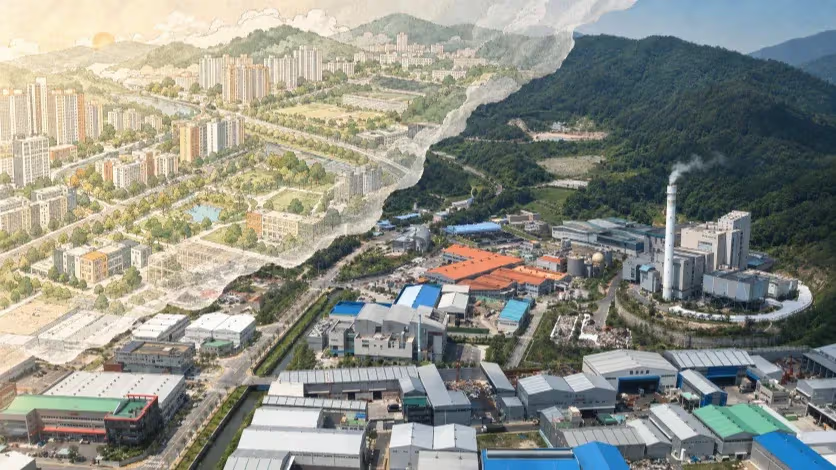 NewsSep 22, 2026
Busan Is Growing Westward as Its Waste Infrastructure Stays Put
Busan’s proposed Saenggok incinerator has moved from 800 to 500 tons a day. T...
 NewsAug 17, 2026
What South Korea’s 87% Drop in Aquaculture Heat Losses Really Measures
South Korea reported an 87 percent drop in aquaculture losses from high water...
 NewsAug 2, 2026
The City Built on Tomorrow’s Buyers
Busan’s apartment-led growth delivered housing and urban renewal at extraordi...
More from the author
More from this byline
Stay with the same line of reporting through more work from this byline.
 NewsSep 16, 2026
Busan’s Young-Adult Migration Turns Sharply at 25–29
 NewsSep 1, 2026
What Lee Jae Myung Thinks a Minister Can Fix
Reader Signal
Community readWhat did this report leave you with?
Choose the signal that best reflects your reading. Select it again to remove it.
One response per article
No response selected
A moderated conversation about the reporting.
One-level replies and newsroom moderation keep the conversation anchored to this article.
Discussion Status
Open
Please sign in to join the discussion.
Newsletter
Weekly reporting and context from Busan and Korea.