Zelensky, South Korea and the Limits of Wartime Pressure
South Korea says Kyiv broke a confidentiality understanding when Zelensky revealed the transfer of two North Korean POWs. The dispute exposes the limits of Ukraine’s wartime pressure on Seoul.

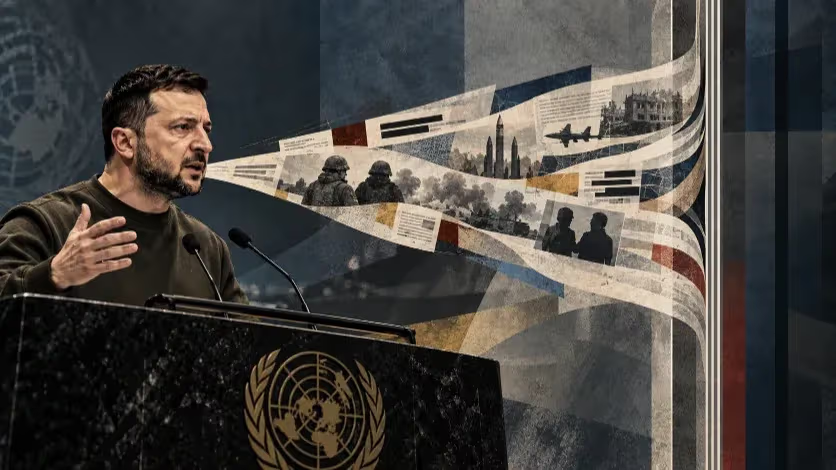
Seoul says Kyiv broke a confidentiality understanding when Volodymyr Zelensky disclosed the transfer of two North Korean POWs at the UN. The dispute exposes a recurring feature of his wartime diplomacy: turning a partner’s own security concerns into arguments for action, even when that partner draws the policy line somewhere else.
Volodymyr Zelensky was warning the United Nations about a war spreading far beyond Ukraine when he turned to North Korea. Pyongyang had sent soldiers to reinforce Russia, he said, while its forces were gaining experience in a modern war and its missile and drone capabilities were improving. Then Zelensky disclosed something South Korea had never announced: Ukraine had transferred two captured North Korean soldiers to the Republic of Korea. The men became part of his case that Russia was not merely drawing North Korea into a European war, but helping create a more capable military power that Asian governments would eventually have to confront.
The argument carried particular force in Seoul because the danger was real. North Korean troops had fought in Russia’s war, and South Korea had already begun examining what battlefield experience, military technology and a closer Moscow-Pyongyang relationship could mean for its own security. Zelensky did not have to invent a Korean interest in Ukraine. He used an interest that already existed and gave it a more urgent political meaning.
The problem was the fact he chose to make that argument concrete. Kyiv had told Seoul in advance that Zelensky might mention the prisoners, according to South Korean officials, but had not made clear that he would reveal their transfer to South Korea. Seoul says it responded by reiterating that the destination should remain confidential. Zelensky disclosed it anyway.
President Lee Jae Myung objected publicly, and the Foreign Ministry soon escalated the dispute through formal diplomatic channels. First Vice Foreign Minister Park Yoon-joo summoned Ukraine’s acting ambassador and demanded an explanation, an apology and measures to prevent another disclosure. Seoul said the two governments had operated under a clear confidentiality understanding because publicity could endanger the soldiers and their families. It then accused Kyiv of aggravating the breach by denying that such an understanding existed.
South Korea’s National Intelligence Service later supplied a chronology that made the complaint harder to dismiss as a misunderstanding created after the speech. According to lawmakers briefed by the agency, Ukraine had itself requested strict confidentiality early in discussions because publicity could complicate future prisoner exchanges. Officials on both sides then handled the case through diplomatic channels on the understanding that it would remain undisclosed. South Korean officials have also said written diplomatic records support their version, although those records remain closed.
Kyiv has denied that account. Dmytro Lytvyn, Zelensky’s communications adviser, said Ukraine had not agreed to conceal where the prisoners were sent. The disagreement therefore cannot yet be settled by comparing the underlying documents. But the two public accounts are not equally developed. Seoul has identified why confidentiality was requested, how the understanding was handled and who it says asked for secrecy first; Kyiv has answered with a categorical denial rather than a comparably detailed account of what it believed could be disclosed.
Months earlier, the same prisoners had represented cooperation rather than rupture. When Lee met Zelensky in Ankara in July, the two governments were already discussing how North Korean soldiers captured by Ukraine should be handled, while South Korea was also allocating a $100 million support package centered on humanitarian aid, recovery and reconstruction. Seoul was helping Ukraine without treating every form of support as one political decision. The prisoner case belonged to that broader relationship before their destination became the source of its most serious recent dispute.
Their eventual transfer carried no military bargain. The NIS later told lawmakers that Ukraine imposed no condition when it sent the two men to South Korea and that Seoul promised no military assistance in return. The prisoners did not arrive as payment for weapons, and South Korea did not incur a military debt by accepting them. The political meaning changed only after Zelensky made their transfer public and folded it into Ukraine’s argument about the Asian consequences of North Korea’s participation in Russia’s war.
That move turned a quietly managed act of bilateral cooperation into something else. Seoul had treated the destination as part of a sensitive process involving prisoners, families and future negotiations. Zelensky used the same fact as evidence that Russia’s war was already producing consequences on the Korean Peninsula. The disclosure placed a genuine Korean security concern inside Ukraine’s international campaign for broader action — and did so over an issue South Korea says Kyiv had agreed to keep out of public view.
From Prisoner Transfer to Public Argument
The prisoners’ move to South Korea began as a bilateral case. At the United Nations, the same transfer became part of Ukraine’s argument about North Korean military learning and Asian security.
Both men had expressed a desire to live in South Korea. The NIS later said Ukraine imposed no condition on their transfer and Seoul promised no military assistance in return.
A transfer handled through sensitive diplomacy is brought into Ukraine’s public case about the wider consequences of Russia’s war.
Zelensky links the prisoners to North Korean battlefield experience and to the risk that Russia is helping create a more capable military power in Asia.
South Korea says the destination was covered by a confidentiality understanding and that written diplomatic records support its account.
Ukraine says it had not agreed to conceal where the prisoners were sent.
The underlying diplomatic records have not been released publicly.
The Presidency Behind the Message
Zelensky’s speeches are not produced at a ceremonial distance from policy. Lytvyn has described a communications operation in which meetings, diplomatic reporting, intelligence briefings and military information flow toward a very small group around the president. Sometimes Zelensky supplies the idea or sets the task; at other times the narrative grows out of the information reaching the presidency. Only Lytvyn and Yurii Kostiuk regularly draft presidential speeches, and Lytvyn has described Zelensky as effectively his own communications team.
That proximity is central to the way the presidency uses communication. Lytvyn has said presidential messages are normally organized around concrete objectives rather than delivered because a president is expected to speak. Ukraine may need a particular weapon, an operation may require political support, or a partner may be moving toward a position Kyiv wants to stop. Communication is then built around changing that environment, and Zelensky looks for ways to increase pressure on the government or audience capable of producing the desired result.
That method has been one of Zelensky’s great political advantages during the war. Ukrainian military needs do not remain confined to requests exchanged between ministries. They can become public moral and political questions inside the countries being asked to respond. A delayed weapon becomes a choice about whether Ukraine survives. A partner’s historical memory becomes a measure of whether it is living up to its own values. A security danger already recognized by another government can become an argument that the government should move further.
The presidency from which that message comes was unusually strong even before Russia’s full-scale invasion. Zelensky won 73.22 percent of the second-round vote in 2019, and Servant of the People then secured 254 parliamentary seats — the first single-party majority in independent Ukraine. Personalized parties and presidents operating through informal influence were hardly new to Ukrainian politics. What changed was the concentration of an overwhelming personal mandate and a parliamentary majority around the same political project.
War magnified the part of that system most favorable to presidential leadership. Foreign affairs, defense and national security moved to the center of the state’s survival. The cabinet, parliament and military command continued to function, and substantial domestic policy remained outside Zelensky’s direct control. Yet the fields in which the presidency was already strongest became the fields through which Ukraine dealt with almost every important foreign partner. Zelensky’s personal political authority, the information gathered by the state and the language used to mobilize outside support came into unusually close contact.
The South Korean disclosure sits directly inside that structure. Kyiv has not said who proposed mentioning the prisoners’ destination, who reviewed the line or whether Seoul’s objection reached Zelensky personally. Those questions remain unanswered. What is already known about the communications system makes the absence of an explanation consequential: this is a presidency that describes its international messages as deliberate instruments of policy, built from diplomatic and security information and designed to move foreign audiences. The reference to South Korea did not emerge from a communications apparatus that treats presidential speeches as ornamental.
From State Information to Presidential Pressure
Diplomatic, intelligence and military information can move through a very small communications circle around Zelensky before becoming a public message built around a political objective.
The Limits of Pressure
Britain showed how powerful Zelensky’s method could be when a partner’s own strategic judgment already pointed in the same direction. After his March 2022 address to the House of Commons, Prime Minister Boris Johnson said the Ukrainian president had moved lawmakers and renewed Britain’s commitment to supporting Ukraine. Zelensky’s words produced an extraordinary political moment, but they did not create British military support from nothing. London had trained more than 22,000 Ukrainian personnel since 2015 and had begun sending anti-armor weapons before Russia launched the full-scale invasion.
Zelensky accelerated a choice Britain was already prepared to make. He gave ministers a language of urgency, brought Ukrainian requests directly before Parliament and made the costs of hesitation harder to separate from the images of Russian aggression reaching British voters. The closer Britain’s existing view of Russia was to Ukraine’s own, the easier it became for Zelensky to turn shared concern into additional action. His influence worked because the underlying strategic alignment was already strong.
Germany exposed the other side of that power. Zelensky’s address to the Bundestag invoked German history and the Berlin Wall while attacking the hesitation of a government that had spent years building economic ties with Russia. His speech put Chancellor Olaf Scholz under immediate domestic pressure and helped make German delay itself a political issue. But it did not remove the calculations driving Berlin’s caution: military stocks, coordination with allies and fear of escalation remained German problems that Ukraine could criticize but could not assume.
The months-long fight over Leopard 2 tanks made the boundary unmistakable. Ukraine, eastern European governments and German opposition politicians pressed Scholz to move faster, while the chancellor insisted on allied coordination and continued warning against a direct Russia-NATO confrontation. Germany eventually authorized the tanks and permitted other states to send their German-made Leopards. Zelensky had helped make continued hesitation politically expensive. The timing and scale of German military involvement still remained a decision Berlin claimed for itself.
Research on Zelensky’s tailored wartime appeals points in the same direction. Historical analogies drawn from speeches delivered to audiences in Britain, Germany, the United States and Israel produced emotional responses without reliably producing the same movement in policy preferences across those countries. Allied military support also varied widely according to geography, threat perception, military capacity, economic interests and domestic politics. Governments could hear the same Ukrainian argument while confronting very different consequences if they acted on it.
Zelensky’s influence therefore operates most powerfully in the distance between an interest a partner already recognizes and the action Ukraine wants that interest to produce. He can narrow that distance. He can raise the political price of delay and make an issue more difficult for another government to avoid. What he cannot do is eliminate the interests, risks and constituencies that make the partner’s decision different from Ukraine’s own.
When Solidarity Meets Another Responsibility
Israel encountered that tension only weeks into the full-scale war. Addressing members of the Knesset, Zelensky invoked Golda Meir, linked Jewish and Ukrainian histories and drew on memories of existential persecution in Europe. He then moved from memory to present policy, challenging Israel over the depth of its response to Russia. The appeal asked Israelis to see support for Ukraine not simply as foreign policy but as a demand arising from the meaning they attached to their own history.
Some Israeli lawmakers who opposed Russia’s invasion nevertheless rejected the comparison. They objected to Zelensky’s treatment of Holocaust history and to the place of Ukrainian history within it. The Israeli government also had a security problem much closer to home: Russian forces were operating in Syria, where Israel depended on a deconfliction mechanism with Moscow as it struck Iranian positions and weapons transfers. Ukraine could challenge the morality of Israeli restraint. It would not bear the military consequences if that arrangement collapsed.
Poland reached a similar conflict from the opposite direction. Few governments had done more for Ukraine after February 2022. Poland supplied military assistance, became a logistical route for outside support and absorbed millions of Ukrainians fleeing the war. By 2023, however, agricultural imports from Ukraine were creating intense pressure on Polish farmers and the domestic market. Warsaw chose to maintain restrictions on selected Ukrainian products, arguing that support for Ukraine did not relieve a Polish government of responsibility for the people bearing those costs at home.
Zelensky answered from the UN General Assembly by accusing some European friends of turning solidarity into “political theater” over grain while indirectly helping Moscow. Poland summoned Ukraine’s ambassador the following day. Its Foreign Ministry called the accusation unjustified, rejected international pressure as a way to resolve the dispute and criticized Kyiv for presenting a multidimensional economic problem through a unilateral Ukrainian narrative.
The clash was important precisely because Poland’s commitment to Ukraine was so difficult to question. Warsaw did not need to become indifferent to Ukrainian survival before refusing the policy conclusion Zelensky wanted. Its solidarity had limits defined by another responsibility. Israel faced a military calculation in Syria; Poland faced concentrated domestic economic costs. The political language Ukraine used to turn solidarity into action became more contentious when the partner itself would absorb consequences that Kyiv could not.
South Korea confronted the same tension under harder security conditions. North Korea’s participation in Russia’s war was not an analogy borrowed from Korean history or an economic dispute adjacent to the war. It directly affected the military environment around the peninsula. Seoul had every reason to care about what North Korean soldiers were learning, what Russia might give Pyongyang in return and how the battlefield relationship might alter North Korea’s capabilities.
That made Kyiv’s argument stronger in Korea than it had been in many other capitals. It also made the boundary more important. South Korea could agree that the threat had changed without agreeing that every response Ukraine wanted had now become a Korean necessity.
The Line Seoul Kept
Zelensky had been trying to move that boundary since 2022. In his April address to South Korea’s National Assembly, he appealed for military assistance and argued that the weapons Ukraine needed would protect more than Ukraine itself. At that point North Korean soldiers were not fighting for Russia. Kyiv’s desire for Korean military support arose from the requirements of its own war, years before Pyongyang’s intervention supplied a much stronger argument about South Korea’s direct security interests.
North Korea’s deployment in 2024 changed Seoul’s calculation on its own terms. South Korea’s intelligence agencies were tracking North Korean troops in Russia, and then-President Yoon Suk Yeol treated their involvement as a serious security development. Zelensky called it an internationalization of the war. The two governments expanded intelligence exchanges, discussed countermeasures and sent delegations to coordinate their response.
For South Korea, Ukraine had become a source of information about an adversary it might someday confront closer to home. North Korean soldiers could return with experience in artillery, drones, battlefield command and combined operations. Moscow might compensate Pyongyang with military technology or political protection. What happened on the Ukrainian battlefield had acquired direct value for Korean security planning.
Seoul responded, but not along a single policy track. Intelligence cooperation could deepen without lethal weapons following automatically. Sanctions, diplomatic pressure, humanitarian aid, reconstruction support and military assistance carried different consequences. Russia’s growing relationship with North Korea strengthened the case for doing more with Ukraine while simultaneously increasing the importance of calculating how Moscow might respond to each Korean decision.
Lee’s government preserved that separation in 2026. South Korea allocated a $100 million comprehensive support package to Ukraine and continued cooperation with Kyiv while withholding lethal weapons. The prisoner case also moved forward without becoming part of a military transaction. Seoul was willing to deepen the relationship in some areas while retaining control over the decision Ukraine had been trying to move since the opening year of the war.
The transfer of the two prisoners initially respected that line. The NIS told lawmakers that Ukraine imposed no conditions when the men were sent to South Korea and that Seoul promised no military aid in exchange. There was no prisoners-for-weapons bargain. After Zelensky disclosed their destination, however, the agency assessed that the announcement may have been intended to build South Korean support for greater assistance to Ukraine, potentially including weapons.
That assessment does not prove Zelensky’s personal motive. It does not stand in isolation either. Ukraine had been asking South Korea for military support since 2022, and North Korea’s entry into the war had dramatically strengthened Kyiv’s ability to argue that helping Ukraine was also an act of Korean self-defense. Zelensky then placed the prisoners’ arrival in South Korea inside an address about North Korean battlefield learning and Asian security. The speech joined a real Korean danger to a broader Ukrainian demand for international action.
Seoul had already responded to that danger. It exchanged intelligence with Ukraine, increased assistance, monitored Russia’s military relationship with North Korea and accepted responsibility for the two captured soldiers. What it had not done was allow those choices to collapse into one another. Lethal weapons remained separate. Relations with Russia remained a Korean calculation. Sensitive North Korean cases remained tied to concerns about prisoners, families and the future management of inter-Korean security.
South Korea Expanded Cooperation Without Crossing the Weapons Line
North Korea’s entry into the war gave Seoul stronger reasons to work with Kyiv. Intelligence, assistance and prisoner coordination expanded, while direct lethal support remained a separate Korean decision.
The NIS said the prisoner transfer itself carried no military condition and that South Korea promised no military aid in exchange.
Zelensky’s disclosure crossed directly into that separation. A prisoner transfer that had not required military support became part of a public argument capable of increasing political pressure for military support. Information South Korea says had been protected by bilateral confidentiality became evidence in Ukraine’s case about what North Korea’s participation should mean for other governments. Kyiv has denied breaking an agreement, but it has not explained the disclosure with anything approaching the detail Seoul has given for why the information was supposed to remain private.
The episode therefore reaches beyond a disagreement over diplomatic etiquette. Zelensky’s wartime politics has repeatedly worked by taking something a partner already believes — its historical responsibility, its solidarity with Ukraine, its fear of Russian aggression or its concern about North Korea — and pressing the political distance between that belief and the action Kyiv wants. In South Korea, the underlying security connection was stronger than in many of his earlier appeals. So was the sensitivity of the policy space he was entering.
Kyrylo Budanov widened that collision days later. The head of Ukraine’s Presidential Office warned that North Korea was learning from the war and improving its capabilities, then raised the possibility of worsening instability on the Korean Peninsula. His warning rested on real dangers. A mine explosion near the Military Demarcation Line had injured South Korean soldiers, and a South Korean–United Nations Command investigation concluded that a North Korean mine was involved and that an armistice violation had occurred. Pyongyang denied responsibility.
Lee objected not to the existence of the North Korean threat but to the way Ukrainian officials were speaking about where it might lead. On Oct. 2, while his government was still demanding an apology over the prisoner disclosure, he accused Ukraine of invoking the possibility of inter-Korean conflict in a way that appeared to encourage war and warned that South Korea could take additional measures. Lee went further in assigning intention than the released facts can support. His anger nevertheless exposed the larger deterioration: Seoul increasingly saw Ukraine as moving from warning South Korea about a danger they shared to speaking as if that danger should carry Korean policy toward conclusions Kyiv preferred.
Ukraine’s foreign minister, Andrii Sybiha, was already trying to pull the relationship back. He called the episode a diplomatic misunderstanding, emphasized South Korea’s importance as a partner and said Kyiv wanted it resolved quickly. South Korean officials said Sybiha and Foreign Minister Cho Hyun were communicating directly over the form and substance of Ukraine’s response to Seoul’s demand.
The two governments had once negotiated the prisoners’ journey away from public view. They were now negotiating the language needed to repair the relationship after Zelensky made that journey part of his case to the world.
Continue this reporting
Reporting on the same issue
Related coverage selected from the article's desk, topics and newsroom relationships.
 NewsSep 1, 2026
What Lee Jae Myung Thinks a Minister Can Fix
President Lee Jae Myung says reform should be judged by results rather than c...
 NewsAug 21, 2026
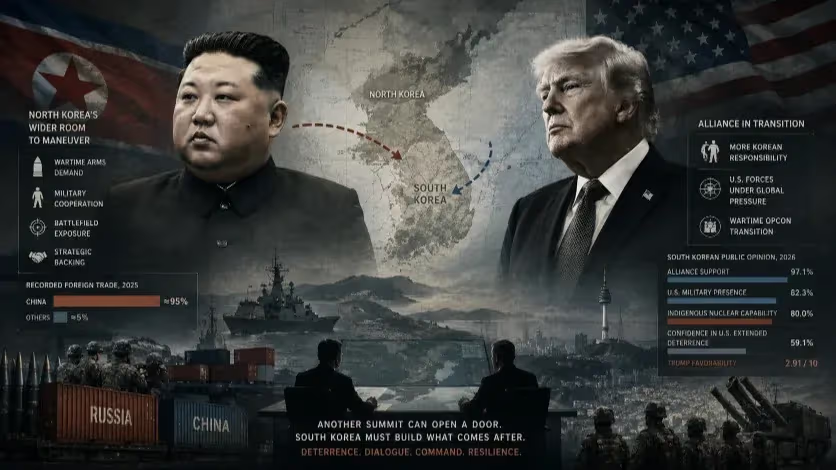
The Korean Peninsula Trump Is Returning To
Another Trump-Kim summit would unfold on a peninsula where North Korea is har...
 NewsAug 16, 2026
What Makes a North Korea Policy Survive a Change of Government?
From Kaesong to military agreements, South Korea’s history shows why some Nor...
More from the author
More from this byline
Stay with the same line of reporting through more work from this byline.
 NewsOct 21, 2026
What a Small Mackerel Is Worth
Reader Signal
Community readWhat did this report leave you with?
Choose the signal that best reflects your reading. Select it again to remove it.
One response per article
No response selected
A moderated conversation about the reporting.
One-level replies and newsroom moderation keep the conversation anchored to this article.
Discussion Status
Open
Please sign in to join the discussion.
Newsletter
Weekly reporting and context from Busan and Korea.