What Lee Jae Myung Thinks a Minister Can Fix
President Lee Jae Myung says reform should be judged by results rather than confrontation. His latest cabinet choices offer a test of that doctrine: whether changing the person in charge can actually change the institutions beneath them.

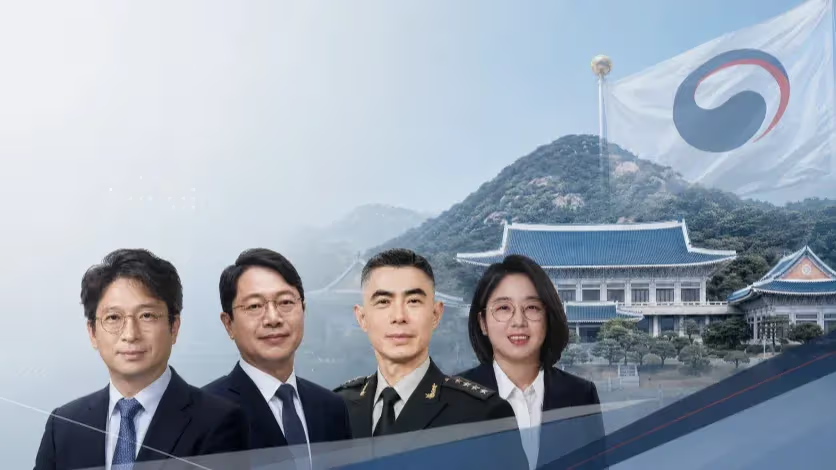
Five days after President Lee Jae Myung argued that reform should be judged by results rather than confrontation, he nominated six new ministers. The reshuffle offers a revealing map of where his government believes policy is getting stuck — and of the risks that arise when institutional problems are translated into personnel choices.
Five days before remaking a substantial part of his cabinet, President Lee Jae Myung offered what amounted to a theory of governing. Reform, he argued at an August 25 cabinet meeting, could defeat itself when political clarity became an end in its own right: governments might win applause by announcing uncompromising goals, only to harden resistance so thoroughly that the institutions they intended to change became harder to move. The answer, in Lee’s formulation, was a more practical and effective approach, one that measured reform less by the conspicuousness of the struggle than by whether the government could produce results without allowing the conflict surrounding change to consume the change itself.
On August 30, Lee nominated new ministers for finance and economy, land and transport, justice, national defense, gender equality and family affairs, and small and medium-sized enterprises and startups. The presidential office presented the reshuffle as an attempt to put “dynamism and expertise” behind changes the public could feel, but its descriptions of the nominees made clear that expertise meant very different things from one ministry to another. Hong Jee-sun, the serving vice minister for transport, was chosen for his record of taking housing policy from design through implementation; Kim Seung-won, a former judge and Democratic Party lawmaker, for his understanding of the coming criminal-justice restructuring; retired four-star general Kang Shin-chul for alliance management and military reform; and Basic Income Party lawmaker Yong Hye-in for what the presidential office called a fresh perspective, political drive and an ability to move beyond generational and gender conflict.
The personnel reset widened on September 1 when Lee accepted the resignation of presidential policy chief Kim Yong-beom, a central figure in the administration’s economic policymaking. The resignation came as the president’s approval rating had fallen and public dissatisfaction over housing costs had become a more visible political liability, although neither the presidential office nor Kim publicly established a single policy failure as the cause of his departure. What is clearer is that the administration is entering its second year by changing not merely individuals but, in several cases, the professional type of person assigned to an existing problem.
Cabinet appointments are never pure exercises in administrative diagnosis. Presidents use them to manage parties and factions, reward trust, broaden representation, prepare for future political contests and balance constituencies that do not appear on an organizational chart. But this administration has itself justified the reshuffle in the language of implementation, expertise and tangible results. That makes the causal claims embedded in the appointments fair subjects for scrutiny. If a minister is being changed because the government believes policy is stuck, the more revealing question is not simply whether the replacement has an impressive résumé. It is what the government believes is causing the blockage, and why the particular capacity of the person entering the office should give that ministry greater leverage over it.
Where the Personnel Logic Is Clearest
Housing offers the easiest place to see that logic because the administration has already spent much of the past year determining what it wants the Ministry of Land, Infrastructure and Transport to do. Its 2026 work program calls for construction to begin on more than 50,000 homes on public land in the Seoul metropolitan region, including 29,000 units to be offered for sale, while committing to supply at least 1.1 million units of publicly supported affordable housing over five years. The plan also seeks to accelerate third-generation new towns, resolve permitting conflicts more quickly and increase direct development by the Korea Land and Housing Corporation rather than relying as heavily on land sales to private developers. Whatever the merits of those policies, the government does not lack a declared housing strategy; much of the challenge now lies in getting announced supply through the institutions that turn a target into a completed home.
Hong Jee-sun’s nomination fits that diagnosis unusually well. In explaining the choice, the presidential office emphasized his experience in Gyeonggi Province, where he had overseen housing policy “from design through field implementation,” and described him as a field-oriented administrator capable of delivering homes quickly in the places where demand is concentrated. The move from a politician to a serving vice minister therefore reads less like another ideological turn in housing policy than a wager that administrative execution has become the binding constraint.
The wager may still be wrong. A land minister can accelerate public development, alter regulatory procedures and push projects through parts of the permitting system, but he cannot determine mortgage-credit conditions, the Bank of Korea’s interest-rate path, household expectations, property taxation or every redevelopment decision taken by local governments. Housing is useful precisely because it exposes the limits as well as the attraction of personnel politics: a more execution-oriented minister may gain leverage over part of the system without gaining control over the market in which the result is ultimately priced. If construction moves more quickly while apartment prices remain elevated, judging Hong solely by the latter would confuse the outcome the public cares about with the narrower mechanism the government says his appointment is meant to improve.
The Justice Ministry presents a different transition, but one that is also visible before the new minister takes office. South Korea is approaching one of the most consequential reorganizations of its criminal-justice system in decades. The government finalized bills establishing the new Prosecution Service and Serious Crimes Investigation Agency in March, while continuing to debate the division of investigative authority and safeguards against gaps between agencies. In August, the cabinet approved revisions to the Criminal Procedure Act that abolish prosecutors’ supplementary investigative authority while strengthening mechanisms for requesting further investigation and other forms of oversight; the new system is scheduled to take effect alongside the launch of the new agencies on October 2.
Kim Seung-won’s nomination can therefore be read against an identifiable change in the work itself. The broad political decision to dismantle the old prosecutorial structure has largely moved into law. The next problems concern how the new institutions will function when jurisdiction is divided, how defective investigations are corrected, how staff and budgets are allocated, and whether victims experience the new architecture as more accountable or merely more fragmented. The presidential office has framed Kim, a former judge and lawmaker on the National Assembly’s Legislation and Judiciary Committee, as someone capable of bringing that new system into operation while protecting victims’ rights.
His political profile creates risks of its own. A justice minister with enough political authority to force a contested institutional transition through a reluctant system may also raise concerns about whether powers formally dispersed by reform are being reorganized around new partisan relationships. The test of the restructuring will not be whether new agencies open on time but whether the distribution of authority functions as intended: whether investigative failures can be corrected without quietly recreating the powers that were abolished, whether victims can move through the system without falling between institutions, and whether the separation of investigation and prosecution disperses state power in practice rather than only on paper. Yet the reason for changing leadership is at least intelligible. The institutional phase has changed, and the government can describe the work it believes the next minister must perform.
Housing and justice are valuable for that reason. They show what a defensible personnel argument looks like without proving that the personnel choice will succeed. The explanation starts with an existing policy, identifies an unfinished task and then connects the qualities of the new minister to that task. The more difficult appointments are those in which one of those links remains uncertain.
Did Civilian Control Become an Institution?
National defense is the most consequential test because the professional identity of the outgoing minister was itself part of the reform. When Ahn Gyu-back took office in July 2025, he became South Korea’s first civilian defense minister in 64 years, following a martial-law crisis in which the deployment of military forces had made civilian control an immediate question of democratic recovery rather than a constitutional abstraction. His appointment was intended not simply to place an experienced lawmaker at the Defense Ministry but to signal that a military drawn into domestic politics would again be subordinated clearly to civilian authority.
That agenda subsequently acquired an institutional dimension. In June, the Defense Ministry announced that it would dismantle the Defense Counterintelligence Command and divide its counterintelligence, security and national-security investigation functions. The proposal would also eliminate politically sensitive activities including trend monitoring, personnel intelligence and reputational information gathering. Ahn described the change as a restructuring of the organization and its mission designed to ensure that a military intelligence body could never again intervene in politics. The distinction is important: instructing an intelligence organization not to misuse powers it retains would be a personnel solution; removing or redistributing the powers that made political abuse possible is an attempt to alter the institution itself.
Ahn’s broader defense agenda, however, was not complete. The ministry was still developing a 2040 force structure built around a smaller, more technologically intensive military using AI and advanced systems, while the government was pursuing wartime operational-control transition and controversial changes to the military academy system. In June, Ahn was still publicly presenting force restructuring as a project whose basic strategic and personnel design remained under development.
Lee has now chosen Kang Shin-chul, a retired four-star general and former deputy commander of the South Korea-U.S. Combined Forces Command. The presidential office explicitly linked his background to strengthening the alliance, preparing for future warfare, building greater autonomous defense capacity and moving ahead with defense innovation, including academy integration.
There is a coherent case for the sequence. The democratic repair demanded after martial law and the technical execution required for command reform are not the same task. A civilian politician may have been particularly well placed to dismantle a politically compromised intelligence structure and assert civilian supremacy, while a former combined-forces commander may bring professional authority and alliance experience to negotiations over command arrangements and military restructuring. A pragmatic administration need not preserve the symbolism of an earlier stage indefinitely if the institutional achievement of that stage has become durable.
But that is precisely what the appointment will now test. The return of a former general does not, by itself, constitute a retreat from civilian control; democratic governments frequently place former officers in political office. The harder question is whether the rules established during the period of civilian leadership are strong enough to constrain the next minister regardless of his professional origins. If the functions removed from the Defense Counterintelligence Command remain gone, if successor organizations do not reconstruct equivalent informal powers and if civilian and parliamentary oversight survives after the political urgency of martial law fades, then Kang’s appointment may ultimately demonstrate that civilian control has moved beyond dependence on a civilian figurehead.
If those safeguards weaken after Ahn leaves, the implication is very different. A reform celebrated as structural would turn out to have remained attached, at least in part, to the individual who supplied the political force behind it. National defense therefore gives Lee’s theory of pragmatic sequencing a demanding but intelligible test: the government can explain why a different professional background might be useful in the work ahead, but that explanation is credible only if the reforms of the first phase survive the person who carried them.
A Ministry Still Under Construction
The transition is harder to identify at the Ministry of Gender Equality and Family Affairs because the institution Yong Hye-in has been nominated to lead is itself less than a year into a major reconstruction.
Won Min-kyong entered government from a background in gender law and human-rights advocacy. After her appointment, the former Ministry of Gender Equality and Family was expanded and relaunched on October 1, 2025, as the Ministry of Gender Equality and Family Affairs. The reorganization created a Gender Equality Policy Office, a new Employment Equality Policy Bureau and a reorganized Safety and Human Rights Policy Bureau, while transferring responsibilities from the Ministry of Employment and Labor including affirmative employment improvement measures and gender-based employment disclosure. The government described the new ministry as a policy “control tower” whose role would extend beyond the traditional administration of women’s, youth and family programs.
Its responsibilities now reach into labor-market inequality, career interruption, gender-based violence, stalking and intimate-partner violence, digital sexual crime, child care, single-parent support and youth policy. Its 2026 expenditure was set at 2.0087 trillion won, up 13 percent from 2025, including additional resources for digital-sex-crime response, legal assistance to victims and a new national qualification system for child-care workers. The larger mission has not magically given the ministry command over all of the institutions on which those outcomes depend, but it has made the office substantially more administrative than the caricature of a ministry concerned mainly with symbolic gender politics would suggest.
Nor was that reconstruction merely sitting on paper when Lee decided to change the minister. A government-wide Digital Sexual Crime Victim Integrated Support Task Force began operating in May, linking the ministry with police and communications regulators in an effort to combine victim assistance with faster blocking, analysis and investigative referrals. The child-support advance-payment program reported that 6,923 households and 10,917 minors had received 16.73 billion won during its first year. The ministry was also preparing the employment-equality disclosure system for a planned 2027 launch: it signed a cooperation agreement with the Korean Women’s Development Institute in June and established a joint planning group in July to develop the disclosure infrastructure and operating model.
These figures should not be mistaken for proof that Won had solved the problems entrusted to her. Administrative activity is not the same thing as social effect. A new bureau does not close South Korea’s gender wage gap, a task force does not demonstrate that digital sexual crime is falling, and a broader mandate can make a ministry appear more powerful on an organization chart while exposing how dependent it remains on police, labor regulators, courts, local governments and private employers. The case for adding greater political weight to the ministry is therefore not implausible. An agency that must secure action from institutions with larger budgets and stronger statutory authority may benefit from a minister who can bargain across government, command parliamentary attention and turn interagency disputes into presidential priorities.
That qualification matters because it prevents the comparison between Won and Yong from collapsing into the easy opposition of specialist and politician. Cabinet ministers are political officials by design, and political authority can itself be an administrative resource. The relevant question is whether the kind of political authority the government gains through Yong’s appointment corresponds to the difficulty that was actually preventing the ministry from advancing.
On that point, the public explanation remains less complete than it is in housing, justice or even defense. The presidential office has described Yong as a young two-term lawmaker who has spoken on digital sexual crime and work-family balance and who can bring a fresh perspective and strong political drive to the task of moving beyond generational and gender conflict. It has been much less specific about what had ceased to work under Won, what institutional stage had been completed, or what new obstacle emerged in August that made a different type of leadership necessary.
Yong does have experience relevant to parts of the portfolio. She has served on the National Assembly committee overseeing gender and family policy, and the opposition claim that none of the 116 bills she introduced as lead sponsor in the 21st and 22nd assemblies fell directly under that committee’s laws tells only part of the story: she also co-sponsored 20 such bills in the 21st Assembly and six in the current one. Committee jurisdiction is in any case an imperfect measure of preparation for a ministry whose responsibilities now cross labor, care, safety and family policy.
The more consequential difference lies not in whether Yong has ever worked on gender policy but in the type of capacity her career supplies. She brings parliamentary experience, public visibility, leadership of a minor progressive party and a political identity that is independent of the Democratic Party while remaining broadly aligned with the governing camp. Those attributes may enable her to do things a specialist minister could not do as effectively: press other ministries, negotiate legislation, defend an expanded policy remit and give a relatively small coordinating agency greater weight inside the executive.
Yet those advantages are still prospective. The administration has explained what it likes about Yong more precisely than it has explained why insufficient political leverage had become the ministry’s principal bottleneck. A convincing institutional case would identify decisions that had stalled, cross-ministerial conflicts that specialist leadership could not settle, or legislation whose passage required a different coalition. Without that intermediate explanation, the argument risks moving too easily from the proposition that Yong possesses political capacity to the separate proposition that political capacity was what the ministry most needed at this particular moment.
Her intention to retain her National Assembly seat makes the appointment more revealing still. Korean law permits a lawmaker to serve concurrently as a cabinet minister, so the issue is not one of formal eligibility. Yong has said that resigning her proportional-representation seat would leave the Basic Income Party, of which she is the sole National Assembly member, outside parliament; historically, proportional lawmakers entering cabinet have generally resigned so that the next candidate on the party list can take the seat.
The arrangement creates an accountability problem more interesting than the accusation that one politician is trying to keep two positions. As a cabinet minister, Yong would participate in executive government and be responsible for carrying out its collective decisions. As a lawmaker, she belongs to an institution responsible for scrutinizing that government. As the Basic Income Party’s only member of parliament, she also carries an unusually direct responsibility for the continued legislative presence of her party. Korean constitutional practice allows the first two roles to coexist, but their concentration together with the third makes the political meaning of the appointment unusually difficult to separate from its administrative one.
It may, in fact, be part of the point. Bringing the leader of a minor progressive party into cabinet without removing that party’s sole parliamentary seat widens the constituency invested in Lee’s government without creating a formal coalition. Presidents have always used cabinet appointments to build political alliances as well as to administer ministries, and there is nothing inherently improper in that purpose. A fragmented political system may even make coalition-building a practical requirement of governance.
But coalition value and administrative value cannot simply be assumed to be identical. Yong may strengthen both the government’s progressive political network and the ministry’s ability to negotiate with more powerful agencies, but the first outcome does not prove the second. If her political standing is the additional capacity Lee believes the ministry needs, the evidence will eventually appear in whether unfinished legislation advances, whether other ministries cooperate more readily, whether the employment-equality system enters operation on schedule and whether political visibility becomes enforceable institutional leverage rather than merely greater attention.
That is why the nomination deserves more scrutiny than a simple argument over Yong’s ideological positions or résumé. It may prove to be a successful political appointment. What is not yet fully visible is the phase transition that made it necessary.
Pragmatism and the Burden of Causation
Lee’s reshuffle does not support the simple claim that his government prefers politicians to experts, or experts to politicians. The pattern is too varied for that. A serving administrator has been elevated at the land ministry; a political lawyer has been selected for a criminal-justice system nearing implementation; a former general is poised to inherit reforms begun by a civilian defense minister; and a specialist in gender law may be replaced by a younger politician in a ministry whose reconstruction is still under way. If there is a common theory here, it is not a theory of professional background. It is the proposition that different bottlenecks require different kinds of authority.
That proposition is compatible with Lee’s broader argument about pragmatic reform. A government does not have to preserve the same political style throughout every stage of a reform. The qualities required to dismantle an old institution may differ from those required to operate its replacement; the official who can design a policy may not be the one best equipped to drive it through local permitting or bureaucratic resistance. Pragmatism in this sense is not the abandonment of an institutional destination but an adjustment of the means used to reach it.
The difficulty is that genuine sequencing imposes a burden of explanation. A sequence has recognizable stages. The government should be able to say what the earlier stage was meant to accomplish, what actually changed, what remains stuck and why the new minister has greater leverage over that remaining obstacle. Without those links, pragmatism becomes so elastic that almost any reversal, delay or personnel change can be justified after the fact as adaptation.
That distinction matters particularly in a presidential system, where policy failure is easily personalized. When housing remains unaffordable, attention turns to the housing minister; when legal reform becomes contentious, the demand is for a stronger justice minister; when a small social-policy ministry lacks influence, the answer can be to place a more prominent politician at its head. Ministers are visible, while institutional interdependence is not. Yet the hardest problems in this reshuffle are difficult precisely because responsibility is distributed. Housing depends on credit, interest rates, municipalities, public developers and private markets. The new criminal-justice system requires institutions deliberately separated from one another to cooperate without reconstructing the concentration of power the reform was designed to end. Defense has to combine democratic civilian supremacy with the professional autonomy required for a military to function. Gender-equality policy seeks to change behavior in workplaces, police investigations, courts, families and online platforms over which the ministry exercises only partial authority.
A capable minister can improve coordination, force decisions and raise the political cost of bureaucratic inaction. No minister can abolish that interdependence. A government that asks to be judged by practical results must therefore become more rigorous, not less, about causation: what result is the appointment supposed to alter, through what power available to the minister, and on what timetable?
That standard gives the reshuffle tests that can eventually be observed rather than merely debated. Hong’s case will depend in part on whether projects already embedded in the government’s housing pipeline move more quickly through implementation. Kim’s will depend on whether the new criminal-justice institutions operate without creating the investigative gaps and renewed concentrations of authority their designers say they are trying to avoid. Kang’s will depend on whether the democratic constraints established during Ahn’s civilian tenure survive under a former general while operational reform proceeds. Yong’s political visibility will matter if it gives a still-developing ministry greater capacity to compel cooperation and complete the institutional work already under way.
For now, the last of those appointments remains the least fully explained in causal terms. That is not the same as saying it is the weakest nominee or that the appointment will fail. The government has made a case for Yong Hye-in’s political attributes. It has not yet made an equally precise public case that those attributes correspond to the binding constraint at the Ministry of Gender Equality and Family Affairs at this stage of its development.
The distinction goes beyond one nomination. Presidents inevitably govern through people. Ministers choose senior officials, negotiate budgets, decide which disputes deserve escalation and determine whether a bureaucracy treats a presidential priority as an enduring mandate or a temporary instruction. Individual leadership is therefore real, and institutional analysis that pretends otherwise misses an important part of government.
Reform matures, however, when the relationship begins to work in the opposite direction as well — when the institution can preserve the change after the person who drove it has gone.
Civilian control of the military will be stronger if it survives the arrival of a former general. Criminal-justice reform will be stronger if the allocation of authority functions regardless of the partisan preferences of the justice minister. Housing delivery will be stronger when projects can move through ordinary administrative systems without requiring exceptional intervention from whoever occupies the minister’s office. The gender-equality ministry will be stronger when its capacity to coordinate labor, safety and family policy rests on durable authority and working institutions rather than on the exceptional political influence of any one minister.
That is the more difficult test of Lee Jae Myung’s practical reform. The immediate question is whether he has chosen people suited to the problems confronting his government. The longer one is whether, if those people succeed, they leave behind institutions that depend less on finding the right person again.
A cabinet reshuffle can show what a president thinks is broken. It cannot establish that the diagnosis is right. That evidence comes later, when the institutional bottleneck either moves or does not — and, after the minister has moved on, when it becomes possible to see whether it stays moved.
Continue this reporting
Reporting on the same issue
Related coverage selected from the article's desk, topics and newsroom relationships.
 NewsOct 4, 2026
Zelensky, South Korea and the Limits of Wartime Pressure
South Korea says Kyiv broke a confidentiality understanding when Zelensky rev...
 NewsAug 21, 2026
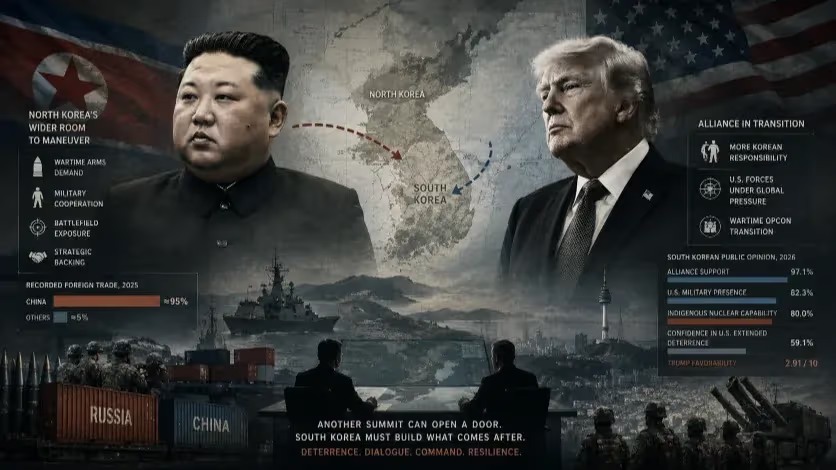
The Korean Peninsula Trump Is Returning To
Another Trump-Kim summit would unfold on a peninsula where North Korea is har...
 NewsAug 16, 2026
What Makes a North Korea Policy Survive a Change of Government?
From Kaesong to military agreements, South Korea’s history shows why some Nor...
More from the author
More from this byline
Stay with the same line of reporting through more work from this byline.
 NewsSep 16, 2026
Busan’s Young-Adult Migration Turns Sharply at 25–29

Reader Signal
Community readWhat did this report leave you with?
Choose the signal that best reflects your reading. Select it again to remove it.
One response per article
No response selected
A moderated conversation about the reporting.
One-level replies and newsroom moderation keep the conversation anchored to this article.
Discussion Status
Open
Please sign in to join the discussion.
Newsletter
Weekly reporting and context from Busan and Korea.