The Korean Peninsula Trump Is Returning To
Another Trump-Kim summit would unfold on a peninsula where North Korea is harder to isolate, U.S. military priorities are increasingly global and South Korea is seeking greater authority over the defense of its own state.

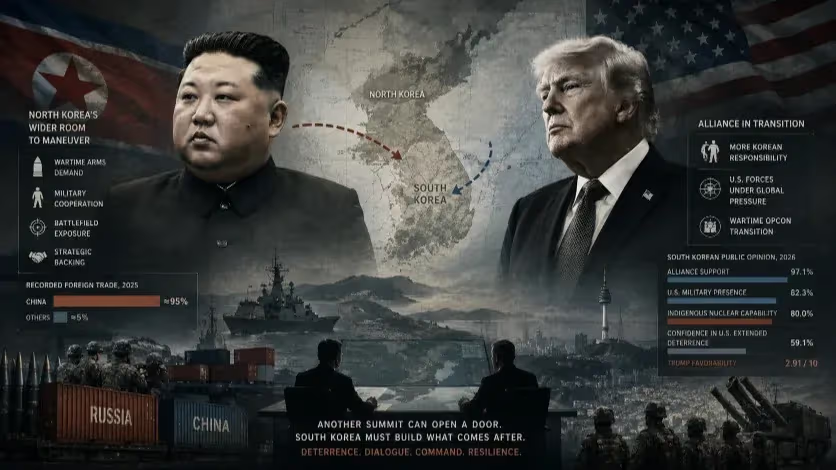
Donald Trump is reaching again for Kim Jong Un as the war with Iran weighs on Washington. But Pyongyang now has wider room to maneuver through Russia, China is reasserting its influence, and Seoul is being asked to carry more responsibility for a war it is still preparing to command.
Trump Wants Kim Jong Un Talks Again. The Korean Peninsula Has Changed
President Donald Trump’s decision to cut Ulchi Freedom Shield carried an explanation that did not stay within the geography of the Korean Peninsula. When he ordered the Pentagon on Aug. 16 to substantially reduce the annual U.S.-South Korean exercise, Trump spoke about its cost and his relationship with Kim Jong Un, but he also invoked Seoul’s refusal to support American action against Iran. The command-post exercise, originally scheduled for 11 days, was reduced to five, its counteroffensive phase removed and some associated field training scaled back. A military exercise designed around a possible war in Korea had become entangled with an American conflict in the Middle East and with a president who has long treated alliance costs, military commitments and personal diplomacy as parts of the same political negotiation.
The reduction did not erase the alliance’s preparations for war. South Korea said the Full Operational Capability assessments scheduled for this year’s exercise had already been completed, and other training continues through the year. Yet Ulchi Freedom Shield is part of the machinery through which South Korean and American forces prepare to fight if deterrence fails, while the alliance is moving toward a future in which a South Korean general would lead the Combined Forces Command in wartime. Washington is asking Seoul to assume more of the conventional defense burden as American forces are weighed against demands in the Middle East, competition with China and commitments elsewhere.
Trump’s renewed interest in Kim therefore comes under very different conditions from the diplomacy of his first presidency. The Iran war is approaching its sixth month without a durable settlement, disruption around the Strait of Hormuz has imposed economic costs beyond the battlefield, and skepticism about a prolonged conflict has grown inside the United States. There is no evidence strong enough to reduce Trump’s North Korea policy to an attempt to escape the political burden of Iran. A visible diplomatic opening nevertheless carries greater value when another overseas conflict is producing costs without a clear conclusion. Trump already has a personal history with Kim that he presents as evidence of his ability to deal directly with an adversary whom conventional diplomacy has failed to move.
Pyongyang can read the same international moment almost in reverse. North Korea has spent decades arguing that a survivable nuclear force raises the cost of invasion or regime destruction beyond what an adversary can safely accept. Iran’s experience does not prove that nuclear weapons alone explain why Washington has treated the two states differently; geography, Seoul’s vulnerability, China and Russia, and the possibility of a wider Northeast Asian war all affect the calculation. A North Korean leadership watching sustained attacks on a non-nuclear Iran nevertheless has little obvious reason to conclude that surrendering its own deterrent would make the state safer. The political value of renewed diplomacy may be rising in Washington while the strategic case for nuclear retention remains firmly entrenched in Pyongyang.
The Political Value of a Summit Has Changed
Trump’s first North Korea diplomacy placed unusual weight on leader-to-leader contact. Singapore in 2018 converted a period of nuclear threats and military confrontation into an encounter whose political force came partly from the fact that it happened at all. Trump later treated letters, direct contact and personal rapport with Kim as evidence that a relationship between the two governments could be created from the top even when the institutional machinery beneath it remained weak. Hanoi exposed the limits of that approach. Once sanctions relief, the scope of North Korean concessions and the sequence of reciprocal measures had to be translated into concrete commitments, personal diplomacy could not resolve disagreements the governments had never settled at the working level.
Hanoi did not remove the value Trump assigns to access. His language this month has again emphasized the respect he believes existed between himself and Kim even though the military and diplomatic landscape has moved farther from the assumptions of 2018. Leader-level contact can carry political meaning before a substantive agreement exists. Reopening a channel offers a president the ability to show that hostility has diminished and that a problem regarded as frozen remains susceptible to his intervention.
Iran makes such an opening more attractive because military superiority has yet to produce a clear political conclusion there. American forces have sustained a costly campaign, negotiations have repeatedly stalled and the economic effects of energy disruption have returned to domestic politics. North Korea offers a different stage. No additional war is required to create a summit, and Trump can return to a diplomatic story already associated with his own presidency. The first political reward can arrive with the meeting itself, well before Washington and Pyongyang resolve what either side is prepared to exchange.
Kim begins from another premise. The strategic value of a nuclear force is exercised first through the decisions it prevents another government from taking. A weapon does not have to be launched to alter an adversary’s calculation if the possibility of retaliation makes an attempt to destroy the regime or the state prohibitively dangerous. North Korea remains conventionally inferior to the United States, but a survivable nuclear arsenal changes the risks of converting that superiority into a war aimed at eliminating the North Korean state. Pyongyang has treated that effect as the central rationale for the program.
Its arsenal has also developed beyond a simple retaliatory shield. North Korea has fielded tactical nuclear systems and formalized circumstances in which nuclear weapons could enter a conflict if the leadership, command structure or state faced what Pyongyang regarded as a critical attack. The weapons can therefore raise the threshold for a deliberate war of regime destruction while making a severe conventional crisis much harder to contain once both sides begin to fear the other’s next move. Deterrence and escalation risk exist within the same system.
Diplomacy occupies a different place inside that system from the one assumed during Trump’s first term. Kim can seek recognition, lower military tension or greater economic space without accepting that the nuclear force must be surrendered as the price of admission to talks, particularly if he regards the arsenal as one reason an American president is willing to meet him. Trump can regard restored contact as politically meaningful without first reconstructing the broad denuclearization bargain that failed at Hanoi. A summit can therefore become easier to imagine even as the strategic distance between the two governments remains wide.
Pyongyang would also enter another negotiation with a wider margin for refusal than it possessed seven years ago. North Korea remains economically constrained and dependent on external relationships, but it has spent the years since Hanoi trying to make failure with Washington less consequential.
Pyongyang Is No Longer Waiting for Washington
Hanoi left North Korea with a problem larger than sanctions. If economic relief and wider military development remained dependent on an agreement with the United States, Washington would retain considerable influence over the conditions under which Pyongyang could escape isolation. North Korea did not answer that problem by becoming economically self-sufficient. Its strategy moved instead toward making the absence of an American agreement more survivable.
The renewed emphasis on self-reliance belongs in that setting. China still dominates North Korea’s recorded foreign trade and remains the principal source of many industrial inputs and commercial connections. Currency instability, weak civilian production and continued shortages make genuine autarky implausible. Pyongyang’s more consequential objective has been to reduce the degree to which reliance on a single external relationship can be translated into political compulsion. Material dependence can remain extensive while the leverage attached to it declines if another route becomes available to the resources on which the state places the greatest value.
Russia’s invasion of Ukraine provided such a route under circumstances Pyongyang could not have created by itself. A North Korean military-industrial system sustained for decades around the possibility of another Korean war suddenly found a major state customer with an urgent demand for artillery ammunition, missiles and other military supplies. North Korean troops subsequently entered the conflict as well, deepening the relationship beyond arms sales. Public estimates of the monetary value vary widely, but the strategic effect is easier to identify. Capabilities that international sanctions sought to isolate became useful to a permanent member of the U.N. Security Council engaged in a large war of its own.
The gains have been concentrated in sectors that matter disproportionately to the North Korean state. Research into industrial activity since military cooperation with Russia intensified points to stronger production around heavy-industrial and military enterprises without comparable improvement across the civilian economy. North Korea can remain poor, civilian consumption can remain weak and sanctions can continue to impose real costs while the institutions sustaining military power receive additional demand and resources. Household welfare and the leadership’s ability to withstand strategic pressure do not necessarily improve or deteriorate at the same rate.
The battlefield supplies another form of value. North Korean personnel and weapons have been exposed to a contemporary interstate war shaped by drones, electronic warfare, precision strike, air defense and rapid tactical adaptation. Ukraine is not a rehearsal for the Korean Peninsula; the terrain, air environment, logistics and alliance structures would be profoundly different. It nevertheless generates information that exercises cannot reproduce in full. Missiles used in combat provide evidence about reliability and interception. Units operating under persistent drone surveillance encounter vulnerabilities that peacetime training can only approximate. A military that had not fought a large modern war for generations now has access to feedback from one.
Moscow has not replaced Beijing. China remains economically indispensable on a scale Russia cannot match, while Russia has widened the range of military and strategic relationships available to Pyongyang. Their roles overlap without becoming interchangeable. That coexistence gives North Korea greater room to maneuver: reliance on China is less constraining when another major power values North Korean military production, while reliance on Russia is less absolute as China continues to underpin much of the wider economy.
Beijing has its own reasons to prevent the balance from shifting too far toward Moscow. Xi Jinping’s return to Pyongyang in June restored high-level political engagement after a period in which Russia had become increasingly prominent in North Korean strategy. Denuclearization was less prominent in the public presentation of the relationship than during earlier phases of Chinese diplomacy, although this should not be confused with formal Chinese recognition of North Korea as a legitimate nuclear-weapons state. The underlying strategic concern is clearer. North Korea is a neighboring state whose security choices directly affect China, and a Pyongyang drawn too deeply into Russia’s military orbit would leave Beijing with less influence over developments on its own northeastern frontier.
The increasingly familiar image of a consolidated North Korea-China-Russia bloc obscures these differences. China values stability and remains extensively connected to South Korea and the global economy. Russia has an immediate wartime interest in North Korean military production and has weakened its participation in the sanctions architecture. Kim gains room precisely because the interests of the two powers do not fully coincide. Pyongyang has not escaped dependence; it has acquired a more diversified set of dependencies that makes decisive pressure from any one direction harder to sustain.
The United States still offers things neither Moscow nor Beijing can fully substitute: access to the wider financial system, lower direct military pressure and the possibility of a fundamentally different relationship with the world’s most powerful state. North Korea therefore retains reasons to talk. The price of refusing an American offer, however, is no longer identical to the price it faced at Hanoi. As Pyongyang has widened its external options, Washington has begun redefining how much conventional responsibility it expects to carry on the southern side of the peninsula.
The Alliance Has Other Wars
The United States is a global military power whose commitments compete for finite resources. South Korea experiences the North Korean threat as a fixed consequence of geography; Washington has to weigh Korea against the Middle East, China, Europe and other contingencies. Earlier this year, Seoul and Washington discussed the possible movement of U.S. Patriot assets associated with the peninsula as American air-defense requirements increased during the Iran war. The discussions did not dismantle Korean defenses, but they showed how rapidly an asset positioned for one contingency can acquire urgent value in another.
Iran is also a direct Korean economic problem. South Korea imports nearly all of its energy and obtains roughly 70 percent of its crude oil from the Middle East. Disruption around the Strait of Hormuz has therefore entered Korean markets, inflation and industrial planning directly. Seoul’s calculation over participation in the conflict cannot be assumed to mirror Washington’s because the two governments absorb different risks. An American administration may evaluate military pressure in the Gulf through a global strategic lens; a Korean government must also account for the possibility that the same strategy disrupts the energy flows on which its economy depends.
Trump nevertheless incorporated South Korea’s position on Iran into his treatment of Ulchi Freedom Shield. The exercise was built around a Korean contingency, while his explanation brought together cost, the Middle East and his relationship with Kim. These issues did not emerge from a single military assessment of North Korea. They entered the same decision because Trump’s approach allows questions from separate policy domains to become part of one presidential negotiation.
The familiar fear that Washington may simply abandon South Korea is too crude to capture the resulting uncertainty. American troops can remain on the peninsula while particular capabilities become more mobile. The treaty can remain intact while exercises change. Extended deterrence can remain official policy while Seoul is expected to assume more of the conventional defense burden. The practical reliability of the alliance depends partly on whether the processes through which forces, training and operational priorities are altered remain predictable enough for South Korea to plan its own defense.
The 2026 U.S. National Defense Strategy gives this redistribution a form beyond Trump’s individual decisions. Washington now argues that South Korea has the military power, defense spending and industrial base to take primary responsibility for deterring North Korea with more limited American support. The assessment reflects South Korea’s transformation since the alliance was created. A country with one of the world’s major economies, a sophisticated military and an increasingly capable defense industry cannot plausibly organize its security indefinitely around the level of dependence that characterized the decades after the Korean War.
The policy also responds to American requirements. Forces committed permanently to one contingency are less available for another, and U.S. strategy increasingly expects capable allies to absorb more local conventional responsibility so that American power can be distributed across a wider strategic landscape. Seoul can see a larger role as the consequence of national capability while Washington sees the same development as a means of preserving flexibility.
The asymmetry lies in mobility. Washington can move forces as wars begin and end, and future administrations can revise the priority assigned to Korea. South Korea cannot relocate the peninsula. North Korea remains across the border, China remains the dominant neighboring power and Russia has become more deeply connected to the North Korean military regardless of which crisis occupies the White House. The more American strategy depends on the ability to move resources elsewhere, the more South Korea needs institutions and capabilities that remain available when American attention does not.
Greater responsibility therefore raises a corresponding question of authority. South Korea can spend more, field more forces and assume a larger share of conventional defense while remaining exposed to decisions in Washington over force posture and exercises. If military burden moves faster than the capacity to direct the defense, an increasingly capable state can remain institutionally anchored to arrangements created during a period of much deeper dependence.
Whose War Would South Korea Command?
China has entered this debate from another direction. During his visit to Seoul this week, Foreign Minister Wang Yi urged South Korea to exercise greater “strategic autonomy” and avoid choosing sides in the rivalry between Beijing and Washington. The phrase can sound compatible with Korean arguments for greater national agency, but China’s definition reflects Chinese interests. Beijing benefits when Seoul limits participation in U.S.-led regional strategies directed at China, just as Washington benefits when South Korea carries more of the conventional burden and American forces gain greater flexibility.
Neither proposition is a Korean strategy on its own. China cannot be treated simply as a distant adversary imported from American grand strategy; it is a neighboring power whose economic and political weight will remain substantial. Seoul also cannot quickly reproduce many of the capabilities supplied through the U.S. alliance. Russia’s military relationship with Pyongyang now adds another nuclear-armed state more directly to the regional calculation. South Korean policy has to operate inside these relationships while preserving the capacity to judge them according to Korean interests.
Wartime operational control is unusually important because it concerns the organization of an actual war. The present command structure originated in the emergency of 1950, when the South Korean state faced possible destruction and operational control of its forces was placed under the U.N. Command. The arrangement later evolved through the creation of the Combined Forces Command in 1978 and the return of peacetime operational control to Seoul in 1994. In wartime, designated South Korean and American forces would still operate through a combined headquarters headed by a U.S. four-star general.
South Korea has not surrendered sovereign command of its armed forces to the United States. The Korean government retains national command authority, while CFC receives operational authority over designated forces through arrangements authorized by both governments. Under the planned transition, the combined headquarters remains. A South Korean four-star becomes commander, an American four-star deputy, and the two countries continue to operate through common plans under political direction from Seoul and Washington.
The legal precision does not diminish the political significance of the change. Another Korean war would be fought principally on South Korean territory. The population, infrastructure and institutions of the South Korean state would absorb the immediate destruction. The commander of the combined force would translate political objectives into theater-level operations at a time when decisions about priorities, force allocation and escalation could carry national consequences. A structure created when the material imbalance between the allies was overwhelming is being reconsidered after South Korea has developed capabilities far beyond those that existed when the institution was formed.
Public opinion suggests that Koreans themselves do not necessarily regard stronger national agency and the American alliance as competing goals. The Asan Institute’s 2026 survey found support for the alliance at 97.1 percent and support for the U.S. military presence at 82.3 percent, while Trump’s personal favorability stood at only 2.91 on a ten-point scale. Support for an independent South Korean nuclear capability also reached a record level, raising a separate and difficult set of strategic questions. Taken together, the findings show a public willing to maintain the alliance while remaining uneasy about placing the entire foundation of national security in decisions made by another country’s political leadership.
A Korean-led CFC fits within that more complex relationship. It would neither expel American forces nor create full strategic independence. U.S. nuclear weapons would remain under American national command, with the final decision over their use made in Washington, and several critical enabling capabilities would continue to depend heavily on the United States. South Korea’s expanding role in nuclear consultation cannot give a Korean commander authority over an American nuclear-use decision.
Wartime OPCON addresses a narrower and more immediate issue: whether a country expected to provide the principal conventional defense of its own territory should also lead the combined operational structure responsible for conducting that defense. The value of the transition will depend on the capacity behind the title. Intelligence, logistics, surveillance, long-range strike, command-and-control and integrated planning determine whether Korean leadership is substantive or largely formal. Reversing the nationalities of the commander and deputy would achieve little if the broader military system remained unable to operate effectively when American resources were stretched elsewhere.
Wang’s language also shows why Korean agency cannot be achieved simply through greater distance from Washington. Moving away from the United States because Beijing wants Seoul to do so substitutes one external preference for another. Remaining permanently dependent on arrangements inherited from a different era creates the opposite problem. A Korean strategy has to identify which forms of interdependence strengthen the country’s security and which leave essential decisions unnecessarily vulnerable to choices made abroad.
Wartime command, however, begins after deterrence has failed. South Korea also needs greater capacity to shape what happens before that point.
What Could Another Summit Actually Change?
President Lee Jae Myung has begun to describe that preventive dimension more explicitly. In his Aug. 15 address, Lee called for renewed dialogue aimed at replacing the armistice that ended the fighting in 1953 with a peace regime and spoke of sustained tension-reduction measures and layered safeguards intended to keep escalation under control. North Korea has so far rejected his overtures and continues to describe the South as a hostile state, leaving little indication that such a process can begin quickly. The proposal nevertheless identifies an area of Korean agency that wartime command cannot provide: the capacity to build mechanisms through which confrontation is managed before it becomes war.
Another Trump-Kim summit could contribute to such an environment without reproducing Singapore or resolving the entire nuclear question. Direct crisis communication, restrictions on particularly destabilizing military behavior and the restoration of some form of inter-Korean contact could have concrete value on a peninsula where a local incident can quickly acquire nuclear implications. Measures that lower the probability of escalation deserve to be evaluated according to what they do to the security environment, rather than only by whether they complete an ultimate denuclearization objective.
That standard requires caution in both directions. Rejecting every arrangement short of immediate denuclearization can exclude narrower measures that reduce danger, while treating the return of summit diplomacy as success creates the opposite illusion. Singapore lowered tension for a period, but the political symbolism of the encounter outran the institutions created to sustain it. When the broader negotiation collapsed, there was little underneath the summit process capable of preserving its ambitions.
Russia and China make another round more complicated. Moscow can welcome reductions in U.S.-South Korean military activity while retaining a strategic relationship with North Korea that Washington may prefer to weaken. Beijing can support dialogue because lower tension serves Chinese interests while resisting an arrangement that marginalizes its influence or expands American strategic freedom near China. Neither government has to oppose a summit to pursue an outcome different from Washington’s.
South Korea faces the consequences more directly. An agreement over exercises or deployments can reduce tension while requiring changes in Korean military planning. Greater political recognition for North Korea can be defensible if it contributes to stability, but Seoul has an interest in understanding what behavior is being exchanged for that recognition and what the new arrangement does to deterrence. As South Korea approaches greater wartime command responsibility, it becomes increasingly difficult to separate responsibility for the consequences from influence over the diplomatic choices that create them.
Lee’s task therefore extends beyond endorsing or resisting Trump’s outreach. Seoul has reason to encourage communication that lowers military risk while rebuilding its own channels with Pyongyang. The proposal for a peace regime and layered safeguards matters even if the prospects remain poor because it places South Korea inside the management of peninsula security instead of leaving the country to choose between an American summit process and a military response to whatever that process produces.
Wartime operational control and crisis management address different stages of the same security problem. One concerns who directs the defense once war has begun; the other concerns whether Seoul has enough political capacity to help keep a confrontation from reaching that point. Neither can eliminate dependence on the United States or compel North Korea to cooperate. Together they define a more substantive form of Korean agency than the familiar argument over whether Seoul should move closer to or farther from Washington.
The Peninsula Needs a Korean Strategy
Several familiar binaries have become less useful as the strategic landscape around Korea has changed. South Korea can regard the American alliance as indispensable while seeking greater authority over its own defense. It can recognize the deterrent effect of North Korea’s nuclear weapons without accepting Pyongyang’s political claims or assuming that nuclear possession produces stable peace. It can maintain workable relations with China without allowing Beijing to define the limits of Korean security policy.
South Korea’s position is ultimately shaped by an asymmetry that none of those debates can remove. The surrounding powers possess strategic options that Korea does not share. Washington can redirect military resources when another theater becomes more urgent. Moscow can expand or reduce its relationship with Pyongyang as Russian needs change. Beijing can alter the degree of pressure or engagement it applies according to its wider regional strategy. South Korea remains on the peninsula throughout those shifts, sharing a border with a nuclear-armed North and living beside the two powers that have become most important to Pyongyang’s external position.
War prevention therefore has to occupy a more central place in Korean strategy than allegiance to any single doctrine. Deterrence is necessary because North Korean military power cannot be wished away, but a nuclearized peninsula cannot rely on deterrence alone when failure would be catastrophic. Diplomacy is necessary because communication and restraint can keep crises under political control, but diplomacy organized principally around the personal relationship of leaders in Washington and Pyongyang is too fragile to provide a durable security order.
The American alliance remains one of South Korea’s most valuable instruments for managing this environment. Its value does not require every institutional arrangement created during a period of much deeper Korean dependence to remain permanent. South Korea has become economically stronger and militarily more capable just as Washington has become more explicit about its desire for Korean forces to carry a larger share of conventional defense. Wartime OPCON transition can form part of that evolution if the authority transferred to a Korean commander is supported by the capabilities required to exercise it.
Political agency has to develop alongside military command. South Korea cannot control American elections, determine the duration of Russia’s confrontation with the West, decide how Beijing balances Moscow and Pyongyang or compel North Korea to abandon the security doctrine on which Kim Jong Un has built his state. It can strengthen the military capacity to lead its own conventional defense, preserve the American alliance without treating permanent dependence as its measure of success, maintain channels with neighboring powers whose interests diverge from its own and seek mechanisms with North Korea that make escalation more difficult.
Trump is returning to personal diplomacy before this new balance has settled. North Korea is harder to isolate than it was at Hanoi, Russia has converted that change into influence, China is protecting its position and Washington is trying to reconcile commitments on the peninsula with wars and competitions elsewhere. Another summit can lower tension inside this system, but it cannot replace the institutions needed to manage the system after the leaders leave the room.
For South Korea, the useful measure of such diplomacy is the environment that remains afterward: whether communication survives, whether military risk becomes easier to control and whether Seoul has gained rather than lost the ability to influence decisions surrounding its own security. Those standards are less dramatic than another declaration promising a final solution to the Korean question, but they correspond more closely to the reality in which the South Korean state must endure. The surrounding powers can redirect forces, change priorities and turn their attention elsewhere. South Korea cannot move the peninsula, and if deterrence fails again, the consequences will arrive there first.
Continue this reporting
Reporting on the same issue
Related coverage selected from the article's desk, topics and newsroom relationships.
 NewsOct 4, 2026
Zelensky, South Korea and the Limits of Wartime Pressure
South Korea says Kyiv broke a confidentiality understanding when Zelensky rev...
 NewsSep 1, 2026
What Lee Jae Myung Thinks a Minister Can Fix
President Lee Jae Myung says reform should be judged by results rather than c...
 NewsAug 16, 2026
What Makes a North Korea Policy Survive a Change of Government?
From Kaesong to military agreements, South Korea’s history shows why some Nor...
More from the author
More from this byline
Stay with the same line of reporting through more work from this byline.
 NewsSep 16, 2026
Busan’s Young-Adult Migration Turns Sharply at 25–29

Reader Signal
Community readWhat did this report leave you with?
Choose the signal that best reflects your reading. Select it again to remove it.
One response per article
No response selected
A moderated conversation about the reporting.
One-level replies and newsroom moderation keep the conversation anchored to this article.
Discussion Status
Open
Please sign in to join the discussion.
Newsletter
Weekly reporting and context from Busan and Korea.