Seoul and Tokyo Turn to Economic Security, Leaving History Disputes Aside
The August 23 Korea–Japan summit produced the first joint statement in seventeen years, focusing on economic security, technology cooperation, and supply chain resilience while avoiding politically sensitive disputes.


On August 23, in Tokyo, Seoul and Tokyo issued their first joint statement in seventeen years. The document was brief, cautious in tone, and confined to areas of practical cooperation. It promised the revival of shuttle diplomacy, broader work on economic security and advanced technologies, and a new forum on aging societies and disaster preparedness. For two governments that had not managed to put their signatures on a joint text for nearly two decades, the act of producing one carried its own meaning.
What stood out, however, were the silences. Absent were any references to wartime labor disputes, trade frictions, or the Fukushima seafood ban—issues that have derailed relations time and again. In diplomacy, silence rarely comes by accident. It sketches the boundaries of what domestic politics will bear. By emphasizing low-cost areas of agreement and leaving the rest for another day, both governments made a calculated choice: to buy time, not to settle history.
The timing made this choice even sharper. Across the Indo-Pacific, the language of “economic security” has moved from think-tank reports into summit communiqués. Semiconductors, batteries, digital standards, and supply chain resilience now sit alongside missile defense and maritime strategy in the vocabulary of regional statecraft. The August 23 statement placed Korea and Japan squarely inside this shift, signaling that technology and trade rules have become as strategic as any alliance treaty.
Domestic calculations were no less evident. In Tokyo, the government needed a demonstration of stability after losing its upper house majority in July. In Seoul, the administration faced major negotiations with Washington and wanted to arrive there with proof that it could manage relations with its closest neighbor. The itinerary reversed the usual order: Tokyo before Washington, leverage before alliance ritual. The agenda focused on what both sides could deliver quickly, while the high-cost disputes stayed off the table.
Signals later that day made the direction clearer. Seoul and Tokyo confirmed a shared commitment to keep tariffs on key exports to the U.S. at the fifteen-percent ceiling, preempting potential hikes as Washington reconsiders its trade regime. President Lee Jae-myung reaffirmed South Korea’s adherence to the 2015 comfort women agreement, keeping historical disputes from crowding out emerging cooperation. Economics and security moved forward; politics stayed in managed containment.
The implications stretch beyond the day’s headlines. Japan, as a founding member of the CPTPP, remains the gatekeeper for any new entrant. Korea’s bid for membership has slowed under domestic and bilateral constraints, but August 23 lowered the political cost of reopening the conversation. If coordination on tariffs and supply chains deepens, the next logical step will be rules, standards, and market access—a shift from tactical deals to institutional commitments.
Politics at Home, Timing Abroad
The statement did not emerge from a vacuum. It reflected two governments navigating different forms of political pressure. In Tokyo, Prime Minister Shigeru Ishiba had watched his party lose its upper house majority in July, an outcome that weakened his authority and fueled talk of leadership challenges. A diplomatic breakthrough offered him a way to shift the conversation outward—toward stability, partnership, and practical achievements that could blunt criticism at home.
Seoul faced a different equation. President Lee Jae-myung was preparing for high-stakes negotiations in Washington on trade, security costs, and supply chains. Arriving in the U.S. capital with a working relationship already reestablished with Japan gave Seoul additional leverage. It showed the ability to manage its closest neighbor before addressing its most powerful ally.
The sequence itself carried meaning. For decades, new South Korean presidents visited Washington first, Tokyo later. Lee reversed the order, signaling that his administration saw regional diplomacy not as a courtesy call to the United States but as a set of linked relationships requiring careful choreography.
Substance mattered too. By focusing on economic security and technology rather than historical disputes, the summit created space for agreements that could survive both parliaments and publics. It avoided the kind of symbolic politics that often flare up quickly and collapse just as fast.
Economic Security and the CPTPP Equation
The summit in Tokyo did more than break a long diplomatic silence; it repositioned the economic agenda itself. In recent years, supply chains, semiconductor access, and digital trade rules have moved from technical negotiations into the core of regional strategy. By adopting this language, Seoul and Tokyo signaled that their relationship would be measured not only by the absence of conflict but by the depth of economic coordination they could build.
The CPTPP hangs over this shift like a gate that has been half open for years. Seoul’s application, first filed in 2021, has been stalled by domestic resistance and the political chill with Tokyo. Japan’s role as a founding member gives it quiet leverage: no major move forward can happen without its consent. Until now, neither side had the political space to reopen the conversation.
The August 23 statement changed that calculation. By focusing on technology and economic security rather than historical disputes, it lowered the political risk of moving CPTPP talks back onto the agenda. For Tokyo, helping Seoul join would strengthen the pact at a moment when China and Taiwan are both seeking entry, turning CPTPP into a stage for competing visions of regional trade. For Seoul, membership would anchor its economy inside the region’s highest-standard trade framework, one that increasingly defines rules for data, intellectual property, and state-owned enterprises.
None of this was finalized in Tokyo. But the subtext of the summit was clear: trade and technology now set the terms of diplomacy, and CPTPP has become the arena where strategy and economics meet.
Risks, Uncertainties, and the Road Ahead
Political calendars in Seoul and Tokyo rarely align for long. In Japan, Prime Minister Shigeru Ishiba still faces party pressure after the upper house defeat in July, and any leadership contest could slow the pace of follow-up talks. In South Korea, the administration heads into negotiations with Washington on trade and security cost-sharing where even small concessions carry domestic political weight.
External shocks are just as unpredictable. A North Korean missile launch, an escalation in U.S.–China trade tensions, or a sharp downturn in global supply chains could all reorder priorities overnight. Any of these could push Seoul and Tokyo back into crisis management mode before economic security frameworks or CPTPP negotiations gain real traction.
Yet the underlying logic for cooperation remains strong. Technology supply chains are growing more complex, digital trade standards are being set in real time, and regional institutions like the CPTPP will expand with or without Korea’s membership. The risk for both governments is less about losing what they have agreed so far and more about falling behind as the region’s rules and alignments harden without them.
By producing their first joint statement in nearly two decades, Seoul and Tokyo lowered the temperature in a relationship too often defined by crisis cycles. They chose to build cooperation where it costs little at home—economic security, technology, disaster preparedness—while leaving historical disputes on the margins.
That choice reflects the moment as much as the two governments themselves. Supply chains, semiconductors, and digital rules now carry strategic weight once reserved for defense treaties. The CPTPP sits at the center of this shift, offering a framework where trade and security converge. Both Seoul and Tokyo know the region will not wait for them; institutions move on, and rules harden with or without latecomers.
The summit did not settle history, rewrite trade regimes, or create new alliances overnight. What it offered was time: time to align economic frameworks, to prepare for CPTPP accession talks, to link regional cooperation with Washington’s broader strategy. Whether that time is used to build durable commitments or simply to postpone the next crisis will decide how August 23 is remembered—either as the start of a new phase or just a pause in a long, unsettled story.
At a GlanceKey Outcomes
- Shuttle diplomacy resumed
- Expanded economic security & tech cooperation
- New forum on aging & disaster preparedness
- First joint text in 17 years carries symbolism
What Was Left Unsaid
Labor disputes, Fukushima seafood, and trade frictions were deliberately excluded. Both governments prioritized low-cost, low-risk agreements over symbolic battles—buying time rather than settling history.
TimingPolitical Calculations & Sequencing
- Tokyo: Post–upper house loss, needed stability signals
- Seoul: Sought leverage before U.S. talks
- Order reversed: Tokyo → Washington to emphasize regional choreography
Tech & Trade Rules as Strategy
Semiconductors, batteries, digital standards, and supply chain resilience now rank alongside defense treaties. The statement placed both nations firmly inside this strategic economic shift.
CPTPPLowering the Political Cost
- Japan as founding member & gatekeeper
- Reduced political risk to reopen Korea’s accession bid
- Potential shift: tactical deals → institutional commitments
Immediate Follow-Ups
- Commitment to 15% tariff ceiling on key U.S. exports
- Seoul reaffirmed 2015 comfort women agreement, containing historical disputes
Uncertainties Ahead
Political calendars, North Korea, U.S.–China tensions, or supply chain shocks could disrupt momentum. The test: turning tactical coordination into durable institutions.
Bottom Line: The Tokyo summit was a reset, not a breakthrough. Both sides bought time by focusing on low-cost cooperation, with the real challenge being whether it leads to institutionalized commitments before the next crisis.
Continue this reporting
Reporting on the same issue
Related coverage selected from the article's desk, topics and newsroom relationships.
 NewsOct 4, 2026
Zelensky, South Korea and the Limits of Wartime Pressure
South Korea says Kyiv broke a confidentiality understanding when Zelensky rev...
 NewsSep 1, 2026
What Lee Jae Myung Thinks a Minister Can Fix
President Lee Jae Myung says reform should be judged by results rather than c...
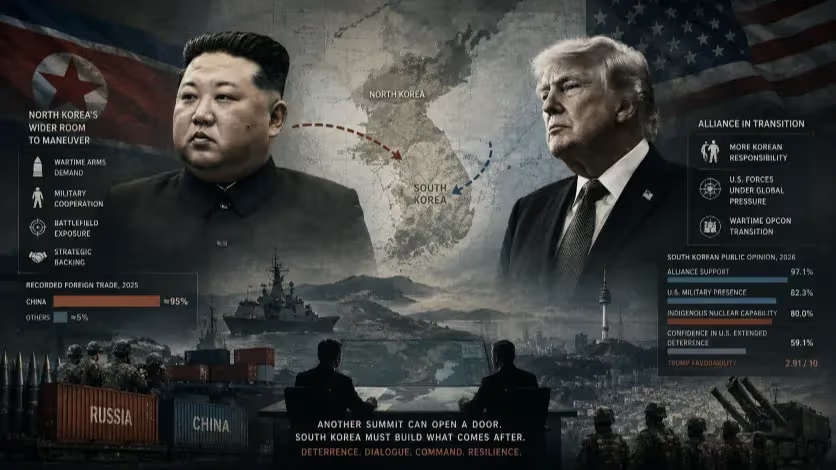 NewsAug 21, 2026
The Korean Peninsula Trump Is Returning To
Another Trump-Kim summit would unfold on a peninsula where North Korea is har...
More from the author
More from this byline
Stay with the same line of reporting through more work from this byline.
- NewsOct 4, 2026
Zelensky, South Korea and the Limits of Wartime Pressure
 NewsSep 24, 2026
Taiwan’s AI Boom Is Surging, but Wealth Follows a Different Map
Reader Signal
Community readWhat did this report leave you with?
Choose the signal that best reflects your reading. Select it again to remove it.
One response per article
No response selected
A moderated conversation about the reporting.
One-level replies and newsroom moderation keep the conversation anchored to this article.
Discussion Status
Open
Please sign in to join the discussion.
Newsletter
Weekly reporting and context from Busan and Korea.