How South Korea and Japan Are Managing Trump’s Demands
President Trump’s revived push for sweeping tariffs and increased defense cost-sharing has placed U.S. alliances in Asia back under pressure.

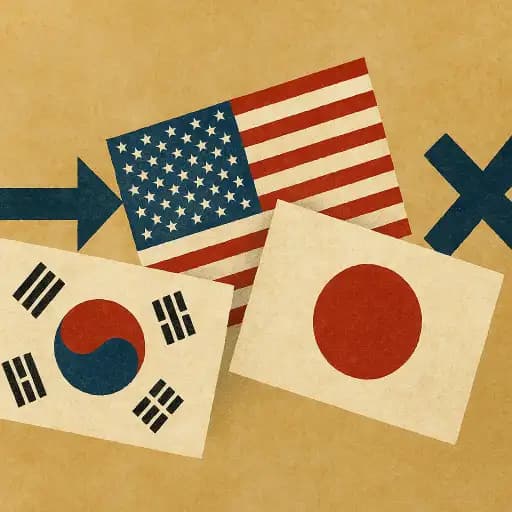
As President Donald Trump reasserts his signature brand of transactional diplomacy, two of America’s closest allies in East Asia—South Korea and Japan—are once again being asked to prove the value of their partnership in concrete terms. Through formal letters delivered last week, the Trump administration has demanded that both countries accept a sweeping 25% tariff on all exports to the United States, effective August 1, unless revised trade terms are reached. At the same time, Trump has revived calls for drastically increased defense cost-sharing, claiming South Korea should be paying up to $10 billion annually for U.S. military presence—a figure nearly nine times the amount agreed under the current Special Measures Agreement (SMA).
Though facing identical pressure, the two allies are responding in markedly different tones. In Tokyo, political leaders have voiced unusually direct frustration. Prime Minister Shigeru Ishiba publicly called the U.S. move “deeply regrettable,” noting that seven rounds of bilateral negotiations had already failed to yield agreement. Behind closed doors, ruling Liberal Democratic Party (LDP) officials have been even sharper. Senior strategist Itsunori Onodera labeled the tariff letter “disrespectful to an ally,” a phrase that has rarely, if ever, appeared in Japan’s diplomatic lexicon. With upper house elections approaching, the political cost of appearing submissive to Washington is weighing heavily on the government.
In contrast, Seoul has chosen to avoid any escalation. South Korean officials have restated the validity of the 2021 SMA and emphasized that defense cost-sharing discussions are not currently on the table. Trade authorities are conducting quiet consultations with the U.S. Trade Representative and assessing the potential economic impact of broad-based tariffs. While no official protest has been lodged, internal government strategy reflects careful preparation—not capitulation.
This difference in approach is not merely stylistic. It reflects structural and political divergences in how each country manages its alliance with the United States. Japan, with a historically sensitive agricultural sector and heightened electoral constraints, has little room to make visible concessions. Public criticism of Washington serves both as domestic political signaling and as a negotiating tactic. South Korea, by contrast, is opting for discretion. With no immediate election cycle and a broader industrial base less dependent on any single sector, Seoul is positioned to absorb pressure without dramatizing the rupture.
Yet both countries are acutely aware that Trump’s demands—though extreme in tone—carry strategic weight. The tariff threat spans semiconductors, vehicles, batteries, and advanced manufacturing—sectors central to the economic identities of both nations. Meanwhile, the reframing of military burden-sharing not as alliance maintenance but as a financial transaction signals a broader shift in U.S. expectations. For Washington, the message is clear: security comes with a price tag, and old assurances no longer suffice.
What is less clear is how far these demands will ultimately go. Trump’s first term was marked by a pattern of maximalist opening gambits followed by pragmatic settlements. But this time, as a sitting president, Trump’s authority to implement tariffs or demand financial adjustments is far more immediate. His domestic political calculus—where appearing “tough” on allies plays well with his base—adds another layer of unpredictability.
The alliance test, therefore, is not only about how much Seoul or Tokyo will pay or concede. It is about whether the bilateral relationships can withstand a transformation in tone, from values-based cooperation to conditional partnership. South Korea’s choice to engage quietly reflects an effort to preserve that framework without triggering a rupture. Japan’s public pushback, while confrontational, aims to draw clear boundaries about what kind of pressure it will accept.
In both cases, the underlying reality is the same: U.S. allies are no longer treated as privileged partners, but as actors expected to demonstrate tangible returns on Washington’s investments. This redefinition of alliance logic—anchored less in shared strategy than in measured contributions—is reshaping how East Asia engages with the United States.
Ultimately, how these two countries respond—through public defiance or quiet diplomacy—will help define the terms of alliance in the Indo-Pacific going forward. If Trump’s model holds, loyalty will be measured not by values, but by volume—of payments made, of trade deficits reduced, of concessions granted. Whether that vision is sustainable, or even strategically wise, remains an open question. But the pressure is real, and the deadline is approaching.
Continue this reporting
Reporting on the same issue
Related coverage selected from the article's desk, topics and newsroom relationships.
 NewsOct 4, 2026
Zelensky, South Korea and the Limits of Wartime Pressure
South Korea says Kyiv broke a confidentiality understanding when Zelensky rev...
 NewsSep 1, 2026
What Lee Jae Myung Thinks a Minister Can Fix
President Lee Jae Myung says reform should be judged by results rather than c...
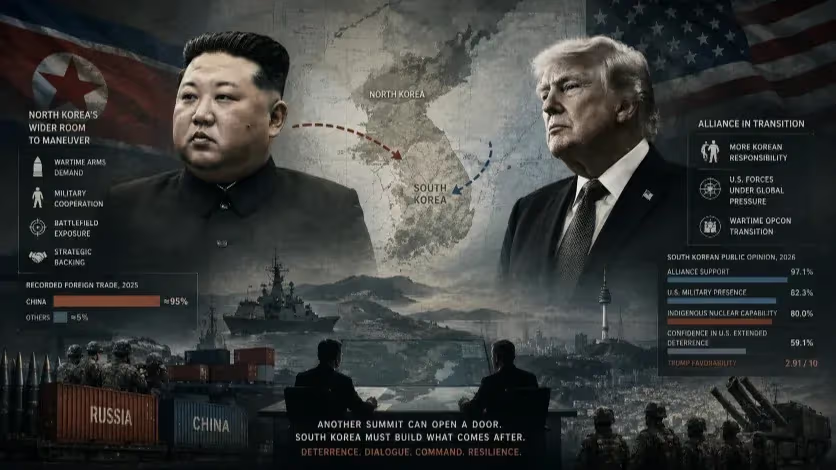 NewsAug 21, 2026
The Korean Peninsula Trump Is Returning To
Another Trump-Kim summit would unfold on a peninsula where North Korea is har...
More from the author
More from this byline
Stay with the same line of reporting through more work from this byline.
- NewsOct 4, 2026
Zelensky, South Korea and the Limits of Wartime Pressure
 NewsSep 24, 2026
Taiwan’s AI Boom Is Surging, but Wealth Follows a Different Map
Reader Signal
Community readWhat did this report leave you with?
Choose the signal that best reflects your reading. Select it again to remove it.
One response per article
No response selected
A moderated conversation about the reporting.
One-level replies and newsroom moderation keep the conversation anchored to this article.
Discussion Status
Open
Please sign in to join the discussion.
Newsletter
Weekly reporting and context from Busan and Korea.